
Architects of Little Rock the focus of June’s Legacies & Lunch

Architects of LR bookCharles Witsell and Gordon Wittenberg, retired principals of Little Rock architecture firms and co-authors of the newly released Architects of Little Rock: 1833-1950, will discuss Little Rock’s architectural history at Legacies & Lunch on Wednesday, June 4, noon-1 p.m. in the CALS Main Library’s Darragh Center, 100 Rock Street.

Witsell and Wittenberg are retired principals of WER Architects/Planners (Witsell, Evans and Rasco) and WD&D (Wittenberg, Delony and Davidson). Architects of Little Rock: 1833-1950 profiles thirty-five architects, including George R. Mann, Thomas Harding, Charles L. Thompson, and more. Famous buildings such as the Arkansas State Capitol, St. Andrews Cathedral, the Pulaski County Court House, Central High School, and Robinson Auditorium are showcased as well. Copies of the book will be available for purchase; Wittenberg and Witsell will sign copies after their talk.

Legacies & Lunch, the Butler Center’s monthly lecture series, is free, open to the public, and supported in part by the Arkansas Humanities Council. Programs are held from noon-1 p.m. on the first Wednesday of each month. Attendees are invited to bring a sack lunch; drinks and dessert are provided. For more information, contact 918-3033.
Book on LR Architects celebrated tonight

Architects of LR bookTonight, the Historic Arkansas Museum will be hosting a lecture and book signing for the recently released Architects of Little Rock: 1833–1950, penned by Little Rock architects, Charles Witsell and Gordon Wittenberg.

The evening will begin at 5:30 with a special presentation and lecture discussing the book. Speakers will include Bill Worthen, Historic Arkansas Museum; Tom Adams, WD&D; John Greer, WER Architects/Planners; Bobby Roberts, Central Arkansas Library and a special presentation will be given by Wesley Walls, President AIA Arkansas.

A reception and book signing will begin immediately following the lecture. All are invited to attend this special evening. “There are many ways of knowing the built environment. In their Architects of Little Rock, Mr. Witsell and Mr. Wittenberg explore the always complex relationship between buildings and the visionary thinkers—sometimes ordinary craftsman— who produced them. In so doing, they not only have uncovered the design rationales and circumstances of production that influenced a wide spectrum of Little Rock architecture but moreover have written a significant work of architectural scholarship that addresses the history of the architect’s profession,” Ethel Goodstein-Murphree, architectural historian and professor of architecture, University of Arkansas.

Architects of Little Rock: 1833–1950, is being released this month. The book is co-written by Little Rock architects, Charles Witsell and Gordon Wittenberg and edited by Marylyn Jackson Parins. Architects of Little Rock provides biographical and historical sketches of the architects at work in Little Rock from 1833 to 1950. It is the story of the people behind the city’s most important buildings. Thirty-five architects are profiled, including George R. Mann, Thomas Harding, Charles L. Thompson, Max F. Mayer, Edwin B. Cromwell, George H. Wittenberg, Lawson L. Delony, and others. Famous buildings, including the Historic Arkansas Museum, the Old State House, the Arkansas State Capitol, St. Andrews Cathedral, Little Rock City Hall, the Pulaski County Court House, Little Rock Central High School and Robinson Auditorium are showcased, bringing attention to and encouraging appreciation of the city’s historic buildings.

Charles Witsell and Gordon Wittenberg are retired principals of the Little Rock architecture firms WER Architects/Planners (Witsell, Evans and Rasco) and WD&D (Wittenberg, Delony and Davidson), respectively.

May 28 Architeaser: AP&L Building

20130527-140356.jpg

The Arkansas Arts Center just opened an exhibit on Bauhaus architecture. Though Little Rock doesn’t have any strictly Bauhaus style buildings, there are a few buildings designed in the International Style which was related to Bauhaus.

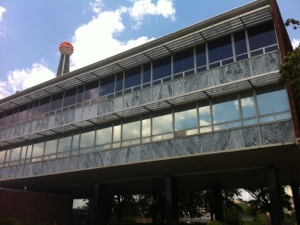
The Arkansas Power & Light Building on Louisiana and 9th Streets was announced in 1953 and completed in 1959. The design was by Fred Arnold of the Wittenberg Delony & Davidson firm. The reason for the delay was due to uncertainty regarding a rate case and labor contracts.

The four story building features a combination of glass, marble and brick. The second and third stories float over an open space as they extend eastward. In 2010, the marble panels on the second and third stories were replaced because of buckling. They were replaced with marble from the same quarry as the original marble.

The orb atop the building once bore the likeness of Reddy Kilowatt, a mascot used by AP&L as well as many other electric utilities in the post-World War II era. When AP&L changed its name to Entergy Arkansas (as part of the system-wide rebranding of various companies into Entergy), the orb was replaced with one which features a three-dimensional version of the Entergy logo.