Tonight’s Local Live – Cutthroat Trout at South on Main

llsom cutthroattroutThe pirate movie Cutthroat Island may have been a bomb.  But the gypsy jazz ensemble Cutthroat Trout is a treat!  Tonight at 7:30 PM, join the Oxford American magazine for this week’s Local Live concert at South on Main, featuring Cutthroat Trout!

As always, Local Live is free and open to the public. To guarantee a table/seat for this popular series, call ahead at (501) 244-9660. Local Live is made possible by the generous sponsorship of Ben and Jane Hunt Meade.

Cutthroat Trout is a gypsy jazz ensemble that plays music in the style of Django Reinhardt and Stephane Grapelli. Based in Fort Smith, the group’s reverence for classics, innovative arrangements of pop tunes, and period originals keep their sound fresh and unique. Combined with excellent musicianship and tight three-part vocal harmonies, Cutthroat Trout allows audiences to relive this timeless music.

Legacies & Lunch Commemorates Roosevelt Thompson

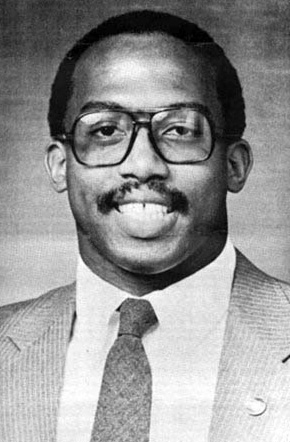
roosevelt_thompson_fRoosevelt Thompson was a gifted young man who had a bright future in public service before his death in an automobile accident in 1984. In honor of the 35th anniversary of Thompson’s graduation from Little Rock Central High School, the Butler Center, a department of the Central Arkansas Library System (CALS), will present a special Legacies & Lunch program, co-hosted by the Clinton School of Public Service, on Wednesday, June 3, from noon-1 p.m. at the CALS Ron Robinson Theater, 100 River Market Ave.

At Central High School, Thompson was student body president, an All-Star football player, and a National Merit Scholar. Thompson went on to attend Yale University, which has established a prestigious prize in his honor. While at Yale, he was selected as a Rhodes Scholar.

At this special Legacies & Lunch program, co-hosted by the Clinton School of Public Service, historic video footage featuring Thompson, Bill and Hillary Clinton, and others, will be shown. A panel, including Elaine Dumas, one of his teachers and mentors; Lee Thompson, his brother; and Beth Felton, his classmate at Central and a staff member at the CALS Roosevelt Thompson Branch Library, will discuss how his memory lives on today. Following this discussion, attendees may share memories and ask questions. After the program, all are invited to send their thoughts to RememberingRosey@cals.org.

Legacies & Lunch is free, open to the public, and sponsored in part by the Arkansas Humanities Council. Attendees are invited to bring a sack lunch; drinks and dessert are provided. For more information, call 501-918-3033.

Tony Awards Week – Trouble with a capital T and that rhymes with…. HAIR?

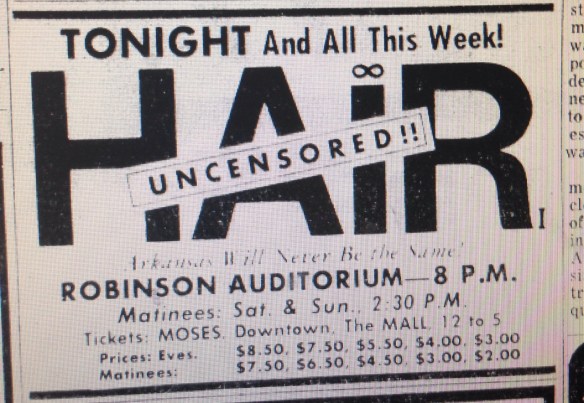
Ad for the original production of HAIR in Little Rock. Note the ticket prices. And that they could be purchased at Moses Music Shops.

Ad for the original production of HAIR in Little Rock. Note the ticket prices. And that they could be purchased at Moses Music Shops.

The Tony winning musical The Music Man may have featured a song about “Trouble in River City” but the Tony nominated musical Hair brought trouble to this “river city” in 1971 and 1972.

In February 1971, a young Little Rock attorney named Phil Kaplan petitioned the Little Rock Board of Censors to see if it would allow a production of Hair to play in the city. He was asking on behalf of a client who was interested in bringing a national tour to Arkansas’ capital city. The show, which had opened on Broadway to great acclaim in April 1968 after an Off Broadway run in 1967, was known for containing a nude scene as well for a script which was fairly liberally sprinkled with four-letter words. The Censors stated they could not offer an opinion without having seen a production.

By July 1971, Kaplan and his client (who by then had been identified as local promoter Jim Porter and his company Southwest Productions) were seeking permission for a January 1972 booking of Hair from the City’s Auditorium Commission which was charged with overseeing operations at Robinson Auditorium. At its July meeting, the Commissioners voted against allowing Hair because of its “brief nude scene” and “bawdy language.”

Kaplan decried the decision. He stated that the body couldn’t “sit in censorship of legitimate theatrical productions.” He noted courts had held that Hair could be produced and that the Auditorium Commission, as an agent for the State, “clearly can’t exercise prior censorship.” He proffered that if the production was obscene it would be a matter for law enforcement not the Auditorium Commission.

The Commission countered that they had an opinion from City Attorney Joseph Kemp stating they had the authority. One of the Commissioners, Mrs. Grady Miller (sister-in-law of the building’s namesake the late Senator Robinson who had served on the Commission since 1939), expressed her concern that allowing Hair would open the door to other productions such as Oh! Calcutta!

On July 26, 1971, Southwest Productions filed suit against the Auditorium Commission. Four days later there was a hearing before Judge G. Thomas Eisele. At that hearing, Auditorium Commission member Lee Rogers read aloud excerpts from the script he found objectionable. Under questioning from Kaplan, a recent touring production of Neil Simon’s Tony winning play Plaza Suite was discussed. That play has adultery as a central theme of one of its acts. Rogers admitted he found the play funny, and that since the adultery did not take place on stage, he did not object to it.

Judge Eisele offered a ruling on August 11 which compelled the Auditorium Commission to allow Hair to be performed. Prior to the ruling, some of the Auditorium Commissioners had publicly stated that if they had to allow Hair they would close it after the first performance on the grounds of obscenity. To combat this, Judge Eisele stated that the Commission had to allow Hair to perform the entire six day engagement it sought.

Upon hearing of the Judge’s ruling, Commissioner Miller offered a succinct, two word response. “Oh, Dear!”

In the end, the production of Hair at Robinson would not be the first performance in the state.  The tour came through Fayetteville for two performances in October 1971. It played Barnhill Arena.

On January 18, 1972, Hair played the first of its 8 performances over 6 days at Robinson Auditorium.  In his review the next day, the Arkansas Gazette’s Bill Lewis noted that Hair “threw out all it had to offer” and that Little Rock had survived.

The ads promoting the production carried the tagline “Arkansas will never be the same.”  Tickets (from $2 all the way up to $8.50) could be purchased at Moses Melody Shops both downtown and in “The Mall” (meaning Park Plaza). That business is gone from downtown, but the scion of that family, Jimmy Moses, is actively involved in building downtown through countless projects. His sons are carrying on the family tradition too.

Little Rock was by no means unique in trying to stop productions of Hair.  St. Louis, Birmingham, Los Angeles, Tallahassee, Boston, Atlanta, Charlotte NC, West Palm Beach, Oklahoma City, Mobile and Chattanooga all tried unsuccessfully to stop performances in their public auditoriums.  Despite Judge Eisele’s ruling against the City of Little Rock, members of the Fort Smith City Council also tried to stop a production later in 1972 in that city. This was despite warnings from City staff that there was not legal standing.

Within a few years, the Board of Censors of the City of Little Rock would be dissolved (as similar bodies also were disappearing across the US). Likewise, the Auditorium Commission was discontinued before Hair even opened with its duties being taken over by the Advertising and Promotion Commission and the Convention & Visitors Bureau staff.  This was not connected to the Hair decision; it was, instead, related to expanding convention facilities in Robinson and the new adjacent hotel.  Regardless of the reasons for their demise, both bygone bodies were vestiges of earlier, simpler and differently focused days in Little Rock.

Over the years, Hair has returned to the Little Rock stage. It has been produced two more times at Robinson Center,  UALR has produced it twice, and the Weekend Theater has also mounted a production.   The most recent visit to Little Rock at Robinson Center, which was the final Broadway show before the building closed for renovations, was based on the 2009 Broadway revival.  That production, was nominated for eight Tony Awards, and captured the Tony for Revival of a Musical.  Several members of the production and creative team are frequent collaborators of Little Rock native Will Trice.

Tonight at South on Main – The Steel Wheels

Photo by Ruby Sky

Photo by Ruby Sky

Tonight at 7:30, the Oxford American magazine welcomes The Steel Wheels to South on Main! Doors open at 5:30 PM.

Reserved tickets guarantee you a seat at a specific table. Choice of seats at that table is first come first seated when doors open. Seating at tables is family-style unless you purchase the entire table, you will be seated with other patrons.

General admission tickets are good for stools at the bar, perimeter chairs (not at tables), and standing room only. Seating is limited for general admission ticket buyers and available on a first come first seated basis when doors open.

Some things come to be in their own time, of their own accord. Such has been the case with The Steel Wheels. In the beginning, it was simply a matter of four young men who’d happened to cross paths at a formative moment in each of their lives reveling in the shared experience of plucking acoustic instruments and blending their voices. But over the years, what had begun organically as a pure lark evolved into a mission: to fuse the personal with the universal, the deeply rooted past with the joys and sorrows of everyday existence.

These thematic and stylistic vectors intersect powerfully on Leave Some Things Behind (released April 13 on the band’s own Big Ring label), a deeply human, emotionally authentic work that interweaves timely songs with timeless sounds. On the album, co-produced and engineered by Ben Surratt, the four band members—lead singer/guitarist/banjo player Trent Wagler, standup bass player Brian Dickel, fiddler Eric Brubaker and mandolin player Jay Lapp—are joined on various tracks by roots-music luminary Tim O’Brien, Nashville-based singer/songwriter Sarah Siskind (who co-wrote two songs and sang on another), drummer Travis Whitmore and Hammond B3 player Ethan Ballinger. Together, they’ve wrought a work that is musically intricate and conceptually resonant, the sounds serving the songs at every moment.

Brian Whelan headlines a special singer-songwriter edition of Tales from the South tonight at Best Impressions

talesfromthesouthA very special Tales from the South will take place tonight.

Dwight Yoakam’s MVP sideman, Brian Whelan plays the pedal steel, electric guitar, the occasional mandolin (primarily when Dwight wanted to change an arrangement into a bluegrass tune), keys/piano and spot-on harmonies. Brian was both in Dwight’s touring and recording band, and played on the critically acclaimed, 3 Pears (#1 on the Americana charts), and is also currently featured on Dwight’s current release, Second Hand Heart (debuting #2 on the Billboard charts).

Brian recently left Dwight’s band to focus on his own music. With instrumental abilities that made him a key member of Dwight Yoakam’s band, a voice reminiscent of Jackson Brown, and a lyrical streak that makes him seem like he’s been writing hook-laden hits for years, Brian Whelan is poised for a much wider attention with the release of his second album. Produced by fellow Yoakamite drummer Mitch Marien, the new record throws Whelan’s hat into the a ring crowded with the likes of John Fullbright, Sturgill Simpson, Mike Stinson, and Jason Isbell. When Brian Whelan is not touring, he can be found in a Los Angeles studio playing on someone’s album or even producing.

Tonight’s program will take place at Best Impressions restaurant at the Arkansas Arts Center.  Music will be provided by The Salty Dogs and bluesman Mark Simpson.

“Tales From the South” is a radio show created and produced by Paula Martin Morell, who is also the show’s host. The show is taped live on Tuesday. The night is a cross between a house concert and a reading/show, with incredible food and great company. Tickets must be purchased before the show, as shows are usually standing-room only.

Dinner is served from 5pm to 6:30pm, the show starts at 7pm.  Admission is $15.  Dinner can be purchased separately.

You MUST purchase your ticket before the show.  Any tickets still available at the door can be purchased for $20.

Previous episodes of “Tales from the South” air on KUAR Public Radio on Thursdays at 7pm.  This program will air on June 25.

Tony Awards Week – History of theatre in Little Rock

Joe E. Brown in HARVEY

Joe E. Brown in HARVEY

Little Rock existed as a theatre town for over 100 years prior to the Tony Awards.  But since this is Tony Awards week, “let’s start at the very beginning, a very good place to start” (words by my favorite lyricist Oscar Hammerstein II).

The first documented theatrical performance was on November 4, 1834, and in August 1838 the construction of the first theatre in Little Rock was announced.  Through Little Rock’s early years a variety of spaces were used for performances including the City Hall on Markham near Main Street which had been built in 1867.

The opening of the Capital Theatre in December 1885 would be Little Rock’s first large-scale, non-church space for performances and gatherings.  The Capital had a seating capacity of approximately 2,000 seats.  Designed to house theatrical productions, it also played host to civic events ranging from high school graduations (for both the white and African American high schools) to public memorials.  For instance, in 1901 it was the site of a public memorial for the recently assassinated President William McKinley.  In time, the Capital Theatre (which was situated on land that is now occupied by a portion of the Statehouse Convention Center) would be joined by a variety of other theatres, public houses, vaudeville houses and lodge halls.

The 1908 “temporary” City Auditorium probably played host to theatrical performances, but records do not exist for it.  The amphitheatre in Forest Park was home to many theatrical performances including appearances by Sarah Bernhardt.  Judy Baker Goss’s play Fond Farewell looked at one of Bernhardt’s visit to Little Rock.  (In the local production of that play, Bernhardt was played by Judy Trice, the mother of a three-time Tony winner Will Trice. His father, Bill Trice, played a Little Rock City Council member smitten with the actress.)

When Robinson Auditorium opened in 1940, it had space to host theatrical productions in the main music hall as well as in the lower level “little theatre.”  By that time, there were a variety of community theatre groups performing.  The first national tour to play in Robinson was Springtime for Henry starring Edward Everett Horton.

The first Tony winning production to play Robinson was the national tour of Harvey starring Joe E. Brown.  Brown, in fact, received a special Tony for starring in the national tour of the play.

Little Rock Look Back: Cornice placed on Robinson Auditorium

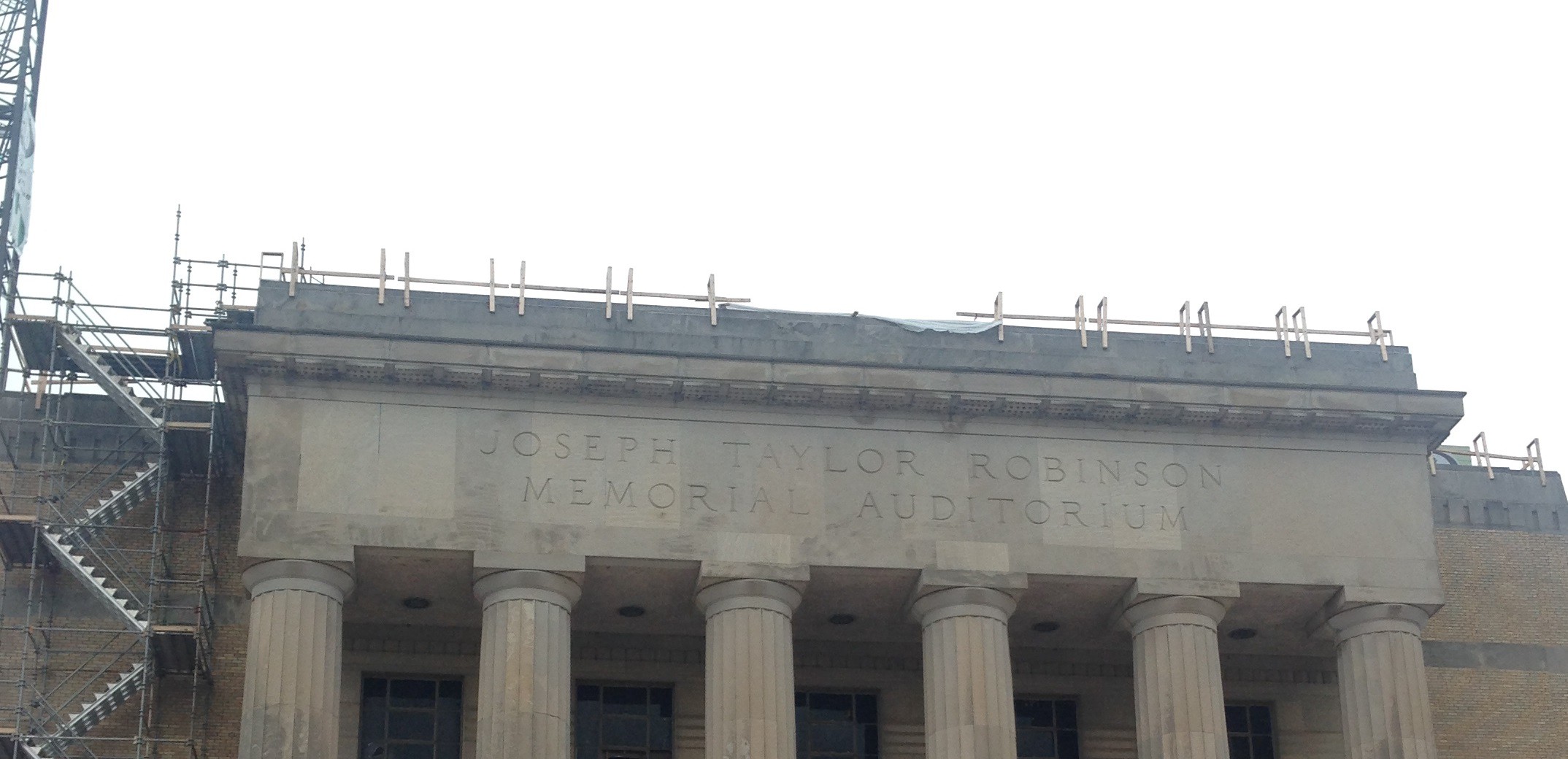
JTR CorniceOn June 1, 1939, the cornice was installed on Robinson Auditorium.  This granite slab noted the name of the building as the Joseph Taylor Robinson Memorial Auditorium.  (It is interesting to note that it used the more modern “u” instead of the classical “v” which was often used in buildings during prior decades – as evidenced by the Pvlaski Covnty Covrt Hovse across the street.)

This was a milestone marking the completion of the front facade of the structure.  Much work would continue on the interior of the structure.  This step in the construction was considered major enough that the Arkansas Gazette mentioned it in a news article.

Today the cornice is again surrounded by construction materials and braces. The front lobby, the cornice and columns are pretty much the only parts of the building not currently under construction as Robinson Center is readied for its second act.  It is scheduled to open in November 2016.