
 The United States Marshals Museum will host NPR Morning Edition co-host and author Steve Inskeep for a “Rule of Law” lecture in Little Rock on November 12.
As part of his remarks, he will discuss the impact then and now on the Indian Removal Act of 1830. The free and open to the public lecture at UA-Little Rock’s Jack Stephens Center will begin at 6 p.m.
Inskeep is the co-host of Morning Edition, a nationally-broadcast daily news program on NPR public radio. Inskeep is the author of Jacksonland, his 2015 historic account on President Andrew Jackson’s long-running conflict with John Ross, a Cherokee chief who resisted the removal of Indians from the eastern United States in the 1830’s. In 1839, Ross’ wife Elizabeth “Quatie” Ross fell ill on the Trail of Tears and died in Little Rock. Her headstone lies in Little Rock’s Mount Holly Cemetery. Inskeep is also the author of Instant City: Life and Death in Karachi, a 2011 book about one of the world’s great megacities.
Former United States Court of Appeals for the Eighth Circuit Judge Morris “Buzz” Arnold will introduce the program and moderate the question-and-answer session. Event sponsors include UA-Little Rock, Sequoyah National Research Center, KUAR-Radio and NPR.
“We’re excited to bring Steve Inskeep to Arkansas,” said Alice Alt of the U.S. Marshals Museum Foundation. “We are all huge fans of his at the museum, and we’re looking forward to hearing his insights on the Rule of Law, one of our nation’s constitutional bedrock principles and a major part of what the museum will be about.”
The Museum, set to open in the fall of 2019, will focus on civic literacy and the Rule of Law, and feature five immersive galleries – Defining Marshals, The Campfire: Stories Under the Stars, Frontier Marshals, A Changing Nation and Modern Marshals.
Admission is free, but an RSVP is required by November 9 to https://theruleoflaw.eventbrite.com/.
About the United States Marshals Museum
The future United States Marshals Museum will be a national Museum located on the riverfront in Fort Smith, Ark. Opening in the fall of 2019, the United States Marshals Museum will tell the story of our nation’s oldest federal law enforcement agency from its establishment by President George Washington through current day. The Museum will honor the sacrifice of Marshals killed in the line of duty, as well as those who continue to place their lives in harm’s way, as they enforce the Constitution. For more information, visit usmmuseum.org.
 The Arkansas Rep kicked off 2014 with the Pulitzer and Tony winning CLYBOURNE PARK. Both a prequel and sequel of sorts to A Raisin in the Sun, it looks at the life of a house and a neighborhood.
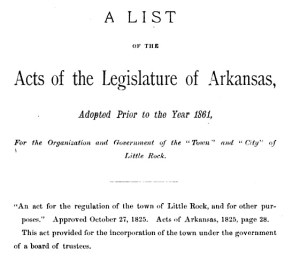 Little Rock started functioning as the capital of Arkansas in June 1821. But by 1825 the settlement known as Little Rock was little more than a loosely defined group of structures. One hundred and ninety-three years ago today, on October 27, 1825,Territorial Governor George Izard signed legislation which started establishing a framework for Little Rock to function as a city.
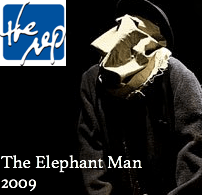 Thirty years after it opened on Broadway, Arkansas Rep presented The Elephant Man. Due to anticipated renovations at the Rep’s main stage, it was performed at Wildwood Park in the Cabe Festival Theatre.
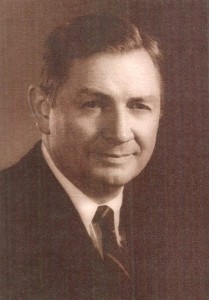 One hundred and three years ago today, on October 26, 1915, future Little Rock Mayor Pratt Cates Remmel was born. He was one of five children of Augustus Caleb and Ellen Lucy Remmel. His father died when he was five, leaving his mother to raise six children (Gertie, Harmon – also known as Buck, Pratt, Gus, Rollie, and Carrie) by herself. After graduating from high school in 1933, he received a bachelor’s degree in economics from the University of Virginia in 1937. During World War II, he held the rank of Lieutenant in the US Navy.
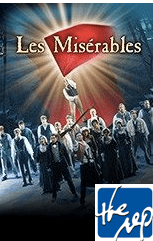 The 33rd season of Arkansas Rep opened with its most expensive and expansive production to date – the Tony winning LES MISERABLES.
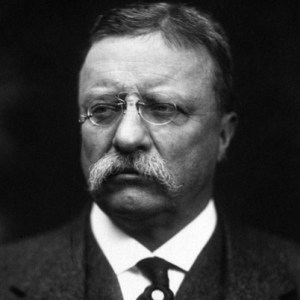 On October 25, 1905, President Teddy Roosevelt, recently elected to a four year term in his own right, made an appearance in Little Rock.
 Little Rock Culture Vulture