31 Days of Arkansas Rep: 1986’s ‘NIGHT, MOTHER

An Oscar winner performing on the Arkansas Rep stage is a rarity. To have one playing the same role she played in a national tour — well, that has only happened once.

From April 17 to May 4, 1986, Mercedes McCambridge starred in the Rep’s production of Marsha Norman’s two-hander ‘night, Mother. In 1984, she headlined the national tour of this same production.

McCambridge and Rep founder/Artistic Director Cliff Fannin Baker had been discussing potential project ideas for a few years.  In the mid-1980s, she lived in Little Rock. Though by 1986 she had moved away, she was glad to return for this project.

The show was directed by Baker and co-starred Cathey Crowell Sawyer.  In his Gazette review Jack Weatherly noted that it was Sawyer’s finest performance to date. Of McCambridge he opined she was “lighting up those recesses of our lives with humor and humanity.”

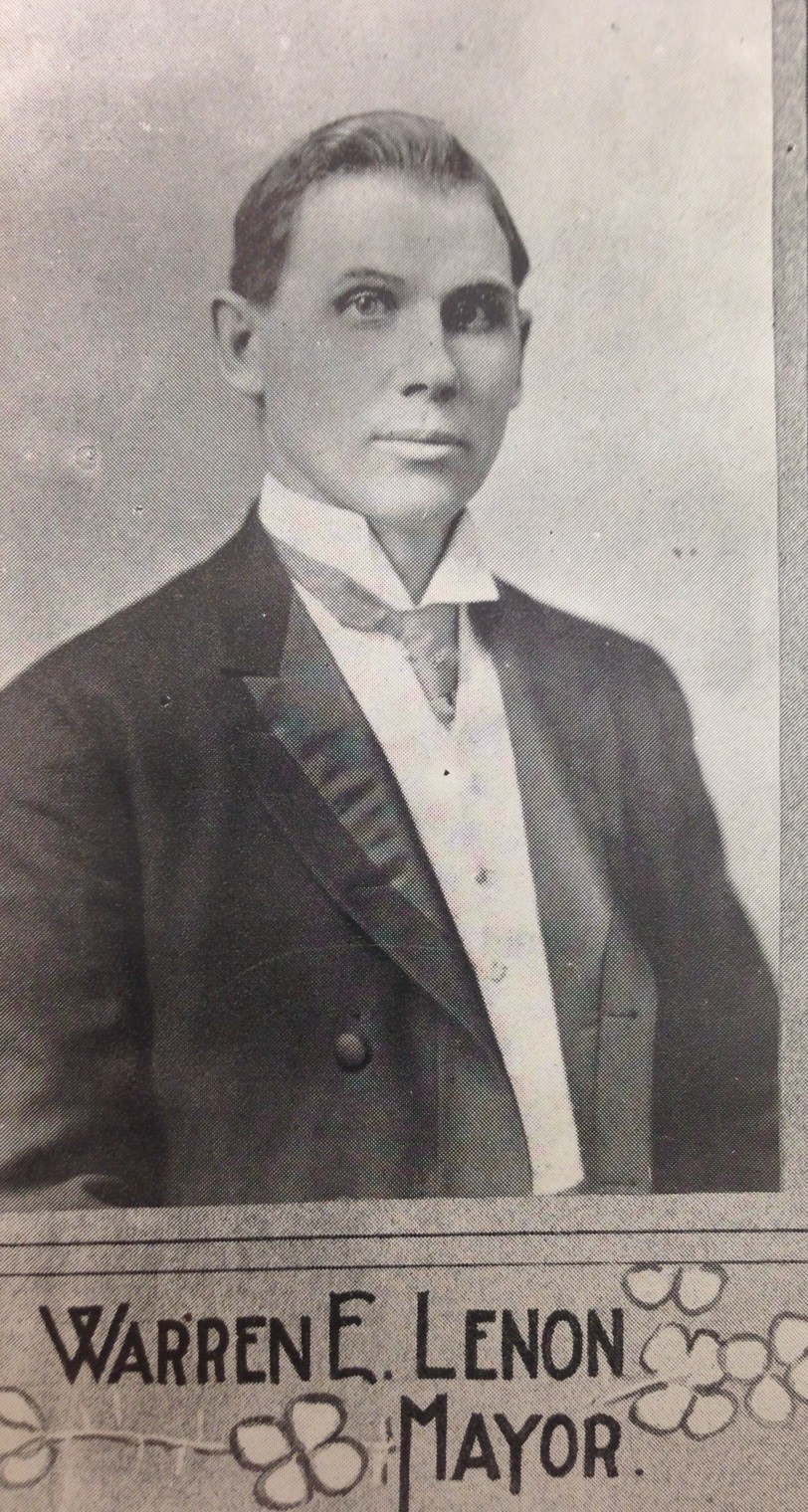
Little Rock Look Back: Mayor W. E. Lenon

OMayor Lenonn October 8, 1867 in Panora, Iowa, future Little Rock Mayor Warren E. Lenon was born.  He was one of eleven children of John D. and Margaret M. Long Lenon.

Lenon came to Little Rock in 1888 after finishing his schooling in Iowa.  He helped set up an abstract company shortly after his arrival.  In 1902 he organized the Peoples Savings Bank.  Among his other business interests were the City Realty Company, the Factory Land Company, the Mountain Park Land Company, and the Pulaski Heights Land Company.

From 1895 to 1903, he was a Little Rock alderman, and in 1903, he was elected Mayor of the city. A progressive Mayor, he championed the construction of a new City Hall which opened in 1908.  At the first meeting of the City Council in that building, Mayor Lenon tendered his resignation.  His duties in his various business interests were taking up too much of his time.

Mayor Lenon had been a champion for the establishment of a municipal auditorium. He had wanted to include one in the new City Hall complex. But a court deemed it not permissible under Arkansas finance laws at the time.  He also worked to help establish the first Carnegie Library in Little Rock which opened in 1912.

Mayor Lenon continued to serve in a variety of public capacities after leaving office.  In the 1920s, he briefly chaired a public facilities board for an auditorium district. It appeared he would see his dream fulfilled of a municipal auditorium.  Unfortunately the Arkansas Supreme Court declared the enabling legislation invalid.

In 1889, he married Clara M. Mercer.  The couple had three children, two of whom survived him: a son W. E. Lenon Jr., and a daughter Vivion Mercer Lenon Brewer.  Together with Adolphine Fletcher Terry (also a daughter of a LR Mayor), Mrs. Brewer was a leader of the Women’s Emergency Committee.

Mayor Lenon died June 25, 1946 and is buried at Roselawn Cemetery.  Lenon Drive just off University Avenue is named after Mayor Lenon.

31 Days of Arkansas Rep: The 1986 production of THE FOREIGNER

Blasny Blasny.  Larry Shue’s 1984 farce THE FOREIGNER made its first of four appearances on the Arkansas Rep stage in January 1986.

Directed by Cliff Fannin Baker, it featured Terry Sneed as the title character, a mild-mannered man who pretends to be a non-English speaking foreigner to avoid interactions with locals at a small-town hunting resort.

Others in the cast were Steve Wilkerson, Mark Johnson, Ron Aulgur, Scott Edmonds, Natalie Canderday and Jean Lind.

The production ran from January 16 through February 9 of 1986. It was so popular that it sold out its run. Standing room only ticket holders filled all available spaces.  Gov. Bill Clinton called for tickets and could not be accommodated.

It has subsequently been mounted at the Rep three times more: during the 1987/88, 1995/96 and 2008/09 seasons. It is the only play to have been staged that many times in the Rep’s history.

The 1988 staging featured Wilkerson, Sneed, and Johnson reprising their roles.


31 Days of Arkansas Rep: 1985 World Premiere of THE GOOD WOMAN OF SETZUAN

The Arkansas Repertory Theatre set the American regional theatre world abuzz with its world premiere of a musical version of Bertolt Brecht’s The Good Woman of Setzuan.

Director Cliff Fannin Baker received many telephone calls from his colleagues who were surprised that the Brecht estate had given its authorization for a musicalization to a small professional theatre in Little Rock.

The songs were written by Arkansas native Michael Rice using as a libretto the Eric Bentley translation of the original Brecht work. Rice also served as music director, leading a seven member orchestra as it played the nineteen songs he wrote.

As director, Baker used many Brechtian techniques to stay true to the story. These included music, neon signs, and non-traditional costuming for some of the characters.  Speaking of costumes, Little Rock fashion designer Connie Fails designed the clothing for the production.

Others on the creative team included Michael R. Smith (a set that was described as “dazzling, trashily opulent”) and Kathy Gray.

The title character was played by Vivian Morrison (now Vivian Norman). Other leading roles were played by Mark Johnson, Terry Sneed, Dianne Tack, and Mychael McMillan (in drag).  Playing a trio of gods were Ronald J. Aulgur, Scott Edmonds, and Candyce Hinkle. Others in the cast included Jean Lind, Ruth Shepherd, Kathryn Pryor, Judy Trice, Carol Ann Connor (now McAdams), Ginny Pace, and Jeff Bailey.

The production took place at the Arkansas Arts Center Theatre instead of the Rep’s facility on 11th Street.  With a cast of twenty and extensive set changes, the production needed more space than the Rep’s home could accommodate.

The Good Woman of Setzuan opened on June 13 and ran through June 22.

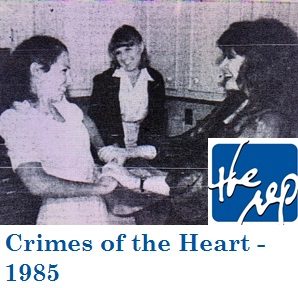
31 Days of Arkansas Rep: 1985’s CRIMES OF THE HEART

Since at least Chekov, playwrights have been fascinated with a trio of women at the center of a play.  Southerner Beth Henley put her own twist on this concept with her 1981 Pulitzer Prize winner Crimes of the Heart.

Focusing on the three Magrath sisters and their assorted friends in Hazelhurst, Mississippi, the story looks at how they come together because one of the sisters is accused of shooting her estranged husband.  A comedy with some dark undertones, it was a hit Off Broadway and then transferred to Broadway after winning the Pulitzer.

Arkansas Rep presented it in April 1985.  The cast featured Evelyn Carol Case, Cathey Crowell Sawyer and Laurel Anne White as the three sisters.  Maggie Murphy, Jeff Bailey and Mark Johnson rounded out the cast.  The show was directed by Cliff Baker, who had  directed the same show (with a different cast and design team) at the Alley Theatre earlier in 1985.

Little Rock Look Back: Gail Davis

Gail Davis is best known as TV’s Annie Oakley.  She was born Betty Jeanne Grayson on October 5, 1925. Her mother was a homemaker and her father, W. B. Grayson, was a physician in McGehee (Desha County), which did not have a hospital, so her birth took place in Little Rock (Pulaski County).

When her father became the state health officer, the family moved from McGehee to Little Rock, where Grayson attended Little Rock High School. Grayson rode horses and was a tomboy growing up. Grayson also held various beauty titles in high school and college, and she sang and danced in local shows from the time she was eight.

While studying dramatics at the University of Texas in Austin, she married Robert Davis in 1945, with whom she had a daughter, Terrie (the couple divorced in 1952). After World War II, they moved to Hollywood, where she worked as a hatcheck girl until being discovered by an agent who obtained an MGM screen test for her. She was signed to a contract, with her first appearance in 1947’s The Romance of Rosy Ridge, starring Van Johnson.

She worked steadily in movies, including fourteen films with Gene Autry in the late 1940s and early 1950s. He was impressed with her, changed her name to Gail Davis, and cast her as the star of the Annie Oakley TV show, which he produced. The show ran for eighty-one episodes from 1954 through 1956.

After her TV series ended, she appeared as Annie Oakley in the 1959 film Alias Jesse James starring Bob Hope. In that film, she appears in an uncredited role along with such other stars, also uncredited, as Gary Cooper, Bing Crosby, Roy Rogers, James Garner (as Bret Maverick), and Fess Parker (as Davy Crockett).

Her television appearances include guest roles on The Lone Ranger, The Gene Autry Show, The Cisco Kid, and Death Valley Days, as well as a 1961 episode of the Andy Griffith Show (Episode 37, “The Perfect Female”), her final appearance as a performer and in which she demonstrated her trademark sharpshooting.

Gail toured with Gene Autry’s Wild West show and made appearances as herself on TV programs such as Wide, Wide World: “The Western” (1958) with fellow Arkansan Ben Piazza. For her work in television, she was awarded a star on the Hollywood Walk of Fame, located at 6385 Hollywood Boulevard, and in 2004, she was inducted posthumously into the National Cowgirl Hall of Fame.

Gail Davis died of cancer in Los Angeles on March 15, 1997, and is buried in Hollywood’s Forest Lawn cemetery.  In 2007, she was posthumously inducted into the Arkansas Entertainer’s Hall of Fame.  In 2016, a room was named in her memory at the newly renovated Robinson Center.

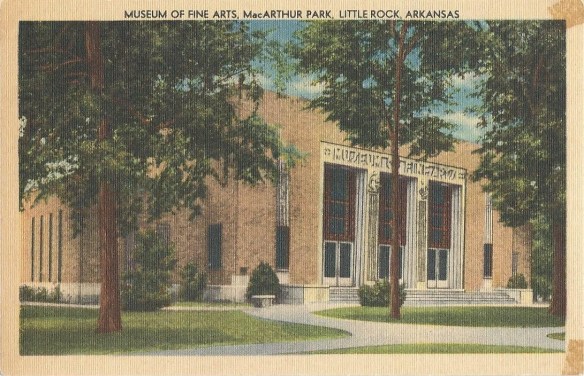
Little Rock Look Back: Open House Gala for Museum of Fine Arts

On Tuesday, October 5, 1937, the Fine Arts Club of Little Rock held its first meeting in the new Museum of Fine Arts.  But it was not a typical meeting. It was an Open House and Dedication for the new building.

Construction on the 10,140 square foot building had commenced with the January 3, 1936, groundbreaking.  By September 1937, the keys were presented to the City, marking the end of the construction process.

During the October 5 events, a letter of congratulations was read by President Franklin D. Roosevelt and WPA Administrator Harry L. Hopkins.  A letter which had been prepared by Sen Joe T. Robinson prior to his death was also read.  Mayor R. E. Overman, architect H. Ray Burks, and Fred W. Allsopp spoke at the event.  The latter was chair of the museum’s board.  Over 1,000 people were in attendance. At the time the city’s population was around 87,000.

The museum officially opened its doors to the public on October 28, 1937.  Nettie L. Robinson, a longtime member of the Fine Arts Club, was its first director and would serve in that capacity for two decades.

The original facade of the Museum can still be seen inside the Arkansas Arts Center.  Once the expansion and renovation of that building is complete in 2022, the original entrance will be highlighted even more with the new design.