Little Rock Look Back: First Sculpture at the River Market Show and Sale in 2007

After a decade of over 100 sculptures being installed throughout the city, it is hard to believe that the first Sculpture at the River Market Show and Sale was only eleven years ago. It took place October 5 through 7, with a preview party on October 4.

Approximately 400 sculptures were on display in the River Market pavilions and in the adjacent area of Riverfront Park. The works featured included all types of media, style, subject matter, and size.

Among the sculptors participating were Gary Alsum, Diana Ashley, Sutton Betti, Shelley Buonaito, Kevin Box, Kathleen Caricof, Chapel, Tim Cherry, Dee Clements, Jane Dedecker, Edward Fleming, Martin Gates, Daniel Glanz, Carol Gold, Bruce Gueswel, Linda Hall, Bre & David Harris, and Denny Haskew.

Other sculptors included Tony Hochstetler, Hank Kaminsky, Kevin Kresse, Mark Leichliter, Gloria Lewis, Jim Lewis, Philip Major, Bryan Massey, Anne Mitchell, Leo E. Osborne, Louise Peterson, Wayne Salge, Ryan Schmidt, Sandy Scott, Margaret Warren, Michael Warrick, CT Whitehouse, and Pete Zaluzec.

31 Days of Arkansas Rep: 1979’s DAMES AT SEA

Guy Couch kicks up his heels while swabbing the deck in DAMES AT SEA.

Take every showbiz cliche imaginable, mix it with a score that is a pastiche of Warner Bros. 1930s musicals, and throw in a bit of World War II nostalgia – you get DAMES AT SEA.  With a cast of six, it was a perfect selection for the Arkansas Rep in the autumn of 1979.

Directed by Cliff Fannin Baker, it featured Jeannie LeMay, Robert Boles, Phyllis Blumenfeld, Guy Couch, and Craig Fuller in the cast.  Also in the cast, as the newest full-time member of the Arkansas Rep company was a young actress/chanteuse named Sharon Douglas. Over the next decade or so she would become closely identified with the Rep.

Multi-talented Jean Lind (who often acted in Rep productions) played the keyboard and served as musical director leading a pit band of three other musicians.

Dames at Sea kicked off the 1979-1980 season.  It ran from September 27 to October 14.  That year the Rep also celebrated ownership of its building. Because of grants it had received, it was able to accelerate the financing for the purchase of the building. As an Arkansas Gazette article pointed out, because of the grant they were able to keep tickets to $5 instead of charging $14.80 for tickets to the shows. (The latter would be the equivalent of $49.97 in 2018 .)

Little Rock Look Back: First Dance at Robinson Auditorium

In October 1939, it looked as if Robinson Auditorium would never open.  The construction had run out of money.  But in an effort to generate a little revenue and give the public the chance to see the building, a few events were booked in the lower level.

At the time, the entrance to the lower level was off of Garland Street which ran to the north of the structure.

While Mayor J. V. Satterfield and other leaders were in Washington seeking additional funding, the Joseph Taylor Robinson Memorial Auditorium hosted its first event.  On October 4, 1939, the convention hall on the lower level was the site of a preview dance.  The pecan block flooring had been installed just the week before.

RC-dance-orchestraThe first four people to enter the building as paying guests were Mr. and Mrs. Alfred Wilheim, Frances Frazier and Bill Christian.  Reports estimated 3,200 people attended and danced to the music of Jan Garber and His Orchestra.

By happenstance, Garber and his musicians had also played in Little Rock on January 26, 1937, the date of the election which approved the auditorium bonds.  Since Little Rock then did not have a suitable space, that appearance had been on the stage of the high school auditorium.

The dance was a success.  But as the building had no heating or cooling mechanism at the time, there were limits as to how long even the lower level could be in use.  After a few weeks, the PWA, which was still in charge of the construction site, halted all future bookings.

Little Rock Look Back: Final film at the Arkansas Theatre

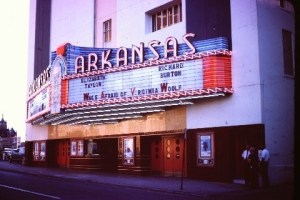
On October 4, 1977, the Arkansas Theatre screened its final films at 516 South Louisiana.  When it closed, it also ended the run of commercial movie theatres in downtown.

The last two films to show there were J. D.’s Revenge (which starred Louis Gossett Jr.) at 5:40pm and 9:00pm, and Coffy (which starred Pam Grier) at 7:20 pm.

The decision to close the theatre was made by United Artists which operated the facility, and had once had its local offices in the building.  Since the 1930s, UA (and its predecessors) had been booking films into the building.  But as the movie going public started preferring to watch their films in the suburbs, downtown movie houses became a thing of the past.

The building opened on September 20, 1910, as the Kempner Opera House. It was designed by New York architect Henry Beaumont Herts of the architectural firm Herts & Tallant. Originally the facade was in a Sullivanesque style, but this was later altered into an Art Deco style, with stucco and ceramic tile highlights.

Seating over 1300, it was home to plays, operas, musicals, lectures, vaudeville, and community meetings. By the late 1920s, with motion pictures a booming business, it was transformed into a movie house.  It reopened as the Arkansas Theatre on September 27, 1929.

The last few years it was open, the Arkansas had featured mainly Blaxploitation films.  But by 1977, Hollywood was moving away from those. The area manager for the UA chain told the Arkansas Gazette that the lack of movies in that genre also contributed to the reason to shut it.

United Artists had a lease with the Kempner family that would run through 1997, unless they could find someone else to take the building over.  They tried to interest the Arkansas Opera Theatre, but it was not a feasible option for AOT.  Eventually, the building was deeded to the University of Arkansas Foundation.

In late 1995, the structure was razed. After 18 years of sitting vacant, the structure had deteriorated beyond repair.  Because of alterations to the interior and exterior over the years, it was not eligible for historic preservation designations or funds.

Today it is a parking lot across the street from the Lafayette Building and due south of the Hall-Davidson Building.

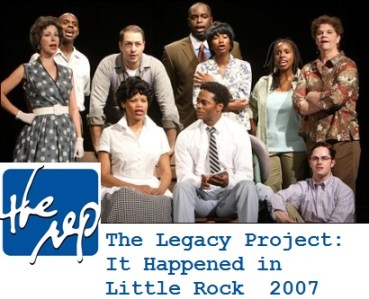
31 Days of Arkansas Rep: THE LEGACY PROJECT: IT HAPPENED IN LITTLE ROCK

Since today is Elizabeth Eckford’s birthday, the past Arkansas Rep production that is featured is 2007’s The Legacy Project: It Happened in Little Rock.
Culled from three years of research and over 80 interviews, playwright and director Rajendra Ramoon Maharaj created a multi-faceted play with music that explored stories past and present of Central High’s desegregation and the legacy the events of those years have provided citizens of Little Rock, of Arkansas and of the United States.

The cast featured Destan Owens (playing parallel roles of a 1957 Harlem reporter and a 2007 artist (a stand-in for Maharaj) as well as nine other actors who played multiple roles of diverse ethnicity — from current Central students to the Little Rock Nine, from elected officials to blue-collar workers.  Those actors were J. Bernard Calloway, Mary-Pat Green, Taifa Harris, Shannon Lamb, Vanessa Lemonides, Arthur W. Marks, Gia McGlone, Nick Petrie and Julian Rebolledo.

The creative team included Sybil Roberts Williams (dramaturg), Michael Susko (choreographer and assistant director), Charles Creath (musical director) Steve Hudelson (musician), Mike Nichols (scenic design), Matthew Webb (lighting design), Leslie Bernstein (costume design), M. Jason Pruzin (sound design) and Lynda Kwallek (properties). Producing Artistic Director Bob Hupp and Education Director Leslie Golden were also involved in shepherding the project over the years.

Funding for the production came, in part, from the Winthrop Rockefeller Foundation and the National Endowment for the Arts.

The production ran from September 14 to September 30, 2007, in conjunction with other events commemorating the 50th anniversary.

In 2008, Maharaj directed a play called Little Rock Off Broadway. While a separate piece of drama, it was based on the research he conducted and infused by his experiences creating The Legacy Project: It Happened in Little Rock.


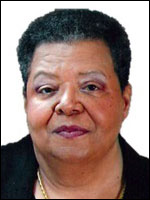
Happy Birthday to Elizabeth Eckford

After 60 years, the most dramatic images of the 1957 crisis at Little Rock Central High School remain those of 15-year-old Elizabeth Eckford, being taunted as she walked through a hate-filled mob, on her way to school.  Today, Ms. Eckford recalls how difficult it was for her parents, Oscar and Birdie, to allow her to continue the struggle to integrate the Little Rock schools.

Last month, a replica of the bench on which she sat on that first day in 1957 was unveiled.  Instead of sitting on a bench surrounded by taunters, this time she sat on a bench surrounded by cheers and applause.  The bench was the latest project of the Central High Memory Project which has also produced an audio tour which takes listeners down the street as Ms. Eckford experienced it in 1957.

Born on October 4, 1941, she grew up in Little Rock.  Because all of the city’s high schools closed her senior year, Ms. Eckford moved to St Louis, where she obtained her GED. She attended Knox College in Illinois, and received her BA in History from Central State University in Wilberforce, Ohio.  While in college, Ms. Eckford became one of the first African Americans to work in a local St. Louis bank, in a non-janitorial position, and later she worked as a substitute teacher, in Little Rock public schools.

Ms. Eckford, a veteran of the U.S. Army, has also worked as a substitute teacher in Little Rock public schools, test administrator, unemployment interviewer, waitress, welfare worker, and military reporter.  Along with her fellow Little Rock Nine members, she is a recipient of the NAACP’s Spingarn Medal and the prestigious Congressional Gold Medal.  Together with one of her former tormenters, Ms. Eckford also received a Humanitarian award, presented by the National Conference for Community and Justice (NCCJ), following their meeting 34 years after an apology.  The award recognizes forgiveness and atonement.  They talked to students for two years, and, together, attended a 12-week racial healing course.

Ms. Eckford has started to walk through the painful past in sharing some of her story.  She has said that true reconciliation can occur if we honestly look back on our shared history. She believes that the lessons learned from Little Rock Central High School must continue to be shared with new generations, reminding audiences that “the dead can be buried, but not the past.”  Ms. Eckford continues her interest in education by sharing her story with school groups, and challenges students to be active participants in confronting justice, rather than being passive observers.

Little Rock Look Back: Bill Clinton Announces Run for Presidency

The Clintons following his remarks.

On October 3, 1991, Governor Bill Clinton strode out the front doors of the Old State House Museum and announced his intentions to seek the 1992 Democratic Party’s nomination for President of the United States.

He was the fifth major Democrat to announce for the office. That there were that many by early October was somewhat surprising considering that the first half of 1991 saw many national Democrats announce they were NOT seeking the office.

Jerry Brown, Bob Kerrey, Paul Tsongas, and Tom Harkin were also in the race.  Clinton was seen as a centrist, along with Senator Kerrey while the others were viewed as being from the far-left wing of the Democratic Party.

In its coverage of the announcement, The New York Times noted the significance of Gov. Clinton’s remarks on race.  In the speech he referenced his desire to strengthen relations and remove barriers between the races.  As the Times pointed out, it was at the Old State House that Arkansas held two conventions on the issue of secession prior to the state’s entry into the Civil War.

At the time of the announcement, Gov. Clinton was far from a frontrunner. His national profile was probably the lowest of any of the announced candidates. Most of the knowledge of him outside of Little Rock came from his lengthy speech about Michael Dukakis at the 1988 Democratic Convention and the subsequent appearance on “The Tonight Show” where both he and Johnny Carson poked fun as his loquaciousness.

Regardless of their views on his chances, the Governor’s family, friends, and fans packed the front lawn of the Old State House to cheer him.  The national media treated him as a serious, albeit largely unknown, candidate.  After having had Wilbur Mills, Dale Bumpers and others flirt with running and then backing out, the local media were probably thrilled to finally have someone from Arkansas actually running for the presidency.

One local media outlet would not see much of the campaign. Just fifteen days later, the Arkansas Gazette would close. As a paper which had covered nearly two decades of his career, the Gazette was often Clinton’s champion, though the paper was not afraid to point out times the two differed.  However, there would be no Gazette headline about Clinton in New Hampshire, at the Democratic Convention, or a general election victory.

On Election Day in 1992 and again in 1996, Bill Clinton would repeat the stride out the front doors of the Old State House accompanied by his wife and daughter.  Those two times the crowds would spill down the streets in all directions. Instead of a handful of media outlets there would be scores of them.

But it all started on a sunny autumn day in Little Rock in early October 1991.