Little Rock Look Back: Mayor George Wimberly

On February 3, 1920, future Little Rock Mayor George Wimberly was born in Star City. He served his country first in the Civilian Conservation Corps and later aboard a U.S. Naval Department hospital ship in the Pacific during World War II.

Wimberly was first elected to the Little Rock City Board in November 1968.  He was re-elected in November 1972 and served until December 1976.  In January 1971, he was selected to serve as Little Rock Mayor through December 1972.

In a rare move, he was again selected to serve as Mayor from January 1975 through December 1976.  During the era of the City Board selecting one of their own members to serve as Mayor, George Wimberly was the only one selected to two non-sequential terms.

In 1978, he was elected to the State House of Representatives and served until December 1988.  While in the House he led the effort for smoking to be banned in the House chambers (a move that predated many public smoking bans of the 1990s and onward).

For over fifty years he was an employee and later owner of Buice Drugstore located on Markham in the Stifft Station neighborhood. In 1986 he received the Arkansas Pharmacist of the Year Award and the Lifetime Achievement Award in 2009.

Mayor Wimberly died on February 5, 2012, two days after his 92nd birthday.

Festival of Hymns tonight at Christ Church

Image may contain: 1 personRichard Webster is a leading American composer of church music, especially of brass arrangements for congregational hymns.

Webster will lead the Christ Church Choir and the congregation in “Blow Ye the Trumpet in Zion: A Festival of Hymns for the Church Year,” singing your favorite hymns set to dazzling arrangements for brass. The hymn festival is free and open to the public (so bring a friend!), and a festive reception will follow.

The program starts at 7pm at Christ Church, located at the corner of Scott and Capitol Streets.

Little Rock Look Back: Opening of Little Rock Public Library

On February 2, 1910, the Little Rock Public Library officially opened its doors.  There had been an open house the night before, but this was the first day of acquiring a library card and checking out books.

Various private libraries had existed sporadically in Little Rock throughout the 19th Century.  In November 1900, a Little Rock School District committee made the first inquiry into the the creation of a Carnegie Library in Little Rock.  Over the next several years, numerous entreaties were made, but funding for the City’s portion was an obstacle.  On December 17, 1906, the Little Rock City Council passed an ordinance to move forward with building, furnishing and equipping a library.  Finally, in February 1908, the City approved acceptance of $88,100 from Andrew Carnegie.  The building would be designed by Edward Tilton, who designed Carnegie libraries, working with local architect Charles Thompson.

Mary Maud Pugsley was hired as the first librarian for Little Rock in May 1909. She began her duties on September 15, 1909, in order to get ready for the opening of the library at the southwest corner of 7th and Louisiana Streets.

On February 2, 1910, formal circulation of books began.  J. N. Heiskell was issued library card number 1.  He was secretary of the Library’s Board of Trustees and had long been an advocate for a public library in Little Rock.  He had often used his bully pulpit as editor of the Arkansas Gazette to advocate for a public library since arriving in Little Rock in 1902.  (Years later — he lived until 1972 — he received a replica of the library card made out of gold.)

That first day of operation, 500 people had applied for library cards. The application process required one to be a Little Rock property owner or to have a property owner sign the application.

Within the first year of operation, 2.5% of Little Rock’s population of 45,951 had applied for a library card.

For more on the history of the transformation of the Little Rock Public Library into the Central Arkansas Library System, read Shirley Schuette and Nathania Sawyer’s From Carnegie to Cyberspace — 100 Years at the Central Arkansas Library System, published by Butler Center Books.

Rock the Oscars 2019: Lisa Blount

Image result for lisa blount ray mckinnonOn March 24, 2002, Lisa Blount and and her husband Ray McKinnon picked up the Oscar for Best Live Action Short for their film “The Accountant.”  Directed by McKinnon (and starring him) it was produced by Blount.

Married since 1998, the couple were strong promoters of the Arkansas film scene, especially from the early 2000s, onward. They were active in supporting the Little Rock Film Festival as well as film projects located in Arkansas.

In 2004, they moved to Little Rock, which was a return for Blount to the Central Arkansas in which she had grown up.  Born in Fayetteville, her family had moved to Jacksonville. After graduating from Jacksonville High School, she attended the University of Central Arkansas. It was there she got her big break appearing in the film September 30, 1955.

A month before her October 2010 death, Blount was inducted into the Arkansas Entertainers Hall of Fame.

Macaws predict arrival of Spring today at Little Rock Zoo

Don’t watch a groundhog look for his shadow, experience the first EVER public flight of the Little Rock Zoo’s macaws!

The newest addition to the our Zoo Program, Zoo staff have been training them for public flight.

These beautiful birds will let Little Rock know if it will experience more winter by flying to our Ice Queen or if citizens should get ready for warmer weather by flying to our Princess of Fire.

Saturday February 2, 2019, at 11am at the Little Rock Zoo in Café Africa.

Regular admission to the Zoo applies.

African Americans and Sports in Arkansas focus of Black History Commission of Arkansas program today (2/2)

Image may contain: one or more people and textThe Black History Commission of Arkansas presents “African Americans and Sports in Arkansas.”  The program runs from 9:45 am to 3 pm today at the Mosaic Templars Cultural Center.

Speakers: Evin Demirel, Jimmy Cunningham Jr., Dr. Wilbert Gaines, and Kenneth (Muskie) Harris. Lunch will be provided. Teachers can earn up to four professional development hours. Registration is required.

10 a.m.
Evin Demirel, author of “African-American Athletes in Arkansas: Muhammad Ali’s Tour, Black Razorbacks and Other Forgotten Stories”
• The legacy of African American sports in Jim Crow era with an emphasis on the now-defunct, all-black high school’s athletic association and stories from his book.

11 a.m.
Jimmy Cunningham, Jr., author of “African Americans of Pine Bluff and Jefferson County”
• Highlights and stories about three African American athletes from Jefferson County, including Boid “One Arm” Buie, Willie Roaf and Ivie Moore.

12:45 p.m.
Dr. Wilbert Gaines, former Arkansas State University professor
• Personal experiences and surmounting challenges and obstacles as a pioneer and trailblazer in sports, sports-related activities and academia.

1:45 p.m.
Kenneth “Muskie” Harris, community activist and former Razorback
• The history of the Razorbacks and integration of athletes, including facts about all 17 sports at the University of Arkansas and some of the first African Americans to receive sports scholarships.

For those unable to attend, footage from the programs will be on the Arkansas State Archives Facebook page in the coming days.

The Black History commission of Arkansas is an advisory board of the Arkansas State Archives, a division of the Department of Arkansas Heritage.

Little Rock Look Back: Movie Ball sends LR Film Fans into Frenzy

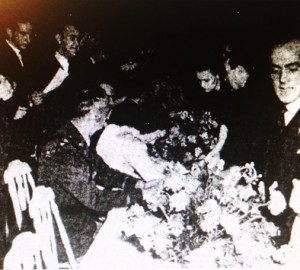
Autograph seekers crowd around the actors at the Movie Ball (photo from Arkansas Gazette)

As final preparations were being made for the opening of the Joseph Taylor Robinson Municipal Auditorium in early 1940, a glamorous evening took place in Robinson’s lower level convention hall on February 1.

In conjunction with a meeting of film executives and movie theatre owners sponsored by Robb and Rowley Theaters (which later became the United Artists theatre chain), several Hollywood actors were in Little Rock and headlined a Movie Ball. While in Little Rock, Maureen O’Hara, Phyllis Brooks, Arleen Whelan, Tim Holt and Gene Autry had also made a variety of public appearances.

Mr. Autrey had to miss the ball because he had to return to Hollywood early to attend to business matters. Actress Ilona Massey had also been scheduled to attend the events but was unable due to illness.

The quartet who did appear at the Movie Ball caused quite a scene. Upon their entrance, so many of the attendees crowded around for autographs that the evening’s grand march could not take place (a newspaper headline in the Democrat innocently used the word “orgy” to describe the crowd). After two attempts, Little Rock Mayor J. V. Satterfield (who was escorting Miss O’Hara) and the other members of the Little Rock host delegation led the Hollywood foursome to their reserved table. For quite a while that evening, the table was besieged by autograph seekers.

Though it is unknown as to whether he sought an autograph, photos from the evening showed a very satisfied Mayor Satterfield with Miss O’Hara on his arm. Satterfield family lore joked that Mrs. Satterfield (who had stayed home that night to tend to a sick son) was not a fan of Miss O’Hara’s films after that evening.

The Movie Ball showed Little Rock citizens the value of Robinson Auditorium even before it had been officially dedicated. The film industry meetings had taken place at the Albert Pike Hotel which did not feature a ballroom large enough to host the ball. Without the auditorium’s availability for the gala, organizers might not have chosen Little Rock for the meeting.

With the auditorium’s convention hall not attached to any hotel, it opened up the chance for Little Rock to host more events. This had been one of the key arguments for an auditorium since Mayor W. E. Lenon’s first proposal back in 1904. Having a glamorous event this early in the auditorium’s life validated that contention. After having endured the challenges to open the building, it was a nice lagniappe for the auditorium’s proponents who were present.

The actor Tim Holt would again be connected to Little Rock. In September 1951, he tried to obtain a divorce in Arkansas and stated that he had been a resident of the state for at least six weeks. He also had someone else testify to that fact. In October 1951, the divorce was granted. Later Mr. Holt was charged with perjury and fined $200 for falsely representing his length of residence in Arkansas. Judicial sanctions for his legal team, which included a State Senator, were eventually reviewed by the Arkansas Supreme Court.
