70 Years Ago Today – War Memorial Park dedicated by President Truman with foreign affairs address

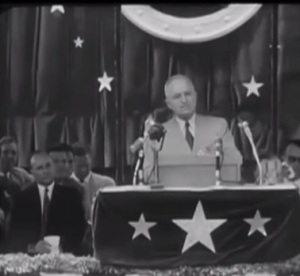
Though President Truman was in Little Rock for a military reunion, he did conduct some official business while here.  In his Presidential role, he spoke at the dedication of War Memorial Park on June 11, 1949.

(It is sometimes erroneously reported that he dedicated the stadium.  That took place in September 1948, at a Razorback game with former Razorback player and future Lt. Governor Maurice “Footsie” Britt delivering the keynote.)

President Truman’s address took place inside War Memorial Stadium at 2:30 p.m..   It was not a brief dedicatory speech, but instead was a lengthy treatise on foreign affairs.  The address was carried live on nationwide radio (though some radio networks opted to broadcast it later).  The text of his address can be found here.

The stadium was by no means full.  A major reason for that was that many thousand individuals had turned out to witness a parade downtown in which President Truman marched along side Governor Sid McMath.  The parade was in conjunction with the military reunion.  Given the June heat in Arkansas (in which parade spectators had been standing for several hours) and the difficulty of getting from the parade route to the stadium, most (if not all) parade spectators opted for skipping the presidential address.

Before the parade, President Truman (who was still riding high from his upset victory in the 1948 election) was asked by a local reporter if he would run in 1952. He refused to answer stating that the national media would think he had planted the question with a local member of the press.

Prior to the name War Memorial Park, the land had been known as Fair Park.  It was a former location of the State Fair.  In the 1930s, it had briefly been known as Overman Park in honor of then-Mayor R. E. Overman.  The City Council had named it for him as a tribute to his work on a variety of projects. When he displeased them, they reversed their decision and renamed it to Fair Park.

The CALS Ron Robinson Theater $2 Terror Tuesdays continue tonight with WHITE ZOMBIE

Image of a film poster with a dark green background. Large eyes overlook two hands clasped together. The text at the top reads "With these zombie eyes, he rendered her powerless". In the middle is the title, White Zombie. Below is written "With these zombie hands he made her perform his every desire!".$2 Terror Tuesdays continue tonight (6/11) at the CALS Ron Robinson Theater with 1932’s WHITE ZOMBIE.

White Zombie is a 1932 American horror film independently produced by Edward Halperin and directed by Victor Halperin.

The screenplay by Garnett Weston, based on The Magic Island by William Seabrook, is about a young woman’s transformation into a zombie at the hands of an evil voodoo master.

The film stars Bela Lugosi as a zombie master, as well as Robert Frazer, Madge Bellamy, and John Harron.  It is considered the first feature-length zombie film.

The showing starts at 7pm.  Cost is $2.

AST Tonight – “Performing Shakespeare’s Women” with Paige Martin Reynolds

Paige Martin Reynolds's Profile PhotoThe Arkansas Shakespeare Theatre continues to expand its offerings.

Following the model of other acclaimed and established Shakespeare festivals in the country like Oregon Shakespeare Festival and Utah Shakespeare Festival, Arkansas Shakespeare Theatre is thrilled to offer educational prep sessions, workshops, lectures, and talk-backs to enhance theatregoers’ understanding of the plays produced during our 13th summer season on the campus of UCA.

In utilizing academic leaders, professional actors, and other members of our creative team, we will enrich exploration of themes and ideas in both the Shakespeare plays and in our musical this season as a way to both facilitate reflection and expand understanding of the plays produced at AST during our summer festival. (Sponsored by Conway A&P Commission.)

Their first lecture will be by Paige Martin Reynolds, AST Actor, Artistic Collective Member, and Director of Dramaturgy: “Performing Shakespeare’s Women”
Why might what happens to Shakespeare’s women matter to us today?

Join AST Artistic Collective member Paige Martin Reynolds for a discussion of what is at stake for Shakespeare’s female characters (and the actors who play them), based on her recent book, Performing Shakespeare’s Women: Playing Dead (Bloomsbury Arden, 2019).

It takes place from 5pm to 6pm in the Brewer-Hegeman Conference Center.

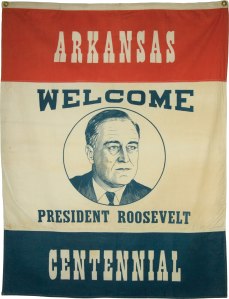
FDR in ARK for State Centennial

On June 10, 1936, President Franklin D. Roosevelt visited Little Rock as part of a day-long series of appearances in conjunction with the Arkansas Centennial celebration.  (The actual statehood dates is June 15.)

His day started in Memphis before he journeyed by train to Hot Springs. After events there that morning and lunch at Couchwood (his longtime friend Harvey Couch was chairman of the Centennial celebration).  He then traveled to Rockport and Malvern for appearances before arriving in Little Rock.  He made his remarks at the State Fairgrounds in a temporary structure called “Centennial Stadium.”

The street he traveled to get to the fairgrounds had been renamed Roosevelt Road in February 1935 in anticipation that he would visit Little Rock in 1936 as part of the state centennial and would likely use that route.  The street was officially named Franklin D. Roosevelt Road.  But given the unwieldy street signs that would be required to bear that name, the ordinance was amended to note that the signs would bear the name “Roosevelt Road.”

Following his remarks, which officially kicked off the six month Arkansas Centennial celebration, he retired to Senator Joseph T. Robinson’s house on South Broadway.  He dined with the Robinsons in the house before departing with the Senator at 8:45 that evening.  The Presidential entourage then journeyed to Texas for the next day.

70 Years Ago Today – Truman in LR

Outside of his capacity as President of the United States, Harry S. Truman visited Little Rock on June 10, 1949, for the annual reunion of the 35th Division, his World War I unit.  He was joined on this trip by members of Arkansas’ congressional delegation and his sister.
Upon arriving in Little Rock, President Truman gave brief remarks at a welcome reception inside Robinson Auditorium.  He also spoke at a reception at the Hotel Marion and following a ball given at Robinson Auditorium.

In all of his June 10th remarks, President Truman spoke of the hospitality he always enjoyed in Little Rock. He discussed visits he had made over the years, including a stay at the Hotel Marion while in Arkansas campaigning for Senator Hattie Caraway.

At the ball, he commented on how, as a Baptist, he had not learned how to dance.  He then joked that however he had picked up other habits which were perhaps not in keeping with his Baptist faith.

At one event, President Truman asked all in attendance to shake hands with their neighbors as a way to shake his hand by proxy.  He explained that on inauguration day, he had shaken over 25,000 hands. Given the fact that he signed 600 documents a day, regardless whether he was in Washington or not, he felt he could not keep up with shaking hands all day.

As he concluded the day, he previewed that he would be giving a national address the next day while in Little Rock.  In his usual, self-deprecating way, Truman remarked “…if you want to hear the President of the United States you had better come out to the stadium tomorrow, and I will tell you something that will be good for your souls.”

The texts of all of his remarks while in Little Rock can be found here.

Journalist Ernie Dumas discusses his new book tonight (6/10)

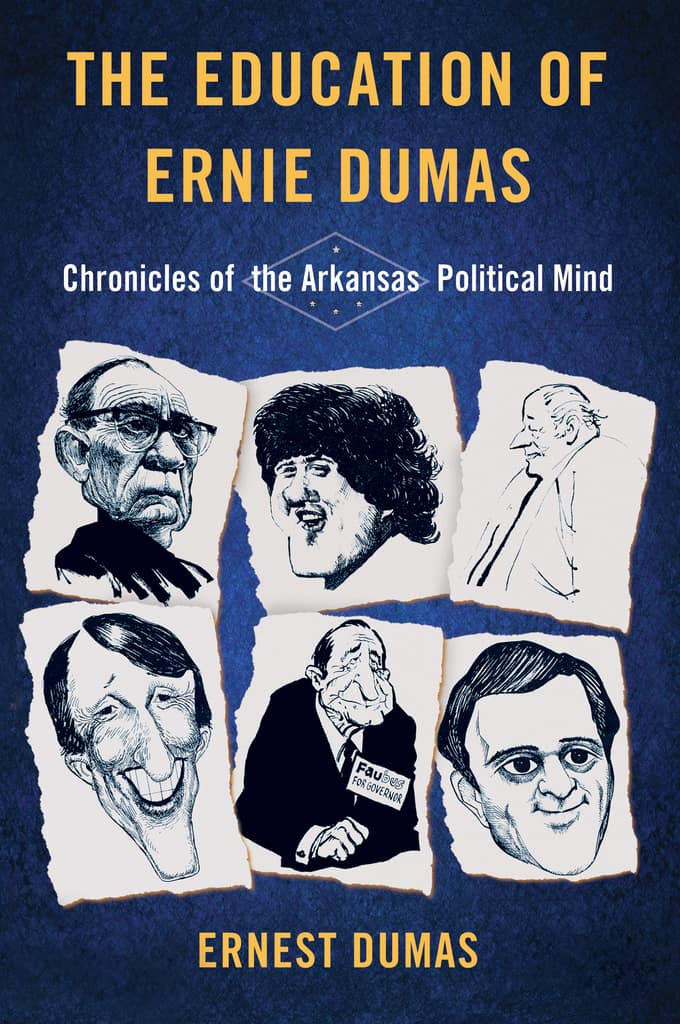
Veteran journalist and political observer Ernie Dumas will talk about his new memoir The Education of Ernie Dumas. He’ll sign copies of the book both before and after his talk, beginning at 5:30 p.m.

Dumas’s book traces the post-World War II evolution of Arkansas, beginning with the defeat of Governor Francis Cherry by Orval Faubus, the son of a hillbilly socialist, at the end of the Joseph McCarthy era, and leading up to Arkansas’s first president of the United States.

The book collects the mostly untold stories, often deeply personal, that reveal the struggles and tribulations of the state’s leaders—Cherry, Faubus, Winthrop Rockefeller, Dale Bumpers, David Pryor, John McClellan, J. William Fulbright, Bill Clinton, Jim Guy Tucker, and others.

Schedule of events:

  • Doors open at 5:00 p.m.
  • Book Signing: 5:30 p.m.
  • Talk: 6:00 p.m.

Co-sponsored by the Clinton School of Public Service and Political Animals Club.