

Movies in the River suggested lineup

Movies in the Park returns this week to Riverfront Park. (More on that later).

But should the flooding continue for many more weeks, perhaps they should consider changing the lineup for 2019 to a Movies in the River.

Here are some suggestions:

  • THE RIVER (1984) – Sissy Spacek and Mel Gibson play a Tennessee farm couple trying to save their farm from a flood.
  • A RIVER RUNS THROUGH IT. (1992) – Brad Pitt and Tom Skerritt fly fish in a river through dreamy gauzy cinematography.
  • MYSTIC RIVER (2003) – Mystery film which netted Oscars for Sean Penn and Tim Robbins.
  • FROZEN RIVER (2008) – Bleak Oscar nominated movie starring Melissa Leo
  • THE RIVER WILD (1994) – Meryl Streep’s entry into the action flick genre. Also her link to six degrees of Kevin Bacon
  • THE BRIDGE ON THE RIVER KWAI (1957) – Alec Guinness, William Holden, Jack Hawkins and Sessue Hayakawa. Guinness at his most Guinness deservedly wins the Oscar while Holden spends part of the film shirtless.
  • RIVER’S EDGE (1986) – Keanu Reeves, Crispin Glover and Ione Skye. Is that a 1980s film cast or what?


A score-related mini-festival

  • WORKING GIRL (1988) – “Let the River Run”
  • THE MUSIC MAN (1962) – “Ya Got Trouble (Right Here in River City)”
  • SHOW BOAT (1936 or 1951) – “Old Man River”
  • BREAKFAST AT TIFFANY’S (1961) – “Moon River”


There could even be an entire John Wayne min-festival:

  • RED RIVER (1948) – John Wayne, Montgomery Clift, Walter Brennan, and Joann Dru. Produced and directed by Howard Hawks with gorgeous cinematography.
  • RIO GRANDE (1950) – John Wayne and Maureen O’Hara spar in a John Ford film. But this one is not set in Ireland.
  • RIO BRAVO (1959) – John Wayne, Dean Martin, Ricky Nelson, Angie Dickinson, Walter Brennan, Ward Bond and Claude Akins in a Howard Hawks film.
  • RIO LOBO (1970) – John Wayne’s first film after TRUE GRIT. Howard Hawks’ final film.
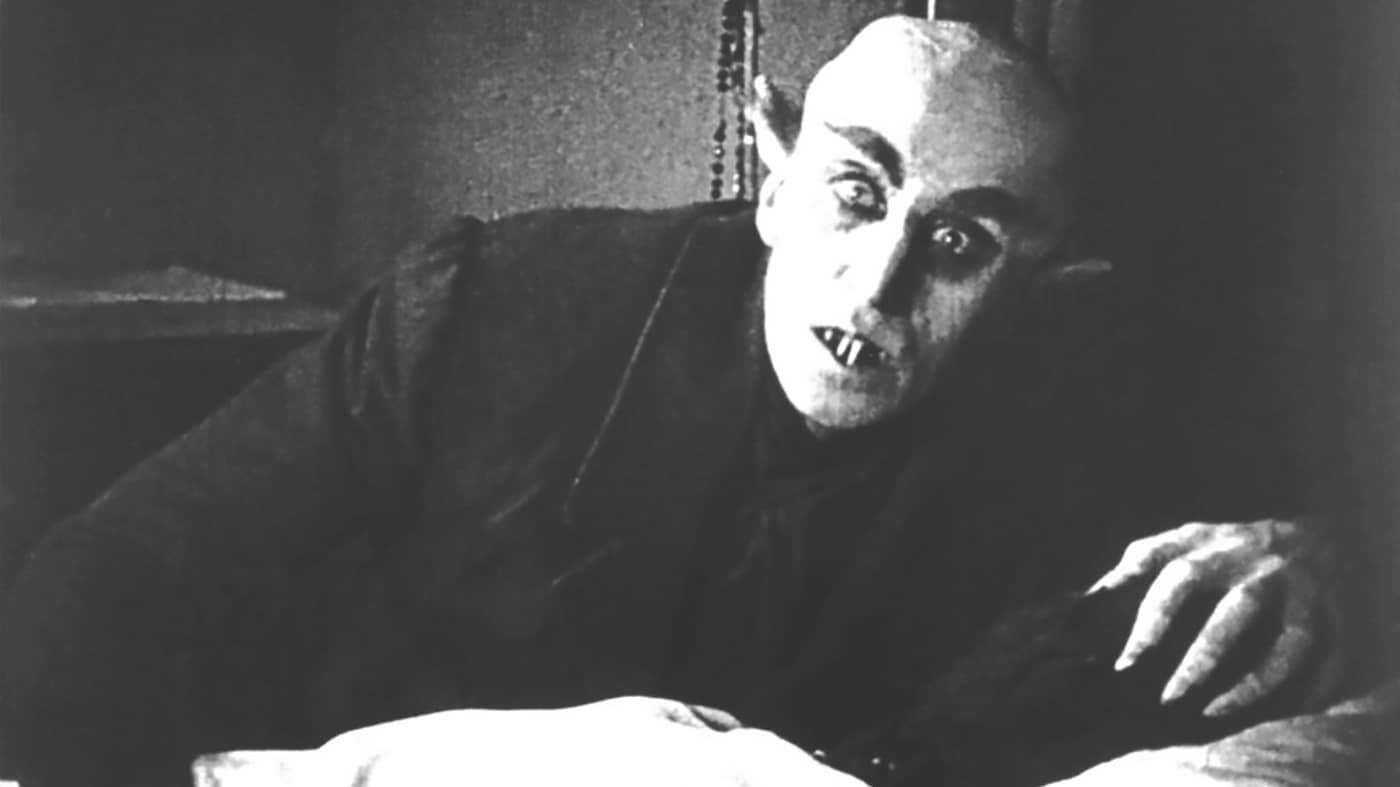
Terror Tuesdays return to CALS Ron Robinson Theater. Up first – NOSFERATU

Nosferatu (1922, NR)

$2 Terror Tuesdays are back! The first one is tonight (June 4).

Nosferatu: A Symphony of Horror, or simply Nosferatu, is a 1922 German Expressionist horror film, directed by F. W. Murnau and starring Max Schreck as the vampire Count Orlok.

The film, shot in 1921 and released in 1922, was an unauthorized adaptation of Bram Stoker’s Dracula (1897), as The Stoker Estate held the books copyright and refused permission. Various names and other details were changed from the novel including “vampire” to “Nosferatu” and “Count Dracula” to “Count Orlok.” Stoker’s heirs sued over the adaptation, and a court ruling ordered that all copies of the film be destroyed. However, a few prints of Nosferatu survived, and the film came to be regarded as an influential masterpiece of cinema.

The showing starts at 7pm.  Cost is $2. (Which begs the question: should this be called Terror TWOsday?)

Czech That Film festival returns to Little Rock for fifth year June 7 & 8

On June 7-8, the Czech That Film (CTF) festival hits Little Rock packed with a program to whet any film-goer’s appetite: A guest director Jakub Šmíd in person and five stellar films showcasing the best in Czech cinema.

The Honorary Consulate of the Czech Republic has partnered with the Arkansas Cinema Society, the Arkansas Economic Development Commission, and CALS Ron Robinson Theater to bring the the Czech That Film festival to Little Rock. The festival begins on June 7 with the family drama Short Cut (Na krátko). A Q&A with director Jakub Šmíd will follow the film screening.

On the following day, June 8, Ron Robinson will screen the drama/comedy Patrimony (Tátova Volha) followed by the sports drama The Golden Betrayal (Zlatý podraz). This will be followed by the Winter Flies (Všechno bude) film which received the Best Director award at the Karlovy Vary International Film Festival; and a historical drama Jan Palach (Jan Palach) honored with the best film award for 2018 from the Czech Film Critics’ Awards.

Q&A June 7th with
Director of SHORT CUT, Jakub Šmíd

Friday June 7th After-party
The Pantry Crest

Tickets can be purchased here.

51 years of continuous community art classes at the Arkansas Arts Center

AAC classes in the 1960s

Though it was not yet officially called the Museum School, the Arkansas Arts Center’s first day of community art classes started on June 3, 1968.

To call it the first day of community art classes is a bit of a misnomer.  Even before the institution opened in May 1963, there were community art classes.  But once the degree-granting program launched in autumn 1964, the consistent, regular offering of those classes went away.

With the January 1968 announcement that the degree-granting program would end by May 31, 1968, plans were underway to bring back community arts classes.  Monday, June 3, 1968, started that program. Since that day, the Arkansas Arts Center has consistently offered arts classes to the community.

The session which began on June 3, 1968, was six weeks in length.  There were fourteen faculty members teaching 48 different classes for both adults and children.  The registration ranged from $10 to $22, depending on the course.   Among the course topics were painting, drawing, print-making, sculpture, crafts, design, children’s and teenage theatre, and art appreciation.  The faculty came from local artists.

Plans were already underway to offer twelve week sessions in the autumn of 1968 and spring of 1969 in a variety of art and dramatic disciplines.

As the Arkansas Arts Center prepares to vacate the space in MacArthur Park for the re-imagining of the building, Museum School classes will not go away.  They are continuing (along with the AAC summer academies) in MacArthur Park through August. Then they will move to the Arkansas Arts Center at Riverdale for the next several quarters.

Final Horace Mann High School Graduation – June 2, 1971

Ms. Wordlow and Mr. Wilkins

On Wednesday, June 2, 1971, the final graduation took place for Horace Mann High School. Opened in the spring of 1956, it had served as Little Rock’s all African American high school for fifteen years. (Since the high schools reopened in August 1959, Central and Hall High had both been gradually increasing the number of African American students each year but students zoned for Mann continued to have the opportunity to attend that school.)

Two-hundred and forty students made up the final class. The graduation took place at Barton Coliseum on June 2.  Three days earlier, the Baccalaureate service took place at the school. The top graduate of the class was Samuel Ray Wilkins, with Eloise Wordlow ranked number two.

1971 marked the first graduating class at Little Rock’s newest high school, Parkview. The presence of that school helped hasten the end of Mann.  This was supposed to be the penultimate year for Mann, under the Little Rock School District’s plan. But in the summer of 1971, a federal court order mandated that Mann no longer serve as a one race high school effective the start of the 1971-1972 school year.

Because of the court order hastening the end of Mann as a high school, there was no opportunity to reflect on Mann’s legacy or note the final graduation.

So the group which thought they would be the final Mann class was instead split up to attend Central, Hall, and Parkview.  Mann was made into a junior high effective that new school year. The students who were supposed to be Mann’s last class have called themselves the 1972 Horace Mann Transitional Class and still have reunions.

Mann had followed Paul Laurence Dunbar High School as Little Rock’s African American high school. That facility had opened in 1929 with a junior high and junior college also in the same building.  Following the opening of Mann, Dunbar became solely a junior high.  The junior college component was dropped in 1955 with no publicly stated reason.

Prior to Dunbar, there had been Gibbs School which served as a primary and secondary school for Little Rock’s African American students beginning in the early 1900s. Eventually the elementary students were located in another building, which was the precursor to today’s Gibbs Elementary School.

Before Gibbs School, Capitol Hill and Union schools both existed at roughly the same time. Both included elementary, junior high, and high school students. After Gibbs School opened, they continued to serve as schools. Capitol Hill lasted as an elementary school into the 1940s.

Robinson Auditorium cornice installed on June 1, 1939

Eighty years ago today, on June 1, 1939, the cornice was installed on Robinson Auditorium.

This granite slab noted the name of the building as the Joseph Taylor Robinson Memorial Auditorium.  (It is interesting to note that it used the more modern “u” instead of the classical “v” which was often used in buildings during prior decades – as evidenced by the Pvlaski Covnty Covrt Hovse across the street.)

This was a milestone marking the completion of the front facade of the structure.  Much work would continue on the interior of the structure.  This step in the construction was considered major enough that the Arkansas Gazette mentioned it in a news article.

June 1, 1939, was also the first day on the job for the auditorium’s first director – William T. Clemons.  A former Little Rock resident who came from Rochester NY.  The Auditorium Commission which hired him would not disclose the sources of his salary, but assured Mayor J. V. Satterfield the money did not come from City coffers.

On this date in 2015 and 2016, the cornice was again surrounded by construction materials and braces. But the restoration of Robinson Center finished in November 2016. Once again, the cornice stands proudly atop the six columns with no impediments around it.