 Eleven teams of students from the University of Arkansas Clinton School of Public Service will complete public service projects in partnership with public agencies, community initiatives, academic ventures, and nonprofit organizations across Arkansas during the 2019-20 academic year.
As part of the school’s Master of Public Service degree program, the students will earn academic credit for their work on the projects that include researching innovative solutions for maintaining infrastructure in Arkansas’ rural towns and counties, developing a statewide plan for victims of child trafficking, and assessing the impact of a pilot transportation program for homeless individuals.
“What makes the Clinton School unique from other more traditional graduate programs is the field service work,” said Clinton School Dean James L. “Skip” Rutherford III. “In collaboration with community organizations, our students will help meet some important needs in Arkansas.”
The projects are part of the Clinton School’s Practicum program, the first of three public service projects completed during the two-year master’s degree program.
The Clinton School students will participate in the projects while also completing in-class coursework on topics such as program planning and development, field research, and communication.
The 11 projects were selected from more than 50 applicants. They are part of more than 100 field service projects to be completed by MPS and Clinton School Online students in the 2019-20 academic year.
Arkansas-based organizations that are interested in partnering with the Clinton School on future projects should contact Hilary Trudell, Director of Local Programs and Regional Outreach with the Office of Community Engagement.
Below is a closer look at each of the 11 projects.
University of Arkansas System Division of Agriculture Cooperative Extension Service Community and Economic Development– Team: Marlie Ball (Gravette, Ark.), Drew Coker (Russellville, Ark.), Brock Hyland (Waco, Texas), J. Dillon Pitts (Pearl, Miss.)
The loss of businesses and declining populations make it difficult for rural towns and counties to finance much needed infrastructure investments. This team of Clinton School students will research innovative solutions for maintaining and developing infrastructure in rural areas and propose best practice recommendations for Arkansas communities.
The team will meet with local and county elected officials, community leaders, and state and federal agencies across the state and region to better understand needs and to identify best practices for infrastructure investments. In addition, the team will assess and highlight national promising practices for rural infrastructure maintenance and development.
The students’ recommendations will be distributed as a report with the potential of a webinar series hosted through the University of Arkansas System Division of Agriculture Cooperative Extension Service Community and Economic Development office.
Arkansas Department of Education, Division of Public School Accountability – Team: Ryan Bell (Los Angeles, Calif.), Nikki Anderson (Fayetteville, Ark.), Jacob McGuire (Tuttle, Okla.), Farrah Beck (Conway, Ark.)
The Arkansas Division of Elementary and Secondary Education’s Public School Accountability office is working to engage its stakeholders to improve school performance by harnessing community support. The Clinton School team will assess the impact and effectiveness of the department’s current stakeholder engagement, both internally and externally, creating tools to help enhance their culture of evaluation and reflection.
This evaluation will help the Division of Elementary and Secondary Education build a plan to improve and expand upon its existing community engagement efforts, including communication with public school administrators and parents.
Arkansas Faith-Academic Initiatives for Transforming Health (FAITH) Network – Team: Samantha Black (Fort Smith, Ark.), Abigail Carlson (Lyon, France), Taylor Donnerson (West Memphis, Ark.)
The Arkansas Faith-Academic Initiatives for Transforming Health (FAITH) Network is a collaboration of the University of Arkansas for Medical Sciences and faith organizations in Arkansas that provides an infrastructure to support faith-based research and the delivery of health programs education within faith communities across Arkansas. In January 2019, FAITH Network transitioned under the umbrella of the Vine & Village nonprofit to preserve and expand its vision of “Healthy People, Healthy Congregations, and Healthy Communities.”
The Clinton School team will assess the organization’s approach to connecting with communities of faith, and will study why faith-based organizations from specific areas in Little Rock are not accessing the initiative’s services.
The team’s research may culminate in the implementation of a connection event to enhance organization’s rapport and presence in faith-based settings and the general community.
Arkansas Homeless Coalition – Transportation Alliance Project Team: Leslie Parker (Dierks, Ark.), Michael Webb (Overland Park, Kansas), Katerina Noori (Chandler, Ariz.), Cassidy Mitchell (Corning, Ark.)
The Transportation Alliance Project (TAP) is a pilot fare agreement program led by the Arkansas Homeless Coalition, the Little Rock Mayor’s Office, and Rock Region Metro Transportation Division, with the goal to provide homeless individuals with free, reliable transportation. This initiative hopes to improve lives in the form of consistent, reliable transportation, and ultimately allow homeless individuals to move into stable housing arrangements.
The Clinton School team will assess the effectiveness of the pilot transportation program through focus groups and interviews while coordinating with 13 nonprofits that case manage homeless services and are partnering on the project.
Arkansas Innovation Hub Team: Jacey Winn (Wynne, Ark.), Michael Morrison (Van Buren, Ark.), Patrick Isokpunwu (Benin City, Nigeria), Tamara Bates (Memphis, Tenn.)
The Arkansas Regional Innovation Hub inspires innovators and entrepreneurs who expand the range of educational and economic opportunities for themselves and their communities. Its members gain full access to the unique and extensive set of resources the Innovation Hub provides, including studio space, traditional equipment, cutting-edge tools, and access to a broad range of classes.
The team of Clinton School students will assess the Innovation Hub’s current membership strategy while studying membership drives of similar organizations across the country to recommend a tangible set of actions to improve outreach and increase membership. Additionally, the team will assess the Innovation Hub’s current member experience and recommend a set of projects, initiatives, and ideas to improve the overall member experience.
Arkansas STEM Coalition. Team: Kate Jenkins (Memphis, Tenn.), Liz Hall (North Little Rock, Ark.), Jaylin Sprout (Hope, Ark.)
The Arkansas Science, Technology, Engineering and Mathematics (STEM) Coalition is a statewide partnership of leaders from the corporate, education, government, and community sectors which coordinates and advocates policies supportive of excellence in STEM teaching and learning in order to expand the economy of Arkansas and produce higher paying jobs.
The Clinton School team will compile a repository of STEM programs, resources and assets across the state while documenting best practices and methods for partnerships. The inventory and information will be used to support the STEM Coalition’s work of leading the Arkansas STEM Ecosystem Initiative and assessing where STEM gaps exist in the state as well as to create a searchable database of programs accessible to the public.
Children’s Advocacy Center of Arkansas. Team: Aisosa Osaretin (Benin City, Nigeria), Courtney Heptig (Fort Worth, Texas), Brittany Moody (Bentonville, Ark.), Mackenzie Bolt (North Little Rock, Ark.)
Children’s Advocacy Center of Arkansas promotes, assists, and supports the development, growth, and continuation of CACs in Arkansas so that every child victim has access to their services.
The team of students will develop a statewide plan for child trafficking victims in Arkansas by meeting with representatives from state and local law enforcement and the Arkansas Department of Transportation, among others.
Downtown Little Rock Community Development Corporation. Team: Cody McKinney (Nags Head, Ark.), Kamelle Gomez (Jacksonville, Fla.), Jennifer Browne (Little Rock, Ark.), Tim Campbell (Little Rock, Ark.)
The Downtown Little Rock Community Development Corporation is organized to improve the quality of life for individuals residing in a target area of downtown Little Rock. The organization is dedicated to the promotion of community interest and involvement in activities which have a positive impact on the target area. Principal areas of focus include enhancing access to housing, promoting economic development, deterring criminal activity, and abating neighborhood deterioration.
The team of students will inventory and map community-based assets within Little Rock’s Pettaway neighborhood. This project will serve as a first step towards asset-based community development (ABCD) in the neighborhood. This approach allows the community itself to drive improvement, identifying and mobilizing existing assets, and encouraging local economic opportunity for residents.
Heart of Arkansas United Way. Team: Blake Farris (Conway, Ark.), Nada Hamida (Aleppo, Ark.), Linda Dipert (Arlington, Texas), Baraka Kengna (Baraka, Kengwa)
Recent national research conducted by United Way Worldwide surveyed 1,500 adults who work for companies that participate in United Way Workplace Giving Campaigns regarding their views of Corporate Social Responsibility. More than 80% responded that it was important they work for a company that gives back to the community.
A team of students will explore the attitudes of the local workforce toward Corporate Social Responsibility (CSR) and develop a framework to help local businesses implement and promote CSR in their workplaces.
The students’ work will include a review of literature related to CSR; determining best practices for CSR in a variety of businesses; primary data collection from local employees; and developing a framework by which companies can develop a formal CSR program.
Phoenix Youth and Family Services. Team: Abraham Kahasay (Clarksville, Tenn.), Brejai Washington (Kansas City, Kansas), Corrinne McClure (Memphis, Tenn.)
Based in Dumas, Ark., Phoenix Youth and Family Services is committed to developing and sustaining quality programs and services that enhance its mission of creating opportunities for rural and low-income residents of southeast Arkansas. The organization is seeking to create a set of evaluations to ensure the services it offers – including violence prevention, judicial services, and drug and alcohol education – are maximizing their impact.
The team of students will assess the services offered, highlighting various successes through the story collection of previous clients that will help move the organization build an effective strategic plan.
Thea Foundation. Team: Connor Thompson (Little Rock, Ark.), Lydia Grate (Russellville, Ark.), Abigail Lee (Fayetteville, Ark.), Alec Zills (Gleason, Tenn.)
A team of students will research the impact of Thea Foundation’s Art Closet program, which awards grants ranging from $1,000-$2,500 for creative materials and artistic supplies to teachers throughout Arkansas. During the 2018-19 academic year, the Art Closet program awarded nearly 150 projects more than $100,000 in support of artistic and creative teaching to public schools across the state.
The students’ research efforts will include interviewing teachers, school administrators, students, parents, and other stakeholders in education, with the goal of measuring the true impact of the Art Closet program.

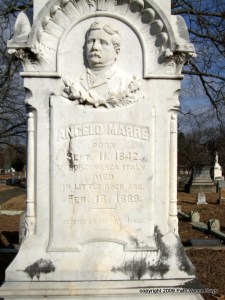 On September 11, 1842, future Little Rock Alderman Angelo Marre was born in Borzonaca, Italy. He immigrated to Tennessee with his parents in 1854.
 Angelo Marre died February 18, 1889, as a result of his infection. He is buried at Calvary Cemetery in LR. His custom designed, marble monument was ordered from Florence, Italy, and cost $5,000.
 On September 11, 1941, Minnijean Brown was born.
 A new exhibit is now open at the Clinton Presidential Center. José Sacal: A Universal Mexican is presented in celebration of the CCIX Anniversary of the Independence of Mexico and National Hispanic Heritage Month
 José Sacal: A Universal Mexican includes two groups of the artist’s work: sculptures inspired by other works of art and portraits of historical figures. In his works, Sacal finds the essence of each character or work. It can be a detail or an object, but the rest is something deeper. By recreating them, Sacal gives them a new meaning and establishes an artistic dialogue at a higher level. In his intelligent observation of art and history, Sacal reveals himself as a universal Mexican.
 The Civil War came to an end for Little Rock 156 years ago today (September 10) as Federal troops took control of the city. Unlike some other Southern capitols, there was no long siege or bloody battle.
 Little Rock Culture Vulture