Unknown's avatar

About Scott

A cultural thinker with a life long interest in the arts and humanities: theatre, music, architecture, photography, history, urban planning, etc.

Mac Park Music Concludes 2013 with Beers and Brats

Beer Brats 2013 MacFrom the late 1920s through the mid 1950s, Little Rock’s MacArthur Park was a centerpiece of live music.  The Foster Bandshell, named in memory of Mrs. H. H. Foster, stood in the park near 10th and Commerce.  The structure was torn down in the early 1960s.  A portion of the Arkansas Arts Center sits on the site of the old Foster Bandshell.

In 2002, the lakeside pavilion in MacArthur Park was renamed the Foster Pavilion to pay tribute to the memory of Mrs. Foster and the bandshell.

The Foster Pavilion will be the site of a new music series taking place on Wednesday nights in September.  MAC PARK MUSIC! wraps up its inaugural series tonight from 5:30pm to 7:30pm.

Tonight is the annual Beer and Brats fundraiser.  The lineup features the Steve Giles Jam Band. Brats will be grilled by Mac Park supporter Bryan Barnhouse.  The cost is $15 for adults, $10 for students aged 13-20, $7 for kids aged 6 to 12.  It is free for those aged 5 and under.  Proceeds go to benefit improvements in MacArthur Park.

ASO Chamber Series Kicks Off Tonight with Brahms the Romantic

The Arkansas Symphony Orchestra kicks off the 2013-2014 Parker Lexus River Rhapsodies Chamber Music series tonight at 7:00 p.m. at the Clinton Presidential Center.

The program will feature Mozart’s “String Quintet No. 3 in C major, K.515;” Takemitsu’s “Rain Tree;” and Brahms “Clarinet Quintet in B minor, Op. 115.”

Mozart’s piece was completed in 1787.  Like all of Mozart’s string quintets, it is a viola quintet.  That means, it is scored for an extra viola: two violins, two violas and one cello.  Takemitsu’s selection was composed in 1982.  At that point in time, many of his compositions have references to water in the title.  Brahms composed his clarinet quintet in the summer of 1891.  The piece is known for its autumnal feeling (appropriate to be performed on one of the first full days after the autumnal equinox).  The selection is written for a clarinet in A and a string quartet.

Six Pioneers, Other Leaders honored by National Park Service Tonight

NPSLRCHTomorrow, September 25, marks the 56th anniversary of the desegregation of Little Rock Central High School.  Each year the school and the National Park Service schedule a series of events to commemorate this.

This year, commemoration activities start this evening.  At 6pm at Philander Smith College, there will be a panel to discuss the Six Pioneers. These were the first six African-American students to desegregate the University of Arkansas at Fayetteville (U of A) School of Law.  The descendants of the Six Pioneers will discuss the role of moral courage and the change that occurred in the hills of northern Arkansas over 65 years ago.  George Haley, the sole living pioneer will give remarks as well.

Their footsteps on the foothills of conviction cleared a path for the desegregation of Hoxie Elementary in 1955 and Little Rock Central High School in 1957. The U of A School of Law was the first southern white university to accept African-American students since Reconstruction.

The Six Pioneers, The Honorable Rodney Slater, Attorney John W. Walker, Sr., Judge Wiley A. Branton, Jr., Sanford Tollette IV, Dr. Sybil Jordan Hampton and Robin Woods Loucks will all be recipients of the Soul of Humanity Award given in recognition of outstanding commitment and service to social justice and lifelong action in the struggle for civil rights.

The evening will close with remarks from Reena Denise Evers-Everette, daughter of civil rights activist and martyr Medgar Evers.

The event will take place at the Kendall Science and Health Mission Center on the Philander Smith College campus.


“A Land Inferior to None” – an evening celebrating “Arkansas: A Narrative History”

The Old State House Museum will present “A Land Inferior to None,” a talk and book signing with Jeannie Whayne, George Sabo and Tom DeBlack, authors of “Arkansas: A Narrative History,” Second Edition, on Tuesday, September 24, from 6 to 8 p.m. Admission to the talk is free. Those who wish to attend are encouraged to RSVP by calling (501) 324-8641 or visiting www.oldstatehouse.com/RSVP.
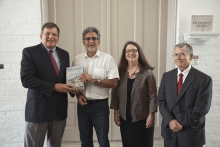
Deblack, Gatewood, Whayne, and Sabo

Deblack, Gatewood, Whayne, and Sabo

The book is a comprehensive state history that has been invaluable to students and the general public since its original publication over 10 years ago. The original edition won the Arkansiana Award when it was published in 2002, and the book is widely used in colleges throughout the state. The new edition has been updated and expanded with three additional chapters, including a new chapter on Arkansas geography. It also covers fresh material on the civil rights movement in the state and the struggle over integration, a new analysis of Arkansas’s school-funding issues and an examination of the Natural State’s transition from colonialism to its entry into the global political economy. The University of Arkansas Press published both editions of the award-winning textbook.

Jeannie Whayne is professor of history at the University of Arkansas. She is the author of “A New Plantation South: Land, Labor, and Federal Favor in Twentieth-Century Arkansas” and “Delta Empire: Lee Wilson and the Transformation of Agriculture in the New South.”

Tom DeBlack is professor of history at Arkansas Tech University. He is the author of “With Fire and Sword: Arkansas, 1861-1874.”

George Sabo is professor of anthropology at the University of Arkansas and director of the Arkansas Archeological Survey. His publications include “Rock Art in Arkansas” and “Paths of Our Children: Historic Indians of Arkansas.”

The Old State House Museum is a program of the Department of Arkansas Heritage.  Bill Gatewood is the Director of the Museum.  Martha Miller is the Director of the Department of Arkansas Heritage.
Arkansas Sounds: Singer Songwriter Showcase

arkansas_sounds_2013Later this week music stages downtown will be filled with three days of music as part of the 2nd annual Arkansas Sounds  music festival.

The week kicks off tonight with a Singer Songwriter Showcase.

Featuring local members of the Nashville Songwriters Association International (Steve Smith, Russellville; Jim Pollock, Conway; Rodger King with Molly Brockinton, Lonoke; Roy Hayle, Malvern) and a special performance by Arkansas songwriter Wood Newton.

The program will start tonight at 6pm at the Darragh Center of the Main Library.

The Butler Center for Arkansas Studies, a department of the Central Arkansas Library System (CALS), sponsors the annual Arkansas Sounds Music Festival.

Focused on Arkansas music and musicians both past and present, the Festival also works to get musicians and songwriters involved in local schools, with songwriting workshops for kids and adults, and related performances and events throughout the state.

Banned Books Week Kicks Off with CLOCKWORK DOLL

ALA Freadom Slide 2013 (2)Banned Books Week started in 1982 because a librarian remembered being a twelve-year-old caught reading with a flashlight under her covers, and her mother telling her to turn the light on while she was reading so she wouldn’t hurt her eyes.

The Central Arkansas Library System (CALS) will celebrate the freedom to read, the importance of First Amendment rights, and the power of literature with special events and displays during Banned Books Week, September 22-28. CALS’s celebration of Banned Books Week is sponsored by the Fred K. Darragh Jr. Foundation, and will include the Arkansas Literary Festival’s collaboration with The Weekend Theater of Clockwork Doll on Sunday, September 22, at 6:30 p.m. at The Weekend Theater, 1001 W. 7th Street.

This one-night only collage features scenes from two plays: Nora, an adaptation of Henrik Ibsen’s A Doll’s House; and a stage version of the dystopian novella A Clockwork Orange by Anthony Burgess. Both works of literature have been banned or challenged, and are part of The Weekend Theater’s fall season. A brief reception will follow the presentation, which is free and open to the public. Seating is open and reservations are requested, but not required, at pedwards@cals.org or 918-3009. There are a limited number of seats, so patrons are urged to arrive early. For more information on Clockwork Doll visit www.arkansasliteraryfestival.org or call (501) 918-3098.  

Banned Books Week stresses the importance of ensuring the availability of all viewpoints, even those which may be unorthodox or unpopular, for all who wish to read and access them; and recognizes the danger that exists when restraints are imposed on the availability of information in a free society. Each year, many books are challenged and/or banned in communities across the United States. In a majority of cases the books are not banned, thanks to the efforts of librarians, teachers, booksellers, and members of the community to retain the books in the library collections.

A challenge is an attempt to remove or restrict materials, based upon the objections of a person or group; a ban is the removal of challenged materials. Often challenges are motivated by a desire to protect children and youth from ideas and information that may be difficult for them to understand. Although this is a commendable motivation, the Library Bill of Rights states that, “Librarians and governing bodies should maintain that parents-and only parents-have the right and the  responsibility to restrict the access of their children-and only their children-to library resources.”


About the Arkansas Literary Festival

The Arkansas Literary Festival, the state’s premier gathering of readers and writers, will feature more than 80 bestselling and emerging authors April 24-27, 2014. The eleventh annual event will feature a stimulating mix of sessions, panels, workshops, activities, performances, special events, and book signings.


About The Weekend Theater

The Weekend Theater, a non-profit theatrical community that produces socially significant plays for the Central Arkansas community, will produce both full length plays in the fall. Performance dates for Nora are October 4, 5, 11, 12, 18, and 19; and A Clockwork Orange runs November 1, 2, 8, 9, 15, and 16. For information about the full productions or to purchase tickets visit www.weekendtheater.org or call (501) 374-3761.

About CALS

CALS libraries in Little Rock include: Main Library, 100 Rock Street; Hillary Rodham Clinton Children’s Library and Learning Center, 4800 W. 10th Street; Dee Brown Library, 6325 Baseline Road; Fletcher Library, 823 North Buchanan Street; Oley E. Rooker Library, 11 Otter Creek Court; Terry Library, 2015 Napa Valley Drive; Thompson Library, 38 Rahling Circle; Williams Library, 1800 Chester Street; and McMath Library, 2100 John Barrow Road. CALS libraries in surrounding communities include: Millie M. Brooks Library, 13024 Hwy. 365, Wrightsville; Maumelle Library, 10 Lake Pointe Drive, Maumelle; Max Milam Library, 609 Aplin Avenue, Perryville; Esther D. Nixon Library, 703 W. Main Street, Jacksonville; and Amy Sanders Library, 31 Shelby Drive, Sherwood.

For more information, contact 918-3000.

Little Rock Look Back: City Government Closes Up

Final 1863 minutesOn September 21, 1863, the City of Little Rock government shut down.  Following the occupation of Little Rock by federal troops (on September 10, 1863), the city was now under control of the United States Army.

The City Council met on September 21 and voted to disband the police force and to suspend the collection of taxes.  Mayor William E. Ashley was not present.  The five aldermen present were Charles P. Bertrand (a former mayor and stepson of Little Rock’s first mayor Dr. Matthew Cunningham), S. H. Tucker, W. B. Wait, I . A. Henry, and Louis George.  Following the actions regarding the police and taxes, the council adjourned.

The month before, on August 24, 1863, the City’s funds were “placed in the hands of a reliable party that was well known to the Council.”  Records in City Hall do not indicate who that was or if those funds were ever returned following the war. (Or if those funds were in Confederate dollars which would have been rendered useless.)

Following the September 21, 1863 meeting, there was not a City Council meeting until January 8, 1866.  I. A. Henry, who had been at the final 1863 City Council meeting was also an alderman on January 8, 1866.