Sandwich in History today (6/7) at the Irv Daniel House

Image may contain: house, tree, sky and outdoor

The Arkansas Historic Preservation Program each month sponsors a Sandwiching in History tour which familiarize people who live and work in central Arkansas with the historic structures and sites around us.

The tours take place on Fridays at noon, last less than an hour, and participants are encouraged to bring their lunches so that they can eat while listening to a brief lecture about the property and its history before proceeding on a short tour.

Today (June 7) at 12 noon, this month’s tour is at the Irv Daniels House, located at 1622 Waterside Drive.

Constructed in 1965, the Irv Daniel House in North Little Rock is one of only 10 designs created by architect Frank Doughty in the state of Arkansas. The architecture of the house was heavily influenced by the work of Frank Lloyd Wright and E. Fay Jones, whom Doughty worked for at one time.

IMPORTANT NOTE: There is very limited parking available along Waterside Drive. There is an area of public parking located to the northeast of the house, along Waterside Drive, and additional parking is available along streets to the east and at the park at the intersection of Waterside Drive and Avondale Road

The Arkansas Historic Preservation Program is an agency of the Department of Arkansas Heritage.

Restoring Taylor House in Drew County is subject of today’s CALS Legacies & Lunch Lecture

Tommy Jameson, lead architect for the restoration of the Taylor House (among many other restoration works in Arkansas), will discuss the past, present, and future of the dogtrot-style home built in 1846 at Hollywood Plantation in Drew County, one of the few remaining examples of Arkansas vernacular architecture built before the Civil War.

The program takes place today (June 5) at noon in the Darragh Center at the Central Arkansas Library System Main Library in Library Square.

The house was donated in 2012 to the University of Arkansas at Monticello (UAM) for historical research and interpretation, and UAM began restoring the house and adjacent grounds to how they appeared in the earliest known photographs.

About Legacies & Lunch

Legacies & Lunch is a free monthly program of CALS Butler Center for Arkansas Studies about Arkansas related topics. Program are held from noon to 1 pm on the first Wednesday of the month. Attendees are invited to bring a sack lunch; drinks and dessert are provided. A library parking discount is available upon request. For more information, call 918-3030.

Robinson Auditorium cornice installed on June 1, 1939

Eighty years ago today, on June 1, 1939, the cornice was installed on Robinson Auditorium.

This granite slab noted the name of the building as the Joseph Taylor Robinson Memorial Auditorium.  (It is interesting to note that it used the more modern “u” instead of the classical “v” which was often used in buildings during prior decades – as evidenced by the Pvlaski Covnty Covrt Hovse across the street.)

This was a milestone marking the completion of the front facade of the structure.  Much work would continue on the interior of the structure.  This step in the construction was considered major enough that the Arkansas Gazette mentioned it in a news article.

June 1, 1939, was also the first day on the job for the auditorium’s first director – William T. Clemons.  A former Little Rock resident who came from Rochester NY.  The Auditorium Commission which hired him would not disclose the sources of his salary, but assured Mayor J. V. Satterfield the money did not come from City coffers.

On this date in 2015 and 2016, the cornice was again surrounded by construction materials and braces. But the restoration of Robinson Center finished in November 2016. Once again, the cornice stands proudly atop the six columns with no impediments around it.

Little Rock Look Back: Plans for Arkansas Arts Center unveiled on May 22, 1961

In a dinner at the Hotel Sam Peck, plans for the new Arkansas Arts Center were unveiled on Monday, May 22, 1961.
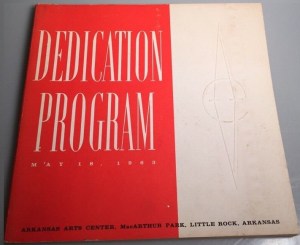
It was estimated the project would cost $600,000. A total of $646,000 (the equivalent of $5.5 million in 2019) had been raised by the Junior League of Little Rock, Fine Arts Club, and the Board of the Museum of Fine Arts.

At the time the project was getting underway, it was one of the first types of multidisciplinary arts facilities in the United States.

Ground was broken in August 1961 and the building would open officially in May 1963 (though parts of it were already in use by December 1962).

The firm of Ginocchio, Cromwell, Carter & Neyland did the architectural design.  Pickens-Bond Construction Company was the general contractor.

The May 1961 plans featured a slight expansion of existing gallery space (which was the 1937 Museum of Fine Arts building). It included the addition of a theatre, classrooms, administrative offices, a library, and more gallery space.  While the original entrance would be kept, the main focus of the building would be shifted from 9th Street into MacArthur Park with a new south entrance.

Over the years, the building underwent several additions.  These were tacked on to the existing edifice without truly linking it into one building.  On July 1, 2019, the facility will be closed to begin the work on the re-imaging and renovation. That process will unite the existing and new spaces into one seamless structure.

Sandwich in History at the Matthews-Storey House today (5/3) at noon

The Arkansas Historic Preservation Program each month sponsors a Sandwiching in History tour which familiarize people who live and work in central Arkansas with the historic structures and sites around us.

The tours take place on Fridays at noon, last less than an hour, and participants are encouraged to bring their lunches so that they can eat while listening to a brief lecture about the property and its history before proceeding on a short tour.

Today (May 3) at 12 noon, this month’s tour is at the Matthews-Storey House, located at 8115 Ascension Road.

This house was constructed c. 1925 and is an amazingly intact example of a Craftsman Style airplane bungalow in central Arkansas built by the Justin Matthews Company in the Westwood development of Little Rock. The airplane bungalow is a rare form of residence designed in the Craftsman Style and named due to the similarity of its form (small upper story and cross gables) to the cockpit and wings of 1920s aircraft.

The Matthews-Storey House was a rental property for several years, before being purchased by the Storey family in 1934. The house eventually was owned by a succession of families, including a Christian Science practitioner, an insurance salesman and a Baptist pastor. The house continues to be a single family residence and includes many original features and fixtures.

The Arkansas Historic Preservation Program is an agency of the Department of Arkansas Heritage.