Virginia San Fratello is tonight’s June Freeman Lecture Series presenter

Related imageArchitecture and Design Network (ADN) continues its 2019/2020 June Freeman lecture series with a lecture entitled “Borderwall as Architecure” with Virginia San Fratello, founding partner of Real San Fratello.

The program will begin at 6pm tonight (January 14) following a 5:30pm reception at the Windgate Center for Art+Design on the UA Little Rock campus.

San Fratello draws, builds, 3D prints, teaches, and writes about architecture and interior design as a cultural endeavor deeply influenced by craft traditions and contemporary technologies.  She is a founding partner in the Oakland based make-tank Emerging Objects. Wired magazine writes of their innovations, “while others busy themselves trying to prove that it’s possible to 3-D print a house, Rael and San Fratello are occupied with trying to design one people would actually want to live in”.

She also speculates about the social agency of design, particularly along the borderlands between the USA and Mexico, in her studio RAEL SAN FRATELLO. You can see her drawings, models, and objects in the permanent collections of the Museum of Modern Art, the Cooper Hewitt Smithsonian Design Museum, and the San Francisco Museum of Modern Art.

Virginia San Fratello will discuss the long-term project, Borderwall as Architecture, an important re-examination of what the 700 miles of physical barrier that divides the United States of America from the United Mexican States is, and could be. It is both a protest against the wall and a projection about its future. She will present a series of propositions suggesting that the nearly seven hundred miles of wall is an opportunity for cultural and social development along the border that encourages its conceptual and physical dismantling, the lecture will take the audience on a journey along a wall that cuts through a “third nation” — the Divided States of America.

On the way the transformative effects of the wall on people, animals, and the natural and built landscape are exposed and interrogated through the story of people who, on both sides of the border, transform the wall, challenging its existence in remarkably creative ways. Coupled with these real-life accounts are counterproposals for the wall, created by Virginia’s studio, that reimagine, hyperbolize, or question the wall and its construction, cost, performance, and meaning. Virginia proposes that despite the intended use of the wall, which is to keep people out and away, the wall is instead an attractor, engaging both sides in a common dialogue.

ADN lectures are free and open to the public. No reservations are required.  Thank you to our presenting sponsor Malmstrom White and our title sponsors Terracon and Evo Business Environments. Supporters of ADN include the Fay Jones School of Architecture and Design, the University of Arkansas Little Rock Windgate Center of Art + Design, the Central Section of the Arkansas Chapter of the American Institute of Architects, the Arkansas Art Center and friends in the community.  For additional information contact  ArchDesignNetwork@gmail.com.
80 years ago today – Basketball came to Robinson Auditorium

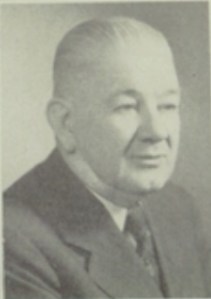
Coach Earl Quigley in the 1940s

While Joseph Taylor Robinson Memorial Auditorium is known today as a performance and meeting venue, in its early days it was also the home to sports. Eighty years ago tonight the first basketball game was played at Robinson.

With the renovation dropping the orchestra level down many feet, one of the basketball goals would have been approximately where the cast of Wicked is currently performing.

One of the first regular activities which took place in the lower level exhibition hall was a series of boxing and wrestling matches.  Building on the success of this, basketball came to the convention hall in January 1940.

A series of games featuring Little Rock High School and North Little Rock High School were announced by Tiger Coach Earl Quigley to take place from January 11 through February 16, the official opening day for the facility.

At that time, neither high school had a gymnasium; therefore both schools played their basketball games on their school auditorium stages with fans seated in the audience. The convention hall offered a regulation size floor (made of pecan block parquet) with seating for over 1,300 people along the sidelines and in the balcony.  The first men’s basketball game in Robinson Auditorium took place between the Little Rock High School Tigers and the North Little Rock High School Wildcats on January 11, 1940.

The Tigers lost the game before a crowd estimated to be 1,300.  Earlier in the evening there had been an exhibition between two women’s basketball teams.  The cost for admission to the games was 35 cents for the reserved seating and 25 cents for general admission.

Sandwich in History at Barton Coliseum today at 12 noon

Image may contain: sky and outdoorYou are invited to join the Arkansas Historic Preservation Program’s next “Sandwiching in History” tour, which will visit one of Little Rock’s most storied structures, T. H. Barton Coliseum beginning at noon on Friday, January 10, 2020.

Barton Coliseum is a 7000+ seat arena at the Arkansas State Fairgrounds which housed many concerts and sporting events over the years and continues to serve as a venue for the State Fair’s rodeo and various motor shows.

Learn more about this 1952 structure during our approximately one hour walking tour of Barton Coliseum. Tickets are NOT required for this event. This event is FREE and OPEN to the public.

Sandwiching in History tours are worth one hour of AIA continuing education credit. If you would like to receive email notifications of upcoming tours instead of postcards or need additional information, please contact Callie Williams, Education and Outreach Coordinator for AHPP, at 501-324-9880 or Callie.Williams@arkansas.gov.

January 3, 1936 – groundbreaking for Museum of Fine Arts

On January 3, 1936, the ground was broken for the Museum of Fine Arts building in City Park.  The facility would face Ninth Street and be to the west of the Arsenal Tower Building.   That building was the one remaining structure of more than 30 which had populated the grounds when it was a federal military establishment.

Excavation for the building uncovered the foundation for another structure.  New footings for the Museum would be poured into the old footings.

The cornerstone would be laid in October 1936, and the building would open in October 1937.  The building would serve as the museum’s home until the new construction for the new Arkansas Arts Center began in 1961. That construction would enclose the original Museum of Fine Arts.  By that time, the City had long renamed the park in honor of General Douglas MacArthur, who was born there when it had been a military installation.

Subsequent additions to the Arkansas Arts Center over the decades have further expanded the museum’s footprint.  After the 2000 expansion, the original 1937 facade was featured prominently in a gallery, giving it more visibility than since 1963. With the Arkansas Arts Center undergoing a reimagining, the original 1937 facade will be maintained and re-exposed as an entrance to the building.

But it all began on January 3, 1936.

19 LR Cultural Touchstones in 2019. Part 2: Changes at the Arkansas Arts Center, ASO and UA Little Rock

As the look back to 19 cultural occurrences in 2019 continues, this entry looks at personnel and location changes.

4. Groundbreaking for reimagined Arkansas Arts Center on first day of tenure for new executive director, Dr. Victoria Ramirez.  October 1, 2019, was a red-letter day for the Arkansas Arts Center.  Not only was it the first day for new executive director, Dr. Victoria Ramirez, but it was also the ground-breaking for the award-winning reimagining of the Arkansas Arts Center.

Dr. Ramirez was hired in August 2019 to take over the leadership of the Arkansas Arts Center. She came from the El Paso Museum of Art, where she has been Director. Previously she has worked at museums in Austin, Houston, Washington DC as well as Georgia and Virginia. Since October 1, she has hit the ground running with meetings and almost daily visits to the construction site.

In June and August 2019, the AAC paid farewell to its previous building in MacArthur Park in a series of events. In August, the staff and museum school moved to facilities in the Riverdale section of Little Rock which will be its home until the reimagined (and largely newly constructed) facility is reopened in 2022.  The AAC continues to offer programming, largely in conjunction with the Central Arkansas Library System and the Clinton Presidential Center.

One last AAC note of mention: in December 2019, Bradley Anderson stepped down after FORTY years as artistic director of the Arkansas Arts Center Children’s Theatre.  In his typical lowkey fashion, he eschewed a public tribute, but was feted by the staff.  Mayor Frank Scott, Jr., honored him with a proclamation, as well.

5.  Philip Mann steps down as Music Director of the Arkansas Symphony Orchestra; Geoffrey Robson is Interim Music Director.  After nearly a decade on the podium of the ASO, Philip Mann left the organization in May 2019.  He was honored by the Board and musicians at final concerts in Robinson Center and the I.N.C. series.  Associate Music Director Geoffrey Robson was named as the Interim Music Director.

While he is conducting many of the concert for the ASO this season, he is sharing the podium with a variety of guest conductors.  Some of the guest conductors may be candidates for the permanent post.  In deference to those who would prefer to keep their interest under wraps, the ASO is conducting (pun intended) this search more privately than in previous efforts.  All of the guest conductors (whether a candidate or not) are being given a chance to interact with audience members.  So far, audience response to the concerts and guest conductors has been overwhelmingly positive.

The ASO has not publicly announced a timeline for naming the next permanent music director.  In the meantime, Robson and Executive Director Christina Littlejohn, along with ASO Board members and staff, continue to present an aggressive concert and outreach schedule.  Another ASO personnel change of note, longtime ASO supporter Ellen M. Gray was named an Honorary Lifetime Member of the ASO Board this year. She joins a very select few who have been granted this designation.

Image result for ua little rock logo6.  A new Chancellor and new arts Dean at UA Little Rock.  While not specifically a cultural institution, the University of Arkansas at Little Rock is definitely a player in the City’s arts environment.  2019 saw Dr. Christy Drale, a longtime university administrator, assuming the helm as the Chancellor of UA Little Rock.  She has been a valued supporter of the university’s arts, cultural and heritage offerings throughout her tenure.

While she is faced with making deep cuts at the university due to declining enrollment and the accompanying decrease in funding, it is highly unlikely that she will make knee-jerk cuts to arts funding first, which has often been the case in the past not only at this university but at many others.

Likewise, Dr. Sarah Beth Estes was permanently named Dean of Arts, Letters, and Sciences at UA Little Rock in the summer of 2019. She had previously held the position in the interim and has been a faculty member and administrator at UA Little Rock since 2006.  Dean Estes has been a vocal advocate for cross-discipline collaborations within the university as well as the importance of UA Little Rock as a community asset.

Image result for ualr public radio7 – Comings and Goings at UA Little Rock Public Radio.  KUAR and KLRE, the public radio stations at UA Little Rock saw some personnel changes of their own this year.  After leading the station as Interim General Manager for several years, Nathan Vandiver was named General Manager in December. He started at the stations in 2009 as an intern while he was a student at UA Little Rock.  From 2013 to 2016, he was program manager for UA Little Rock Public Radio before assuming the title of Interim G.M. following the death of Ben Fry.

Longtime Arts Scene host Ann Nicholson retired from the station in the fall of 2019. A British national, she was raised in India, Scotland, and England. She moved to Canada in the 1950s and the US in the 1960s. She and her late husband moved to Little Rock in the 1970s, upon which she quickly ensconced herself in the arts community. In 1985, she started hosting Arts Scene on UA Little Rock Public Radio. Since then, she has interviewed hundreds of artists, musicians, authors, and performers about projects in Little Rock.

UA Little Rock reporter Daniel Breen is conducting the Arts Scene interviews now. A graduate of Little Rock Central High School and UA LIttle Rock, Breen is an avid fan of the music scene and the arts in general in Little Rock.

An early Christmas present in 1937, Robinson Auditorium groundbreaking on Christmas Eve

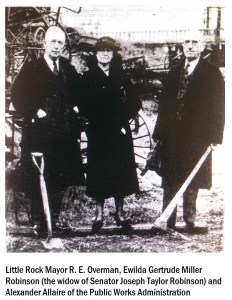
On December 24, 1937, at 11:30 a.m., Little Rock Mayor R. E. Overman, Ewilda Gertrude Miller Robinson (the widow of Senator Joseph Taylor Robinson) and  Alexander Allaire of the PWA turned dirt to participate in the brief groundbreaking ceremony for Little Rock’s municipal auditorium.

That morning, the Arkansas Gazette ran a brief story on the upcoming groundbreaking.  The story mentioned that the building would be named in memory of the late beloved Arkansas politician.  This appears to be the first public pronouncement of the Robinson name for this civic structure.

Among others in attendance at the groundbreaking were Mrs. Charles Miller (sister-in-law of Mrs. Robinson), Mr. and Mrs. Grady Miller (brother and sister-in-law of Mrs. Robinson), the mayor’s wife, the three architects (George Wittenberg, Lawson Delony and Eugene John Stern), and D. H. Daugherty and Will Terry of the City’s Board of Public Affairs.

Construction had to start by January 1, 1938, in order to receive PWA funds.  By breaking ground on December 24, there was over a week to spare.  The site had been selected in late October 1937, and the purchase had not been finalized.  But the PWA did give permission for the City to let a contract for excavation, demolition and filling on the site.

The groundbreaking took place at the corner of Garland and Spring Streets which was on the northeast corner of the block set aside for the auditorium.  Today, Spring Street does not extend north of Markham; the street was closed to make way for the parking structure and what is now the Doubletree Hotel.  That section of Garland Street is basically an alley that runs parallel to Markham north of City Hall, Robinson Auditorium and the Doubletree Hotel.