Second 2nd Friday Art Night of 2015

2nd Friday Art NightForget friggatriskaidekaphobia. Don’t think of today as Friday the 13th. Embrace it as the second 2nd Friday Art Night of the year.  Among the highlights for tonight are:

Butler Center
Three exhibits continue at the Butler Center.  Reflections on Line & Mass: Paintings & Sculpture by Robyn Horn in the Butler Center Galleries (through April 24), Of the Soil: Photography by Geoff Winningham in the Butler Center Loft Gallery (through Febraury 28) and Echoes of the Ancestors: Native American Objects from the University of Arkansas Museum (through March 15).

Historic Arkansas Museum
Two exhibit openings – John Harlan Norris: Public Face opens in the Trinity Gallery for Arkansas Artists  and Lisa Krannichfeld: She opens in the Second Floor Gallery.  Live music by Whale Fire and food by The Veg.  As part of the continuing Year of Arkansas Beer, this month features Stones Throw Brewing’s Chocolate Stout.

Old State House Museum
Join violinist Geoff Robson and cellist Felice Farrell for a performance of works for solo strings by J.S. Bach. The performance will begin at 5:00 and last until 6:30. The museum will remain open until 8:00. This is a casual event and guests are welcome to drop in and seat themselves after the music has started.

A Lincoln Viaduct Portrait

Photo courtesy of the Arkansas Historic Preservation Program

Photo courtesy of the Arkansas Historic Preservation Program

Since today is Abraham Lincoln’s birthday, it is a good day to pay tribute to the Lincoln Avenue Viaduct.  This arched bridge is traversed by thousands of cars each day, with most having no idea the name of the structure.  The Lincoln Avenue Viaduct is the arched bridge connecting LaHarpe with Cantrell Road which (literally) bridges downtown with the west along Highway 10.

The Lincoln Avenue Viaduct is a reinforced concrete rainbow arch bridge. It was opened at 2:05 p.m. on Friday, December 28, 1928, and, despite later alterations, it remains particularly well-preserved. The Missouri Pacific Railroad Company, considered the most important railroad company in the state, constructed the bridge amid a series of improvements in Little Rock made necessary by the damage wrought by the infamous spring floods of 1927.

Though the bride was constructed by the railroad, the City had to give authorization to do so, this was accomplished by the passing of Ordinance 4,335, at the May 28, 1928, City Council meeting.

Lincoln Avenue was one of several names for stretches of Highway 10 in Little Rock. By the 1960s, the areas west of the Lincoln Avenue viaduct were all renamed Cantrell in honor of the man who had developed much of the area west of the Heights. The longest stretch of the road already carried that name. There had been an effort to rename Highway 10 (including sections named Lincoln, Q, and Cantrell) in Little Rock for Senator Joseph Taylor Robinson in 1930. He declined the offer because he did not want to diminish the contributions of Mr. Cantrell.  Over time the entire stretch bore the name Cantrell.

The stretches east of the viaduct which involved a couple of names were renamed La Harpe Boulevard in honor of the French explorer who first saw the Little Rock.

Though the street has been renamed, the bridge still carries the name of the 16th President of the United States.

New Dean of UofA Fay Jones School of Architecture to speak tonight

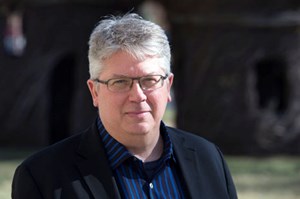
PeterMacKeithAs part of the monthly Architecture & Design Network architecture lecture, Peter MacKeith will discuss Aalto’s Identities tonight.

Dean MacKeith, an internationally recognized design educator, assumed the deanship of the Fay Jones School of Architecture on July 1, 2014. Before joining the Fayetteville school, McKeith was a professor and associate dean at Washington University’s Sam Fox School of Design and Visual Arts, Saint Louis. Prior to his tenure there, he directed the Master of Architecture program at Helsinki University of Technology, now Aalto University.

He will offer an informed perspective on the life and work of Finland’s foremost Twentieth Century architect/designer, Alvar Aalto (1898-1976), an international icon in his own right. Iterations of the furniture, textiles and glassware he designed continue to have a significant presence in American homes and numerous public spaces.

The program will take place tonight at 6pm in the lecture hall of the Arkansas Arts Center. A reception will precede at 5:30.

MacKeith began his tenure at Washington University in 1999 as a faculty member and assistant dean of the School of Architecture. In 2001, he became the associate dean of architecture, and was later named the associate dean of the Sam Fox School in 2006. He also serves as adjunct associate curator of architecture and design at the Mildred Lane Kemper Art Museum.

Before joining the Sam Fox School faculty and administration, MacKeith was the director of the Master of Architecture – International Program at the Helsinki University of Technology (now Aalto University) in Finland. He previously held faculty appointments in architecture at the University of Virginia, the University of Ljubljana in Slovenia, and Yale University.

MacKeith received a bachelor’s degree in English and international relations from the University of Virginia and a master of architecture from Yale University. His architectural teaching has been recognized nationally with two Creative Achievement Awards in architectural education from the Association of Collegiate Schools of Architecture (2007-2008, 2013-2014).

MacKeith has worked in architecture and design practices in both the United States and Finland, notably with the renowned Finnish architect Juhani Pallasmaa. He has written, lectured and published extensively in the United States, Finland, and other Nordic countries on modern and contemporary Finnish and Nordic architecture. His particular emphasis is on the work of Alvar Aalto. In 2012, MacKeith was the curator and designer of “Light Houses: On the Nordic Common Ground,” the exhibition of contemporary Nordic architecture at the Nordic Pavilion at the 13th Venice Architecture Biennale.

MacKeith is the author and editor of Archipelago, Essays on Architecture(2006), the editor of Encounters: Architectural Essays, volumes 1 and 2 – two selections of essays by Pallasmaa (2005, 2012) – and the author of The Dissolving Corporation: Contemporary Architecture and Corporate Identity in Finland (2005) and The Finland Pavilions: Finland at the Universal Expositions 1900-1992 (1993). He is the outgoing editor of The SOM Journal, a professional review of history and criticism, having overseen numbers 8 (“On Teamwork and Collaboration”) and 9 (“On Leadership and Authorship”). He is the recipient of a Fulbright Fellowship to Finland (1990) and research grants from The Graham Foundation for Advanced Studies in the Visual Arts and the Brookings Institution, among others.

In February 2014, MacKeith was recognized by the President of Finland for his contributions to the culture and architecture of Finland with the insignia of Knight, First Class, of the Order of the Lion of Finland.


For additional information contact ardenetwork@ icloud.com. Check out ADN on Facebook. Supporters of the Architecture and Design Network (ADN) include the Arkansas Arts Center, the Fay Jones School of Architecture, the Central Arkansas Section of the Arkansas Chapter of the American Institute of Architects and friends in the community.

Shadows for Groundhog Day

Today is Groundhog Day.  In honor of prognostication based on shadows, some photos showcasing shadows.

0202Peace

Lorri Acott’s “Peace” sculpture at 2nd and Main


0202Barre

Windows and barres casting shadows in a Ballet Arkansas studio

The footbridge between Riverfront Park and the Old State House Museum.

The footbridge between Riverfront Park and the Old State House Museum.

A bird looking at its shadow in the River Market parking deck.

A bird looking at its shadow in the River Market parking deck.

The Broadway Bridge balustrade.

The Broadway Bridge balustrade.


Little Rock Look Back: Voters Approve Municipal Auditorium

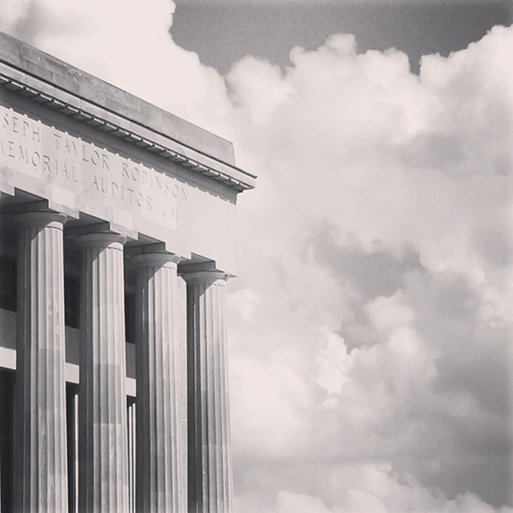
muni aud elect ad editedOn January 26, 1937, Little Rock voters went to the polls to vote on three different municipal bond issues.  One of them was the construction of a municipal auditorium (what would become Joseph Taylor Robinson Memorial Auditorium, now Robinson Center Music Hall).

The bonds for the auditorium would be $468,000 in general obligation bonds which would be paid off between 1940 and 1971. This was toward a total cost of $760,000 for the entire project.

The official campaign for the auditorium was sponsored by the Little Rock Forward Committee which was led by W. H. Williams. In campaign advertisements it showed the value of conventions in New York City which was estimated at $100 per convention attendee. Little Rock organizers were estimating a $10 a day expenditure by visitors, which the committee stressed was very conservative. The campaign committee emphasized the importance of acting at that time due to the federal government money involved.

Various committees and organizations endorsed the auditorium project including the Little Rock Chamber of Commerce, Little Rock Federation of Women’s Clubs, and the Young Business Men’s Association.

The thrust of the campaign focused on the economic benefit to Little Rock as well as the fact that the auditorium would be for all citizens. This message was picked up in editorials by both the Democrat and Gazette. In editorials on January 23 and 25, the Democrat opined that the benefits of the auditorium would be distributed among all classes of the citizenry. The next day, both papers ran editorials which touted the economic boon an auditorium would bring through conventions and meetings.

The Democrat’s approach broke down the current value of conventions to Little Rock with, what it termed, the city’s “existing inadequate” facilities. The paper emphasized a conservative estimate of what the added value to Little Rock’s economy would be with the new auditorium.

In expressing support for the auditorium the Gazette stressed the values for local, statewide and national groups. “An auditorium would provide a more convenient and better adapted community center for all kinds of local gathering,” and continued that it would make Little Rock “the logical meeting place for state conventions of every sort.” In discussing the value of state, regional and national meetings the paper stressed that the outside money spent by convention attendees has an impact beyond stores, hotels and restaurants.

Both papers also echoed the importance of the federal government financing to make this possible. The Democrat noted that the Public Works Administration grant and federal low cost loan made this an ideal time.

On January 26, 1937, Little Rock voters approved the auditorium bond by a vote of 1,518 to 519. It passed in each of the city’s 23 precincts. Little Rock Mayor R. E. Overman expressed his pleasure at the outcome of the vote and extended his thanks to the voters.

After the election, a Gazette editorial commented on the low turnout for the special election by commenting that the weather had been nice and there were no other barriers to voting. The editorial writer opined that those not voting in the election must not have been opposed to the endeavor.

Little Rock Look Back: City Takes Possession of Robinson Auditorium

10.+citylittlerock-2On January 25, 1940, the City of Little Rock officially took complete possession of the Joseph Taylor Robinson Memorial Auditorium. By assuming custody of the structure from the contractor and the PWA, the City accepted responsibility for any of the remaining work to be completed.  This event happened one day shy of the third anniversary of the election which approved plans to issue bonds for an auditorium.

E. E. Beaumont, the Auditorium Commission chairman, stated that an opening date could not be set until more work was completed. A major unfinished task was the laying of the front sidewalk which had been delayed due to cold weather.

The night before Little Rock took possession, Robinson Auditorium had been a topic of discussion at the Little Rock Chamber of Commerce annual meeting. The new Chamber president Reeves E. Ritchie (who as an Arkansas Power & Light executive had been engaged in the lengthy discussions about the installation of the steam line and transformers of the building) pledged that the Chamber would work to bring more and larger conventions to Little Rock at the Joseph Taylor Robinson Memorial Auditorium.

Today, the building is once again a construction site as it is being renovated and repurposed to become a performing arts and event space for the 21st Century.

Historic Preservationists Honored by HPAA

hpaa awardsLast Friday, the Historic Preservation Alliance of Arkansas presented the 2014 Arkansas Preservation Awards.

Ruth Hawkins, Ph.D. of Jonesboro received the Parker Westbrook Award for Lifetime Achievement.  Named in honor of the Alliance’s Founding President, the Parker Westbrook Award recognizes significant individual achievement in historic preservation. It is the Alliance’s only award for achievement in preservation over a period of years. The award may be presented to an individual, organization, business or public agency whose activity may be of local, statewide or regional importance.

As director of the Arkansas Heritage Sites program at ASU, Dr. Hawkins has the  responsibility for development of the Hemingway-Pfeiffer Museum and Educational Center at Piggott, the Southern Tenant Farmers Museum at Tyronza, the Lakeport Plantation near Lake Village and the Historic Dyess Colony: Boyhood Home of Johnny Cash.   She also is executive director of Arkansas Delta Byways, Inc., a tourism promotion association serving 15 counties in Eastern Arkansas. The association manages and promotes two National Scenic Byways in the region:  the Crowley’s Ridge Parkway and the Arkansas segment of The Great River Road.

Other awards were:

Excellence in Preservation through Rehabilitation 

  • William F. Laman Public Library, North Little Rock
  • Dempsey Bakery, Little Rock


Excellence in Preservation through Restoration

  • Beth El Heritage Hall, Helena

Ned Shank Award for Outstanding Preservation Publication

  • Architects of Little Rock: 1833-1950 by Gordon Wittenberg and Charles Witsell. Published by University of Arkansas Press


Outstanding Achievement in Preservation Advocacy

  • Scott Darwin, Jonesboro. For the V.C. Kays House.


Outstanding Achievement in Preservation Education

  • Hot Springs Historic Baseball Trail


Outstanding Service in Neighborhood Preservation

  • Jennifer Carman and Donna Thomas, Little Rock. Rehabilitation projects in the Central High School Neighborhood Historic District.


Outstanding Work by a Craftsperson

  • Clancy McMahon. A. R. Carrol Drugstore, Canehill


Outstanding Preservation Reporting in the Media

  • Rex Nelson, Little Rock. Coverage of the historic Majestic Hotel and downtown Hot Springs


The Historic Preservation Alliance of Arkansas works to build stronger communities by reconnecting Arkansans to our heritage and empowering Arkansans to save and rehabilitate historic places.
As Arkansas’s only statewide nonprofit organization focused on preserving Arkansas’ architectural and cultural resources, the Alliance has been educating,
advocating and assisting preservation efforts across Arkansas since 1981. From educating lawmakers to assisting individual property owners, the Alliance
is committed to protecting the many valuable heritage resources that make our state unique. The Alliance’s numerous educational programs include the
quarterly Arkansas Preservation Digest, the annual Arkansas Preservation Conference and the Ramble tours of historic sites. The Alliance has effectively
advocated for public sources of preservation funding and incentives, such as the Real Estate Transfer Tax and the Arkansas Historic Rehabilitation Tax Credit.

The Alliance assists local governments and historic downtown communities through administration of the federal Preserve America program in Arkansas
and participation in the Arkansas Historic Preservation Program’s Main Street Arkansas program—programs which promote historic preservation and heritage
tourism as economic development tools. We hope that you will support the Alliance in these efforts by becoming a member and staying informed of our
many programs and events which enhance the sustainability and quality of life in Arkansas.