Artspace seeking input from Little Rock creatives and arts supporters

Image may contain: text

Earlier in 2019, the Windgate Foundation invited Artspace, a national nonprofit leader in the field of affordable creative space development, to explore the feasibility of creating an affordable live/work community in the Little Rock metro region, a region they are calling “The Rocks.”

A series of meetings with the community and local leaders occurred in July and August, setting the stage for this next big step: A Creative Space Needs Survey of creative people, especially those interested in affordable space. Input will help the local stakeholder group and Artspace determine if there is ample need for new space, what type of space to create, what “affordable” means in the community, where to build, and if this idea should be taken to the next step.

Your input is critical to advancing plans for a new, affordable, creative space facility in the Little Rock metro area. A facility where creative people (artists, “creatives”, arts educators/administrators, people who make things, and those who keep alive cultural practices) can have affordable space in which to live and work, create, practice, connect and share with the public.

Please take the survey at https://www.artspace.org/ArtspaceRocks to have your voice heard in this process.

 

Jennifer Bonner of Mall and Harvard University Graduate School of Design is first 2019-2020 Architecture & Design Network speaker

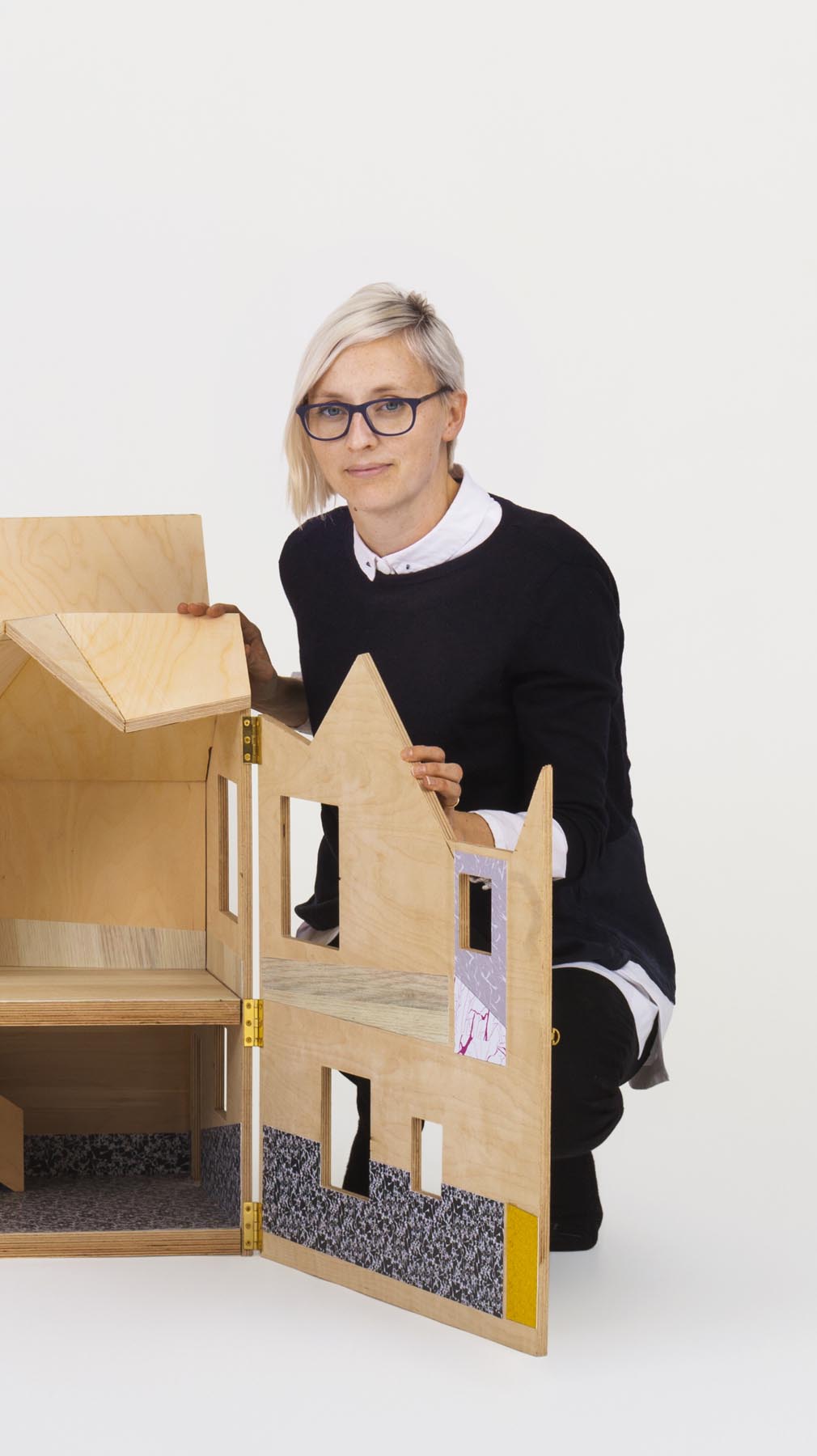
Image result for jennifer bonnerIn partnership with the Fay Jones School of Architecture and Design, the June Freeman Lecture Series is excited to welcome Jennifer Bonner, Director of MALL and Associate Professor of Architecture and Director of the Master in Architecture II Program at the Harvard University Graduate School of Design.

“Before and After Haus Gables” is the topic of the program.  It will take place at the Windgate Center of Art + Design on the UA Little Rock campus.

Born in Alabama, Jennifer Bonner founded MALL, a creative practice for art and architecture in 2009. MALL stands for Mass Architectural Loopty Loops or Maximum Arches with Limited Liability—an acronym with built-in flexibility. As a recipient of the Architectural League Prize for Young Architects + Designers, Emerging Voices Award (AIA/Young Architects Forum), and Progressive Architecture (P/A) Award, her creative work has been published in architectural trade journals including Architect, Metropolis, Architectural Review, Architectural Record, and Wallpaper, as well as a+t , DAMN, PLAT, Offramp, and MAS Context . She is founder and author of A Guide to the Dirty South: Atlanta, editor of Platform: Still Life, and a guest editor for ART PAPERS special issue on architecture and design of Los Angeles.

MALL’s recent work includes a single-family residence constructed out of cross-laminated timber, a mid-rise tower that resembles a sandwich, an urban development for a small lot located in Atlanta, Georgia and a temporary installation for Boston’s Rose Kennedy Greenway. The work can be described as pictorially graphic and out of place and playfully challenges the production of architecture through representation, materiality and color.

ADN lectures are free and open to the public. No reservations are required.   Supporters of ADN include the Fay Jones School of Architecture and Design, the University of Arkansas Little Rock Windgate Center of Art + Design, the Central Section of the Arkansas Chapter of the American Institute of Architects, the Arkansas Art Center and friends in the community.  For additional information contact  ArchDesignNetwork@gmail.com.

Birth of the man who built the Villa Marre

On September 11, 1842, future Little Rock Alderman Angelo Marre was born in Borzonaca, Italy.  He immigrated to Tennessee with his parents in 1854.
During the Civil War, he served in the Confederate Army. From 1865 to 1868, Angelo Marre worked for the Memphis Police Department but was forced to resign after he was accused of killing a man during an argument.  After his acquittal, he returned to the saloon business.  In 1872 Marre was convicted of stealing money and sentenced to three years in prison.

Tennessee Governor John Brown granted Marre a full pardon two years into his sentence, and he regained his citizenship in 1879.

After getting out of prison, he claimed an inheritance and joined his brothers in Little Rock.  He worked as a bartender at the Metropolitan Hotel.  He later opened a saloon and billiard parlor.

By the mid-1880s, Marre owned two saloons, a liquor import business, an office building in downtown LR, 3,000 sharesof stock in mining companies operating in Garland and Montgomery counties, and he was the first president of Edison Electric Company of LR.

In 1883, he was elected as an alderman on the Little Rock City Council.  He lost is bid for reelection in 1885. In 1888, he was an unsuccessful candidate for Pulaski County Sheriff.

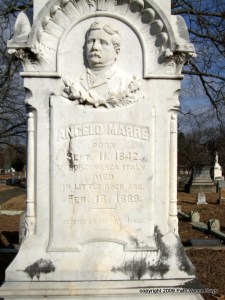
villamarreAngelo Marre died February 18, 1889, as a result of his infection.  He is buried at Calvary Cemetery in LR. His custom designed, marble monument was ordered from Florence, Italy, and cost $5,000.

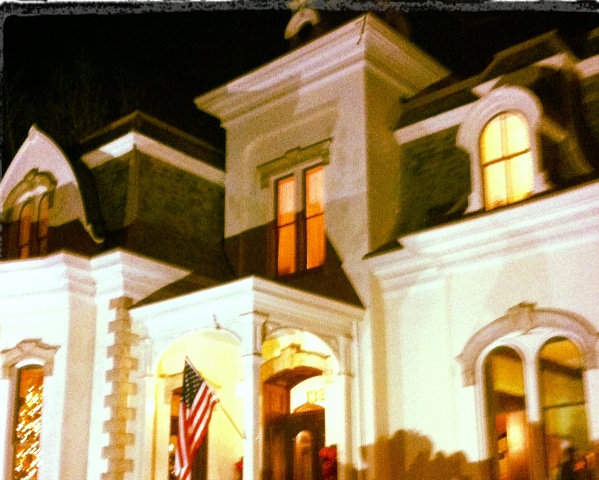
Marre is probably best known today as the builder of the structure now known as the Villa Marre.  Built in 1881, it is designed in the Italianate and Second Empire styles.  It was built in 1881 and 1882 on Block 21, Lots 5 & 6 of the Original City of Little Rock.  The cost was $5,000.

It was originally a red brick structure and has been modified and expanded several times as well as painted white.  It did not bear the name Villa Marre until the 1960s when historic preservation advocate Jimmy Strawn gave it that name.

After serving as the headquarters for the Quapaw Quarter Association for several years, it was returned to a private residence.  It is now available for special events and rentals.

The Villa Marre is probably best known locally and nationally for serving as the facade for the Sugarbaker design firm on the CBS sitcom “Designing Women.”  Though the interior of the house does not match the interior on TV, the building was featured in the opening credits as well as in exterior shots each week.

Final plans approved for “new” (and still current) Little Rock City Hall in 1906

City Hall circa 1908

After a judge ruled in August 1906 that the City of Little Rock could not build a new City Hall and Auditorium complex, it looked like Little Rock would be stuck with its existing inadequate building.

However on September 10 it became obvious that much work had been taking place behind the scenes after that ruling.  On that day, the Board of Public Affairs (a City body charged with overseeing municipal government construction projects and comprised of the mayor and two citizens approved by the City Council) voted to ask the aldermen to cancel plans and rescind legislation for the city hall, jail and auditorium complex.  The Board of Public Affairs then offered up a new plan for a city hall and jail building.  Because no auditorium was involved, these plans would not be in violation of the Chancery Court.

That same evening the City Council followed suit and revoked the plans for the original project.  The aldermen then voted to proceed with building a new city hall and jail without the auditorium.  There was only one dissenting vote; Alderman Jonathan Tuohey voted no.  He explained his negative vote was not a lack of support for the project, but he was not comfortable with the way it was rushed through.

Mayor Warren E. Lenon told the Gazette, “The Chancery Court has enjoined us from erecting an auditorium and the Board of Public Affairs has consequently rescinded all resolutions and orders pertaining to that structure.” He noted that there would “be no appeal from the injunction granted by Chancellor Hart, because there is nothing to appeal.”

The coverage of the actions of the City Council that night was in keeping with the manner in which the two daily newspapers had covered the lawsuit and the trial.  The Gazette headline cried “City Hall Ordinance Railroaded Through” while the staid Democrat merely stated “New $175,000 City Hall Provided by City Council.”  The tone of theGazette’s article matched the headline while the Democrat’s story was more straightforward.

Architect Charles Thompson adjusted his plan for the new City Hall by removing the auditorium wing.  With the revised Th0mpson plan and the approval of the City Council, Little Rock was at last on its way to a new City Hall.  This was over two years after Mayor Lenon had first broached the subject.

Originally slated to open in 1907, the building officially opened in April 1908.

The Arkansas Arts Center was formally established on Sept 6, 1960

Architectural model of the original Arkansas Arts Center which would open in 1963.

On Tuesday, September 6, 1960, the City of Little Rock Board of Directors adopted ordinance 11,111 which formally established the Arkansas Arts Center.

In July 1957, the City Council of Little Rock granted the Museum of Fine Arts the authority to solicit and receive funds for expanding that museum’s physical plant.  During that process, it had been decided that the museum needed an expanded mission and a new name.  By the summer of 1960, the museum supporters had raised sufficient funds to proceed with constructing the new facility.  Therefor the new ordinance was prepared and submitted to the City Board.  (In November 1957, the City Council had been replaced by a City Board.)

Ordinance 11,111 set forth that the Museum of Fine Arts would be known as the Arkansas Arts Center and that the previous museum’s board would serve as the board for the new museum.  The Board of the Arkansas Arts Center was given the authority to have the new building constructed in MacArthur Park and the existing building modified.  As a part of the planning for the new museum, the City committed $75,000 for the capital campaign.

The groundbreaking for the new museum would take place in August 1961.  Mayor Werner Knoop, who signed Ordinance 11,111, took part in the groundbreaking.

Media attending the September 6, 1960, City Board meeting were more interested in discussion about a potential leash law for dogs within the City limits.