Little Rock Look Back: Mayoral Race of 1924

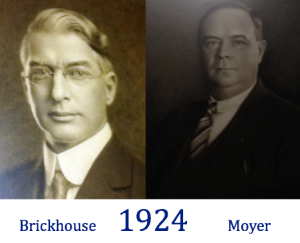
After serving three two-year terms as mayor, Ben D. Brickhouse decided to follow the precedent of his predecessor Charles Taylor and seek a fourth term in the Democratic Primary of 1924.  In the election for his third term, Brickhouse was unopposed. So it would have appeared that he was well-positioned for this fourth bid.

However…

Early in his third term, Brickhouse had broken ranks with the Ku Klux Klan. At the time, the Klan controlled much of Democratic Party politics in Little Rock (and indeed all of Arkansas).  Mayor Brickhouse did not appreciate local Klan leadership trying to dictate City appointments to him.  Beaten but unbowed, the Klan sought someone to run for mayor.  The candidate who was found was Pulaski County Judge Charles Moyer.

In October 1924, Moyer and Brickhouse both announced what everyone in Little Rock already knew, they would be seeking the Democratic nomination for Little Rock mayor.  Traditionally, the primary was in December before the April general election (in which the Democratic nominee was usually unopposed).  The Pulaski County Democratic Committee set the date for the election.

There was a bit of a surprise at the early November meeting of the Democratic Committee when it was announced the election would be in January. Neither Moyer nor Brickhouse nor their surrogates offered much comments on the change.  But Arthur Jones, who announced at the meeting he too would be seeking the office of mayor, protested the change.  The date was set for the later option.

However, a week later, the Committee met again and moved the elections back to the originally anticipated times.  Several of the Committee members had been unaware of the proposed change. Upon further reflection (and likely conversations with candidates), they opted to reverse the earlier vote.

At the start of the race, Moyer talked about the need for better control of City finances, better parks, and improving the police and fire.  Jones attacked the City’s police force and courts in general. He called Brickhouse a “double crosser” who got the City into debt and cannot get it out of it.  About Moyer, Jones said he was reactionary, non-progressive, opposed women’s suffrage, and only improved roads for political purposes.

While Jones was in the race, and lobbed charges at both Brickhouse and Moyer, it really was a two-man faceoff. In fact, neither Moyer nor Brickhouse seemed to discuss Jones much at all.

The major issues in the campaign revolved around government debt and the Klan.  Moyer accused Brickhouse of getting the City into debt and not paying with cash.  Brickhouse countered that the County had more debt than Moyer claimed, and that any fiscal improvements at the County were due to others such as the County Treasurer.  Further, Brickhouse stated he had inherited $1,000,000 in debt. But he gladly took ownership of the $750,000 in debt he had caused because that was the only way to improve the hospital and the parks.  He also laid out plans for a zoo and a City swimming pool.

Moyer was openly backed by the Klan.  Leadership of the KKK attacked Brickhouse. They said he had an attitude of ingratitude for the support he had previously received.  Moyer did not distance himself from the Klan but remained personally silent about the organization or his affiliation with it.  At one of his final rallies, a Moyer Glee Club sang. It was composed of Gus Blass department store employees and contained Jews, Catholics, and Klan members.

The Saturday before the Monday election, both Moyer and Brickhouse had parades on Main Street.  In fact, there were so many people either in the parades or watching them, a retailer estimated he had lost $10,000 in Christmas sales that night.

In the end, the election was not close.  Moyer won all of the City’s wards. His vote total was 5,534, while Brickhouse had 2,944. Jones received 100 votes.  Moyer was unopposed in the April 1925 election.

Many of the Little Rock aldermen were disappointed by the outcome.  Before taking office in April, Moyer met in private with the aldermen to try to assuage their concerns.
Little Rock Look Back: Mayor Woodrow W. Mann

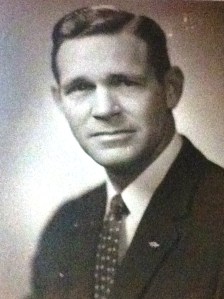
IMG_3231Future Little Rock Mayor Woodrow Wilson Mann was born on November 13, 1916, in Little Rock.  His tenure at Little Rock mayor was tumultuous from both things of his doing as well as events that catapulted him onto the international scene.

In 1955, he ran as the Democratic nominee for Mayor of Little Rock and defeated two term incumbent Pratt C. Remmel, a Republican.  He took office in January 1956 and immediately set about to make a lot of changes.  In addition to revitalizing the City’s bus system, and removing some color barriers at City Hall, he oversaw the dismantling of the copper dome on top of Little Rock City Hall (as opposed to the repair of the dome championed by Mayor Remmel).

Mayor Mann was caught up in a grand jury investigation into purchasing practices at City Hall as well as within the City government in North Little Rock.  Partially in response to this, Little Rock voters approved a new form of government in late 1956.  Mayor Mann opposed the switch to the City Manager form and refused to set the election for the new officials but was ultimately compelled to do so.

He was also Mayor during the 1957 integration of Little Rock Central High School.  He sought to keep the peace and to broker a deal between President Dwight Eisenhower and Governor Orval Faubus.  His powers within the city were, no doubt, hampered because of his lame duck status as Mayor.  In November 1957 following the election of the new City Board of Directors, he chaired his last City Council meeting and left office.

In January of 1958, a series of articles written by Mayor Mann detailed his perspective on the events at Central High. These were carried by newspapers throughout the US.

Because of ill will toward him due to the Central High crisis (he was criticized by both sides) and grand jury investigation, Mayor Mann felt it would be difficult to maintain his insurance business in Little Rock. He moved to Texas in 1959 and remained there the rest of his life.  He died in Houston on August 6, 2002.

An entry about Mayor Mann in the Encyclopedia of Arkansas History and Culture can be found here.

Little Rock Look Back: Little Rock Celebrates End of The Great War

Portion of a Pfeifer Brothers ad in November 11 1918 ARKANSAS DEMOCRAT

Portion of a Pfeifer Brothers ad in November 11 1918 ARKANSAS DEMOCRAT

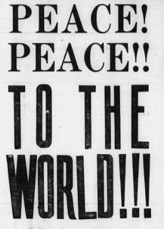
When the residents of Little Rock awoke on Monday, November 11, 1918, they discovered that the Armistice had been signed.  A celebration of Peace broke out and continued on throughout the day.

The Arkansas Democrat (an afternoon paper) got the ball rolling when it issued a special edition at 2:27am that the treaty would be signed. In addition to being distributed around the City, copies were rushed to Arkansas Governor Charles Brough and Little Rock Mayor Charles Taylor.  Mayor Taylor declared he would issue a proclamation setting aside Saturday, November 16, as a day of celebration in the city.

Unwilling to wait that long, throngs of people filled the streets greeting each other with handshakes and hugs. From the wee hours of the morning through late at night, friends and strangers alike were treated as familiars as the celebratory love swept through the city.

Firecrackers, car horns, whistles, and church bells competed with each other and with the shouts of the citizenry in contributing to the din of celebration.  An impromptu parade formed at Third and Main around 9:00am and eventually stretched the length of Main Street’s business district.  Student forgot their studies and participated in the parade instead of going to the high school at Scott and 14th Street.  (While many businesses closed that day, the schools did not.  But one suspects that attendance was light.)

At 10am, there was five minutes of silence. Most men stopped and removed their hats while many women were seen offering silent prayers.  Then the Governor and Mayor addressed the crowds gathered at Capitol and Main Streets.

Two hundred recent arrivals from Puerto Rico who were in to Little Rock to work at a factory grabbed an American flag and joined in the parade once they were informed of the news. They joined a throng that cared not about race or ethnicity, class or status, faith background, gender, or occupation.

Three thousand employees of the Missouri Pacific Railroad marched in a parade led by a coffin with an effigy of Kaiser Wilhelm in it. Next came the railroad’s marching band, followed by row after row of railroad employees.  Interspersed were rail company trucks equipped with railroad bells which had been rung previously as part of war bond rallies. Now they were rung in tribute to peace and victory.

Around noon, the crowds moved back to sidewalks and side streets, turning Main Street and Capitol Street over to an automobile parade. Cars, trucks, and other vehicles were festooned with red, white, and blue bunting and packed with people.  Overhead throughout the day, airplanes performed acrobatic feats to the delight of crowds below.

Government offices closed early as did factories and most businesses.  About the only people working that day seemed to be the Little Rock police.  They reported no major incidents, although one officer did have to rescue his hat from being nearly trampled by a group of dancing women.  The only quibble seems to have come from various groups claiming to have been the first to start the celebration.

Community Input sought by CALS

The Central Arkansas Library System is undergoing a strategic planning process, and they would like your input and comments.

As part of the process, CALS is conducting an online community survey.  They encourage all residents – whether or not you use the Library regularly – to complete the survey.

The community survey is available online (English | Español) through December 15th.  Paper, hard copies of the survey will also be available at Library facilities.  The short survey only takes about 10 minutes to complete.  It includes an open-ended comment section, and all suggestions for the future directions of the Library are encouraged.

The survey is being conducted by the independent, Library Strategies Consulting Group, and all individual responses will be confidential. Only aggregate responses will be reported to the Library Board and administration.

The community survey, along with other Library data and trends, and input from the staff, Board and other key stakeholders, will form the basis for the strategic plan.  The plan is expected to be completed and approved in the first quarter of next year.

Little Rock Look Back: LR voters create Airport Commission

On November 7, 1950, Little Rock voters approved the creation of the Little Rock Airport Commission.  This was an extremely rare initiated ordinance.

Local business leaders had tried two times prior to get the City Council to create an Airport Commission.  At the time, the Airport was managed by the Council’s Airport Committee, composed of aldermen.  Both times, the Council rejected the measure.  This prompted an organization called the Private Flyers Association to begin the drive to collect the signatures to place the ordinance on the ballot.  Mayor Sam Wassell was in favor of the creation of the separate commission to oversee the airport and was a member of the Private Flyers Association.

At the general election on November 7, 1950, the ordinance was on the ballot.  It passed with an overwhelming majority: 13,025 voters approved of it, and only 3,206 opposed it.  The Arkansas Gazette had been a proponent of the switch, endorsing it with a front page editorial entitled “An Airport for the Air Age.”

In many ways this movement was a precursor to Little Rock’s switch to the City Manager form of government later in the decade.  Where once the business leadership and city council had been one and the same, over the 1940s the two diverged.  Business leaders were less interested in party politics (and at the time the city races were partisan affairs) and more interested in professionally run government.  The main argument for a separate commission was that it would allow the airport to be run more efficiently and removed from party politics.  These would be the same arguments used by the Good Government Committee in 1956.

Also on the ballot in 1950 was a GOP challenger to a Democrat for one of the aldermen positions.  George D. Kelley, Jr., ran against incumbent Lee H. Evans.  Kelley was the first GOP contestant for a city race since Pratt Remmel ran unsuccessfully for City Council in 1938.  Remmel would be back on the ballot in 1951, this time for the position of mayor in a successful effort.

187 years since Little Rock was chartered

With the stroke of Territorial Governor John Pope’s pen, Little Rock was officially chartered as a town on November 7, 1831. This followed approval by the Arkansas legislature a few days earlier.

As a chartered, officially recognized municipality, the Town of Little Rock was authorized to create a government and to plan for a Mayor and Aldermen to be elected. That election would take place in January 1832 with the initial council meeting later that month.

There are several earlier and later days which could be used to mark Little Rock’s official birth (La Harpe sighting in 1722, first settler in 1812, permanent settlement in 1820, selection of trustees in 1825, chartered as a City in 1835, chartered as a City of First Class in 1875) — but it is November 7, 1831, which has been the officially recognized and accepted date.

In 1931, Little Rock celebrated her centennial with a series of events.  Likewise, in November 1981, Little Rock Mayor Charles Bussey signed and City Clerk Jane Czech attested Resolution 6,687 which recognized the Little Rock sesquicentennial.

Little Rock Look Back: Little Rock announced as Clinton Library site

Refuse on the site where the Clinton Center would be built

On November 7, 1997, President Bill Clinton announced his intentions to locate his presidential library in Little Rock at the end of a warehouse district.

The Little Rock City Board met in a special meeting that day to rename part of Markham Street, which would lead to the site, as President Clinton Avenue.

While the announcement was met with excitement in many quarters, there were still some skeptics who had a hard time envisioning a presidential library and park in the middle of a wasteland worthy of a T. S. Eliot poem.

There would be many hurdles between the November 1997 announcement to the December 2001 groundbreaking. But for the moment, City of Little Rock leaders, celebrated the achievement.  Then Mayor Jim Dailey had appointed City Director Dean Kumpuris and City employee Bruce T. Moore to lead the City’s efforts.  Moore and Kumpuris worked with Skip Rutherford and others to narrow the potential sites.

In September 1997, the Clintons were in town for the 40th anniversary of the integration of Central High School.  They surprised Kumpuris and Moore with a decision for a Sunday afternoon visit to the warehouse district proposed site. Secret Service would not let the limousine drive in part of the property, so the Clintons, Moore, Kumpuris, and Rutherford walked up a path to the roof of the abandoned Arkansas Book Depository.  It was there that the Clintons could see the Little Rock skyline which would be visible from the library.

Of course by the time the library had opened in November 2004, the Little Rock skyline was different. Spurred on by the library, several new highrises had been constructed in downtown.