
 It appears that the first meeting of the Arkansas Razorbacks and Ole Miss Rebels in Little Rock was in 1913. That would have been at Kavanaugh Field (now the site of Quigley Stadium on the campus of Little Rock Central High School).
On November 15, 1913, the two squads faced off in only the second gridiron match between the schools. The Razorbacks were on the losing end of a 21 to 10 score.
The next year, on November 14, 1914, the two teams again met in Little Rock. Because of the use of an ineligible player by Ole Miss, the Razorbacks count this as a victory by a score of 1 to 0 due to a forfeit. Ole Miss, to this day, disputes that fact and counts it as a 13 to 7 win over the Hogs. Due to the dispute, the teams would not meet again until 1924.
On October 25, 1924, the Hogs and Rebels resumed their football face off and returned to Little Rock. That day, the Razorbacks (under third year coach Francis Schmidt) dominated Ole Miss by a score of 20 to 0. This would be the final time the two teams would meet in Little Rock for over two decades. Most of their games would be in Memphis during the intervening years.
The series returned to Little Rock on October 25, 1952. This would be the first time the two teams would meet in War Memorial Stadium. It was in the final of Otis Douglas’ three unremarkable seasons as coach of the team. The score reflected the disappointments of his tenure as the Razorbacks managed only 7 points to Ole Miss’s 34.
When the Hogs returned to War Memorial two years later to face Ole Miss (October 23, 1954), both teams were nationally ranked. Arkansas was number 7 and Ole Miss was number 5. The result was a 6-0 upset of Ole Miss on a 66-yard touchdown pass from Bob Benson to Preston Carpenter known to Razorback fans as the “Powder River Play.” After the season, coach Bowden Wyatt left to coach at his alma mater, Tennessee.
In his three seasons as coach, Jack Mitchell led the Razorbacks against Ole Miss in Little Rock only once. But that single entry on October 27, 1956, was a Hog victory. Ole Miss was again held scoreless while the Hogs ended the game with fourteen points. Prior to the game, Ole Miss had been undefeated. (The Razorbacks also would hand the Rebels their first defeat of the season the following year in Jackson.)
On October 25, 1958, first year coach Frank Broyles would lead his Razorbacks into Little Rock to face 6th ranked Ole Miss. It was Broyles’s second appearance in Little Rock following a 12 to zero defeat by Baylor in his inaugural Hogs game. While the Razorbacks lost the game to Ole Miss by a score of 14 to 12, it was in this game that a Broyles-led team scored its first points in Little Rock.
October 22, 1960, saw Broyles and the Hogs return to Little Rock to face Ole Miss. This time both teams were nationally ranked. Arkansas was 14 and Ole Miss was 2. After a defensive slugfest, Ole Miss escaped with a 10 to 7 win over the Hogs. Though Arkansas lost, they actually rose in the national polls to number 12 the following week.
It would be over twenty years before the two teams would again play each other in Little Rock. On September 25, 1982, the 9th ranked Razorbacks met the unranked Rebels. This would be coach Lou Holtz’s penultimate season as head coach for the Hogs, though no one knew it at the time. (Except possibly athletic director Frank Broyles.) The team that season was captained by Gary Anderson, Jessie Clark, Richard Richardson, and Billy Ray Smith. Arkansas escaped with a 14 to 12 victory. Perhaps because of the closeness of the game, the team fell to number 10 for the following week.
Ken Hatfield’s first game as Hogs head coach was in Little Rock against Ole Miss. The date was September 15, 1984. The outcome of the game was a tie. Both sides scored fourteen points. His other two Little Rock entries that first season would be wins (Texas Tech 24-0, Rice 28-6).
Two years later (September 13, 1986), Hatfield’s Hogs again started the season in Little Rock against Ole Miss. This time Arkansas was ranked 18 while Mississippi was unranked. The Hogs team (captained by James Shibest, Derrick Thomas, and Theo Young) dominated Ole Miss and ended the game with a final score of 21 to 0.
September 17, 1988 was the next time the two teams met in Little Rock. That year Hatfield’s team was captained by Steve Atwater, John Bland, Odis Lloyd, and Kerry Owens. Both teams were unranked for this game. The Hogs again scored 21 points, but this time Ole Miss scored 13. While not as convincing a win as two years prior, it was still a victory for the Hogs.
In 1990, new head coach Jack Crowe led the Razorbacks to War Memorial to face Ole Miss. The Hogs were ranked 13 while Ole Miss was unranked. Arkansas lost by a score of 21 to 17. The team would fall ten spots in the polls and be out of the polls for the remainder of the season shortly thereafter.
Interim head coach Joe Kines did not have much better luck against Ole Miss in Little Rock. On October 17, 1992, the two teams met for the first time at War Memorial Stadium as conference foes. This was the first season after the Hogs had made the jump to the SEC. Ole Miss left win a 17 to 3 win.
With the conference switch, the scheduling of Hogs vs. Rebels games entered a new phase. For the next twenty years the teams would alternate between Fayetteville and Oxford MS for games. Hogs coaches Danny Ford, Houston Nutt, and Bobby Petrino never coached a Razorback team against Ole Miss in Little Rock. (Though all coached plenty of games against Ole Miss and in Little Rock.)
When the 2012 season was announced, it looked like Bobby Petrino would coach the Hogs against Ole Miss in Little Rock. However due to an off-season incident, by the time the October 27, 2012, game came around, the Razorbacks were coached by John L. Smith. In what would be his only season leading the team, Arkansas lost the Little Rock game to Ole Miss by a score of 30 to 27. That is the most recent meeting of the teams in Little Rock until 2018.
Over all the Razorbacks lead the series against the Rebels by a tally of 36 to 27 to 1. In Little Rock, the record is 7 wins, 7 losses, and 1 tie.
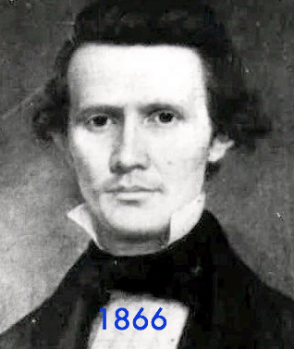 Following the cessation of Little Rock municipal government in September 1863, there was no mayor of Little Rock for the remainder of the Civil War.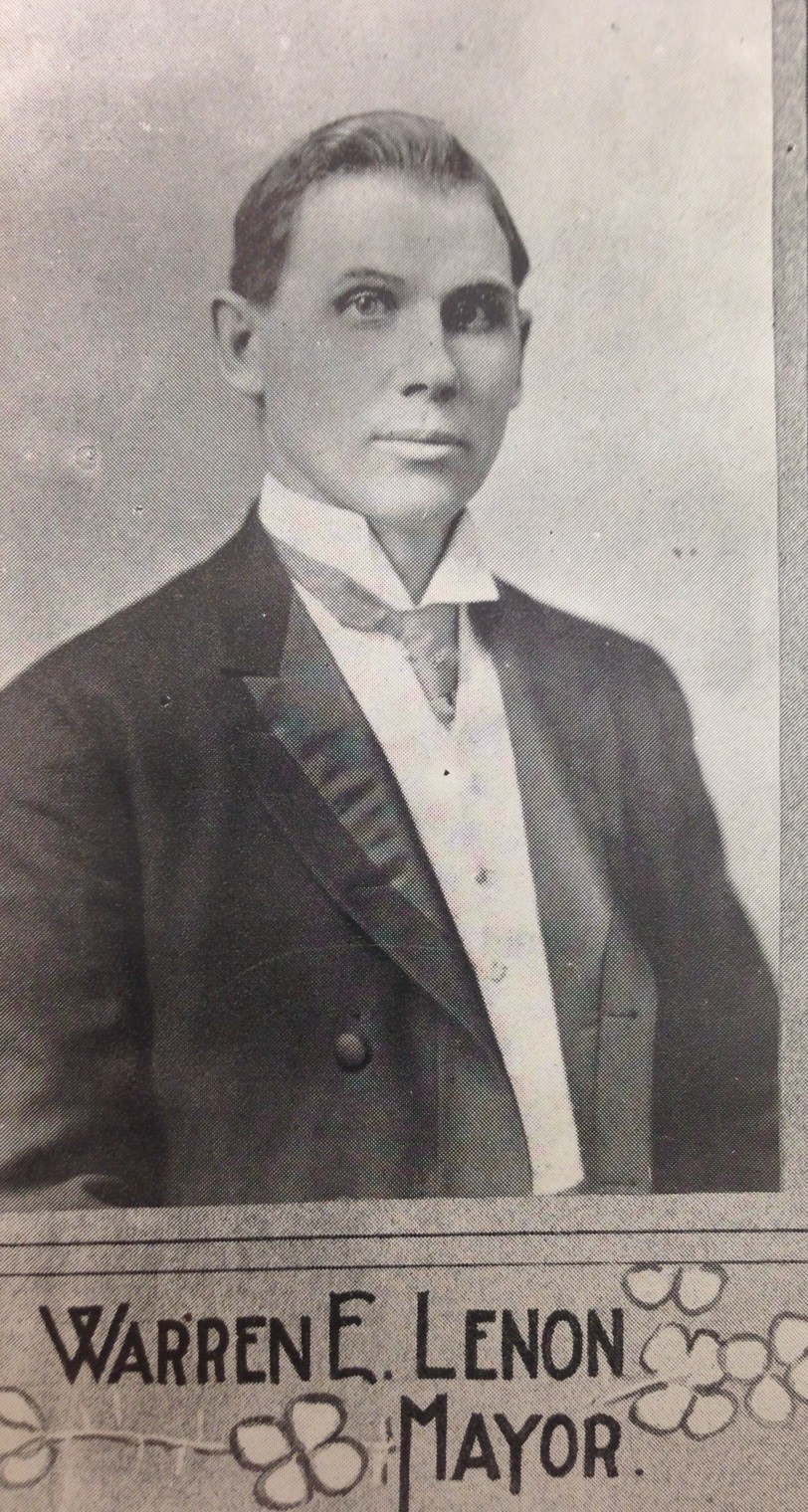
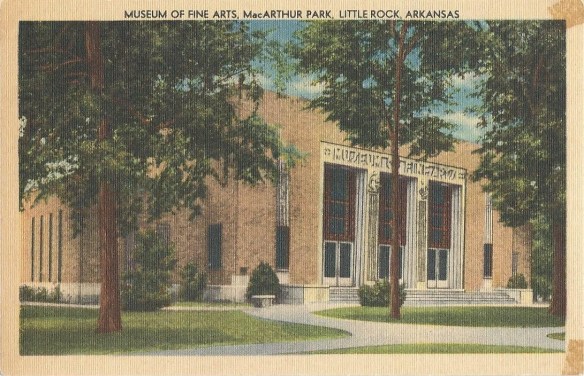 On Tuesday, October 5, 1937, the Fine Arts Club of Little Rock held its first meeting in the new Museum of Fine Arts. But it was not a typical meeting. It was an Open House and Dedication for the new building.
 After a decade of over 100 sculptures being installed throughout the city, it is hard to believe that the first Sculpture at the River Market Show and Sale was only eleven years ago. It took place October 5 through 7, with a preview party on October 4.
 In October 1939, it looked as if Robinson Auditorium would never open. The construction had run out of money. But in an effort to generate a little revenue and give the public the chance to see the building, a few events were booked in the lower level.
 The first four people to enter the building as paying guests were Mr. and Mrs. Alfred Wilheim, Frances Frazier and Bill Christian. Reports estimated 3,200 people attended and danced to the music of Jan Garber and His Orchestra.
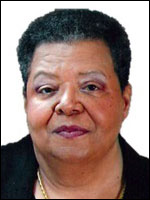 After 60 years, the most dramatic images of the 1957 crisis at Little Rock Central High School remain those of 15-year-old Elizabeth Eckford, being taunted as she walked through a hate-filled mob, on her way to school. Today, Ms. Eckford recalls how difficult it was for her parents, Oscar and Birdie, to allow her to continue the struggle to integrate the Little Rock schools.
