Star Wars Science tonight at Museum of Discovery, or “Light Sabres and Beer, What Could Possibly Go Wrong?”

MOD Dark Star WarsEach month the Museum of Discovery hosts “Science after Dark” for adults aged 21 and up.  This month’s theme is “Star Wars Science.”

Here are some of the things you can expect:
-Making finger light sabres

-Fusing plastic to make Darth Vader capes

-Geeking out with Star Wars science facts, fun, and..well, it’s Star Wars!!!!!!

Don’t forget to bring cash for refreshments from Stone’s Throw Brewing and Damgoode Pies.

The program runs from 6pm to 9pm. Cost is $5, FREE for museum members. (Go ahead and get a membership, it will more than pay for itself within a year!)

Art+History Throwback Thursday: City Park in 1907

On February 9, Little Rock voters will have the chance to say Yes to improving the MacArthur Museum of Arkansas Military History, Arkansas Arts Center, and MacArthur Park.

Leading up to that election is a good time to look back at the development of MacArthur Park.

The land now known as MacArthur Park had originally served as a horse racetrack in the early days of Little Rock.  By 1836, the federal government purchased the land for construction of a military arsenal.  The flagship building, the Arsenal Tower building, is the only remaining structure from that time period.  

The land served as a military outpost until 1892.  On April 23, 1892, a land swap took place where in the City of Little Rock was given the property with the stipulation that it would be “forever exclusively devoted to the uses and purposes of a public park.” (Never mind that the federal government took part of the land back for the construction of the Wilbur Mills Freeway.)  

In return for giving the City this land, the federal government took possession of land on the north side of the Arkansas River (then part of Little Rock) – that 1,000 acres became Fort Logan H. Roots. The park opened on July 4, 1893, with the name Arsenal Park. Since it was the City’s first and only park at the time, residents started referring to it as City Park. In time, the designation Arsenal Park fell from use.  In fact, it is referred to as City Park exclusively and officially in City documents throughout the first 42 years of the 20th Century. 

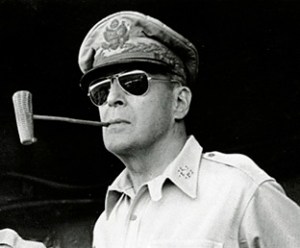
On March 9, 1942, Little Rock’s first public park was renamed by the Little Rock City Council.  By a vote of fourteen ayes, zero nays and four absent, the alderman approved Ordinance 6,388 which renamed the park in honor of General Douglas MacArthur. 

The text of the ordinance says that “it is fitting and proper that the bravery and glorious deeds of General Douglas MacArthur, a native son of Little Rock, should be commemorated.”  This was passed a few months after the United States’ entry into World War II.   Though he was already a well-established military figure, most of the MacArthur legend during the war would take place after this naming. 

In 1952, General MacArthur (contemplating a run for the GOP nomination for President) visited Little Rock in March.  Later that year, the eventual GOP nominee (and 34th US President) General Dwight Eisenhower visited the park.  The 1952 Democratic nominee Adlai Stevenson also visited MacArthur Park in 1952.

Today, MacArthur Park is the anchor of the burgeoning MacPark district as well as the MacArthur Park Historic Distric.


Next week’s Iowa Caucus focus of Clinton School program today

Today (January 27) at noon, Steffen Schmidt will discuss Historical Significance and Current Trends in the Iowa Caucus today at the Clinton School.

Steffen Schmidt is a University Professor of Political Science at Iowa State University and an internationally recognized expert on American elections.

He’s the author of 70 articles in scholarly journals and 11 books, including the best-selling college textbook “American Government and Politics Today (19th edition),” which has been read by over 3 million college students, and the recipient of numerous prestigious teaching prizes, including the Amoco Award for Lifetime Career Achievement in Teaching and Teacher of the Year award.

Known as “Dr. Politics,” Schmidt has been analyzing the Iowa caucuses and US national politics since 1972 and is currently teaching a free, short online course on the caucuses.

Little Rock Look Back: LR Voters Approve Municipal Auditorium

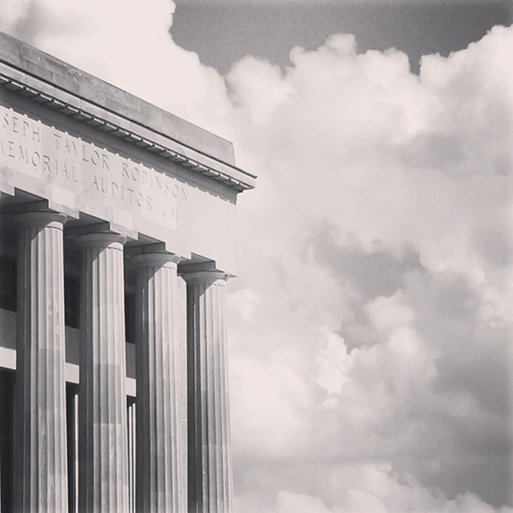
muni aud elect ad editedOn January 26, 1937, Little Rock voters went to the polls to vote on three different municipal bond issues.  One of them was the construction of a municipal auditorium (what would become Joseph Taylor Robinson Memorial Auditorium, now Robinson Center Music Hall).

The bonds for the auditorium would be $468,000 in general obligation bonds which would be paid off between 1940 and 1971. This was toward a total cost of $760,000 for the entire project.

The official campaign for the auditorium was sponsored by the Little Rock Forward Committee which was led by W. H. Williams. In campaign advertisements it showed the value of conventions in New York City which was estimated at $100 per convention attendee. Little Rock organizers were estimating a $10 a day expenditure by visitors, which the committee stressed was very conservative. The campaign committee emphasized the importance of acting at that time due to the federal government money involved.

Various committees and organizations endorsed the auditorium project including the Little Rock Chamber of Commerce, Little Rock Federation of Women’s Clubs, and the Young Business Men’s Association.

The thrust of the campaign focused on the economic benefit to Little Rock as well as the fact that the auditorium would be for all citizens. This message was picked up in editorials by both the Democrat and Gazette. In editorials on January 23 and 25, the Democrat opined that the benefits of the auditorium would be distributed among all classes of the citizenry. The next day, both papers ran editorials which touted the economic boon an auditorium would bring through conventions and meetings.

The Democrat’s approach broke down the current value of conventions to Little Rock with, what it termed, the city’s “existing inadequate” facilities. The paper emphasized a conservative estimate of what the added value to Little Rock’s economy would be with the new auditorium.

In expressing support for the auditorium the Gazette stressed the values for local, statewide and national groups. “An auditorium would provide a more convenient and better adapted community center for all kinds of local gathering,” and continued that it would make Little Rock “the logical meeting place for state conventions of every sort.” In discussing the value of state, regional and national meetings the paper stressed that the outside money spent by convention attendees has an impact beyond stores, hotels and restaurants.

Both papers also echoed the importance of the federal government financing to make this possible. TheDemocrat noted that the Public Works Administration grant and federal low cost loan made this an ideal time.

On January 26, 1937, Little Rock voters approved the auditorium bond by a vote of 1,518 to 519. It passed in each of the city’s 23 precincts. Little Rock Mayor R. E. Overman expressed his pleasure at the outcome of the vote and extended his thanks to the voters.

After the election, a Gazette editorial commented on the low turnout for the special election by commenting that the weather had been nice and there were no other barriers to voting. The editorial writer opined that those not voting in the election must not have been opposed to the endeavor.

Little Rock Look Back: Gen. Douglas MacArthur

GOn January 26, 1880, Douglas MacArthur was born in the Arsenal Building while his father was stationed at the Little Rock Barracks.  Though he left Arkansas a few weeks later when his father was transferred, he returned to his birthplace on March 23, 1952. On that day he was greeted by crowds welcoming one of the USA’s most famous military figures.

Though Gen. MacArthur spent only a few weeks in Little Rock, he was baptized at Christ Episcopal Church.  The location of the baptism remains a mystery today because the church was meeting in temporary locations due to the first structure having been lost to a fire.

When the General returned to Little Rock in 1952, he did pay a brief visit to Christ Church.  He also spoke at the Foster Bandshell in the park which bore his name.  He was one of three presidential candidates to speak at the Foster Bandshell in 1952, the others were the eventual Democratic and Republican nominees Adlai Stevenson and Dwight Eisenhower.

When General MacArthur died, he was granted a state funeral.  He was one of the few non-Presidents to have been given this honor.

Today, the MacArthur Museum of Arkansas Military History is located in the Arsenal building.  It was created to interpret our state’s military heritage from its territorial period to the present.  Located in the historic Tower Building of the Little Rock Arsenal–the birthplace of General Douglas MacArthur–the museum preserves the contributions of Arkansas men and women who served in the armed forces.  Exhibits feature artifacts, photographs, weapons, documents, uniforms and other military items that vividly portray Arkansas’s military history at home and abroad.

That museum will be one of the main beneficiaries of the successful approval of the tax election set for February 9.

Little Rock Look Back: City Takes Possession of Joseph T. Robinson Auditorium

10.+citylittlerock-2On January 25, 1940, the City of Little Rock officially took complete possession of the Joseph Taylor Robinson Memorial Auditorium. By assuming custody of the structure from the contractor and the PWA, the City accepted responsibility for any of the remaining work to be completed.  This event happened one day shy of the third anniversary of the election which approved plans to issue bonds for an auditorium.

E. E. Beaumont, the Auditorium Commission chairman, stated that an opening date could not be set until more work was completed. A major unfinished task was the laying of the front sidewalk which had been delayed due to cold weather.

The night before Little Rock took possession, Robinson Auditorium had been a topic of discussion at the Little Rock Chamber of Commerce annual meeting. The new Chamber president Reeves E. Ritchie (who as an Arkansas Power & Light executive had been engaged in the lengthy discussions about the installation of the steam line and transformers of the building) pledged that the Chamber would work to bring more and larger conventions to Little Rock at the Joseph Taylor Robinson Memorial Auditorium.

Today, the building is once again a construction site as it is being renovated and repurposed to become a performing arts and event space for the 21st Century.

Arkansas Sounds and Arkansas Times present premiere of URANIA DESCENDING film tonight

urania_descendingThe U.S. premiere of a film by Arkansas’s Tav Falco, a musician, artist, author, and filmmaker, who will hold an audience discussion after the screening. The film’s length is 1 hour, 8 minutes. This event is presented by Arkansas Sounds in partnership with the Arkansas Times.

The screening is free and open to the public.  It begins at 7pm in the CALS Ron Robinson Theater.

Urania Descending is described as “a black and white film poem infused with metaphor and mood, where the past overtakes the present…the story of an American girl on a one-way ticket to merry/sinister old Vienna who becomes embroiled in an intrigue to uncover buried Nazi plunder.”

Tav Falco has created films for over fifteen years, working with performers, artists, and directors such as Winona Ryder, Bruce MacDonald, Jean Michel Basquiat, and Iggy Pop.