Little Rock Look Back: City Park becomes MacArthur Park

GOn March 9, 1942, Little Rock’s first public park was renamed by the Little Rock City Council.  By a vote of fourteen ayes, zero nays and four absent, the alderman approved Ordinance 6,388 which renamed the park in honor of General Douglas MacArthur. 

The text of the ordinance says that “it is fitting and proper that the bravery and glorious deeds of General Douglas MacArthur, a native son of Little Rock, should be commemorated.”  This was passed a few months after the United States’ entry into World War II. 

Though he was already a well-established military figure, most of the MacArthur legend during the war would take place after this naming. 

The park land had originally served as a horse racetrack in the early days of Little Rock.  By 1836, the federal government purchased the land for construction of a military arsenal.  The flagship building, the Arsenal Tower building, is the only remaining structure from that time period.  

The land served as a military outpost until 1892.  On April 23, 1892, a land swap took place where in the City of Little Rock was given the property with the stipulation that it would be “forever exclusively devoted to the uses and purposes of a public park.” (Never mind that the federal government took part of the land back for the construction of the Wilbur Mills Freeway.)  

In return for giving the City this land, the federal government took possession of land on the north side of the Arkansas River (then part of Little Rock) – that 1,000 acres became Fort Logan H. Roots. The park opened on July 4, 1893, with the name Arsenal Park. Since it was the City’s first and only park at the time, residents started referring to it as City Park. In time, the designation Arsenal Park fell from use.  In fact, it is referred to as City Park exclusively and officially in City documents throughout the first 42 years of the 20th Century. 

The action of the City Council in March 1942, was accompanied by petitions encouraging the action which were submitted by the Arkansas Authors and Composers Society, the Arkansas Engineers Club and the Pulaski County Republican Central Committee.  

City records do not indicate if anyone registered opposition to the name change. It would be another decade before General MacArthur would return to the site of his birth, a place he had not visited since his infancy.MacPark ordinance

Lights! Camera! Arkansas! book signing with Robert Cochran and Suzanne McCray

The authors of a new book that explores the legacy of Arkansas on film will be center-stage for a panel and book-signing at the Old State House Museum. 

On Sunday, March 8, at 2 p.m., Robert Cochran and Suzanne McCray will be discussing their new book, “Lights! Camera! Arkansas!” on a panel hosted by Ben Fry, general manager of KUAR and host of Second Friday Cinema. 

“Lights! Camera! Arkansas!” traces the roles played by Arkansans in the first century of Hollywood’s film industry, from the first cowboy star, Broncho Billy Anderson, to Mary Steenburgen, Billy Bob Thornton and many others. 

The Arkansas landscape also plays a starring role: Crittenden County as a setting for Hallelujah (1929), and various locations in the state’s southeastern quadrant in 2012’s Mud are all given fascinating exploration. 

Cochran and McCray screened close to two hundred films—from laughable box-office bombs to laudable examples of filmmaking – in their research for this book. 

They’ve enhanced their spirited chronological narrative with an appendix on documentary films, a ratings section and illustrations chosen by Jo Ellen Maack of the Old State House Museum, where “Lights! Camera! Arkansas!” debuted as an exhibit curated by the authors in 2013.

 The exhibit will close on July 31, 2015. 

Meander through Mindbender Mansion at the Museum of Discovery 

Mister E. and the Mindbender Society invite you to enter the wonderfully puzzling world of Mindbender Mansion, an eclectic place full of puzzles, brainteasers, and interactive challenges guaranteed to test the brain power and problem solving skills of even the most experienced puzzlers. Adults and children alike will enjoy exercising their minds as they try to master each of the 11 individual brain teasers and the three group activities in this fun and unconventional new exhibit.

Visitors to Mindbender Mansion will be greeted by the wacky Mr. E., master brainteaser and puzzler extraordinaire, and current curator of the Mindbender Society. He will explain the mysteries of Mindbender Mansion and how to become a member of the eccentric Mindbender Society by gathering hidden clues and secret passwords. The clues can only be found by solving key puzzles found in select themed areas. 

Throughout the exhibit visitors will find a combination of tabletop brainteasers they can solve on their own and larger group challenges that require assistance from their fellow mansion guests. 

The group challenges include:

  • Feeding Frenzy-Kitchen mayhem is guaranteed in a race to beat the clock by filling T.V. dinner trays (with five kinds of food) on a fast moving conveyer belt.
  • Spelling Fever-Hopscotch meets Scrabble® in this race to spell correct words within a limited amount of time by hopping on letter squares that light up.  
  • Amazing Maze-In this version of the classic steel ball labyrinth game visitors must work together to tilt a table in different directions, guiding a ball into six holes as quickly as possible. 

Upon completing each of the select brainteasers and group challenges, visitors will have gathered the necessary clues and secret passwords to become a member of the Mindbender Society and add their portrait to the “Wall of Fame.”

Legacies & Lunch Looks at “The Way It ‘Wuz’ Back Then”    

Lonoke County native Aretha Dodson attended segregated public schools and worked for the same school district during and after integration. She details these experiences in her memoir, That’s the Way It “Wuz” Back Then, which she will discuss at Legacies & Lunch, the Butler Center’s monthly lecture series, on Wednesday, March 4, noon-1 p.m., in the Main Library’s Darragh Center, 100 Rock Street. Books will be available for purchase, and Dodson will sign copies after her talk.


Dodson is a school improvement educational consultant who worked nearly forty years for the Lonoke public schools. That’s the Way It “Wuz” Back Then uses Dodson’s experiences, interviews she conducted, and clippings from the Lonoke Democrat to depict “the hardship and suffering of black families during the early twentieth century, segregated schools in the South, and the unrest experienced in the South during the desegregation of schools.”

Legacies & Lunch is free, open to the public, and sponsored in part by the Arkansas Humanities Council. Attendees are invited to bring a sack lunch; drinks and dessert are provided. For more information, call 501-918-3033.

“Privacy in the Age of Big Data” at Clinton School at noon today

Today at noon at the Clinton School, Theresa Payton will discuss issues surrounding privacy in today’s data-mining world. 

Payton was the White House Chief Information Officer from May 2006 until September 2008. 

She was the first woman to hold that position and her team served President George W. Bush and over 3,000 members of the executive office. 

Payton is the founder and CEO of Fortalice, a team of cybercrime fighters protecting against internet predators. 

“Privacy in the Age of Big Data” highlights the many positive outcomes of digital surveillance and data collection while also outlining those forms of data collection to which we may not consent, and of which we are likely unaware.

Little Rock Look Back: Arkansas Territory Authorized 


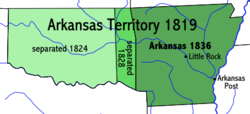
On March 2, 1819, the Arkansas Territory was authorized by an act of Congress, to take effect  on July 4, 1819.

The Arkansas Territory was created from the portion of the Missouri Territory. It originally encompassed all of what is now Arkansas and much of what is now Oklahoma. The westernmost portion of the territory was removed on November 15, 1824, a second westernmost portion was removed on May 6, 1828, reducing the territory to the extent of the present state of Arkansas.

The Territorial capital was Arkansas Post from July 1819 until June 1821. At that point in time it was moved to Little Rock. In 1819, there was no permanent settlement in Little Rock. It would my be until early 1820 that a permanent settlement would be established.  On 1818, the Quapaw Treaty had anticipated a future settlement in Little Rock. 

Celebrate Dr. Seuss’s Birthday with Read Across America Day

Oh, the places you’ll go when you read!

Celebrate Dr. Seuss’s birthday and the National Education Association’s (NEA) Read Across America Day with the Central Arkansas Library System (CALS) and millions of others at events and programs on Monday, March 2 and throughout the week.

On Monday, March 2, from 4-7 p.m., The Cat in the Hat and Pete the Cat will join participants at Park Plaza Mall, 6000 W. Markham Street, for crafts, reading, and fun. Events at branch libraries may be found below. All events are free and open to the public.

  • Main Library
    Dr. Seuss Storytime with Lupe Pena Valadez • Saturday, March 7 • 10:30 a.m.
  • McMath Library
    Dr. Seuss Birthday Bash • Monday, March 2 • 6:00 p.m.
  • Terry Library
    Dr. Seuss Family Night • Monday, March 2 • 6:30 p.m.
  • Thompson Library
    Dr. Seuss Family Night • Thursday, March 5 • 6:30 p.m.
  • Children’s Library
    Dr. Seuss on the Loose Party • Saturday, March 7 • 10:30 a.m.

NEA’s Read Across America Day, which celebrates Dr. Seuss’s birthday and the joys of reading, expects more than 45 million readers, both young and old, to pick up a book and read. The goal is to show America’s children the joy of reading and build a nation of readers.