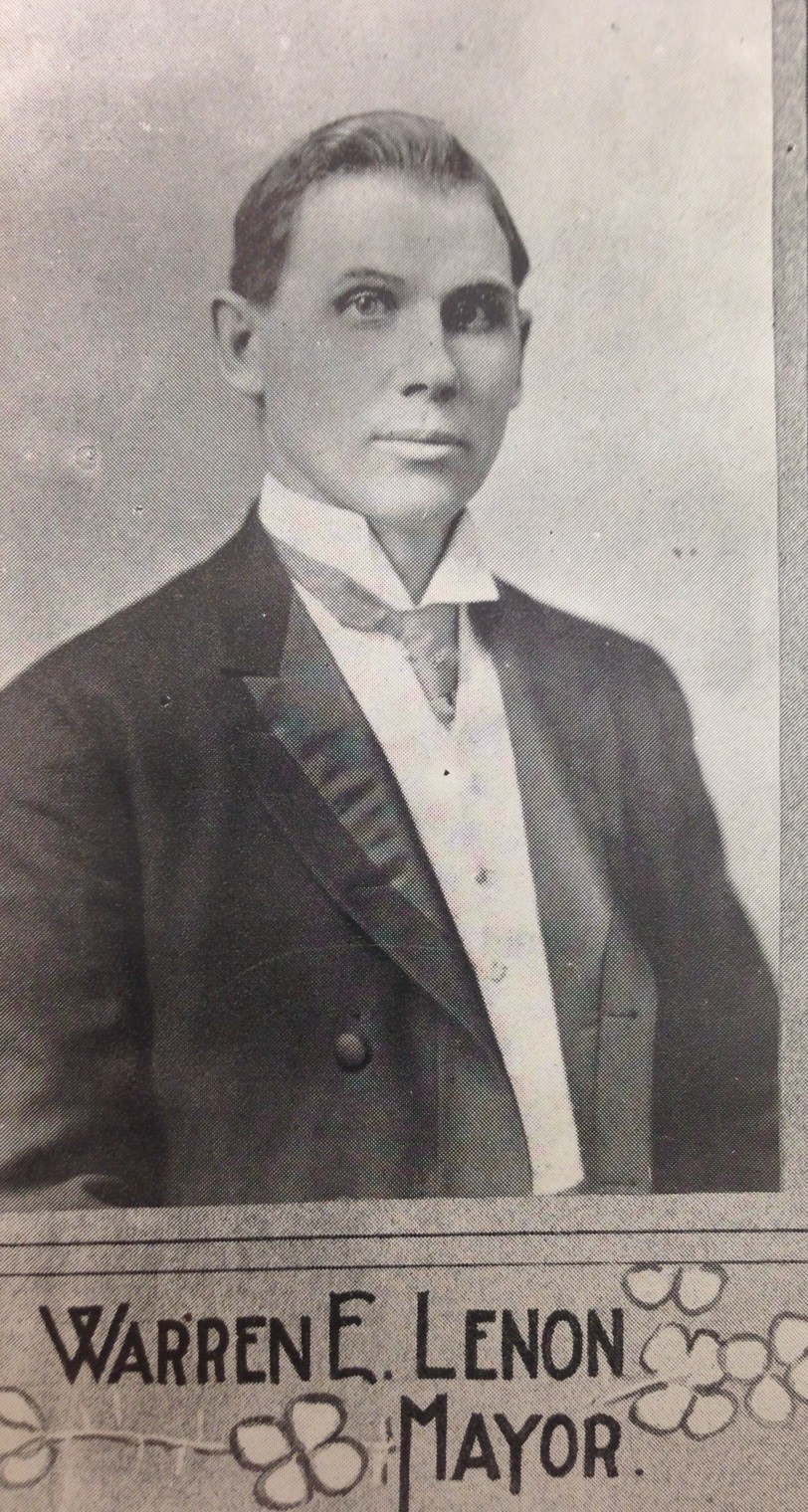
Little Rock Look Back: Warren E. Lenon – LR’s 39th Mayor and Father of City Hall

OMayor Lenonn October 8, 1867 in Panora, Iowa, future Little Rock Mayor Warren E. Lenon was born.  He was one of eleven children of John D. and Margaret M. Long Lenon.

Lenon came to LIttle Rock in 1888 after finishing his schooling in Iowa.  He helped set up an abstract company shortly after his arrival.  In 1902 he organized the Peoples Savings Bank.  Among his other business interests were the City Realty Company, the Factory Land Company, the Mountain Park Land Company, and the Pulaski Heights Land Company.

From 1895 to 1903, he was a Little Rock alderman, and in 1903, he was elected Mayor of the city. A progressive Mayor, he championed the construction of a new City Hall which opened in 1908.  At the first meeting of the City Council in that building, Mayor Lenon tendered his resignation.  His duties in his various business interests were taking up too much of his time.

Mayor Lenon had been a champion for the establishment of a municipal auditorium. He had wanted to include one in the new City Hall complex. But a court deemed it not permissible under Arkansas finance laws at the time.  He also worked to help establish the first Carnegie Library in Little Rock which opened in 1912.

Mayor Lenon continued to serve in a variety of public capacities after leaving office.  In the 1920s, he briefly chaired a public facilities board for an auditorium district. It appeared he would see his dream fulfilled of a municipal auditorium.  Unfortunately the Arkansas Supreme Court declared the enabling legislation invalid.

In 1889, he married Clara M. Mercer.  The couple had three children, two of whom survived him.  A son W. E. Lenon Jr., and a daughter Vivian Mercer Lenon Brewer.  She was married to Joseph Brewer, a nephew of Joseph Taylor Robinson, after whom the City’s eventual municipal auditorium would be named.  Mrs. Brewer was also a leader of the Women’s Emergency Committee.

Mayor Lenon died June 25, 1946 and is buried at Roselawn Cemetery.  Lenon Drive just off University Avenue is named after Mayor Lenon.

Ramifications of Nixon’s Win in 1968 is topic of Clinton School Program today at noon

The 1968 general election was pivotal in the future of the U.S.  While locally it saw Arkansas voters re-electing GOP Governor Winthrop Rockefeller & Democratic Senator J. William Fulbright while tossing their electoral votes for independent (and segregationist) George Wallace, on the national scale the election of Richard M. Nixon set the tone for a new type of political partisanship.  Though the long-reaching outcomes of that election were not really apparent at the time.  The narrative in 1968 was more about Nixon’s career redemption, but it was also about the rise of the GOP in the formerly solidly Democratic South.

Michael Nelson, author of Resilient America: Electing Nixon in 1968, Channeling Dissent, and Dividing Government, will discuss his book at the Clinton School today at 12 noon.

Nelson is the Fulmer Professor of Political Science at Rhodes College, a Fellow of Southern Methodist University’s Center for Presidential History, and a Senior Fellow at the University of Virginia’s Miller Center. He is the author of numerous books, including “How the South Joined the Gambling Nation: The Politics of State Policy Innovation,” with John L. Mason, winner of the 2009 V. O. Key Award for Outstanding Book on Southern Politics from the Southern Political Science Association. His new book, “Resilient America,” explores how urban riots and the Tet Offensive, the assassinations of Martin Luther King, Jr. and Robert F. Kennedy, the politics of outrage and race—all pointed to a reordering of party coalitions, of groups and regions, a hardening and widening of an ideological divide—and to the historical importance of the 1968 election as a watershed event.

With all the talk recently about the 40th anniversary of Nixon’s resignation, this talk will present an interesting take on the set-up to Nixon’s first term.  In addition, as both the GOP and Democrats have their eyes on Arkansas’ political future, Nelson’s book sets the stage for the seeds being sown of the rise of the two party system in the South.

Reserve your seats by emailing publicprograms@clintonschool.uasys.edu or calling (501) 683-5239.

Visit the Little Rock Zoo on Saint Francis Day weekend

Little-Rock-zoo-logo-4-c-with-tagYesterday, October 4, was officially Saint Francis Day. But most churches commemorate it on the Sunday closest to the Feast Day, which is today.

Saint Francis of Assisi is the patron saint of animals.  As such, many churches have “Blessing of the Animals” services.

While the Little Rock Zoo does not have a “Blessing of the Animals” event, it does provide an opportunity to see and learn about many different types of animals.

No longer a space where animals are kept in tightly confined concrete and steel cages, the focus of the Little Rock Zoo is education about animals and the environment.  This mission is in keeping with Saint Francis’ belief in the importance of animals as part of the larger community.

The Little Rock Zoo has long been one of Arkansas’ great treasures. It all began modestly in 1926, with just two animals — an abandoned timber wolf and a circus-trained brown bear. Today, the Zoo has grown to include nearly 700 animals representing 200+ species, many on the endangered list. The Zoo itself, has become one of the state’s greatest educational and conservation resources.

The Little Rock Zoo is accredited by the Association of Zoos and Aquariums.  Look for the AZA logo whenever you visit a zoo or aquarium as your assurance that you are supporting a facility dedicated to providing excellent care for animals, a great experience for you and a better future for all living things.  With its more than 200 accredited members, AZA is a leader in global wildlife conservation and your link to helping animals in their native habitats.  For more information, visit http://www.aza.org.

Chairman of the National Endowment for the Arts to visit Little Rock

NEA LRDr. Jane Chu, a former resident of Arkadelphia, is the new chairman of the National Endowment for the Arts.  On Tuesday, October 7, she will be in Little Rock.

At 1:30, she will be part of a presentation at the Arkansas Repertory Theatre.  Steve Luoni of the University of Arkansas Community Design Center, will lead a discussion of the Creative Corridor.  Dr. Chu will also make remarks.  Mayor Mark Stodola will be the host of the event.  The public is invited to attend.

During her visit in Little Rock, Dr. Chu will also take part in a variety of meetings and tours.

Arkansas Arts Council to honor 9 Individual Artist Fellowship recipients tonight

Arkansas_Arts_Council_logo_2Tonight, the Arkansas Arts Council honors the nine recipients of its 2014 Individual Artist Fellowship awards. The artists will be recognized at a reception, co-sponsored by Historic Arkansas Museum, from 5:00-8 p.m. at the museum on 200 E. Third St. in Little Rock. The reception is free and open to the public. Seating is limited; reservations are required. For reservations, call (501) 324-9766.

Fellowships are awarded annually in the amount of $4,000 each to Arkansas artists in recognition of their individual artistic abilities. These fellowships enable artists to set aside time for creating their art and improving their skills. Three artistic disciplines are selected each year as categories for the awards.

The three categories for this year are Literary Arts: Short Story Writing; Performing Arts: Directing of Theater Productions; and Visual Arts: Works on Paper.

The following recipients were selected by a jury of professional artists, writers, performers and art administrators:

Literary Arts: Short Story Writing

  • Marla Cantrell, Alma
  • Alice Otto, Fayetteville
  • Hung Pham, Fayetteville

Performing Arts: Directing of Theater Productions

  • Amy Herzberg, Fayetteville
  • Kassie Misiewicz, Bentonville
  • Rebekah Scallet, Little Rock

Visual Arts: Works on Paper

  • Sheila Cantrell, Batesville
  • Delita S. Martin, Little Rock
  • Kathryn (Kat) Wilson, Fayetteville


The Arkansas Arts Council advances the arts in Arkansas by providing services and grants-in-aid supporting arts endeavors that encourage and assist literary, performing and visual artists in achieving standards of professional excellence. In addition, the Arkansas Arts Council provides technical and financial assistance to Arkansas arts organizations and other providers of cultural and educational programs.

The Arkansas Arts Council was established in 1966 to enable the state of Arkansas to receive funds from the National Endowment for the Arts. In 1971, Act 359 (A.C.A. § 13-8-101 et seq.) gave independent agency status to the Arts Council, with an executive director and a 17-member council appointed by the governor. In 1975, the Arts Council became an agency of the Department of Arkansas Heritage.

The Arkansas Arts Council is an agency of the Department of Arkansas Heritage and shares the goals of all seven Department of Arkansas Heritage agencies, that of preserving and enhancing the heritage of the state of Arkansas. The agencies are: Arkansas Historic Preservation Program, Arkansas Natural Heritage Commission, Delta Cultural Center in Helena, Historic Arkansas Museum, Mosaic Templars Cultural Center and the Old State House Museum. Funding for the Arkansas Arts Council and its programs is provided by the State of Arkansas and the National Endowment for the Arts.

LR Cultural Touchstone: Bernie Babcock

BabcockBernie_fLittle Rock’s rich cultural history has been influenced by many outstanding men and women.  This October, during Arts & Humanities Month 2014, the Culture Vulture is looking at 31 outstanding women who have shaped cultural life in Little Rock…and beyond.

Julia Burnelle “Bernie” Smade Babcock was an author and museum founder.  Born in April 1868 in Ohio, she moved with her family to Arkansas as a child.  Marrying and starting a family, she also continued to write, which had been a passion since she was younger.  When her husband died, leaving her with five children, she starting writing for money. She published several temperance novels and later wrote for the Arkansas Democrat.  She also published a magazine and a poetry anthology.  She later became recognized as an expert on Abraham Lincoln and wrote several books about him, as well as other historical figures.

In 1927, after professional curmudgeon H. L. Mencken wrote derisively of Arkansas, she decided to start a museum. The Museum of Natural History and Antiquities was first located in a Main Street storefront.  In 1929, she “gave the City of Little Rock a Christmas present” by giving the museum to the city.  It was relocated to the unfinished third floor of City Hall, with her as its employee.  In 1933, as New Deal programs were ramping up, the space was needed for WPA offices, and the museum was shuttered. Many of the museum’s artifacts were lost during this time.    She became folklore editor for the Federal Writers’ Project in 1935.

In 1941, she and businessman Fred Allsopp convinced the City of Little Rock to reopen the museum (then known as the Museum of Natural History) by locating it in the old Arsenal Building in City Park.  She lived in the basement of the building.  She was involved in the efforts to rename City Park in honor of Douglas MacArthur (who had been born there) and welcomed him when he came to Little Rock in 1952.  Retiring from the museum in 1953, she donated some items and billed the City $800 for others. That money was her retirement pension at age 85.

Moving to Petit Jean Mountain, she wrote, painted and published poetry.  She died in June 1962 at age 94.  She is buried in Little Rock’s Oakland Cemetery.

After more name changes and a relocation, her museum is now known as the Museum of Discovery and is an anchor in the River Market district.

LR Cultural Touchstone: Kay Kelley Arnold

(Photo courtesy of Bill & Hillary Clinton National Airport)

(Photo courtesy of Bill & Hillary Clinton National Airport)

Little Rock’s rich cultural history has been influenced by many outstanding men and women.  This October, during Arts & Humanities Month 2014, the Culture Vulture is looking at 31 outstanding women who have shaped cultural life in Little Rock…and beyond.

Kay Kelley Arnold.  While attending law school, she worked at the Arkansas Arts Council.  As she relayed to Soiree, she helped artists who taught in schools. Through that job, she met many creative people “and developed a love of all types of artistic expression.”  During Bill Clinton’s first term in office as Governor, she was on his staff. In that capacity, she served as his liaison to what is now known as the Department of Arkansas Heritage.  When he left office in January 1981, so did she.

In 1986, Governor Clinton tapped Arnold to lead the Department of Arkansas Heritage.  In addition to supervising six cultural departments, she stepped into the job as plans were being made for Arkansas’ Sesquicentennial. She also oversaw those efforts which were heavily tilted toward artistic and historic events.

During the 1987 Arkansas General Assembly, Arnold led the successful effort for the legislators to approve a real estate transfer tax.  The legislation proved immensely beneficial to historic properties.  She entered the corporate world in 1988 joining Arkansas Power & Light. While serving in various capacities for AP&L and Entergy, Arnold split her time between Little Rock and Washington DC.  She maintained close ties to Little Rock’s cultural community including service on the Arkansas Symphony Orchestra Board.  She served as Chair of the ASO Board at a crucial time in the organization’s history.  In addition, she has served as a member of the Arkansas Natural Heritage Commission.

Arnold has recently completed two terms on the Little Rock Airport Commission.  During her time on that body, the airport purchased and installed several pieces of public art.

Now retired from Entergy, she is often seen around Little Rock enjoying cultural events.