LRCVB announces agreement with AWAKENING EVENTS to book and promote First Security Amphitheater in Riverfront Park

Image result for first security amphitheaterThe Little Rock Convention & Visitors Bureau (LRCVB) has finalized a Promoter Agreement with AWAKENING EVENTS to provide exclusive rights to book and promote ticketed concerts in the First Security Amphitheater in Riverfront Park downtown.

AWAKENING EVENTS is a nationwide, full service live event company based in Arkansas. They successfully produce over 250 concerts each year. AWAKENING EVENTS has produced concerts at Verizon Arena, Wal-Mart Amphitheater, the First Security Amphitheater, as well as many iconic venues around the country, including Madison Square Garden, Red Rocks Amphitheatre and The Forum in Los Angeles. AWAKENING EVENTS is owned by Arkansas native Dan Fife.

AWAKENING EVENTS is proudly partnering with STARR HILL Presents, owned by Red Light Management’s Coran Capshaw. Red Light Management’s extensive artist management roster ranges from Dave Matthews Band to Chris Stapleton and many others. STARR HILL Presents is an independent concert promotion company based in Charlottesville, Virginia, promoting hundreds of events each year, ranging from small club shows to multi-day festivals. The company operates multiple venues and is a partner in festivals across the country including Bonnaroo, SXSW and Outside Lands.

AWAKENING EVENTS responded to a Request for Qualifications released by the LRCVB in late 2018. Following negotiations, an agreement was finalized and signed on March 11, 2019. The agreement requires a minimum of three “A-Tier” concerts in 2019 and six concerts each year in 2020-2023. A-Tier is defined as “Artists that tour nationally or globally, having the documented ability to sell 2,000 or more tickets.”

In addition, it is the desire of AWAKENING EVENTS & STARR HILL PRESENTS to create an additional 2020 series of free, or very low cost, “Live at Five” type events. Dan Fife, president of AWAKENING EVENTS, stated, “We are excited to get back into the Amp business on the River in Riverfront Park. It is a great venue and we need to start offering regular and diverse concert programming again.”

Gretchen Hall, LRCVB President & CEO said, “I am excited about this new partnership and the quality of entertainment it will provide in Little Rock.”

This exclusive promoter agreement is designed to allow a booking window for the concert season, as well as protecting Little Rock’s long time Amphitheater and Pavilion events and provide the flexibility for community events to continue booking in those venues. LRCVB will maintain the booking and coordination efforts for all non-concert bookings.

A formal press conference to announce the initial season is expected in the next 30 days.

Jazz in the Park kicks off with Bijoux tonight

Image may contain: 1 person, smiling, text

Jazz in the Park is a free happy hour style event featuring different Jazz musicians weekly from 6pm-8pm in the History Pavilion in Riverfront Park. Family and Pet Friendly.  It is offered each Wednesday in April and September.

First up is Bijoux.

Bijoux—a native of Little Rock – is a sultry  singer adept in various styles. The daughter of West African parents, Bijoux grew up in a household exposed to differing genres of music including folk, classic rock and roll, makossa, country, and R&B. Her jovial spirit, endearing vocals, vibrant entertaining, and musical versatility make her concerts engaging and fun.

No Coolers Please. Lawn Chairs Welcome. (Rain Location is East Pavilion at River Market)

Little Rock Look Back: Voters approve funds for completion of Robinson in 1940

Though Joseph Taylor Robinson Memorial Auditorium opened in February 1940, there was still money that needed to be raised to finish the construction and the building’s furnishing.  Ten days after the auditorium opening, the City Council approved an ordinance to call a special election on April 2, 1940, for the purposes of approving bonds for three separate projects.  One of these was for $30,000 for the completion of the auditorium; the bonds would not require any additional tax levy.

At the same meeting, a letter was read from the Young Men’s Business Association expressing support for the auditorium in the election, which was to be held in conjunction with the annual municipal general election. The Auditorium Commission had previously asked the City Council to consider issuing the bonds to pay for additional equipment for the building.  In their request to the aldermen, the members stressed that due to the current bond structure, these new bonds would not necessitate any tax increase.

The campaign for the new bonds used a similar structure and message as the 1937 election to build the auditorium.  There were newspaper ads by the steering committee (this time simply called the Citizen’s Committee and led by Omar Throgmorton) and support from civic organizations.  One thing very different from the 1937 campaign was the presence of an actual building.  On Sunday, March 31, just two days before the election, there was an open house for the public to explore the edifice.

On April 2, 1940, Little Rock voters approved the new bonds 1,413 to 423.  Every precinct in every ward of the city voted in favor of the new bonds.  Shortly after the election, the bonds were issued.  The auditorium construction which had first been broached in 1904 was now completed in 1940.

Arkansas Launch of “The People” tonight at the Clinton School

The People was born out of a question that original members social activist Andrew Shue and well-known conservative pollster Frank Luntz asked themselves: “Do the American people really have irreconcilable differences?”
If you are interested in working across the political aisle to restore the will of the people in the United States, ThePeople.org wants you. The People is a nonprofit organization with a mission to bring Americans together to engage in civil discourse and to establish and carry out nonpartisan governmental reforms.
By doing so, people will live in a truly representative democracy. By activating all citizens and bringing the country together, one collective voice will be established and the average person can be heard. The organization will help individuals organize around common causes, rounding out strengths and weaknesses, and connecting them with others to accelerate their efforts. This will help the organization to facilitate productive dialogue between those with variation in beliefs and promote action to address needed governmental reforms.
The event at the Clinton School is one of more than 30 meetings the organization is holding across the country to provide a forum for finding shared issues, creating solutions at the grassroots level, and recruiting volunteers to join the movement and take action.
Join them for the Arkansas launch session with a representative from The People.

All Clinton School Speaker Series events are free and open to the public. Reserve your seats by emailing publicprograms@clintonschool.uasys.edu or by calling (501) 683-5239.

Little Rock Look Back: 1940 Open House gives many first view inside Robinson Auditorium

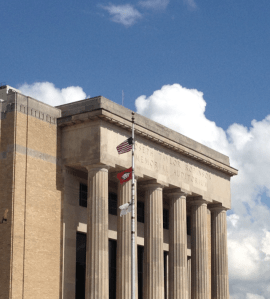
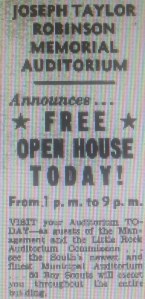
On March 31, 1940, the City of Little Rock and the Auditorium Commission threw open the doors of Joseph Taylor Robinson Memorial Auditorium to the public for an open house.
The building had officially opened in February 1940 (after construction was completed in January), and events had been taking place in the lower level since October 1939. But this was the first time that the public could tour the entire facility from top to bottom.

The event took place on a Sunday from 1pm to 9pm.  Curiously, it took place two days before a special election to approve the bonds to finish the auditorium. Though no one at the time was cynical enough to comment on the connection.

Members of various Little Rock Boy Scout troops led 4,000 visitors on tours of the auditorium.  Visitors were shown all over the building; one scout calculated that the walking tour equated to two miles.  Though most people were from Little Rock, the guest registry indicated visitors from California and Pennsylvania.  Among the last guests to sign the register were Mayor J. V. Satterfield and his family.

The idea for the open house had first been floated in December by Alderman E. W. Gibb after taking a tour of the construction site. He had enthusiastically professed that everyone should be able to tour and see what a magnificent structure it was going to be.  Mayor Satterfield had to tamper the alderman’s enthusiasm. He agreed with Mr. Gibb that it was a fine building but stated that a public open house could not be scheduled for a few weeks because there was still much work to be done.  Mayor Satterfield noted that the seats in the music hall were going to have to be removed and then reinstalled because they needed to be anchored better.

Little Rock Look Back: Werner C. Knoop

To Little Rock citizens under a certain age, the name Knoop means Knoop Park — a picturesque park tucked away in a pocket of Hillcrest.  There are, however, still many who remember Werner C. Knoop as a business and political leader who helped shape Little Rock as a modern city.
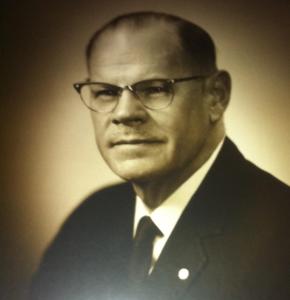
Knoop was born on March 30, 1902.

In 1946, Knoop joined with Olen A. Cates and P. W. Baldwin to form Baldwin Construction Company in Little Rock.  Knoop had previously founded Capital Steel Company and established his business reputation there.  From 1945 through 1951, he served on the Little Rock School Board.

Following a series of political scandals, efforts were undertaken for Little Rock to shift from Mayor-Council to City Manager form of government.  Even before the desegregation of Little Rock Central put the city in the eyes of the world, an election for new leaders had been set for November 1957.  Knoop was on a “Good Government” slate and was one of the members elected.

At the first meeting of the new City Board, Werner C. Knoop was chosen by his fellow directors to serve as Little Rock Mayor.  Knoop served as Mayor until December 1962.  For the first several months in office, Little Rock had no City Manager so Knoop oversaw the transition of City staff as the forms of government changed.

Though City Hall generally stayed out of school district matters, that did not mean that the public viewed the two entities separately.  In September 1959, the Baldwin Construction offices were bombed as part of a series of terrorist activities protesting the desegregated reopening of all Little Rock high schools.

Downtown LR as viewed from Knoop Park

Downtown LR as viewed from Knoop Park

After two terms on the City Board, Knoop decided against seeking a third term.  He concluded his elected public service on December 31, 1962.  Following his time on the City Board, Knoop did not retire from Civic Affairs.  In 1970, he served as Chairman of the Little Rock Chamber of Commerce.   The previous year he served as President of the Arkansas Chapter of Associated General Contractors.

Mayor Knoop died in July 1983.  He is buried at Roselawn Memorial Park next to his wife Faith Yingling Knoop, a renowned author.

In the 1930s, Knoop moved into an Art Moderne house on Ozark Point in Hillcrest.  It was adjacent to Little Rock Waterworks property which was developed around the same time.  Eventually much of the land was deeded to the City for creation of a park.  In 1989, it was named in tribute to long-time neighbor Knoop in honor of his lifetime of service to Little Rock.

Little Rock Look Back: Last City Council meeting in 1868 City Hall

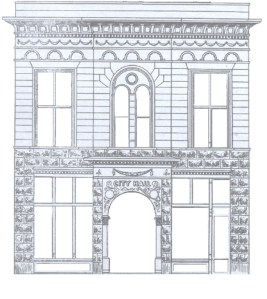
On March 30, 1908, the Little Rock City Hall held its final meeting in the 1868 City Hall.  The new city hall, located at Markham and Broadway streets, was nearing completion.  The meeting was presided over by Mayor W. E. Lenon.

The aldermen present were: John A. Adams, John Brod, A. B. Hightower, W. H. Jarrett, Christopher Ledwidge, Louie Miller, Jonathan S. Odom, R. C. Powers, A. L. Smith, George Stratman, Jonathan H. Tuohey, Louis Volmer, and L. N. Whitcomb.  Three aldermen missed the meeting: John Herndon Hollis, A. B. Poe and Benjamin S. Thalheimer.

The meeting was filled with typical requests for zoning and street improvements.  There was actually nothing out of the ordinary about the meeting.  If there was mention that it would be the final meeting, it did not make it into the minutes.

There was a request by the Arkansas Association of Pharmacists to have a meeting at the new building on May 12, 13 and 14.  It was referred to the City Hall Committee.  At prior meetings, there had also been requests by other groups to hold conferences at the new edifice.

At the conclusion of the meeting, it was noted that former City Clerk Clay Jones had died. A resolution memorializing him was proposed to be presented and adopted at the next meeting.

And with that, the meeting ended.  Forty years of City Council meetings at 120 to 122 West Markham came to a close.