Black History Month Spotlight – Horace Mann High School

Mann-SignThe new Arkansas Civil Rights History Audio Tour was launched in November 2015. Produced by the City of Little Rock and the University of Arkansas at Little Rock allows the many places and stories of the City’s Civil Rights history to come to life an interactive tour.  This month, during Black History Month, the Culture Vulture looks at some of the stops on this tour which focus on African American history.

Horace Mann Senior High School opened in 1956 as one of two new Little Rock public high schools, after the 1954 U. S. Supreme Court Brown v. Board of Education school desegregation decision. Mann was built in the predominantly black eastern part of Little Rock, while Hall High was in a predominantly affluent and white western area of residence. This plan ensured that, in practical terms, both schools would remain racially segregated. The assignment of an all-black teaching faculty to Mann and an all-white teaching faculty to Hall underscored this intent.

After Mann was built, the school board transferred black students from Dunbar High, the city’s existing segregated black high school, to Mann. Dunbar then became a junior high school. Teachers were divided and reassigned, new principals were named, and the school mascots respectively became the “Dunbar Bobcats” and the “Horace Mann Bearcats.” The schools are now Horace Mann Arts and Science Magnet Middle School and the Dunbar International Studies Magnet Middle School. In 2012, both alumni groups combined to form the National Dunbar Horace Mann Alumni Association.

The app, funded by a generous grant from the Arkansas Humanities Council, was a collaboration among UALR’s Institute on Race and Ethnicity, the City of Little Rock, the Mayor’s Tourism Commission, and KUAR, UALR’s public radio station, with assistance from the Little Rock Convention and Visitors Bureau.

A Lincoln Viaduct Portrait

Photo courtesy of the Arkansas Historic Preservation Program

Photo courtesy of the Arkansas Historic Preservation Program

Since today is Abraham Lincoln’s birthday, it is a good day to pay tribute to the Lincoln Avenue Viaduct.  This arched bridge is traversed by thousands of cars each day, with most having no idea the name of the structure.  The Lincoln Avenue Viaduct is the arched bridge connecting LaHarpe with Cantrell Road which (literally) bridges downtown with the west along Highway 10.

The Lincoln Avenue Viaduct is a reinforced concrete rainbow arch bridge. It was opened at 2:05 p.m. on Friday, December 28, 1928, and, despite later alterations, it remains particularly well-preserved. The Missouri Pacific Railroad Company, considered the most important railroad company in the state, constructed the bridge amid a series of improvements in Little Rock made necessary by the damage wrought by the infamous spring floods of 1927.

Though the bride was constructed by the railroad, the City had to give authorization to do so, this was accomplished by the passing of Ordinance 4,335, at the May 28, 1928, City Council meeting.

Lincoln Avenue was one of several names for stretches of Highway 10 in Little Rock. By the 1960s, the areas west of the Lincoln Avenue viaduct were all renamed Cantrell in honor of the man who had developed much of the area west of the Heights. The longest stretch of the road already carried that name. There had been an effort to rename Highway 10 (including sections named Lincoln, Q, and Cantrell) in Little Rock for Senator Joseph Taylor Robinson in 1930. He declined the offer because he did not want to diminish the contributions of Mr. Cantrell.  Over time the entire stretch bore the name Cantrell.

The stretches east of the viaduct which involved a couple of names were renamed La Harpe Boulevard in honor of the French explorer who first saw the Little Rock.

Though the street has been renamed, the bridge still carries the name of the 16th President of the United States.

Little Rock Look Back – Abraham Lincoln

Abraham_Lincoln_November_1863On February 12, 1809, Abraham Lincoln was born in Kentucky.

Lincoln never visited Arkansas. In the 1860 election, he barely registered on the Arkansas election map. Arkansas counties went strongly for Southern Democratic candidate John Breckinridge.  John Bell, the Constitutional Union/Whig candidate ran strongly in Pulaski County and a scattering of other counties.  Neither Lincoln nor Northern Democratic candidate Stephen Douglas carried a county in Arkansas.  In 1864, though Arkansas was officially under control of the Union forces, the state had not been readmitted. Therefore no Arkansans voted for Lincoln that year.

As President, Lincoln did correspond with several Arkansans.  It is said that the polite written exchanges he had with former Mayors C. P. Bertrand and Gordon Peay were helpful in maintaining a fairly peaceful occupation of Little Rock by federal forces.

In the listing of Presidential Streets of Little Rock, Lincoln is omitted.  On first blush, this might seem to be intentional to skip the name of the President who oversaw the “occupation.”  However, if that were the case, then surely Johnson would have been left out as well since he was President during the final years of the federal military occupation.  In fact, there once was a Lincoln Street. A portion of what is now Cantrell/Highway 10 was named for Lincoln. It predated the other Presidential streets.  At the time the other streets were laid out, Lincoln was skipped because a street already bore the name.

Over time, Highway 10 had been given multiple names for various sections: Lincoln, Q, and Cantrell. In the 1930s, these names were consolidated into Cantrell which was the longest section. The name Lincoln was dropped. There were very few addresses on Lincoln, most of it was railroad property.  The viaduct connecting Highway 10 with LaHarpe still bears the name of Lincoln Avenue.

In 2008, Sam Waterston appeared at the Clinton School of Public Service to kick off the Abraham Lincoln Sesquicentennial celebration activities. The official launch was supposed to be elsewhere but was cancelled due to inclement weather. So it happened in Little Rock as Waterston appeared in a program reading letters and writings from throughout Lincoln’s lifetime.  In 1994, Waterstson had received a Tony Award nomination for starring in the Lincoln Center revival of Abe Lincoln in Illinois.

Your Heart will be filled with ART at tonight’s 2nd Friday Art Night

2FAN logo Font sm2It is 2nd Friday Art Night again. From 5pm to 8pm (times may vary at individual locations), a variety of museums and galleries downtown are open with free events to enjoy art, music and exhibits.

Highlights include:

Mosaic Templars Cultural Center – Opening reception for “I WALKED ON WATER TO MY HOMELAND” FEATURING WORKS BY DELITA MARTIN (6pm to 8pm)

“I Walked on Water to My Homeland” is a series of mixed media works that explore the power of the narrative impulse. These works capture oral traditions that are firmly based in factual events and bring them to life using layers of various printmaking, drawing, sewing, collage and printing techniques.

The opening will feature an artist talk, refreshments and live entertainment by Acoustix with Rod P. featuring Bijoux.

Matt McLeod Fine Art – (5pm to 8pm)

A chance to see the art at the gallery and perhaps pick up a Valentine’s gift.

Historic Arkansas Museum – Opening reception for ARKANSAS CONTEMPORARIES: THEN, NOW, NEXT (5pm to 8pm)

Check out the new exhibit and enjoy a free evening of art, history, Museum Store shopping and live music by Shannon Wurst!
Enjoy a craft cocktail by Pink House Alchemy(They will also have Pink Lemonade)
Enter to win a box of chocolates from Cocoa Rouge-The winner will be announced at 6:30 pm (must be present to win)

“Arkansas Contemporaries: Then, Now, Next” – The museum’s Trinity Gallery for Arkansas Artists and Second Floor Gallery for Emerging Artists focus on exhibitions by contemporary Arkansas artists. This exhibit features exemplary selections from the museum’s permanent collection and reflects upon the work of the talented Arkansans who have been represented in these galleries over the past ten years and a glimpse to future exhibitions.  Featured artworks in this exhibit represent important points in the careers of contemporary Arkansas artists like Bryan Massey, Warren Criswell, Katherine Strause, John Harlan Norris, Katherine Rutter, Grace Mikell Ramsey and others.  Exhibit continues through May 8, 2016.

Old State House Museum – Felice Farrell, cello (5pm to 8pm)

Join the Old State House as Arkansas Symphony Orchestra cellist Felice Farrell performs solo works for cello by the well-known 18th century German composer Johann Sebastian Bach and 20th century Spanish cellist and composer Gaspar Cassado. The Old State House Museum is one of several downtown locations that hosts this evening of entertainment and exhibits. While here, shop the Museum Store. Visitors can ride the trolley to visit other Second Friday venues, including the Historic Arkansas Museum.

Butler Center for Arkansas Studies – Opening reception for PAINTING 360: A LOOK AT CONTEMPORARY PANORAMIC PAINTING (5pm to 8pm)

On view through Saturday, April 30, artists whose work is featured in Painting 360° include Marcia Clark, Nicholas Evans-Cato, Christopher Evans, Amer Kobaslija, Jackie Lima, Matthew Lopas, Carrie O’Coyle, Dick Termes, and Melissa Cowper Smith.
Featured artist: Julie Holt, an artist who handbuilds clay objects and vessels.
Featured musician: The Rolling Blackouts

Black History Spotlight – Dunbar Historic Neighborhood

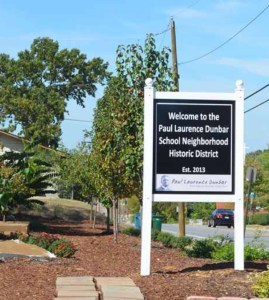
DunbarNeighborhoodThe new Arkansas Civil Rights History Audio Tour was launched in November 2015. Produced by the City of Little Rock and the University of Arkansas at Little Rock allows the many places and stories of the City’s Civil Rights history to come to life an interactive tour.  This month, during Black History Month, the Culture Vulture looks at some of the stops on this tour which focus on African American history.

The Paul Laurence Dunbar School Historic District played an important role as the center of Little Rock’s African American community from the mid-1800s to the mid-1900s.  Development began around Wesley Chapel, organized in 1853.

The neighborhood expanded after the Civil War to become home to many African Americans noted for their success in a number of fields, including business, politics, religion, education, law, music, and medicine. Among the historically black institutions that were founded in the neighborhood and remain there today are several churches, including Wesley Chapel United Methodist, Bethel A.M.E., Mount Pleasant Baptist, Mount Zion Baptist, and Union A.M.E.; and two colleges, Arkansas Baptist and Philander Smith.

The existing Dunbar School replaced an older high school that was named for Mifflin Gibbs, a prominent African American lawyer and political leader who lived in the neighborhood.  Today, Gibbs Elementary School continues the recognition of Gibbs.

The app, funded by a generous grant from the Arkansas Humanities Council, was a collaboration among UALR’s Institute on Race and Ethnicity, the City of Little Rock, the Mayor’s Tourism Commission, and KUAR, UALR’s public radio station, with assistance from the Little Rock Convention and Visitors Bureau.
Tonight at the Clinton School – Devery Anderson discusses the 1955 murder of Emmett Till

Emmett Till bookThis evening at 6pm at the Clinton School, Devery Anderson discusses his book on the murder of Emmett Till. A book signing will follow.

Emmett Till: The Murder That Shocked the World and Propelled the Civil Rights Movement offers the first truly comprehensive account of the 1955 murder and its aftermath. It tells the story of Emmett Till, the fourteen-year-old African American boy from Chicago brutally lynched for a harmless flirtation at a country store in the Mississippi Delta. His death and the acquittal of his killers by an all-white jury set off a firestorm of protests that reverberated all over the world and spurred on the civil rights movement. Like no other event in modern history, the death of Emmett Till provoked people all over the United States to seek social change.

For six decades the Till story has continued to haunt the South as the lingering injustice of Till’s murder and the aftermath altered many lives. Fifty years after the murder, renewed interest in the case led the Justice Department to open an investigation into identifying and possibly prosecuting accomplices of the two men originally tried. Between 2004 and 2005, the Federal Bureau of Investigation conducted the first real probe into the killing and turned up important information that had been lost for decades.

This book will stand as the definitive work on Emmett Till for years to come. Incorporating much new information, the book demonstrates how the Emmett Till murder exemplifies the Jim Crow South at its nadir. The author accessed a wealth of new evidence. Anderson has made a dozen trips to Mississippi and Chicago to conduct research and interview witnesses and reporters who covered the trial. In Emmett Till Anderson corrects the historical record and presents this critical saga in its entirety.

Black History Month Spotlight – Dunbar High School

dunbarimage2The new Arkansas Civil Rights History Audio Tour was launched in November 2015. Produced by the City of Little Rock and the University of Arkansas at Little Rock allows the many places and stories of the City’s Civil Rights history to come to life an interactive tour.  This month, during Black History Month, the Culture Vulture looks at some of the stops on this tour which focus on African American history.

After Little Rock High School (now Central High School) was completed in 1927, the building of Paul Laurence Dunbar High School was completed in 1929.  Money came from the Rosenwald Fund, founded by Julius Rosenwald, president of Sears, Roebuck and Company, and from local black residents.  Local blacks insisted on adding college preparatory classes to the vocational-industrial ones that were offered in black schools at the time. The building, modeled after the white high school, housed grades seven through twelve plus a junior college.  Black students came from all over Arkansas to take advantage of its educational opportunities.

When Horace Mann High School opened as a segregated school in 1956, Dunbar became a junior high school. A Dunbar-Mann Alumni Association, whose members live throughout the country, still helps to support both schools.  In the 1930s, Charlotte Andrews Stephens, the first black public school teacher in Little Rock, was on the faculty at Dunbar, completing seventy years of teaching with the district.  In the 1940s, Sue Cowan Williams, English Department chair, lost her job when she sued the Little Rock School District for equal pay for black and white teachers.

The app, funded by a generous grant from the Arkansas Humanities Council, was a collaboration among UALR’s Institute on Race and Ethnicity, the City of Little Rock, the Mayor’s Tourism Commission, and KUAR, UALR’s public radio station, with assistance from the Little Rock Convention and Visitors Bureau.