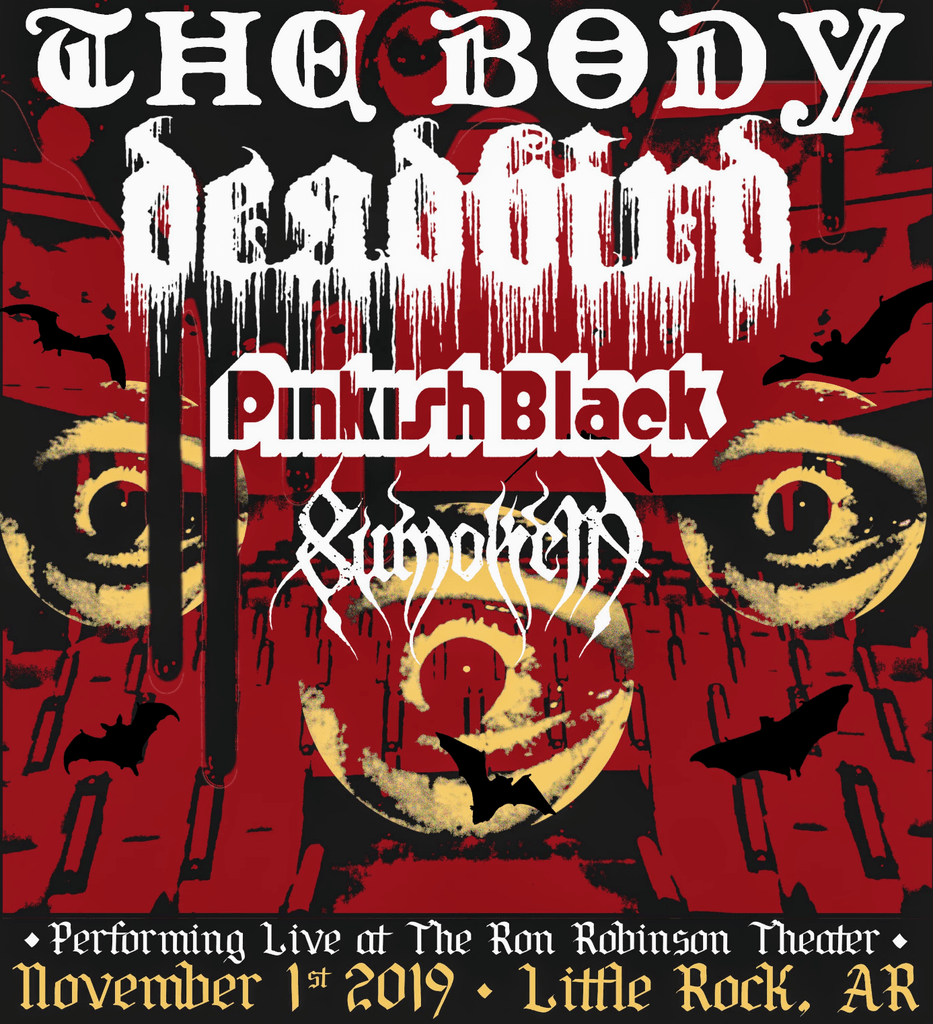
Four Bands on stage tonight at CALS Ron Robinson Theater presented by CALS Arkansas Sounds

CALS Arkansas Sounds presents The BodyDeadbirdPinkish Black, and Sumokem tonight (November 1) in the CALS Ron Robinson Theater.

The Body is an experimental metal duo formed in 1999 and composed of Little Rock natives Chip King (guitar, vocals) and Lee Buford (drums, programming). As of 2019, they have released seven studio albums as well as a number of EPs and several collaborative albums with other artists.

Deadbird is a heavy blues black punk metal band that was originally formed in Fayetteville in 2002. Now based in Little Rock, the band consists of Chuck on guitar and vocals, Phillip on drums and vocals, Alan on guitar and vocals, Jeff on bass and vocals, Reid on bass and vocals, and CT on mini Korg, noise, and vocals. Since 2002, they have released two albums.

Pinkish Black is an experimental rock duo from Fort Worth, Texas formed in 2010. The musical duo of Daron Beck and Jon Teague includes drums and synthesizer/keyboard only. Since 2012, they have released four albums.

Sumokem is a progressive sludge doom rock band formed in Little Rock in 2013. The band consists of Jacob Sawrie on vocals and rhythm  guitar, Drew Skarda on percussion, Tyler Weaver on lead guitar, and Dustin Weddle on bass. Since 2015, they have released two albums.

Tickets are $10 for general admission seating. The doors open at 7:00 pm and the concert starts at 8:00 pm.

Tricks and Treats on Little Rock Streets: Halloween 1950 in Downtown

A recent romp through an ARKANSAS GAZETTE gave insight into Halloween in Little Rock in the middle of the 20th Century.

Apparently by late afternoon on Halloween 1950, downtown Little Rock was filled with kids and teens in costumes. Much of the focus seemed to be on tricks as many of these revelers were utilizing water guns to soak people, throwing enough talcum powder to create an aroma downtown, shooting off firecrackers, and soaping store windows. Several industrious store owners had coated there windows with glycerine so that soap would not mark them.

The mayhem was enough to cause even more problems to traffic at rush hour. Police officers were helpless as they were directing traffic.  One city bus filled with passengers was attacked by a phalanx of waterguns, until the windows were all closed.

GAZETTE writer noted that two teen boys were dressed rather convincingly as girls. One was described as “rather pretty.” It was not until the teen let out an expletive (which the paper reported as “g— d—–”) that the reporter was certain it was a male.

Not everyone was focused on tricks.  Merchants in the Heights neighborhood created a block party with a carnival. It was deemed to be so successful that it would become an annual event.

Dedication of the Little Rock High School Auditorium on October 31, 1927

The stage and front seating area of the Central High Auditorium in September 2017.

On October 31, 1927, a recital took place in the auditorium of the new Little Rock High School which served as a dedication ceremony for the new high school auditorium.  The school had been serving students for several weeks by the time the recital took place.  The first day of school was Wednesday, September 14, 1927.

The star of the recital was Mary Lewis, a Little Rock High School graduate (from the previous location on Scott Street) who had made her Metropolitan Opera debut and become a toast of New York City.

The evening started with remarks from former Arkansas Governor Charles Brough, who had made a name for himself as an advocate for education before, during and after his stint in the statehouse.  He was followed by Miss Lewis, who sang over a dozen arias and musical selections.  For her final number she was supposed to sing “Home Sweet Home.”  After several attempts to sing it, she was so overcome with emotion that she had to abandon the effort.

For more on the opening event, read Jay Jennings’ excellent book Carry the Rock: Race, Football, and the Soul of an American City.

The 1927 schoolbuilding replaced one built in 1905 at 14th and Scott Streets (with an auditorium completed a few years later at 14th and Cumberland).  This new building was located in the western edges of Little Rock on what had been city parkland.  The former West End Park was now site to Little Rock High School.  The adjoining Kavanaugh Field was a baseball field on which Earl Quigley’s football Tigers also played their games.

Architects John Parks Almand, Lawson L. Delony, George R. Mann, Eugene John Stern, and George H. Wittenberg (virtually all of Little Rock’s full-time working architects at the time) designed the $1.5 million structure, which the New York Times dubbed the most expensive school ever built in the United States at that time.

Featuring a combination of Collegiate Gothic and Art Deco architecture, Central High spans two city blocks, comprising over 150,000 square feet of floor space, upon its completion. Requiring 36 million pounds of concrete and 370 tons of steel, the finished product consisted of 100 classrooms (accommodating over 1,800 students), a fireproof 2,000-seat auditorium, a gymnasium, and a greenhouse.

The six-story structure (counting the bell tower and basement) features a middle section containing the auditorium with four classroom wings (two per side) flanking a reflection pool in the foreground of the building. Faced with brick, the building’s highlights include pilasters and colonnades of cut stone, double-hung window frames with twelve lights per sash, and a main entry terrace supported by a colonnade of five masonry arches rising above Corinthian columns of stone.

Site Finally(!) selected for Robinson Auditorium on Oct. 29, 1937

Potential rendering of new auditorium which appeared in October 30, 1937 ARKANSAS GAZETTE

On October 29, 1937, the Little Rock City Council finally selected the site for the Municipal Auditorium.  It had been approved by voters in January of that year, but no site had been identified during the campaign.

During the early autumn, the City had engaged a consultant to evaluate several downtown locations as potential sites for the municipal auditorium.  One stipulation was that it had to be an entire city block.

The six sites were:

  • Broadway, Markham, Spring and Garland Streets;
  • Center, Markham, Spring and Second Streets;
  • Center, Eighth, Louisiana and Ninth Streets;
  • Scott, Fourth, Cumberland and Capitol Streets;
  • Scott, Tenth, Cumberland and Ninth Streets; and
  • Third, State, Second and Gaines Streets

The top choice was the site bounded by Center, Markham, Spring and Second Streets. It was felt that location’s proximity to public buildings made it ideal for a civic auditorium. It was across the street from the former state capitol (then known as the Arkansas War Memorial) which was, at the time, housing state and federal offices.  The site was also adjacent to the county courthouse structures.

Half of the desired property was owned by the federal government.  Because it was being used for federal offices, it was uncertain as to the site’s availability.  Therefore a city committee recommended the site bounded by Center, Eighth, Louisiana and Ninth Streets be utilized as the auditorium location.

The City Council met on October 20 to make a decision. But were at a stalemate. They met again a few days later with still no resolution.

At an October 25 City Council meeting, Arkansas Gazette publisher (and chairman of the Planning Commission) J. N. Heiskell, advocated the site on Markham and Broadway Streets. The Council convened on October 29 to meet again.  The clock was ticking, a site had to be selected because ground had to be broken prior to January 1, 1938.

At the October 29th meeting, the discussion from previous meetings among the aldermen picked up where it had left off.  Again J. N. Heiskell spoke about the importance of employing city planning concepts in selecting the site.

“In the past, selection of a site for a public building has been merely a matter of who could sell the city some property.  I had hoped we were starting a new effort in starting selection of an auditorium site with the advice of Mr. Bartholomew.  Starting with the auditorium, we should be guided by competent advice and locate future buildings following a city plan.  Your vote today will determine the future of Little Rock so far as city building goes.”

After having engaged in discussions with various federal government agencies, Mayor Overman reported that the city could not obtain the recommended site.  It would not be possible for the federal government to relocate those agencies currently occupying half of that block within the time allowed.  The mayor also stated that he had been warned that if construction did not start by January 1, 1938, (which was just a few weeks away) then the money could be taken back and allocated to other projects.

Ultimately the City Council voted 16 to 1 with 1 absent to locate it at the corner of Markham and Broadway.  At last, Little Rock had a location for the new municipal auditorium!

Though it had not been anyone’s first choice (except Mr. Heiskell, who did not have a vote), in retrospect, the auditorium site finally chosen offered many advantages which were not identified during the marathon selection discussions.  The grade of the land sloped toward the Arkansas River from Markham Street down to Garland Street which allowed for a street level entrance to both the planned exhibition hall on a lower level and the music hall on an upper level.

Given the topography of the other sites under consideration, this was only possible at the chosen location.  By stacking the two major components the project did not take up an entire block, which had been the forecasted footprint.  Not using the entire block allowed for subsequent expansion of the complex’s footprint in the coming decades.  This would not have been possible at any of the other sites under consideration if the original structure had taken up the entire block.  In addition, both Markham and Broadway Streets are wider than normal city streets which allowed for better traffic flow and for easier access to a loading dock.

Interestingly, the Convention & Visitors Bureau, which oversees Robinson Center Music Hall, now has offices in the Cromwell Building. This building is located on the site which had been the first choice for the auditorium in 1937.

20 years of indoor mural at Little Rock City Hall

On October 28, 1999, a mural was dedicated inside Little Rock City Hall.  Painted by artists Donald Gensler and Charlotte Allison, it was created to honor the City for its assistance in saving the Kramer School building.  As calendars everywhere were poised to turn from 1999 to 2000, it looked back to a time when the 20th Century was on the horizon.

Gensler and Allison drew inspiration for the mural from images they saw in old photographs. They were surprised to see photos of white and African American men working together at the original port of Little Rock which existed at La Petite Roche in what is now Riverfront Park. The photo was from the late 1800s before Jim Crow laws were fully enforced in Little Rock which separated the races more fully.

The only image in the mural that was not taken from an old photo is the mother holding the young baby. A fellow Kramer School resident and her young child posed for that photo. (Given that it was 20 years ago, that child is soon to be 21.)

At the dedication ceremony, held in Little Rock City Hall’s rotunda, Gensler and Allison as well as Mayor Jim Dailey spoke.   Joe Terry, a local actor and dancer who was also a Kramer School resident, sang “Old Man River” from Show Boat.

Gensler and Allison worked on the painting inside City Hall for a couple of weeks. They would often stop what they were doing to talk to City Hall employees and visitors to the building about the process of painting a mural.

While neither of the two artists currently live in Little Rock, a piece of them remains in this lasting tribute.

At the time, the Kramer School was serving as an artists cooperative.  While the building is no longer fulfilling that purpose, the efforts to make it thus saved it from a wrecking ball.  (The burgeoning effort of Artspace to create a live/work space in Little Rock would not repeat the Kramer School scenario because Artspace will maintain ownership of their facility guaranteeing its mission remains arts-based.)