Little Rock Look Back: Groundbreaking for Robinson Auditorium

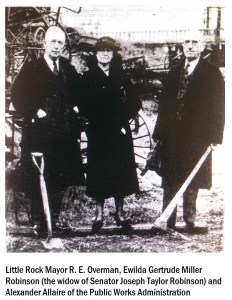
122437 GroundbreakOn December 24, 1937, at 11:30 a.m., Little Rock Mayor R. E. Overman, Ewilda Gertrude Miller Robinson (the widow of Senator Joseph Taylor Robinson) and  Alexander Allaire of the PWA turned dirt to participate in the brief groundbreaking ceremony for Little Rock’s municipal auditorium.  That morning, the Arkansas Gazette ran a brief story on the upcoming groundbreaking.  The story mentioned that the building would be named in memory of the late beloved Arkansas politician.  This appears to be the first public pronouncement of the Robinson name for this civic structure.

Among others in attendance at the groundbreaking were Mrs. Charles Miller (sister-in-law of Mrs. Robinson), Mr. and Mrs. Grady Miller (brother and sister-in-law of Mrs. Robinson), the mayor’s wife, the three architects (George Wittenberg, Lawson Delony and Eugene John Stern), and D. H. Daugherty and Will Terry of the City’s Board of Public Affairs.

Construction had to start by January 1, 1938, in order to receive PWA funds.  By breaking ground on December 24, there was over a week to spare.  The site had been selected in late October 1937, and the purchase had not been finalized.  But the PWA did give permission for the City to let a contract for excavation, demolition and filling on the site.

The groundbreaking took place at the corner of Garland and Spring Streets which was on the northeast corner of the block set aside for the auditorium.  Today, Spring Street does not extend north of Markham; the street was closed to make way for the parking structure and what is now the Doubletree Hotel.  Garland Street is basically an alley that runs parallel to Markham north of City Hall, Robinson Auditorium and the Doubletree Hotel.
Little Rock Look Back: LR Mayor Roswell Beebe

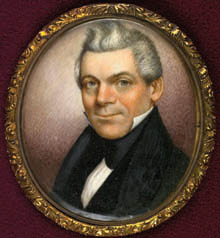
Mayor BeebeOn December 22, 1795, future Little Rock Mayor Roswell Beebe was born in Hinsdale, New York.  His family were wealthy English immigrants.  At seventeen, Beebe went to New Orleans and fought with Andrew Jackson in the 1815 Battle of New Orleans.  He stayed in the Crescent City for the next two decades building successful lumber and brick businesses.

Due to health concerns, he moved north to a drier climate in 1834.  After first stopping in Fulton, Arkansas, he settled in Little Rock in 1835 at the age of forty.  He stayed at the home of Chester Ashley and married Ashley’s sister-in-law, Clarissa Elliott.  He and Clarissa had two children, Roswell and Cora.

For nearly 30 years, Little Rock had a complicated history of deeds, titles and land ownership.  In 1839, Beebe went to Washington DC and received the original patent from President Martin Van Buren.  He then set about clearing up the land and title issues, as well as drawing up a plan for the city and laying off blocks and streets.  Beebe deeded the streets and alleys to the City for a dollar.  He also donated the land on Markham Street for a new State Capitol building (now home of the Old State House Museum).  Along with his brother-in-law Chester Ashley, he donated the land for the establishment of Mount Holly Cemetery.

In 1848, Beebe was elected to the Little Rock City Council.  The following year, he was elected Mayor.  He served as Mayor of Little Rock from April 1849 to February 1850.

While his primary business focus in the 1840s had been real estate, in the 1850s he focused on railroads.  Beebe was named president of the Cairo and Fulton Railroad Company in 1853.

While on a visit to New York, Beebe died on September 27, 1856.  His body was returned to Little Rock, and Roswell Beebe was buried at Mount Holly Cemetery.  The town of Beebe, Arkansas, is named in his honor.

Little Rock Look Back: School Children Sing Christmas Carols at Robinson Auditorium

Christmas Carols

Photo from Arkansas Gazette

Right now, music is silenced at Robinson Center.  During the renovation, violins and tubas have been replaced by saws and heavy equipment.

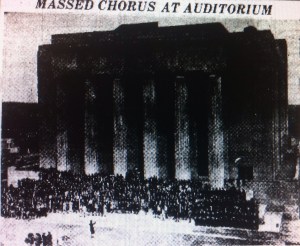
Similarly, 76 years ago, the halls of that building were alive with only the sounds of construction.  But out front, on December 18, 1939, the sounds of Christmas carols filled the air.

That afternoon, 500 school children from elementary schools were joined by the A Capella Choir of Little Rock High School as they sang Christmas carols on the front steps of the auditorium on a weekday afternoon.  The singers were accompanied by the Little Rock High School Brass Sextet.  The invocation for the event, which was sponsored by the Little Rock Council of Parents and Teachers, was delivered by the Right Reverend Richard Bland Mitchell, the Episcopal Bishop of Arkansas.

A Christmas tree in front of City Hall was lit up as part of the ceremony as well.  Media coverage noted that the audience witnessing the program stood on the front steps of the Pulaski County Courthouse, the side lawn of City Hall and in front of the steps of Robinson Auditorium.  It was also noted that most windows in the nearby government buildings were filled with people watching the ceremony.

Little Rock Look Back: LR Mayor Charles Bussey

Mayor Bussey BWFuture Little Rock Mayor Charles Bussey was born on December 18 in 1918.  Throughout his life he was a trailblazer.  He was the first African American Sheriff’s Deputy in Pulaski County and expanded the Junior Deputy program into the African American community.

In 1968 he became the first African American elected to the Little Rock City Board of Directors. He was not the first African American to run for the City Board, but he was the first to win a race.  Mr. Bussey sought support not just from the African American community, but from all sectors of Little Rock.  Apparently, while campaigning in 1968, he deliberately went into the Arkansas headquarters of segregationist presidential candidate George Wallace to see about leaving campaign literature.  A hulking man with a broad smile, he shocked the young receptionist. He was undoubtedly the first (and probably last) African American to enter that campaign headquarters.

He served from 1969-1977 and again from 1979 through 1991.  In 1981 he was selected by his fellow City Directors to serve as Little Rock’s Mayor, which made him the first African American Mayor of Little Rock.  He served as Vice Mayor of Little Rock for a total of 8.5 years which is the longest of anyone in the City’s history.

Throughout his lifetime Mayor Bussey championed youth outreach efforts.  He also was active in the Arkansas Municipal League, National League of Cities, West Little Rock Rotary Club, Elks, Shriners and many other organizations.

In 2006 he was posthumously inducted into the Arkansas Black Hall of Fame.  The previous year, 20th Street in Little Rock was renamed in his honor. In 2015 he was included in the Arkansas Civil Rights Heritage Trail.

Dr. Susanah Shaw Romney, UALR History Professor, receives NEH fellowship

Susanah Shaw Romney, assistant professor of history at the University of Arkansas at Little Rock, received a $50,400 fellowship award from the National Endowment for the Humanities to conduct research on the Dutch empire.

Dr. Susanah Shaw Romney, UALR

Dr. Susanah Shaw Romney, UALR professor and author, lands National Endowment for the Humanities Fellowship.

Romney was awarded the maximum amount under the Fellowships for University Teachers category to pursue her project titled “Personal Interactions and Imperial Geographies in Early Modern Dutch Colonies.”

In addition to Romney, the NEH awarded 294 other projects, for a total of $21.8 million in grants. Only two projects from Arkansas received NEH funding.

“NEH provides support for projects across America that preserve our heritage, promote scholarly discoveries, and make the best of America’s humanities ideas available to all Americans,” said NEH Chairman William D. Adams.

Romney, who plans to write a book based on her research, will conduct a comparative study of the early modern Dutch empire in North and South America, southern Africa, and southeast Asia.

“This fellowship lets me do new research on people and places that I haven’t encountered before. It gives me a chance to read records about Munsee Indians in the Hudson Valley, Khoekhoe people of southern Africa, Dutch traders in Guyana, and South Asian slaves on Java,” said Romney.

“I’ll be able to bring that new perspective to students in my classes at UALR and to the scholarly community through the book that I will write,” she added.                                                  

Romney’s previous book on the Dutch empire, “New Netherland Connections: Intimate Networks and Atlantic Ties in Seventeenth-Century America” garnered several awards, including the 2014 Berkshire Conference of Women Historians Book Prize.

Susanah Shaw Romney is originally from California, and did her undergraduate work in history at UC Santa Cruz. She received her Ph.D. from Cornell University, where she worked with Prof. Mary Beth Norton on women in Colonial America. Her research focuses on gender, race, and the fur trade in the seventeenth-century Dutch colony that later became New York. Her book is the winner of the 2014 Berkshire Conference of Women Historians First Book Prize, 2013 Jamestown Prize (given every two years by the Omohundro Institute of Early American History and Culture), and the 2013 Hendricks Prize from the New Netherland Institute. She is now at work on a new project looking at gender, settlement, and land claims in the seventeenth-century Dutch empire in North America, Guyana, South Africa, and Java. Her research has taken her from the Huntington Library in California, to the Stadsarchief in Amsterdam, to the Western Cape Archives in South Africa. She offers classes at UALR on the colonial period, slavery, the frontier, pirates, gender, and other topics.

For more information about recently awarded NEH grants, go to www.neh.gov/news.

About the National Endowment for the Humanities

Created in 1965 as an independent federal agency, the National Endowment for the Humanitiessupports research and learning in history, literature, philosophy, and other areas of the humanities by funding selected, peer-reviewed proposals from around the nation. Additional information about the National Endowment for the Humanities and its grant programs is available at www.neh.gov.

Grants for Rep, ASO, Oxford American announced by National Endowment for the Arts

nea-logo-960Three Little Rock based cultural institutions were among the eight Arkansas recipients of National Endowment for Arts grants recently announced.

These were Art Works and Challenge America grants. Art Works grants supports the creation of art that meets the highest standards of excellence, public engagement with diverse and excellent art, lifelong learning in the arts and the strengthening of communities through the arts. Challenge America grants offer support primarily to small and mid-sized organizations for projects that extend the reach of the arts to underserved populations whose opportunities to experience the arts are limited by geography, ethnicity, economics or disability.

The Arkanas Repertory Theatre received $15,000 to support a production of An Iliad by Lisa Peterson and Denis O’Hare.  The playwriting team has adapted Homer’s Trojan War epic into a compelling monologue that captures both the heroism and horror of warfare. A key theme is the personal cost of war. The theatre will continue and deepen its ongoing partnership with the Little Rock Air Force base and will engage with the service members and their families during the project. During the performance run, veterans returning from service overseas will share their personal stories as part of a post-performance community conversation. Activities will occur in the theater’s newly constructed second stage and center for community engagement on the Main Street Creative Corridor.

The Arkansas Symphony Orchestra received $10,000 to support performances and educational workshops that will culminate in the world premiere performance of a composition by D.J. Sparr, featuring guitarist Ted Ludwig.  The composition is inspired by Ludwig’s flight from New Orleans following Hurricane Katrina. In addition to performances, electric guitarists Ludwig and Sparr will lead workshops for student musicians and community members from central and southeastern Arkansas, including a high percentage of low-income residents.

The Oxford American received $20,000 to support the publication and promotion of the magazine.  Exploring the complexity and vitality of the American South, the magazine publishes poetry, fiction, creative nonfiction, and criticism by emerging and established authors. The magazine will be promoted through social media, the magazine’s website, a weekly e-newsletter, and events throughout the South.

In addition, TheatreSquared in Fayetteville received $25,000 for its Arkansas New Play Festival. This is presented in Fayetteville and Little Rock. The Little Rock performances are in conjunction with the Arkansas Rep.

Other Arkansas recipients were the Walton Arts Center, Sonny Boy Blues Society (for the King Biscuit Blues Festival), Ozarks Foothills Film Festival and John Brown University.

Fourteen new names added to 2015 Arkansas Civil Rights Heritage Trail

2015 ACRHTLast month, the University of Arkansas at Little Rock Institute on Race and Ethnicity unveiled the 2015 Arkansas Civil Rights Heritage Trail markers. This year’s theme is “Politics and Law” to commemorate the 50th anniversary of the passage of the Voting Rights Act of 1965.

The fourteen new markers are installed at Scott and Markham Streets near the Statehouse Convention Center.

Established in the summer of 2011, the Arkansas Civil Rights Heritage Trail honors those who made significant contributions to civil rights in Arkansas. The trail raises public awareness of the long and rich legacy of Arkansas’s civil rights history.

A 12-inch bronze marker is placed in the sidewalk for each honoree. The trail begins in front of the Old State House Convention Center on Markham Street and will eventually extend to the William J. Clinton Presidential Center and Park and other points throughout the downtown corridor.

This year’s 14 honorees are:

  • Annie Mae Bankhead, who was a community activist in Pulaski County’s black College Station neighborhood
  • Wiley Branton, Sr., who was head of the Southern Regional Council’s Voter Education Project in the 1960s
  • Charles Bussey, who was leader of the Veterans Good Government Association and became Little Rock’s first black mayor in 1980
  • William Harold Flowers, who laid the foundations for the Arkansas State Conference of National Association for the Advancement of Colored People branches
  • Jeffrey Hawkins, who was for decades the unofficial mayor of Little Rock’s black East End neighborhood
  • Irma Hunter Brown, who was the first black woman elected to the Arkansas General Assembly
  • Scipio Africanus Jones, a leading black Republican who defended 12 prisoners for their role in the 1919 Elaine Race Riot
  • Mahlon Martin, who was the first black city manager of Little Rock
  • I.S. McClinton, who was head of the Arkansas Democratic Voters Association, a forerunner of today’s Black Democratic Caucus
  • Richard L. Mays and Henry Wilkins III, who were among the first blacks elected to the Arkansas General Assembly in the 20th century in 1972
  • Olly Neal, who was the first black district prosecuting attorney in Arkansas and later served on the Arkansas Court of Appeals
  • Lottie Shackelford, who was the first black woman mayor of Little Rock
  • John Walker, who for more than five decades has been involved in civil rights activism in the courts, most notably in school desegregation cases

Dr. John Kirk is the director of the Institute.  At the November ceremony, he spoke along with UALR Chancellor Joel Anderson. At a reception following the ceremony, Senator Joyce Elliott gave a toast in honor of the 14 and several of the honorees or their descendants spoke.