
June 2nd Friday Art Night at Historic Arkansas Museum

Join Historic Arkansas Museum for June’s 2FAN! Jacob Flores Music will be the evening’s musical guest. Flyway Brewing will be the featured brewery.

In addition, there will be a couple of new objects to view in our galleries. While the Arkansas Arts Center is closed for renovations, institutions around Little Rock will host artwork from their collections. HAM is excited to display a delightful wooden mechanical toy created around 1960 by Arkansas artist Marvin Warren (1895-1994). Woman with Spinning Wheel and Man with Banjo is a humorous depiction of life in rural Arkansas, made in the Southern folk art tradition.
Also new in HAM’s exhibit Life in the Western Country is a portrait of prominent Arkansan Peter Hanger (1807-1895) painted by nationally-recognized portrait and landscape painter John Mix Stanley (1814-1872), who became well-known for his genre scenes of Native Americans. Stanley stayed in Van Buren (Crawford County) for a short time, where he painted a portrait of his host, Peter Hanger. The portrait is on loan to the museum from Kathy and Adam Ratcliffe, Peter Hanger’s descendants.

The reception is sponsored by the Historic Arkansas Museum Foundation, with special thanks to 107 Liquor. Beverages and appetizers will be served in the Stella Boyle Smith Atrium. The exhibits and reception are free and open to the public.

Little Rock Look Back: First Little Rock High School graduation

The Sherman School at 7th and Sherman Streets, which contained Little Rock’s first high school. It is now the site of the Kramer School apartments.

On June 13, 1873, the first Little Rock High School graduation ceremony took place. Newspaper accounts do not indicate how many were in the class.

The ceremony took place at the Centenary Methodist Episcopal Church, North, which was located on Main Street in the 400 block.  (Part of the Little Rock Technology Park is now on a portion of that site.)

Miss Eva K. Smith, the class Salutatorian was unable to attend and bring opening remarks due to illness.  However, several other speeches by students were given including “Earth’s Battlefields” by Mattie A. Chrisman, “Arkansas, Her Past and Future” by Marcus Mentzer, “Turning the Leaves” by Mary W. Smith, and “Water” by Ella Wood.  Mr. Mentzer also delivered a valedictory address which was praised by those in attendance, according to newspaper accounts.

School Board President Frederick Kramer also made remarks as did the school’s principal, Mr. Helm, and General A. W. Bishop.  Mr. Kramer also passed out the diplomas.

While education opportunities had been offered in Little Rock since the 1820s, these had been with private tutors or private academies.  A one room public school was created in the 1850s and governed by the City of Little Rock. No records exist of anyone graduating from that school.  In February 1869, the Arkansas General Assembly authorized the creation of school districts in cities as separate entities.  Little Rock voters approved the establishment of a Little Rock public school system.  Classes began in the autumn of 1869.

The Sherman School was originally built as one of Little Rock’s elementary schools but also contained the first high school classes.  In 1885, high school classes moved to 14th and Scott Streets to the Scott Street School. In 1890, they moved to the Peabody School at Capitol and Gaines Streets where they were located until the new Little Rock High School opened in 1905. This building was constructed on the site of the old Scott Street School. Today it is the East Side lofts. It served as Little Rock High School until 1927 when what is now Little Rock Central High School opened.

In the 1860s and 1870s, African American students studied at Capitol Hill and Union schools, which both contained elementary and secondary classes. By the early 1900s, Gibbs High School had opened as a new elementary and secondary school for African American students. It would serve as the City’s African American high school until Dunbar opened in 1929.

Stained Glass windows focus of tonight QQA Preservation Conversation

The Quapaw Quarter Association is hosting its next “Preservation Conversation” tonight.
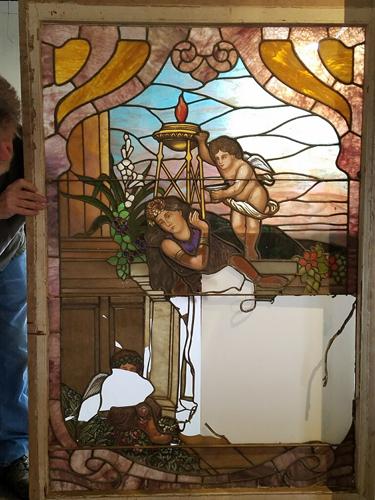
Jay King’s talk will cover history of stained glass, the care and maintenance of antique windows, what a basic repair job entails as opposed to full scale restoration,and the commission process.
The program starts at 6pm, with a 5:30pm reception preceding it.  It will be in the Mixing Room at the Old Paint Factor in the East Village (1306 East 6th Street).
Jay King began his career in glass repairing antique stained glass windows in Chicago’s Old Town. In 1974 he moved to Austin, Texas where he learned the art of constructing windows while working at Renaissance Glass Co. and several other local studios. In 1988 he set his sites for Eureka Springs, AR, but found too much to fall in love with in Little Rock, so has been here ever since. He decided to start up his own stained glass studio, Arkansas Glassworks, in 1993.
As Arkansas Glassworks, Jay has built stained glass windows for numerous homes and churches around the state. These days, churches are his main focus, but he continues to both build and repair windows for homes as well. He still manages to make the occasional window that calls him to build, regardless of commission. He’s also known to teach his craft to the few who are still around who want to learn it.

Parking: There is parking directly in front of the doors that are marked “live,” “print,“ “meet.” If those spots are taken. park in the parking lot to the right. There is also street parking in front of the building.

Entrance: Enter the event space through the door facing 6th Street marked “meet.”

Questions? Call 501-371-0075 ext. 3 or email qqa@quapaw.com<

On Anne Frank’s birthday – a look at the Anne Frank trees in Little Rock

Ninety years ago today, on June 12, 1929, Anne Frank was born in Frankfurt, Germany.  Through her diary, she has inspired generations with her courage as her family was in hiding from the Nazis.  During the two years she and her family were in seclusion, she looked out and saw a white horse chestnut tree from her window.

In 2009, the Anne Frank Center USA announced an initiative to place saplings from the tree at various locations throughout the United States.  Little Rock became the only city to receive two saplings.  One to be placed at Central High School, the other to be placed at the Clinton Presidential Center.

The Clinton Foundation and the Sisterhood of Congregation B’nai Israel, in conjunction with the Anne Frank Center USA, joined together to create a powerful exhibit, The Anne Frank Tree, located on the grounds of the Clinton Presidential Park.  The permanent installation, which surrounds the Anne Frank Tree sapling, was dedicated on October 2, 2015.

Anne’s tree would outlive her by more than 50 years before being weakened by disease and succumbing to a windstorm in 2010. But today, thanks to dozens of saplings propagated in the months before its death, Anne’s tree lives on in cities and towns around the world.
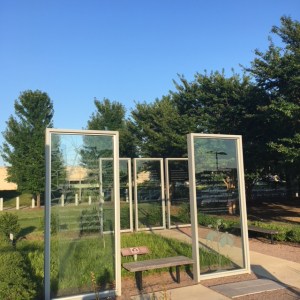
The Anne Frank Tree installation at the Clinton Center consists of five framed, etched glass panels – arranged to evoke the feeling of being inside a room – surrounded by complementary natural landscaping. The two front panels feature quotes from Anne Frank and President Clinton. The three additional panels convey the complex history of human rights in Arkansas through descriptions of the Indian Removal Act of 1830, the internment of Japanese Americans during World War II, and the Little Rock Central High School desegregation crisis of 1957. These panels feature quotes from Chief Heckaton, hereditary chief of the Quapaw during Arkansas’s Indian Removal; George Takei, Japanese-American actor who was interned at the Rohwer Relocation Center in Desha County, Arkansas, in 1942; and Melba Pattillo Beals, of the Little Rock Nine.

In collaboration with the Clinton Foundation, Little Rock landscape architect Cinde Bauer and Ralph Appelbaum Associates, exhibit designer for both the Center and The National Holocaust Museum, assisted in the design of the exhibit. The installation has been made possible thanks to the support of the Ben J. Altheimer Charitable Foundation, TRG Foundation, and other generous partners.

50 Years ago – World Premiere of TRUE GRIT takes place in Little Rock at Cinema 150

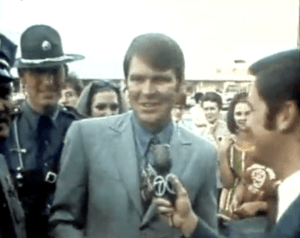
Glen Campbell speaks with Larry McAdams of KATV at the opening of TRUE GRIT.

On June 12, 1969, the world premiere of the film TRUE GRIT took place at the Cinema 150.

Actor/singer (and Arkansas native) Glen Campbell was in attendance at the event, but another Arkansan connected to the movie – author Charles Portis, did not attend.

Portis’ objection was that the film was being used as a fundraiser for the Democratic Party of Arkansas, and he was a supporter of Governor Winthrop Rockefeller, a Republican. Portis described himself as a Rockefeller Democrat.  The next night, in Hot Springs, Portis hosted what was billed as the “Author’s Premiere.”

While Portis may have been absent (and there is no way that GOP stalwart John Wayne would have considered coming to the premiere), the Cinema 150 was sold-out.  Press accounts noted that attendees ranged from Senator J. William Fulbright and Rep. Bill Alexander to former office holders Orval Faubus and Bruce Bennett (who presumably took a break that evening from trying to prove who was the more ardent segregationist).

Quite a few in attendance also had their eye on 1970’s Democratic primaries including Attorney General Joe Purcell and Secretary of State Kelly Bryant.  No mention was made in the media if Charleston, Arkansas, attorney Dale Bumpers was in attendance.

The film was cheered by those in attendance, although some did comment about the presence of snow-capped mountains in the film that was set in Arkansas and Oklahoma. But that was a minor quibble. (The film was shot in Colorado.)

Following the premiere, the party continued under a big circus tent, set up that evening in the parking lot of the shopping center at the southwest corner of Asher and University (now the home to Murry’s Dinner Playhouse).

The Pryor Center for Arkansas Studies has compiled a video clip from the opening.  It can be viewed here.

Anne Frank lecture this evening at Pulaski Tech

Image may contain: indoor

In conjunction with the touring exhibitions, “Anne Frank: A Private Photo Album” and “Anne Frank: A History for Today,” UA-Pulaskii Tech invites the public to join them for a panel discussion in honor of what would have been Anne Frank’s 90th birthday, on June 12 at 6:00pm in The Center for Humanities and Arts Theater.

In partnership with the Jewish Federation of Arkansas and moderated by its Executive Director, Marianne Tettlebaum, panelists will include: Aniko Diamant, Holocaust Survivor, originally from Budapest, Hungary; Dr. Dorian Stuber, Isabelle Peregrin Odyssey Professor at Hendrix College; and Rabbi Yosef Kramer, Program Director, Lubavitch of Arkansas.

The event is free and open to the public. For more information contact Debra Wood at dwood@uaptc.edu or 501.812.2715

70 Years Ago Today – War Memorial Park dedicated by President Truman with foreign affairs address

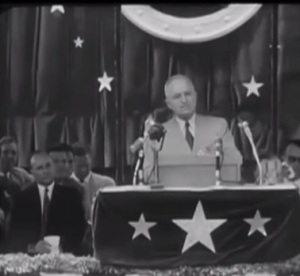
Though President Truman was in Little Rock for a military reunion, he did conduct some official business while here.  In his Presidential role, he spoke at the dedication of War Memorial Park on June 11, 1949.

(It is sometimes erroneously reported that he dedicated the stadium.  That took place in September 1948, at a Razorback game with former Razorback player and future Lt. Governor Maurice “Footsie” Britt delivering the keynote.)

President Truman’s address took place inside War Memorial Stadium at 2:30 p.m..   It was not a brief dedicatory speech, but instead was a lengthy treatise on foreign affairs.  The address was carried live on nationwide radio (though some radio networks opted to broadcast it later).  The text of his address can be found here.

The stadium was by no means full.  A major reason for that was that many thousand individuals had turned out to witness a parade downtown in which President Truman marched along side Governor Sid McMath.  The parade was in conjunction with the military reunion.  Given the June heat in Arkansas (in which parade spectators had been standing for several hours) and the difficulty of getting from the parade route to the stadium, most (if not all) parade spectators opted for skipping the presidential address.

Before the parade, President Truman (who was still riding high from his upset victory in the 1948 election) was asked by a local reporter if he would run in 1952. He refused to answer stating that the national media would think he had planted the question with a local member of the press.

Prior to the name War Memorial Park, the land had been known as Fair Park.  It was a former location of the State Fair.  In the 1930s, it had briefly been known as Overman Park in honor of then-Mayor R. E. Overman.  The City Council had named it for him as a tribute to his work on a variety of projects. When he displeased them, they reversed their decision and renamed it to Fair Park.