
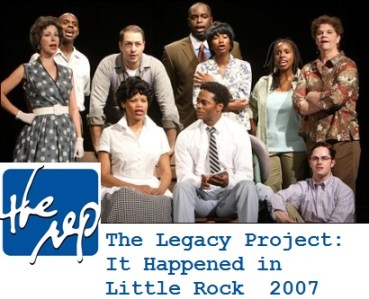
31 Days of Arkansas Rep: THE LEGACY PROJECT: IT HAPPENED IN LITTLE ROCK

Since today is Elizabeth Eckford’s birthday, the past Arkansas Rep production that is featured is 2007’s The Legacy Project: It Happened in Little Rock.

Culled from three years of research and over 80 interviews, playwright and director Rajendra Ramoon Maharaj created a multi-faceted play with music that explored stories past and present of Central High’s desegregation and the legacy the events of those years have provided citizens of Little Rock, of Arkansas and of the United States.

The cast featured Destan Owens (playing parallel roles of a 1957 Harlem reporter and a 2007 artist (a stand-in for Maharaj) as well as nine other actors who played multiple roles of diverse ethnicity — from current Central students to the Little Rock Nine, from elected officials to blue-collar workers.  Those actors were J. Bernard Calloway, Mary-Pat Green, Taifa Harris, Shannon Lamb, Vanessa Lemonides, Arthur W. Marks, Gia McGlone, Nick Petrie and Julian Rebolledo.

The creative team included Sybil Roberts Williams (dramaturg), Michael Susko (choreographer and assistant director), Charles Creath (musical director) Steve Hudelson (musician), Mike Nichols (scenic design), Matthew Webb (lighting design), Leslie Bernstein (costume design), M. Jason Pruzin (sound design) and Lynda Kwallek (properties). Producing Artistic Director Bob Hupp and Education Director Leslie Golden were also involved in shepherding the project over the years.

Funding for the production came, in part, from the Winthrop Rockefeller Foundation and the National Endowment for the Arts.

The production ran from September 14 to September 30, 2007, in conjunction with other events commemorating the 50th anniversary.

In 2008, Maharaj directed a play called Little Rock Off Broadway. While a separate piece of drama, it was based on the research he conducted and infused by his experiences creating The Legacy Project: It Happened in Little Rock.
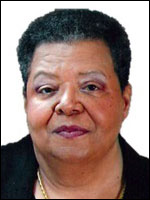
 

Happy Birthday to Elizabeth Eckford

After 60 years, the most dramatic images of the 1957 crisis at Little Rock Central High School remain those of 15-year-old Elizabeth Eckford, being taunted as she walked through a hate-filled mob, on her way to school.  Today, Ms. Eckford recalls how difficult it was for her parents, Oscar and Birdie, to allow her to continue the struggle to integrate the Little Rock schools.

Last month, a replica of the bench on which she sat on that first day in 1957 was unveiled.  Instead of sitting on a bench surrounded by taunters, this time she sat on a bench surrounded by cheers and applause.  The bench was the latest project of the Central High Memory Project which has also produced an audio tour which takes listeners down the street as Ms. Eckford experienced it in 1957.

Born on October 4, 1941, she grew up in Little Rock.  Because all of the city’s high schools closed her senior year, Ms. Eckford moved to St Louis, where she obtained her GED. She attended Knox College in Illinois, and received her BA in History from Central State University in Wilberforce, Ohio.  While in college, Ms. Eckford became one of the first African Americans to work in a local St. Louis bank, in a non-janitorial position, and later she worked as a substitute teacher, in Little Rock public schools.

Ms. Eckford, a veteran of the U.S. Army, has also worked as a substitute teacher in Little Rock public schools, test administrator, unemployment interviewer, waitress, welfare worker, and military reporter.  Along with her fellow Little Rock Nine members, she is a recipient of the NAACP’s Spingarn Medal and the prestigious Congressional Gold Medal.  Together with one of her former tormenters, Ms. Eckford also received a Humanitarian award, presented by the National Conference for Community and Justice (NCCJ), following their meeting 34 years after an apology.  The award recognizes forgiveness and atonement.  They talked to students for two years, and, together, attended a 12-week racial healing course.

Ms. Eckford has started to walk through the painful past in sharing some of her story.  She has said that true reconciliation can occur if we honestly look back on our shared history. She believes that the lessons learned from Little Rock Central High School must continue to be shared with new generations, reminding audiences that “the dead can be buried, but not the past.”  Ms. Eckford continues her interest in education by sharing her story with school groups, and challenges students to be active participants in confronting justice, rather than being passive observers.

Little Rock Look Back: Bill Clinton Announces Run for Presidency

The Clintons following his remarks.

On October 3, 1991, Governor Bill Clinton strode out the front doors of the Old State House Museum and announced his intentions to seek the 1992 Democratic Party’s nomination for President of the United States.

He was the fifth major Democrat to announce for the office. That there were that many by early October was somewhat surprising considering that the first half of 1991 saw many national Democrats announce they were NOT seeking the office.

Jerry Brown, Bob Kerrey, Paul Tsongas, and Tom Harkin were also in the race.  Clinton was seen as a centrist, along with Senator Kerrey while the others were viewed as being from the far-left wing of the Democratic Party.

In its coverage of the announcement, The New York Times noted the significance of Gov. Clinton’s remarks on race.  In the speech he referenced his desire to strengthen relations and remove barriers between the races.  As the Times pointed out, it was at the Old State House that Arkansas held two conventions on the issue of secession prior to the state’s entry into the Civil War.

At the time of the announcement, Gov. Clinton was far from a frontrunner. His national profile was probably the lowest of any of the announced candidates. Most of the knowledge of him outside of Little Rock came from his lengthy speech about Michael Dukakis at the 1988 Democratic Convention and the subsequent appearance on “The Tonight Show” where both he and Johnny Carson poked fun as his loquaciousness.

Regardless of their views on his chances, the Governor’s family, friends, and fans packed the front lawn of the Old State House to cheer him.  The national media treated him as a serious, albeit largely unknown, candidate.  After having had Wilbur Mills, Dale Bumpers and others flirt with running and then backing out, the local media were probably thrilled to finally have someone from Arkansas actually running for the presidency.

One local media outlet would not see much of the campaign. Just fifteen days later, the Arkansas Gazette would close. As a paper which had covered nearly two decades of his career, the Gazette was often Clinton’s champion, though the paper was not afraid to point out times the two differed.  However, there would be no Gazette headline about Clinton in New Hampshire, at the Democratic Convention, or a general election victory.

On Election Day in 1992 and again in 1996, Bill Clinton would repeat the stride out the front doors of the Old State House accompanied by his wife and daughter.  Those two times the crowds would spill down the streets in all directions. Instead of a handful of media outlets there would be scores of them.

But it all started on a sunny autumn day in Little Rock in early October 1991.

31 Days of Arkansas Rep: KENNEDY’S CHILDREN in 1977

Since October 3, 2018, marks the 55th anniversary of JFK speaking in Little Rock, it seems an appropriate day to feature the 1977 Arkansas Rep production of Robert Patrick’s KENNEDY’S CHILDREN.

The play takes place in a NYC bar on Valentine’s Day 1974 as its denizens speak in intertwining monologues about the 1960s and coping with the disillusions they feel from that earlier decade.  The title comes from the sense that the 1960s after November 1963 were a reaction to the loss of JFK and his idealism.

One of the characters, who was played by Jean Lind at Arkansas Rep, is obsessed with the Kennedy Administration. Others in the cast were Jean Hendrickson, Phyllis Blumenfeld, Scott Edmonds and Barry Carter.  Guy Couch played the important, but non-speaking, role of the bartender who plies the quintet with drinks throughout the play.

In the original production, there is a jukebox which plays musical interludes as transitions. In a nod to director Cliff Fannin Baker’s ingenuity, that role was played by Frank Gordon on jazz clarinet. It actually added a sense of humanity and added soulfulness to the production.

The bar in which the action took place was designed and lit by Byl Harriell.  The physical presence was described by Bill Lewis in the Arkansas Gazette review as a “masterful sleezy bar.”

The production ran from December 1 through 17 in 1977. Tickets were $5.00 a person. (This is the equivalent of $20.80 today.)

JFK in ARK (and specifically LR)

On October 3, 1963, President John F. Kennedy delivered remarks at the Arkansas State Fairgrounds.  Only a few weeks later, he would be felled by an assassins bullet in Texas.

In the speech, the President praised Arkansas’ congressional delegation including Senators John McClellan and J. William Fulbright and Congressmen Took Gathings, Bill Trimble, Wilbur Mills and Oren Harris.  Each of these men held senior leadership positions in key committees.  The main focus of the speech was to discuss President Kennedy’s vision for a new economy in the South.

The President was actually in the state to speak at the dedication of the Greers Ferry Dam. He agreed to make that appearance as a part of a negotiation with Congressman Mills as they were deadlocked over changes to the tax code.  He had previously visited Little Rock in 1957 when he came to the state to address the Arkansas Bar Association meeting in Hot Springs.

President Kennedy continued the string of 20th Century Presidents to visit Little Rock.  Presidents Theodore Roosevelt, William Howard Taft, Franklin Roosevelt and Harry Truman had all visited while in office.  Woodrow Wilson, Herbert Hoover and Dwight Eisenhower all visited prior to attaining the presidency.

31 Day of Arkansas Rep: THE RUNNER STUMBLES in 1979

Pat Brown, director of THE RUNNER STUMBLES

While he directed most shows at the Rep during the early years, Cliff Fannin Baker would bring in guest directors from time to time. One of these was Pat Brown who helmed the February 1979 production of The Runner Stumbles.

A co-founder of Houston’s Alley Theatre, Brown also had connections to Little Rock; she was a niece of Little Rock businesswoman Mae Horn (who dressed ALL the best-dressed men.)

Though Brown had worked all over the US, this was the first time she had directed The Runner Stumbles. This Milan Stitt play had run for 396 performances on Broadway from 1976 to 1978. The Arkansas Rep was one of the first regional theatres to produce the play.  (Side note: the original Broadway production was directed by Austin Pendleton who would later direct A Loss of Roses at Arkansas Rep.)

In his Arkansas Gazette review, Bill Lewis called the production “one of the strongest yet” for the Rep.  He described it as a “compelling, somber drama” that was “impeccably directed and acted with highest octane virtuosity.”  Lewis was not one to mince words, so when he gave praise it was deserved.

The cast for A Runner Stumbles included Craig Fuller, Jean Hendrickson, Scott Edmonds, Jean Lind, Ron Aulgur, Ken Klingenmeier, Jeannine Le May, Robert Boles, and Phyllis Blumenfeld. The show was designed by Byl Harriell.  Guy Couch assisted with set decoration and props.

The production ran from February 1 to 18 of 1979.

Little Rock Look Back: Mayoral Election of 1832

Little Rock’s 73rd Mayor will take office on Tuesday, January 1, 2019.  In the next few weeks, past races for mayor will be featured on Tuesdays.

Up first is the the first race for mayor.  It was between Dr. Matthew Cunningham and Rev. W. W. Stevenson.

  • Dr. Cunningham had been a founding father of Little Rock.  He was the first physician, husband of the first woman to be a permanent settler of Little Rock, and father of the first baby born to a Little Rock resident.
  • Rev. Stevenson was a member of the Presbyterian clergy as well as a geologist.  He had first come to Batesville before settling in Little Rock.

In November 1831, the Town of Little Rock was officially chartered by the Territory of Arkansas.  The first election was set for New Year’s Day, 1832.

On the appointed day, the white men who were eligible to vote gathered at the prescribed location and cast their votes. By a vote of 23 to 15, Dr. Cunningham won the race. There are no media accounts of issues that may have arisen during the campaign, or if there was even much of a campaign.

Dr. Cunningham served as Little Rock’s first mayor during the calendar year of 1832 but did not seek a second term.  His successor was Rev. Stevenson. Records suggest that Rev. Stevenson may have been unopposed in his quest. He, too, served only one year.  Later in the 1830s, some friends tried to recruit him to run for mayor again, but he declined.