CALS Branch Up for Best Public Library

Hillary Clinton Children’ s Library and Learning Center (photo courtesy of Polk Stanley Wilcox)

And then there were 32!

The Central Arkansas Library System’s Hillary Clinton Children’s Library and Learning Center is advancing in a national competition for the Best Public Library.  The search is sponsored by Engaging Local Government Leaders (ELGL).

The competition started with 116 libraries spread throughout all 50 states.  CALS was the only library system with three nominees. They were the Main Branch, the Roosevelt Thompson Branch, and the Hillary Clinton Children’s Library and Learning Center.  After over 11,000 votes were cast, the top 32 were announced on Saturday.

The next round features 32 libraries from 25 states.  You can vote for Little Rock, here!  Voting runs through February 2!  You can only vote once, so encourage others to do so, too!

The award is named for fictional city government employee extraordinaire Leslie Knope.

CALS renames Ark Studies Institute for former Director Bobby Roberts

The Central Arkansas Library System (CALS) has renamed the Arkansas Studies Institute (ASI) the Bobby L. Roberts Library of Arkansas History and Art in honor of the former CALS executive director who served in the position for more than twenty years before retiring in 2016. CALS Board of Trustees approved the motion in December.

“Bobby established a new normal at CALS by creating new concepts of what the public library could offer the community and by constructing unique spaces to make the library more appealing and accessible to all sorts of groups with varied interests in learning, enrichment, and entertainment,” said Nate Coulter, CALS executive director. “The library’s primary purpose has always been to provide access to information, but Bobby transformed and expanded what it means to be a library by placing a particular emphasis on Arkansas history and culture.”

Since the early 1990s, CALS has undergone several changes and expansions, now consisting of fourteen library locations in Little Rock, Perryville, and throughout Pulaski County. The Main Library moved from its original location at 7th and Louisiana to its current home in the River Market District, which helped trigger the revitalization of downtown Little Rock. That Main Library is now the centerpiece of a campus that includes the Ron Robinson Theater, the Cox Creative Center, and the Bobby L. Roberts Library of Arkansas History and Art (formerly ASI). Former CALS Board members spoke of Roberts’s leadership and his vision for the library system. Susan Fleming and Sheila Wright, former board vice-president and president, respectively, said Roberts’s vision and commitment to excellence are reflected in the building that will be displaying his name. Former CALS board member Frederick Ursery expanded on their thoughts:

“Our library system has been fortunate throughout its history to have strong leadership from numerous members of our community,” said Ursery. “However, I am not aware of any single person who has done more than Bobby Roberts to make CALS the dynamic asset that it is today. He deserves to be recognized for his achievement.”

Roberts’s efforts in building striking library structures, in ecologically sustainable construction, and in adaptive reuse have been recognized by local, state, national, and international organizations. That includes the newly named Roberts Library. Opened in 2009, as the Arkansas Studies Institute, the structure houses the Butler Center for Arkansas Studies, CALS’s Arkansas history department, and five galleries that feature art depicting the state or created by artists living in or from Arkansas.

“This complex of buildings certainly wouldn’t be here if it hadn’t been for Bobby Roberts. It is truly fitting for this edifice to be named in his honor,” said David Stricklin, director of the Butler Center.

Roberts’s special interests in Arkansas history and art and CALS’s long-held practice of collecting materials for the benefit of patrons interested in those topics helped inspire the conception of the ASI, which also houses the UA Little Rock Center for Arkansas History and Culture. The university’s Arkansas-related documents and photographs were moved to the facility and are available for public use under an arrangement Roberts developed with former UA Little Rock Chancellor Joel Anderson. The building is also home to the Arkansas Humanities Council’s headquarters and classrooms and offices for the Clinton School of Public Service.

Little Rock Look Back: First edition of ARKANSAS GAZETTE to be published in Little Rock

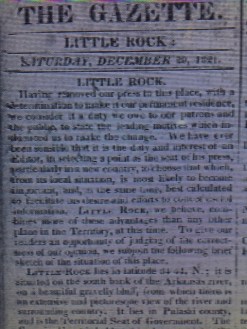
First LR ArkGaz front

First LR ArkGaz insideAfter months of planning, on December 29, 1821, the first edition of ARKANSAS GAZETTE to be published in Little Rock came off the press.  Due to a shortage of paper supplies, it was only a two page edition, instead of the four pages which publisher William Woodruff had been customarily printing.

Because the capitol of the Arkansas Territory had moved from Arkansas Post to Little Rock earlier in 1821, Woodruff wanted to relocate as well.  Not only did it make sense for a newspaperman to be close to the seat of government for purposes of stories, there was a financial reason for the move, too.  Woodruff wanted to continue to be the contracted official publisher of government records.  If he stayed in Arkansas Post, someone else would certainly have opened up an operation in Little Rock to do the printing.

The first Little Rock edition featured the usual mix of national news (often culled from other newspapers once they arrived at Woodruff’s establishment), local stories, and advertisements.  One of the stories was a letter from General Andrew Jackson to the citizens of the Florida Territory.  There was also a dispatch from Pernambuco, Brazil.

Because it was the first issue from Little Rock, Woodruff took time to write about Little Rock.  He noted it was located on the south side of the Arkansas River on a “beautiful gravelly bluff” with picturesque views of the river and surrounding areas.  He noted the territorial and federal government offices which were located in Little Rock.

Though the Gazette ceased publication in 1991, the 1821 publication of that paper in Little Rock set the stage for more than just that one newspaper.  It marks a continual presence of newspaper and journal publication in Little Rock for 196 years.


Little Rock Look Back: Adolphine Fletcher Terry

Photos from the collection of the Butler Center

Adolphine Fletcher Terry was born on November 3, 1882 to former Little Rock Mayor John Gould Fletcher and his wife Adolphine Krause Fletcher.

Raised in Little Rock, in 1889 she moved into the Albert Pike House on East 7th Street, when her aunt transferred the title to her father. That house would be her primary residence the rest of her life.  Her sister Mary Fletcher Drennan never lived in Arkansas as an adult after marriage. Her brother John Gould Fletcher spent much of his adulthood in Europe before returning to Little Rock and establishing his own house, Johnswood.

At age 15, Adolphine attended Vassar. She later credited that experience as broadening her views on many issues.  After graduating at age 19, she returned to Little Rock.  Her parents both died prior to her 1910 wedding to David D. Terry, which took place at what was then known as the Pike-Fletcher House (and today is known as the Pike-Fletcher-Terry House).

She is perhaps best known today for establishing the Women’s Emergency Committee in 1958 and for her subsequent deeding of the family house to the City for use by the Arkansas Arts Center.  But her entire life was based on civic engagement.

She was instrumental in establishing the first juvenile court system in Arkansas and helped form the first school improvement association in the state. She was long an advocate for libraries, serving 40 years on the Little Rock public library board.  Through her leadership, the library opened its doors to African Americans in the early 1950s. Today a branch of the Central Arkansas Library System (the successor the Little Rock public library) is named after her.  Another branch is named after her Pulitzer Prize winning brother.

Adolphine formed the Little Rock chapter of the American Association of University Women, the Pulaski County tuberculosis association and the Community Chest.

In 1958, when the Little Rock public high schools were closed instead of allowing them to be desegregated again, she called Harry Ashmore the editor of the Gazette and exclaimed, “the men have failed us…it’s time to call out the women.”  With this, she formed the Women’s Emergency Committee to Open Our Schools. This group played a major role in getting the four high schools open the following year.

From 1933 to 1942, David Terry served in the U.S. Congress. During that time, Adolphine alternated her time between Washington DC and Little Rock. But she spent much time in Little Rock raising her five children.

After her husband’s death in 1963, she continued to remain active in civic affairs. In the 1960’s, she and her sister deeded the Pike-Fletcher-Terry House to the City of Little Rock for use by the Arkansas Arts Center upon both their deaths.  Following Adolphine Fletcher Terry’s death in 1976, Mary turned over the title to the City.

Adolphine Fletcher Terry is buried in Mount Holly Cemetery alongside her husband. Three of her children are also buried in that plot.  Her parents and brother are buried in a nearby plot.

Her granddaughters and their families carry on Adolphine Fletcher Terry’s commitment to making Little Rock better.

Little Rock Look Back: J. N. Heiskell

At the age of 87, J. N. Heiskell in 1960.

John Netherland (J. N.) Heiskell served as editor of the Arkansas Gazette for more than seventy years.  He was usually called “Mr. Heiskell” by all, but a very few confidantes felt confident to call him “Ned.”

Mr. Heiskell is the person most responsible for Robinson Center Music Hall being located at the corner of Markham and Broadway.  As Chair of the Planning Commission and editor of the Arkansas Gazette he had twin bully pulpits to promote this location when those on the City Council (who actually had the final say) were looking at other locations.  He felt the location would help create a cluster of public buildings with its proximity to the county courthouse and to City Hall.  Mr. Heiskell finally succeeded in winning over the mayor and aldermen to his viewpoint.

He was born on November 2, 1872, in Rogersville, Tennessee, to Carrick White Heiskell and Eliza Ayre Netherland Heiskell. He entered the University of Tennessee at Knoxville before his eighteenth birthday and graduated in three years at the head of his class on June 7, 1893.

His early journalism career included jobs with newspapers in Knoxville and Memphis and with the Associated Press in Chicago and Louisville. On June 17, 1902, Heiskell’s family bought controlling interest in the Arkansas Gazette. Heiskell became the editor, and his brother, Fred, became managing editor.

Governor George Donaghey appointed Heiskell to succeed Jeff Davis in the United States Senate after Davis’s death in office. Heiskell served from January 6, 1913, until January 29, 1913, when a successor was chosen by the Arkansas General Assembly.  His tenure is the shortest in the U. S. Senate history.  His first speech on the Senate floor was his farewell.  He was also only the second US Senator to live to be 100.

On June 28, 1910, Heiskell married Wilhelmina Mann, daughter of the nationally prominent architect, George R. Mann. The couple had four children: Elizabeth, Louise, John N. Jr., and Carrick.

In 1907, he joined a successful effort to build the city’s first public library. He served on the library board from that year until his death and was issued the first library card.  He also served on the City’s Planning Commission for decades.  In 1912, he was instrumental in bringing John Nolen to Little Rock to devise a park plan.

In the paper and in his own personal opinions, he crusaded on a variety of progressive causes.  Perhaps the most famous was the Gazette’s stance in the 1957 Central High desegregation crisis.  It was for this effort that the paper received two Pulitzer Prizes.

Although Heiskell stopped going to the office at age ninety-nine, he continued to take an active interest in the newspaper. He began by having a copy of the newspaper delivered to his home by messenger as soon as it came off the press each night. Eventually, he switched to having his secretary call him daily at his home and read the entire newspaper to him. He operated on the premise that “anyone who runs a newspaper needs to know what’s in it, even to the classified ads.”

A few weeks after turning 100, Heiskell died of congestive heart failure brought on by arteriosclerosis on December 28, 1972. He is buried in Little Rock’s Mount Holly Cemetery.  Interestingly, he is buried in the same cemetery as two of his most notable adversaries: Governor Jeff Davis, and segregationist Congressman Dale Alford.

Mr. Heiskell donated his vast papers to UALR. They are part of the Arkansas Studies Institute collection. These papers give insight into not only his career as a journalist, but also his political and civic affairs.  Thankfully he saved much of his paperwork. Without it, much insight into Little Rock in the 20th Century would be lost.

Central to Creativity – Deborah Mathis

Deborah Mathis has deep Arkansas roots.  She grew up in Little Rock the daughter of Rev. Lloyd Myers, a Baptist minister, and Rachel A. Myers Jones, a teacher.

Her journalistic pursuits began as early as junior high school, when she became the first black editor of West Side Junior High’s school newspaper. In 1970 she became the first black and first female editor of Central High School’s Tiger student newspaper. From the early 70′s through the early 90′s, Mathis was busy establishing herself as a journalist and broadcaster. She served in various positions ” reporter, editor, columnist and anchor ” at statewide media outlets including the Arkansas DemocratArkansas Gazette, KARK-Channel 4, KTH V-Channel 11, and KATV-Channel 7 From Arkansas, Mathis career took her to briefly to Jackson, Mississippi before she landed in Washington, D.C., where she was a White House Correspondent for Gannett News Service from 1993-2000.

Since 1992, Mathis has been a syndicated columnist, appearing in more than 100 U.S. publications and periodicals. She is also a contributor to such outlets as USA Today and BlackAmericaWeb.com and a frequent commentator on political and public affairs talk shows such as PBS’s Frontline, CNNs Inside Politics NPR’s All Things Considered America’s Black Forum and Oprah, to name a few. She also field-produced, wrote and narrated two nationally aired documentaries: “Edukashun: The Cost of Failure” (1982) and “Return of the Little Rock Nine” (1987).

Mathis is the author of Yet A Stranger Why Black Americans Still Don’t Feel at Home, Sole Sisters: The Joy and Pains of Single Black Women and What God Can Do: How Faith Changes Lives for the Better.  She has also been an assistant professor at Northwestern University’s Medill School of Journalism (Washington office).  In 2003, she was inducted into the Arkansas Black Hall of Fame.

Central to Creativity – Ben Piazza


benpiazza book coverActor-director-playwright-author Ben Piazza was born on July 30, 1933, in Little Rock, and graduated from Little Rock High School in 1951 as valedictorian. He also had starred in the senior play that year (The Man Who Came to Dinner) and edited the literary magazine.

After graduating from Princeton, he moved to New York City to become an actor.  He made his Broadway debut in 1958 in Winesburg, Ohio.  In April 1959, he starred in Kataki and received a Theatre World Award for his performance.

As the 1960s dawned, Piazza joined a small cadre of actors who had achieved status on Broadway who then also returned to acting Off Broadway.  Colleen Dewhurst, George C. Scott, and James Earl Jones were others in this select group who helped establish Off Broadway as an entity in itself, instead of being just a farm team for Broadway.

In February 1963, he took over the role of Nick in the original run of Who’s Afraid of Virginia Woolf? on Broadway.  During the run of this show, Piazza’s novel The Exact and Very Strange Truth was published.  It is a fictionalized account of his growing up in Little Rock during the 1930s and 1940s.  The book is filled with references to Centennial Elementary, Westside Junior High, Central High School, Immanuel Baptist Church and various stores and shops in Little Rock during that era.

In August of 1967, his play The Sunday Agreement premiered at LaMaMa.  This was Piazza’s first playwright output to be professionally staged.  In March 1969, a double bill of his one-acts: Lime Green/Khaki Blue opened at the Provincetown Playhouse.  It

Throughout the 1960s and early 1970s, Piazza toured in many plays nationally and internationally. He also appeared in major regional theatres as an actor and a director.  As the 1970s progressed, he turned his focus to television and movies.

Piazza’s film debut had been in a 1959 Canadian film called The Dangerous Age. That same year, his Hollywood film debut came opposite Gary Cooper in The Hanging Tree.  Throughout the 1950s and 1960s, he appeared in a number of TV shows including Studio One, Kraft Theatre, Zane Grey Theatre, The Naked City and Dick Powell Theatre.

In the 1970s and 1980s, his appearances included I Never Promised You a Rose Garden, The Bad News Bears, The Blues Brothers, and Mask.  On TV, he appeared in Dallas, Dynasty, Saint Elsewhere, Barnaby Miller, Moonlighting and Family Ties. 

Piazza’s final big screen appearance was in the 1991 film Guilty by Suspicion.  He played studio head Darryl Zanuck in this Robert DeNiro-Annette Bening tale of Hollywood during the Red scare.

Ben Piazza died on September 7, 1991.  In 2016, a meeting room in the new Robinson Conference Center was named in his memory.