
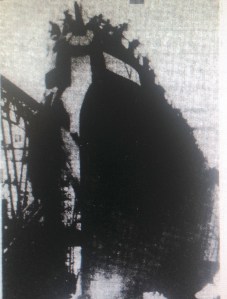
75 years ago, first USS Little Rock was launched

On August 27, 1944, the first USS Little Rock was launched in Philadelphia at the Cramp Shipbuilding Company shipyards.  A 10,000 ton Cleveland Class light cruiser, it first touched water in the Delaware River.

The sponsor of the ship (who broke the champagne bottle on the hull) was Ruth May Wassell, the wife of Little Rock alderman Sam Wassell.  The main address was delivered by Congressman Brooks Hays, whose district included Little Rock.  A crowd of 5,000 was gathered to witness the launch.

According to the Associated Press Congressman Hays called light cruisers, “the hottest item of naval combat.”

The congressman further elaborated:

The people of Little Rock are proud to have such a ship as this bear their city’s name.” said Mr. Hays. “Even those of us who know little about the classification of naval vessels know that the cruisers have distinguished themselves in the Pacific war and that this is the outstanding type of combat vessel for that area. The navy men tell us that the cruiser is the ‘work horse of the navy.’ big enough to go into any battle, fast enough to lead any task force.

Carrying, as it has, the heaviest load in the Pacific where the greatest battles have taken place, the cruisers have added luster to naval history. We hope that, in the time remaining before our enemies are put down, the Little Rock will take her place along side the Boise, the San Francisco, the Helena,and the Chicago, preserving the prestige of the cruisers.

We are glad to honor the workmen and the company for which they work.  I am sure we are all impressed with the spirit of teamwork which produced the results we observe today.  In March 1943, the keel was laid and for 18 months materials for the ship have come from everywhere. The taxes to pay for it will be assessed against men and women of great and little resources. Teamwork from beginning to end did the job.

So with the war.  A glorious victory lies ahead, but there is much remaining to be done. Only teamwork can supply the dynamic power yet needed to complete that victory. Every ship launching is a reminder of the power that comes to a people who work together to achieve.”

Other guests at the ceremony included United States Senator John L. McClellan and Congressman and senator-elect J. William Fulbright. Alderman Sam Wassell was also present.  He and his wife hosted a dinner for the Arkansas delegation and other dignitaries the night before the christening while they were in Philadelphia.

At the request of the Secretary of the Navy, Little Rock Mayor Charles Moyer designated Mrs. Wassell for the honor of sponsoring the USS Little Rock. There are not details as to why Mayor Moyer made the designation.  A first cousin of Alderman Wassell, Dr. Corydon Wassell had been an early World War II hero and was a favorite of President Franklin Roosevelt.  Paramount had released a movie about him earlier in 1944. That may have been a reason for the designation.

The Little Rock City Council sent a bouquet of roses to the ceremony, fitting since the city’s nickname at the time was “City of Roses.” After the launch, Mrs. Wassell sent a telegram to Mayor Moyer and the Council

Thanks a million for the beautiful bouquet of red roses. They made the christening of the cruiser Little Rock perfect. I wish it could have been possible for you to have been present.  The cruiser is 600 feet long and will have a crew of 1,200 men.  I was so proud of our city.  Little Rock has something to be proud of.

The USS Little Rock (CL-92) was commissioned at the Philadelphia Navy Yard, on June 17, 1945.  After service during the end of World War II and the post-war era, it was decommissioned on June 24, 1949. After being refit, it was recommissioned on June 3, 1960. It was permanently decommissioned on November 22, 1976.  The following year it was towed to Buffalo where it has been a museum since then.

The current USS Little Rock was commissioned adjacent to the original USS Little Rock — the only time a new ship was commissioned next to the previous ship to bear its name.

201 years of the Quapaw Line

Stones placed in Riverfront Park denote where there Quapaw Line started from La Petite Roche

On August 24, 1818, the Quapaw Line was drawn.  Starting at La Petite Roche and heading due south, this line formed the boundary between the Quapaw tribal lands and public lands available for settlement.  (In the 1810s and 1820s, the Quapaw alternated between Central Arkansas and Northwest Louisiana depending on preferences of the tribal leadership.)

Though by 1824, the Quapaw were forced by the federal government to give up all of their lands in the area, the line continued serve as an important marker.   In the ensuing six years, the first permanent settlement of Little Rock took place and streets were planned.

The 1818 treaty referred to La Petite Roche as the Little Rock.  Some have speculated that this is the first official use of “Little Rock” to designate the outcropping and to name the area.  When the U.S. Post Office was established in March 1820, it was given the name Little Rock.

There is a marker commemorating the beginning of the Quapaw Line located at La Petite Roche in Riverfront Park.  The first segment of the line is also noted in the park.  There are also sunken markers place along the line at various points.  In MacArthur Park, at the corner of 9th and Commerce Streets, there is a marker noting that the line passed through at that location.  A few years ago, engineers from Garver retraced the line using modern technology. They found the original surveyors’ work to be extremely accurate.

A good account of walking the Quapaw Line through downtown Little Rock can be found on this website.

Most of what is now called the Quapaw Quarter was located to the west of the Quapaw Line.  However, it did take its name from the fact that the tribe had once lived in that area and was later sequestered to lands near it.  The name for the area was chosen by a committee composed of David D. Terry, Peg Newton Smith, Mrs. Walter Riddick Sr., Dr. John L. Ferguson, and James Hatcher. They had been appointed to a Significant Structures Technical Advisory Committee to advocate for preservation of important structures as a component of the City of Little Rock’s urban renewal efforts.

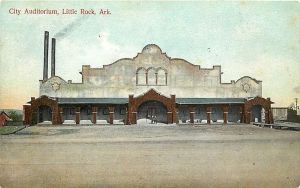
Little Rock Look Back: Roller Rink and Auditorium approved by LR City Council

Following the court decision which forbade the City of Little Rock from using public dollars to construct a municipal auditorium, a temporary solution was sought.  On August 20, 1906, the City Council approved plans for such a structure.

After the September 10, 1906, City Council meeting, the mayor told the Gazette that the Board of Public Affairs had leased part of the City’s land at Markham and Arch Streets to A. C. Read to construct the rink and auditorium.  The lease also allowed the building to extend out into Arch Street (the 1913 Sanborn Map shows it covering approximately two-thirds of the width of the street).  The mayor noted that, “It is stipulated in our lease to Mr. Read that the city shall have the use of the auditorium which he shall erect at any time.”

According to the Democrat, by September the building was already under construction.  That paper also noted that “after three years it passes into the hands of the city, when it can be repaired or remodeled to suit convention purposes.”  In the story about the new plans, the Democrat also gave the facility a very optimistic seating capacity of 9,000 people.

On August 13, 1906, A. C. Read, a businessman and real estate developer, petitioned the City for the right to construct a skating rink.  The matter was referred to the Street & Fire Committee, the Superintendent of Public Works and Aldermen Louis Volmer and Benjamin S. Thalheimer, who represented the Sixth Ward, in which the structure would be located.

By the next Council meeting a week later, the committee had reported back with a recommendation for approval.  Resolution 288 was adopted giving Mr. Read the right to build the skating rink.  Interestingly, the resolution did not contain the words “skating rink” though the original petition had.  Instead it permitted Mr. Read to construct a building “suitable for purposes as defined by the Board of Public Affairs.”

The resolution also stated that within three years the building would become property of the City.  The unnamed Gazette reporter at the August 21, 1906, City Council meeting did note in a story the day after the meeting that Mr. Read’s structure would probably be used as an auditorium in three years when the lease was up and the land use reverted back to the City.

Matters often languished in committees of the City Council for weeks; the one week turnaround of Mr. Read’s petition was highly uncommon.  It was also rare for the City Council to meet two weeks in a row.  The fact that it was reported back so quickly would be an indication that this was no standard petition from a citizen.

Civic observers might also have noted that the resolution contained language that a private citizen had been given permission to construct a building on City-owned property to the specifications of the City’s Board of Public Affairs.

August 20, 1961 – Groundbreaking for Arkansas Arts Center

On a warm Sunday afternoon, ten golden shovels turned dirt to mark the start of construction for the new Arkansas Arts Center.  The activity followed a series of speeches that day, August 20, 1961.

The speakers and dignitaries sat on the front portico of the original Museum of Fine Arts in MacArthur Park. That building would be incorporated into the new structure.

Among those who took part in the speeches and groundbreaking were Winthrop Rockefeller, Jeannette Edris Rockefeller, Gov. Orval Faubus, Congressman Dale Alford, and Little Rock Mayor Werner Knoop.

The efforts to create the Arkansas Arts Center started in the mid-1950s when the Junior League of Little Rock started an effort to establish a new art museum.  Next, the business community founded a Committee for a Center of Art and Science to accept funds donated.

When a suitable location within Little Rock could not be found, the decision was made to join with the Fine Arts Club and the Museum of Fine Arts.  Under the leadership of the Rockefellers, the drive to form the Arkansas Arts Center was launched. In September 1960, the City of Little Rock formally established the Arkansas Arts Center.

Little Rock Look Back: Birth of longtime Arkansas Arts Center director Townsend Wolfe

Townsend Wolfe, who led the Arkansas Arts Center for 34 years, was born on August 15, 1935.  He was hired to lead the Arkansas Arts Center 50 years ago this month.

Though not the founding director of the Arkansas Arts Center, Wolfe was the director for well over half of the institution’s 57 year history. Hired in 1968 at the age of 32 (making him one of the youngest art museum directors in the US at the time), he retired in 2002.  That year he was honored with the Governor’s Arts Award for Lifetime Achievement by the Arkansas Arts Council.

A native of South Carolina, Wolfe held a bachelor’s degree from the Atlanta Art Institute and a master’s degree from the Cranbrook Academy of Art. He also received a certificate from the Harvard Institute of Arts Administration, and honorary doctoral degrees from two other institutions.  After teaching some classes and seminars at the AAC in the early 1960s, he was recruited to return full-time to the Arkansas Arts Center by Governor and Mrs. Winthrop Rockefeller.

During his tenure at the Arts Center, he first was responsible for creating financial stability. After drastic cost-cutting measures, he refocused programming which led to the creation of the current Museum School, a focus of works on paper for the collection, cultivating a thriving collectors group, establishment of a children’s theatre, expansion of statewide services, and several additions to the physical structure.  He encouraged others to collect art and expanded Arts Center programming into Little Rock neighborhoods.

In addition to serving on the National Council of the Arts, Wolfe was a member of the National Museum Services Board and the board of the Elizabeth Foundation for the Arts in New York. He was curator for an exhibition in the First Ladies’ Sculpture Garden at the White House in 1995, and was the recipient of the 1997 Distinguished Service Award (outside the profession) by the National Art Educators Association.

Over the years, Wolfe has served in a variety of capacities for the Association of American Museums, the National Endowment for the Arts, and the Institute of Museum and Library Services.

Wolfe, who died in 2017, was posthumously honored by the Arts Center in 2018 with one of its Portrait of a Patron awards.  In 1973, he received the first Winthrop Rockefeller Memorial Award from the Arkansas Arts Center.

Little Rock Look Back: The Culture Vulture Goes to School

The Little Rock School District and many area schools start back this week.  Here is a look back to Kindergarten and First Grade for me.

PS – Just because I am wearing turtlenecks in two of the three photos does not mean I have EVER liked them.  Hated them. But when your parents buy your clothes, you wear what you have.  And hey, it was the 1970s.  The collared shirt was from Singapore, it was a gift from an uncle I had who lived there for a few years. I liked it a lot – not just because it had a collar.