
Little Rock Look Back: School Board Election of 1958

The regularly scheduled Little Rock School Board election of 1958 took place on Saturday, December 6 of that year.  While other school boards throughout the state generally had just their regular two positions on the ballot that day, Little Rock had a unique situation with all six seats being open.

In November, five of the members of the school board resigned out of frustration. They were caught between federal court orders compelling integration at the high school level and state laws which openly forbade it (and allowed for the closing of the high schools to keep them segregated).

The one remaining member was leaving office in December because he was about to take a seat in Congress.  Dr. Dale Alford had unseated incumbent Brooks Hays by running as a write in candidate in the general election.

Grainger Williams of the Chamber of Commerce worked with Adolphine Fletcher Terry and the Women’s Emergency Committee to recruit candidates to run for the six seats. They sought people who would work to reopen the schools.  The five who resigned had done so a mere two days prior to the filing deadline.  The “business-civic” slate which filed for the six seats were Ted Lamb, Billy Rector, Everett Tucker, Russell Matson, Margaret Stephens and Ed McKinley.  The latter was seeking Alford’s seat and was the only one unopposed.

There were a total of thirteen candidates who filed for the six seats.  On November 30, the pro-segregationist Capital Citizens’ Council endorsed Ed McKinley, Pauline Woodson, Ben D. Rowland Sr., Margaret Morrison, C. C. Railey, and R. W. Laster.  An offshoot of the CCC, the State’s Rights Council offered its own endorsements including George P. Branscum, who had once been a CCC officer.

In what the GAZETTE called “Little Rock’s Strangest School Board Election,” voters chose Laster, McKinley, and Rowland from the CCC-backed list and Lamb, Tucker, and Matson.  The latter three had been labeled by Gov. Faubus as “integrationists.”

Many of the races were close.  Laster won when the results from the final precinct were counted.  Losing candidates on both sides of the issue challenged the results.  Mrs. Stephens had lost to Laster by 81 one votes.  Rector paid for her race and his to be recounted.  The recount took two days with seven 4-man teams doing the work by hand.  But the results stood.

There were approximately 42,500 voters in the district.  The election drew 14,300 voters. That was double the usual 7,000 voters who participated in school board elections.

Though disappointed that only three of their candidates had won, members of the WEC and their allies took comfort in the fact they had elected three moderates to the School Board less than three months after the group was founded.

An evenly divided School Board was set to take office later in the month.  But the odd elections during the 1958-59 school year involving the Little Rock School District were far from over.


Little Rock Look Back: Ages of Little Rock Mayors

With the election of Frank D. Scott, Jr., as Little Rock’s next mayor, there have been questions about the ages of Little Rock’s past mayors.

Mayor-elect Scott will become Little Rock’s 73rd mayor when he takes office on January 1, 2019..  There have been sixty-six other men and women serve as mayor of Little Rock.  Much like Grover Cleveland is counted twice in the list of US presidents because of serving non-sequential terms, there have been six men who have served non-sequential terms as Little Rock’s mayor and are therefore counted twice.

Of the seventy-three mayors of Little Rock (including Mayor-elect Scott), the ages are known of fifty-eight at the the time they took office.

Of those fifty eight, the youngest mayor of Little Rock was Eli Colby. He took office in 1843 at the age of 28.  The next youngest is Pat L. Robinson who took office a month after turning 29.

The oldest person to take office as mayor was 66 year old Haco Boyd in 1969. The next oldest was 64 year old David Fulton in 1835.

The average age upon taking office is 45.

The largest gap of years between the ages of sequential mayors at the start of their terms was 31 years. Webster Hubbell was 31 when he took office in 1979. He was succeeded by 62 year old Charles Bussey in 1981.

The shortest gap of ages of sequential mayors at the start of their terms was roughly one year.  W.W. Stevenson and Elijah A. More (yes he spelled his name with only one “O”).  In 1833, Stevenson took office at the age of 35. The next year, More took office at the age of 34. Stevenson’s birthday was on January 29 and More’s was on January 20.

Here is the list of the ten youngest mayors of Little Rock at known age of starting their term:
1. Eli Colby — 28 in September 1843
2. Pat L. Robinson  — 29 in April 1929
3. Webster L. Hubbell — 31 in June 1979
4. J. G. Botsford — 32 in January 1871
5. William E. Ashley — 33 in January 1857
6. John E. Knight — 34 in January 1851 (34 years and 3 months)
7. Harold E. “Sonney” Henson, Jr. — 34 in January 1965 (34 years and 5 months)
8.  Elijah A. More – 34 in January 1834 (34 years and 11 months)
9.  Frank D. Scott, Jr. – 35 in January 2019 (35 years and 1 month)
10. Thomas A. Prince – 35 in January 1985 (35 years and 4 months)

Little Rock Look Back: 1938 Mayoral Primary

Two term incumbent R. E. Overman was challenged by businessman J. V. Satterfield for the 1938 Democratic mayoral primary in Little Rock.

It has been said that Overman never met a New Deal program he did not like, regardless of financial circumstances.  Partially in response to concerns about the City’s finances, a group of business leaders approached Satterfield about running for mayor. (Interestingly, at the time Satterfield lived just a few doors down from Overman.)

J. V. Satterfield was not a creature of politics. He had been a successful in the financial services industry. But he had not been active in the City’s political life.  In addition to concerns about the City’s finances, Overman was viewed as vulnerable due to the fact he had alienated most of the City Council.  (In fact, after renaming Fair Park in his honor, in a fit of pique the Council reversed course a few months later and returned the name to Fair Park. It is now War Memorial Park.)

In the campaign Overman proudly proclaimed his administration had given the City a public water utility, an airport, art museum, auditorium, golf courses, and street paving program.  Satterfield countered that many of those projects were actually federal projects and some had started before the Overman administration.  In a swipe at Overman, the Satterfield campaign noted that the incumbent forgot to take credit for the State Capitol in Baton Rouge and Soldier’s Field in Chicago.

Overman countered that Satterfield had no proposals and was a tool of the utilities.  He called the Bond Broker candidate. In return, Satterfield noted that Little Rock’s 1938 debt was $15.8 million, up from $2.04 million in 1935. He followed that with “and still bills go unpaid.”

In a rarity, the local Democratic primary took place on the actual General Election Day.  This boosted voter turnout.  Satterfield swept every precinct and every ward with a total of 6,432 votes while Overman garnered 2,978.

In April 1939, Satterfield easily won the City’s general election – he was unopposed.  At age 36 he became Little Rock’s 48th mayor.

Little Rock Look Back: Twelve Jailed Aldermen

The Pulaski County Courthouse where the 12 Little Rock aldermen were arraigned.

On Monday, December 4, 1939, a dozen of Little Rock’s aldermen reported to the county jail to serve sentences for contempt of court.

The previous Monday, the twelve council members had voted against an ordinance which had been ordered by the judge in an improvement district matter.  The other aldermen had either voted in the affirmative or had been absent.  Because the twelve had refused to change their votes since that meeting, the judge ordered them jailed.

At the hearing, the judge brought each alderman up one by one. This seemed to be in order to further embarrass the aldermen.  The judge also interviewed Mayor J. V. Satterfield and City Clerk H. C. “Sport” Graham to put on the record that they had counseled the aldermen to obey the judge’s order.

Mrs. C. C. Conner, the only female alderman, was not jailed but was fined $50. The eleven men were held at the jail, though not in cells.  Newspaper photos showed the men playing cards in a conference room.  In order to get out of jail, the judge gave the aldermen the chance to change their votes.

Mayor J. V. Satterfield plead with the judge to let the aldermen leave the jail to attend the meeting at City Hall, which was nearby.  He requested that the city be allowed to maintain “what little dignity remained” by not having the meeting at the jail.  The judge relented, and the aldermen were escorted by deputies to the council chambers.

After the aldermen changed their votes, the judge suspended the remainder of their sentences.  The sentences were not vacated, they were only suspended.  The judge admonished them that should they attempt to reverse their reversal, he would throw them back in jail.

Little Rock Culture Vulture Blog Hits a Milestone

Founded in October 2011, the Little Rock Culture Vulture blog passed a milestone today. It has had over 300,000 views during that 7 years and one month.  Considering that it averaged about 10 views a day during the first three months, this accomplishment is a moment to brag.

When it was started, I was unsure if anyone would care. This entry is the 3,874th post on the blog.  Over 10,400 organizations, people, events, pieces of art and works of literature, or historical facts have been featured.

To all the readers and those who post about it on social media, let me say “Thank you!”

Little Rock Look Back: In first day without 101st Airborne, LR Central plays final Thanksgiving game against NLR

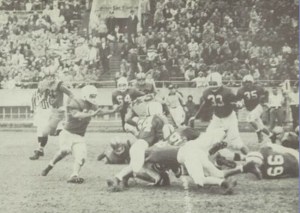
Central dominating NLR in 1957

Central dominating NLR in 1957

The November 28, 1957, football game between Little Rock Central and North Little Rock had been poised to be memorable for a few years.

With the 1957 opening of Little Rock Hall High, the Tigers would switch their rivalry on Thanksgiving Day from a cross-river one to a cross-town one starting in 1958.  So the 1957 edition of Tigers vs. Wildcats was set to be historic as the end of a 24 year tradition.

(In its first year, Hall played smaller schools because its team was largely younger.  It would move up to top classification schools in the 1958 season.)

The events at Little Rock Central in September 1957 added a new layer of history to everything that school year.  The 101st Airborne was sent in by President Eisenhower in the evening of September 24 to ensure the Little Rock Nine were able to attend classes.  But President Eisenhower did not intend the Army to be there indefinitely.  On Wednesday, November 27, the soldiers left Little Rock. The National Guard was now charged with keeping the peace at Central.

The first day without the US Army was also Thanksgiving Day, and the final Bengals vs. Cats game.  The sports coverage of this game however belied all the drama off the field. News reports focused on Turkey Day as the final game between the longtime rivals and on the fact that it had a morning start time instead of the traditional afternoon start time.

In the end, the Tigers had the same result as they did in the first Turkey Day meeting: a win.  The Bengals scored 40 while the Cats only managed 7.

After 24 meetings on Thanksgiving Day, Little Rock had 19 wins, 4 losses, and one tie.  Seven times they shut out the Wildcats, and one time the northern team blanked them.  The fewest total points scored were 2 in the 1934 game, while the 1950 game produced a cumulative total of 71 points (LR 64, NLR 7).  The Tigers scored a total of 517 points over 24 games and gave up only 203.

Little Rock Look Back: Mayoral Race of 1930

KNOWLTON

In the early 20th century, Little Rock mayors were traditionally granted a second two-year term, if they wanted them. So, 30 year old Mayor Pat Robinson may have been surprised when City Clerk Horace A. Knowlton Jr., announced his challenge for the Democratic primary in 1930.

Robinson had been the rising star of the Democratic Party in Little Rock. At the age of 25, he was nominated for the position of City Attorney and elected at 26 to the position. Two years later, he was re-elected. Then, a few months into his second term, he ran for the position of mayor. In the primary, he defeated the incumbent, an alderman and a school board member.  Taking office a few days after turning 29, Robinson was one of Little Rock’s youngest mayors ever.

However, shortly after taking office, Robinson butted heads with the majority of the City Council over a special election. And his term was marked with continual political strife.

In 1929 and 1930, Little Rock was recovering from the 1927 flood and the 1929 stock market crash. Yet Robinson appeared to be trying to spend the city out of the doldrums and driving up the city’s debt.

Knowlton was elected City Clerk in 1921 and had been re-elected in 1923, 1925, 1927, and 1929. He was viewed as an efficient politico and a stalwart member of the party.

The City’s financial state was the main thrust of Knowlton’s campaign against Robinson.  The phrase “orgy of spending” appeared in an ad. The incumbent countered with the progress of the City.

A third candidate, Bob Brown, was not a factor in the race.

November 10, 1930, dawned. It was the local Democratic primary day. Since the GOP was virtually non-existent, the winner of the nomination would be the ultimate winner in April 1931.

Anyone thinking the nasty election would be over soon was in for a surprise.

When the results came in, the tallies were: Horace A. Knowlton, 4,537; Pat L. Robinson, 4,554; Bob Brown. 61. It appeared that Robinson had eked out a 17 vote victory.  On November 12, the Pulaski County Democratic Committee certified the results.

Three days later, Knowlton filed suit in circuit court claiming that a variety of illegal votes had been cast for Robinson.  A few days later, Robinson alleged that illegal votes had been cast for Knowlton.

The case was extensive. The transcript of the trial runs over 1,800 pages.  The judge reviewed the more than 9,000 ballots cast and compared them to voter rolls and poll tax lists.  Ultimately, he found that Knowlton had received ten more votes than Robinson and declared that Knowlton was the nominee.

Knowlton’s name was placed on the ballot in April and he was elected, taking office later that month.

However, Robinson had appealed the circuit court ruling to the Arkansas Supreme Court.  In June 1921, the Court upheld the lower court ruling and affirmed that Knowlton was indeed the duly elected mayor of Little Rock.