40 years since the first Ballet Arkansas production of THE NUTCRACKER

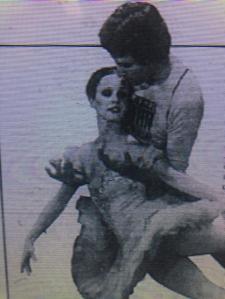
Burton and Tuzas from 1979 production

One of the sure signs of the Christmas season is the return of The Nutcracker to ballet companies across America.  Though the Little Rock Civic Ballet had first presented this ballet in 1968, by the mid-1970s, it was no longer performing the complete ballet.

In 1978, the Little Rock Civic Ballet was reorganized and re-christened Ballet Arkansas.  That first year, it did not perform The Nutcracker.  But on December 11, 1979, the tradition returned as Ballet Arkansas presented its first production of The Nutcracker.  It was once again at Robinson Center Music Hall.

The production was directed and choreographed by Lorraine Cranford, Ballet Arkansas’ Artistic Director.  The music was provided by musicians from the Arkansas Symphony Orchestra under the baton of guest conductor David Schimmell.  This was the first time in several years that the ballet had been accompanied by the ASO.

The guest artists were Anne Burton and Tanju Tuzer, both from Dallas.  The local dancers including David Twillie, Mirana, Peggy Howard, Carol Campbell, Jeffrey Stuart, Haven Cooper, Buddy Harris, Chris Clarke and Jeff Johns.

Tickets were $3.00 for the matinee. Evening performances ranged from $5 to $10 a person.

6 years since LR voters approved Restore Robinson project

On Tuesday, Dec. 10, 2013, voters of Little Rock overwhelmingly chose to renovate the historic Joseph Taylor Robinson Memorial Auditorium.

By a vote of 5,183 For and 1,800 Against, Little Rock citizens approved a plan to use a portion of the city’s existing 2 percent restaurant and hotel tax to repay bonds for a renovation of Robinson Center.  The campaign was chaired by businessman Charles Stewart, restaurateur Capi Peck and former LR Mayor Jim Dailey.

Robinson has long been a landmark in central Arkansas. Construction of the Joseph T. Robinson Memorial Auditorium began in 1938 (after a December 1937 groundbreaking under a deadline) and officially opened February 1940. The structure was a PWA (Public Works Administration) project, and is an excellent example of the Art Deco style architecture of the time. The building was added to the National Register of Historic Places in 2007.

The facility is owned by the City of Little Rock and managed by the Little Rock Convention & Visitors Bureau.

The 1940 structure suffered from a wide array of deficiencies, including stage loading and unloading, stage size, acoustical insufficiency, dressing room access and inadequate wing space within the performance hall. Also, structural, mechanical and electrical issues, public circulation and outdated conference center spaces existed within the facility.

Knowing the center is in need of major upgrades if the facility is to continue to serve central Arkansas into the future, the Little Rock Advertising and Promotion Commission (LRA&P) created a Robinson Center Concept Team in October 2011. The group was tasked with evaluating all aspects of the existing facility, researching user needs, proposing conceptual solutions and estimating the cost and construction schedule of the proposed additions and renovations. The concept team was led by Mike Steelman of SCM Architects, PLLC, and included representatives from WD&D Architects, Shuler Shook Theatre Planners, Jaffe-Holden Acoustical Consultants, TME Inc. Mechanical and Electrical Engineers, ECI Inc. Structural Engineers, McClelland Consulting Engineers Inc. Civil Engineers, East Harding Construction, HVS Consulting and Hunt Construction Group.

Additionally, stakeholder and tenant organizations representing the Arkansas Symphony Orchestra, Celebrity Attractions of Tulsa, Oklahoma and the Double Tree Hotel participated in the planning. The concept team findings were presented publicly on June 5, 2012.

On January 17, 2013 the LRA&P announced the selection of Polk Stanley Wilcox Architects, partnered with Ennead Architects, as the architectural and design team for the future renovations. On March 28, 2013 CDI Contractors LLC, partnered with Hunt Construction Group, were selected by LRA&P as the general contractors and construction managers.

On September 23, 2013 the final schematic renderings and cost estimates were presented publicly. The schematic plans depict major interior upgrades within the performance hall including additional volume to create a two-balcony setup, increased lobby space, acoustical improvements, theatrical upgrades, loading dock expansion, a larger stage area, and new dressing room facilities. Additionally, an enhanced modern ballroom and small conference center was unveiled. New technology, mechanical systems, and outdoor plaza spaces were included in the presentation.

Construction would begin on July 1, 2014.  It reopened on schedule and on budget on November 10, 2016.

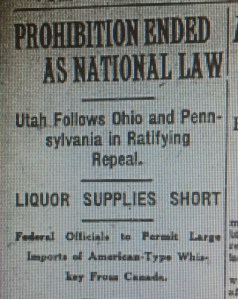
Prohibition Repealed on December 5, 1933

On December 5, 1933, Ohio, Pennsylvania and Utah provided the necessary support to officially repeal “the great experiment.”

Because this was such a foregone conclusion, the Arkansas Gazette and Arkansas Democrat carried only small, single column stories on their front pages.  Perhaps because this was Arkansas, it did not appear that any Little Rock businesses immediately set about to capitalize on this.  At least there were not any large scale advertisements in the days following that would indicate any specials or activities planned for the December 15 official end.

In fact, the only mention in the newspapers on December 15 was that President Roosevelt was trying to decide what the alcohol taxing structure should be.

One amusing story that ran in the Arkansas Democrat on December 6 was that Mrs. Roosevelt was keeping the wine glasses in storage at the White House for the time being.  She was awaiting action by Congress once it convened in January 1934 as to how it would deal with properly ending Prohibition in the District of Columbia.  Over 3,000 wine glasses had been in storage since Prohibition had been enacted.

Arrest of 12 Little Rock Aldermen on December 4, 1939

The Pulaski County Courthouse where the 12 Little Rock aldermen were arraigned.

On Monday, December 4, 1939, a dozen of Little Rock’s aldermen reported to the county jail to serve sentences for contempt of court.

The previous Monday, the twelve council members had voted against an ordinance which had been ordered by the judge in an improvement district matter.  The other aldermen had either voted in the affirmative or had been absent.  Because the twelve had refused to change their votes since that meeting, the judge ordered them jailed.

At the hearing, the judge brought each alderman up one by one. This seemed to be in order to further embarrass the aldermen.  The judge also interviewed Mayor J. V. Satterfield and City Clerk H. C. “Sport” Graham to put on the record that they had counseled the aldermen to obey the judge’s order.

Mrs. C. C. Conner, the only female alderman, was not jailed but was fined $50. The eleven men were held at the jail, though not in cells.  Newspaper photos showed the men playing cards in a conference room.  In order to get out of jail, the judge gave the aldermen the chance to change their votes.

Mayor J. V. Satterfield plead with the judge to let the aldermen leave the jail to attend the meeting at City Hall, which was nearby.  He requested that the city be allowed to maintain “what little dignity remained” by not having the meeting at the jail.  The judge relented, and the aldermen were escorted by deputies to the council chambers.

After the aldermen changed their votes, the judge suspended the remainder of their sentences.  The sentences were not vacated, they were only suspended.  The judge admonished them that should they attempt to reverse their reversal, he would throw them back in jail.

Nov 30, 1936 – City of Little Rock sets election for what is now Robinson Center Performance Hall

On November 30, 1936, Little Rock Mayor R. E. Overman asked the City Council to call a special election for January 1937 for approval of the issuance of bonds for a municipal auditorium.  Prior to asking the aldermen to call the election, the mayor had been in Washington DC to visit with Public Works Administration (PWA) officials. The mayor was assured that the auditorium project would be approved for federal funds.
While the mayor was meeting with federal officials, architects Eugene Stern, George Wittenberg and Lawson Delony were meeting with local PWA officials in Little Rock.  They were reviewing the plans for the funding request.  Though there were still a few refinements to be completed in the documents, the local officials seemed satisfied.  With these assurances in hand, Mayor Overman moved forward with putting the request before the City Council.

Though there were many things discussed at length during the November 30 City Council meeting, there was virtually no conversation regarding the structure before the 15-0 vote by the City Council to refer the auditorium bonds to the voters.  There were three different bond programs to be put before the voters in January 1937: a municipal auditorium, expansion of the public library and creation of a park for African Americans.

The bonds for the auditorium would be $468,000 in general obligation bonds which would be paid off between 1940 and 1971.  This was toward a total cost of $760,000 for the entire project.  At the time of the initial auditorium application in 1935, the mayor had noted that if the PWA failed to approve funding for the entire project, it could be submitted to the voters for the issuance of municipal bonds.  This was ultimately the course of action that would come to pass.  The PWA grant would only cover a portion of the project.  The government did agree it would purchase the financing bonds if no other entity did.

The election would be held on January 26, 1937.

Thanksgiving Day 1957 – final Tigers vs. Wildcats holiday gridiron meeting

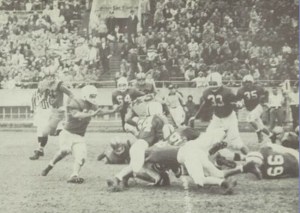
Central Tigers dominating the northside Wildcats in 1957

The November 28, 1957, football game on Thanksgiving Day between Little Rock Central and North Little Rock had been poised to be memorable for a few years.

With the 1957 opening of Little Rock Hall High, the Tigers would switch their rivalry on Thanksgiving Day from a cross-river one to a cross-town one starting in 1958.  So the 1957 edition of Tigers vs. Wildcats was set to be historic as the end of a 24 year tradition.

(In its first year, Hall played smaller schools because its team was largely younger.  It would move up to top classification schools in the 1958 season.)

The events at Little Rock Central in September 1957 added a new layer of history to everything that school year.  The 101st Airborne was sent in by President Eisenhower in the evening of September 24 to ensure the Little Rock Nine were able to attend classes.  But President Eisenhower did not intend the Army to be there indefinitely.  On Wednesday, November 27, the soldiers left Little Rock. The National Guard was now charged with keeping the peace at Central.

The first day without the US Army was also Thanksgiving Day, and the final Bengals vs. Cats game.  The sports coverage of this game however belied all the drama off the field. News reports focused on Turkey Day as the final game between the longtime rivals and on the fact that it had a morning start time instead of the traditional afternoon start time.

In the end, the Tigers had the same result as they did in the first Turkey Day meeting: a win.  The Bengals scored 40 while the Cats only managed 7.

After 24 meetings on Thanksgiving Day, Little Rock had 19 wins, 4 losses, and one tie.  Seven times they shut out the Wildcats, and one time the northern team blanked them.  The fewest total points scored were 2 in the 1934 game, while the 1950 game produced a cumulative total of 71 points (LR 64, NLR 7).  The Tigers scored a total of 517 points over 24 games and gave up only 203.