Nominate an Arkansas Living Treasure for Arts Council recognition

AACDAH Living TreasWhat do a potter, a wood sculptor, a basket maker, an egg artist, a stained glass artist, a fiddle maker, a log cabin maker, a handmade wooden plane maker, a chair maker, a quilt maker, and a bladesmith have in common?

They are all past recipients of our Arkansas Living Treasure award.

The Arkansas Arts Council is currently searching for a new artist to take his or her reign as the 2016 Arkansas Living Treasure. They are seeking an Arkansas artist who excels in the creation of a traditional craft and who actively preserves and advances his or her craft through community outreach and educating others.

Nominations are due Friday, November 6. ‪#‎AuthenticArkansas‬‪#‎SupportCraftArt‬ ‪#‎ArkansasArts‬
http://www.arkansasarts.org/…/Arkansas-Living-Treasure…/home

Now in its 14th year, the Arkansas Living Treasure program annually recognizes an Arkansas artist who excels in the creation of a traditional craft and who actively preserves and advances his or her craft through community outreach and educating others.

An independent panel of practicing craft artists and professionals in the fields of craft and folk art selects the recipient based on the following criteria: quality of work, community outreach and total contribution to the field of traditional crafts. The awardee is honored at a ceremony in May during Arkansas Heritage Month.

In 2013, the Arkansas Arts Council and Historic Arkansas Museum collaborated to produce a series of short films that celebrate the lives and work of each Arkansas Living Treasure recipient. Click HERE to view the documentaries featured in the Arkansas Living Treasure Film Project.

Creative Class of 2015: Matt McLeod

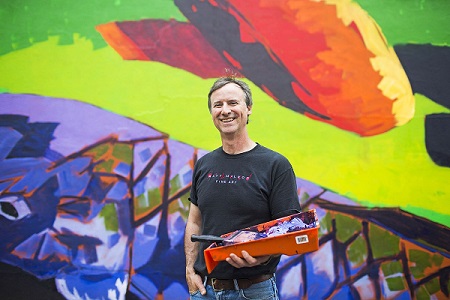
McLeodMuralMatt McLeod is a painter, sculp­tor and mural­ist, spe­cial­iz­ing in fine art for res­i­den­tial, com­mer­cial and pub­lic art projects. His art hangs in many homes and businesses throughout Central Arkansas and beyond. Arguably his most visible work is the new mural at the corner of 6th and Main in the Creative Corridor.

After grad­u­at­ing from South­ern Methodist Uni­ver­sity in 1987, Matt spent a fifteen-year career in adver­tis­ing, before becom­ing a full-time artist. Matt spent the last eleven years in fine art, devel­op­ing paint­ings into his bold, vibrant style — what he calls Ener­getic Color.

Matt’s Ener­getic Color is included in sev­eral pri­vate and cor­po­rate col­lec­tions across the US and has brought sig­nif­i­cant recog­ni­tion, includ­ing pieces in the Delta Exhi­bi­tion at The Arkansas Arts Cen­ter and a paint­ing on the front cover of the first Arkansas Artists Cal­en­dar, cre­ated by The Arkansas Governor’s Man­sion Asso­ci­a­tion.

In 2011, Matt was the fea­tured artist for River­fest music fes­ti­val. Matt was the fea­tured artist for MusicFest El Dorado, in 2012. In 2013, Matt was the fea­tured artist for The Thea Foundation’s Annual Spring Fine Arts Fes­ti­val. This month, Matt opened a gallery in down­town Lit­tle Rock, spe­cial­iz­ing in highly col­lectible regional artists and res­i­den­tial and com­mer­cial commissions.

Our America exhibit at Arkansas Arts Center celebrates Latino presence in American Art

The Arkansas Arts Center welcomes the exhibition Our America: The Latino Presence in American Art, a major collection of modern and contemporary Latino art from the Smithsonian American Art Museum,  through January 17, 2016.

The exhibition Our America includes 93 works in all media by 72 artists who participated in various artistic styles and movements, including abstract expressionism; activist, conceptual and performance art and classic American genres such as landscape, portraiture and scenes of everyday life.

Our America presents the rich and varied contributions of Latino artists in the United States since the mid-20th century, when the concept of a collective Latino identity began to emerge. The exhibition is drawn entirely from the Smithsonian American Art Museum’s pioneering collection of Latino art.

To enhance the “Our America” exhibition, the AAC is incorporating several digital components including an exhibition preview video on YouTube, a six-part documentary film series and podcasts to accompany several works. The video can be viewed at tiny.cc/YouTubeOurAmerica.

In collaboration with the University of Arkansas at Little Rock, the AAC is hosting a free film series in six parts. Latino Americans: 500 Years of History is a landmark documentary produced by the National Endowment for the Humanities (NEH) and the American Library Association (ALA), featuring interviews with nearly 100 Latinos and exploring more than 500 years of history. Each episode will be shown Sundays at 2 p.m. in the Lower Level Lecture Hall beginning October 18 with a special community discussion led by Dr. Kristin Dutcher Mann, UALR associate professor of history and social studies education coordinator.

The film schedule is as follows:

October 18, 2015 | 2:00 p.m.
Latino Americans “Episode 1: Foreigners in their Own Land (1565-1880)”
Following the screening, Dr. Kristin Dutcher Mann, UALR associate professor of history and social studies education coordinator, will lead a community discussion about the continuing relevance of the colonial and early national periods in the U.S.-Mexico borderlands

October 25, 2015 | 2:00 p.m.
Latino Americans 
“Episode 2: Empire of Dreams (1880-1942)”

November 1, 2015 | 2:00 p.m.
Latino Americans 
“Episode 3: War and Peace (1942-1954)”

November 8, 2015 | 2:00 p.m.
Latino Americans 
“Episode 4: The New Latinos (1946-1965)”

November 15, 2015 | 2:00 p.m.
Latino Americans “Episode 5:  Prejudice and Pride (1965-1980)”
Following the screening, Edma Delgado-Solórzano, UALR doctoral candidate and visiting assistant professor will lead a community discussion about the episode which focuses on the development of the “Chicano” identity.

November 22, 2015 | 2:00 p.m.

Latino Americans “Episode 6: Peril and Promise (1980-2000)”

Additionally, the Arkansas Arts Center will offer several programs and events to complement the exhibition and enhance the impact on both English- and Spanish-speaking visitors.

Our America will feature bilingual labels for each work and a Spanish-language website created by the Smithsonian American Art Museum. Select works also feature podcasts with the artist’s commentary. Museum goers can simply call a number, scan a QR code or visit a website for more background on the artist and background on each piece—in English and Spanish.

Artists featured in the exhibition reflect the rich diversity of Latino communities in the United States. Our America showcases artists of Mexican, Puerto Rican, Cuban and Dominican descent, as well as other Latin American groups with deep roots in the United States. By presenting works by artists of different generations and regions, the exhibition reveals recurring themes among artists working across the country.

The 72 artists featured in the exhibition are ADÁL, Manuel Acevedo, Elia Alba, Olga Albizu, Carlos Almaraz, Jesse Amado, Asco (Harry Gamboa Jr., Gronk, Willie Herrón and Patssi Valdez), Luis Cruz Azaceta, Myrna Báez, Guillermo Bejarano, Charles “Chaz” Bojórquez, María Brito, Margarita Cabrera, María Magdalena Campos-Pons, Melesio “Mel” Casas, Leonard Castellanos, Oscar R. Castillo, José Cervantes, Enrique Chagoya, Roberto Chavez, Carlos A. Cortéz, Marcos Dimas, Ricardo Favela, Christina Fernandez, Teresita Fernández, iliana emilia garcía, Rupert García, Scherezade García, Carmen Lomas Garza, Ignacio Gomez, Ken Gonzales-Day, Hector González, Luis C. “Louie the Foot” González, Muriel Hasbun, Ester Hernandez, Judithe Hernández, Carmen Herrera, Carlos Irizarry, Luis Jiménez, Miguel Luciano, Emanuel Martinez, María Martínez-Cañas, Antonio Martorell, Ana Mendieta, Amalia Mesa-Bains, Franco Mondini-Ruiz, Delilah Montoya, Malaquias Montoya, Abelardo Morell, Jesús Moroles, Raphael Montañez Ortiz, Pepón Osorio, Amado M. Peña Jr., Chuck Ramirez, Paul Henry Ramirez, Sophie Rivera, Arturo Rodríguez, Freddy Rodríguez, Joseph Rodríguez, Frank Romero, Emilio Sánchez, Juan Sánchez, Jorge Soto Sánchez, Rafael Soriano, Ruben Trejo, Jesse Treviño, John M. Valadez, Alberto Valdés and Xavier Viramontes.

The exhibition is organized by E. Carmen Ramos, curator of Latino art at the Smithsonian American Art Museum.

Our America: The Latino Presence in American Art is organized by the Smithsonian American Art Museum. Generous support for the exhibition has been provided by Altria Group, the Honorable Aida M. Alvarez, Judah Best, The James F. Dicke Family Endowment, Sheila Duignan and Mike Wilkins, Tania and Tom Evans, Friends of the National Museum of the American Latino, The Michael A. and the Honorable Marilyn Logsdon Mennello Endowment, Henry R. Muñoz III, Wells Fargo and Zions Bank. Additional significant support was provided by The Latino Initiatives Pool, administered by the Smithsonian Latino Center. Support for “Treasures to Go,” the museum’s traveling exhibition program, comes from The C.F. Foundation, Atlanta.

Our America is sponsored in Arkansas by Donna and Mack McLarty, The Brown Foundation, Inc., of Houston, Consulate of Mexico in Little Rock and Alan DuBois Contemporary Craft Fund. Media sponsors include ¡Hola! Arkansas and Telemundo Arkansas.

October 2015 2nd Friday Art Night!

2FAN logo Font sm2It is time again for Second Friday Art Night!
On the second Friday of Arts & Humanities Month, it is a great way to experience the richness the arts and humanities bring to Little Rock.  Among the offerings this month are:

Historic Arkansas Museum’s free opening reception of “Kat Wilson’s Layers”

Arkansas photographer Kat Wilson is widely known for her Habitats series inspired by the hard-working people living in her blue-collar Arkansas town. Wilson’s work has continued to evolve as she has exhibited across Arkansas at Crystal Bridges Museum of American Art and Arkansas Arts Center among others, and across the nation through exhibitions in Reno, NV, and Chicago, IL. Her work has received national and international recognition.

In a new series, Wilson’s technical process of layering photographs draws out a painterly quality typically absent in the glossy surface of a photograph. Wilson gathers images from varying degrees, often pulling information in a complete 360. She then layers them in an effort to tell a broader story of the scene.


CALS Butler Center opening of “Photographic Arts: African American Studio Photography from the Joshua & Mary Swift Collection”

This is the first exhibition of works from the Joshua & Mary Swift Collection, featuring photographs of African American people, created in a studio setting during the 1860s-1940s. Many of the featured photographs were hand colored, which created artful and unusual effects on otherwise formal portraits.

Other exhibits at the Butler Center are “Disparate Acts Redux: Bailin, Criswell, Peters” – an exhibition created by three artists who have found community with each other during the past thirty years’ “Weaving Stories & Hope: Textile Arts from the Japanese American Internment Camp at Rohwer, Arkansas” – a collection of decorative patterns, landscapes, and still life compositions created on muslin and denim; and “Gene Hatfield: Outside the Lines” – an exhibition characterizing the life and vitality of his life’s works.


Christ Church opening of solo exhibit of mixed media works by Diane Harper.

Little Rock artist Diane Harper translates images from a military childhood into new works of art in painting, printmaking, and mixed media in what she calls a “posthumous collaboration” with her father. His was a colorful career as a forensic photographer in the U.S. Military Crime Lab, and later in the Arkansas State Crime Lab. He taught himself photography by taking volumes of photos of his family and their adventures together.

The driving motivation behind this collaborative work is not only for Harper to gain a sense of place, but to position herself behind her father’s lens to see how he saw her, his family, and the rest of the world

Monday Musings: Kelly Kinard Fleming

Kelly FlemingToday launches a new feature on the Little Rock Culture Vulture: Monday Musings.

Little Rock cultural personalities will be asked nine questions (there were nine muses).

Up first is Kelly Kinard Fleming. A member of Little Rock’s Arts & Culture Commission, she is also Development Director at the Arkansas Arts Center. A graduate of the Clinton School of Public Service, she has previously worked at the Arkansas Repertory Theatre in development and marketing.

Monday Musings

-My earliest memory was (age and incident)

From birth to age 5 I lived in the booming metropolis of Sikes, Louisiana. The post office was in the general store. My dad was principal of the K-12 school and our house was on the edge of the school’s playground. I remember walking next door for a fresh cookie and carton of cold milk from the sweet lunchroom ladies. Oh, and the water in town was brown. I remember taking baths in clean, but brown, water.

-When I was in high school and imagined my adulthood, I thought I would be

…a novelist, a lawyer or both. Surprise! I’m neither.

-Star Wars, Star Trek, Battle of the Network Stars, or Dancing with the Stars?

If I MUST, Dancing with the Stars.

-I most identify with the Winnie the Pooh character of…

…there’s something in all of them we identify with, don’t you think? Much like the Wizard of Oz characters. But I’ll say Christopher Robin because he is cheerful and gets along well with others.

-The performer I’d drop everything to see is

…Bette Midler.

-My first paying job was

…babysitting. Swore I’d never have kids.

-A book I think everyone should read is

….Cry the Beloved Country by Alan Paton

-My favorite season is…

….Spring. Great convertible weather.

-We are all geeks (or experts) about something. My field is

….shopping on the cheap.

Happy 50th Birthday to the National Endowment for the Arts & National Endowment for the Humanities

NEANEH50On September 29, 1965, President Lyndon Baines Johnson signed into law the National Foundation on the Arts and the Humanities Act of 1965 at a White House Rose Garden ceremony, attended by scholars, artists, educators, political leaders, and other luminaries.

The law created the National Endowment for the Humanities as an independent federal agency, the first grand public investment in American culture. It identified the need for a national cultural agency that would preserve America’s rich history and cultural heritage, and encourage and support scholarship and innovation in history, archeology, philosophy, literature, and other humanities disciplines.

On this occasion, President Johnson said: “Art is a nation’s most precious heritage. For it is in our works of art that we reveal ourselves, and to others, the inner vision which guides us as a nation. And where there is no vision, the people perish.”

This new law was the fruit of two presidents, several senators and representatives, and four previous pieces of legislation. Separate bills had been introduced, in previous years, into the House by Representative Frank Thompson (D-NJ), and into the Senate by Senators Hubert Humphrey (D-MN) and Jacob Javits (R-NY). Senator Claiborne Pell (D-RI) had overseen hearings on some of this preliminary legislation, beginning in October 1963, before the death of President John F. Kennedy.

Over the years, the NEA and NEH have awarded millions of dollars to Little Rock based institutions, organizations and individuals through direct appropriations.  They have also impacted Little Rock cultural life through funding of the Mid-America Arts Alliance, Arkansas Arts Council, Department of Arkansas Heritage, Arkansas Department of Parks & Tourism, and U.S. Conference of Mayors among others. These groups have either re-granted the dollars to Little Rock entities or undertaken projects which have directly impacted and improved life in Little Rock.


Sculpture Vulture for Banned Books Week – Dee Brown

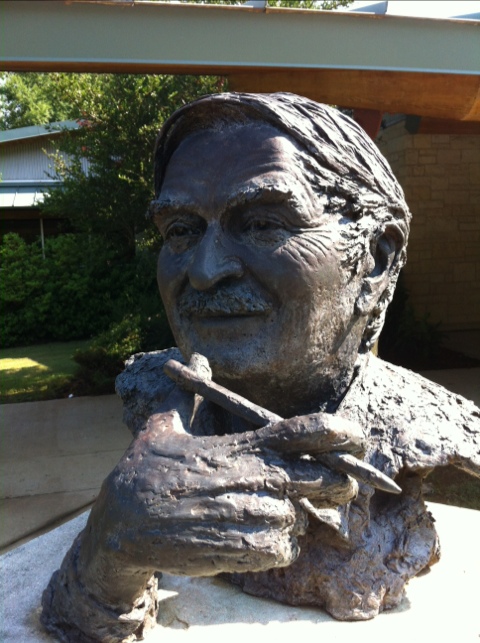
20120519-114242.jpgThis week is Banned Books Week.  One of the books which has often appeared on Banned Books list is Arkansan Dee Brown’s Bury My Heart at Wounded Knee.  In honor of that, today’s Sculpture Vulture revisits Kevin Kresse’s sculpture of the author which is located at the CALS branch which bears his name.

Visitors to the Dee Brown Library are greeted by Kevin Kresse’s 2004 sculpture of the celebrated author. The bronze likeness depicts Brown with a bepenciled hand raised to his chin as if in the midst of a wondrous thought while writing. The titles of some of his books surround the pedestal including his most famous book: 1971’s Bury My Heart at Wounded Knee.

Brown was a graduate of Little Rock High and Arkansas State Teachers College (now Little Rock Central and University of Central Arkansas, respectively). After a career as a librarian and bivocational but prolific author, he returned to Little Rock in 1973 and focused full time on his writing. He died in 2002.