ACANSA Arts Festival Receives $10,000 Planning & Implementation Grant

acansa


The newly founded ACANSA Arts Festival accepted a $10,000 check from the Central Arkansas Planning and Development District (CAPDD) on Monday, February 24th. The distribution comes from CAPDD’s General Improvement Fund and is awarded through a grant process to qualifying organizations for the planning and implementation of economic and community development projects. The ACANSA application had the endorsement of Arkansas State Representative Warwick Sabin.

The CAPDD award adds to growing level of interest and support for the new arts festival to be held over 5 days in September. “Cultural enrichment opportunities that bring people together in Little Rock and North Little Rock both address the “quality of life” issues our board endeavors to support and generate viable economic opportunities in our community over their duration,” remarked CAPDD Executive Director Rodney Larsen.

Warwick Sabin and Rodney Larsen presented the check to Charlotte Gadberry, founder of the ACANSA Arts Festival and ACANSA Executive Director Renay Dean.

ACANSA Arts Festival is a southern celebration of visual and performing arts, premiering its inaugural event September 24-28, 2014, in Central Arkansas.

It is Spring – Fly a Kite (or see art about it)

Today marks the first day of spring aka the Vernal Equinox.  It is a good day to go kite flying.

Next season the Arkansas Rep will be presenting Mary Poppins with its song about flying a kite.  The original Broadway Mary Poppins, Ashley Brown, will be performing with the Arkansas Symphony as well next season.

But this year, on the Arkansas Arts Center website, you can see art from their collection which features kites.
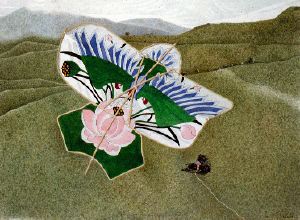
Alice Andrews - Kite Flying - from collection of Arkansas Arts Center

Alice Andrews – Kite Flying – from collection of Arkansas Arts Center

The first is Alice Andrews’ Kite Flying.  This 1978 watercolor on paper depicts a kite being flown in a field. The perspective is from above the kite looking down on it and the ground below. The artwork measures 21.5 by 29.5 inches.  It was a gift to the Arkansas Arts Center in 1978 by the Mid-Southern Watercolorists.

Alice Andrews lives in an old white farmhouse built in the 1800’s in the Boxley Valley in Newton County, Arkansas. Boxley is full of clear rocky creeks and pastures and is surrounded by mountains. It has the feeling of being back in time about one hundred years, and has more cow residents than people.

Alice works in both oils and pastels. Her subject matter ranges from landscapes and paintings of her home and garden, to paintings of dreams, of allegory and of pure abstraction. Alice has been awarded residency at The Helene Wurlitzer Foundation in Taos, New Mexico, and the respected pastel artist Wolf Kahn personally awarded her a residency at the prestigious Vermont Studio Center in Johnson, Vermont.

She is a graduate of Henderson State University and the Maryland Institute College of Art in Baltimore.

Lothar Krueger's Day of the Great Kite Race - from collection of Arkansas Arts Center

Lothar Krueger’s Day of the Great Kite Race – from collection of Arkansas Arts Center

Another piece in the Arts Center collection is Lothar Krueger’s Day of the Great Kite Race.  This 1980 drawing is chalk and colored pencil on paper. The art measures 21 7/8  by 34 inches.  It was purchased by the Arkansas Arts Center Foundation after the 13th Annual Prints, Drawings and Crafts Exhibition.

Lothar Krueger, was a native of Two Rivers, WI.  Born in 1909, he became interested in art in Washington High School where he was “considered one of the greatest all-round football players in that school’s history.” He received his B.S. degree in art from Milwaukee State Teachers College in 1942 when he was drafted into the army. After officers training he took part in the World War II.  In the war, he took part in the D-Day invasion of Normandy and received two Purple Hearts, a Silver Star and a Bronze Star.  In 1947, he had one of his first art shows at the Wisconsin Historical Museum in Madison.

Krueger joined the faculty of the University of Arkansas. During his tenure on the art faculty at the university, he established himself as a major artist in Arkansas and in the regional and national art scene by winning numerous awards and honors. He taught Art, Art Education, and Art Criticism from 1953 until 1981, and also served as acting chairman of the art department for a year. After his retirement from the university, he continued to live in Fayetteville.   He died in January 2009 at the age of 89.
ChildrenKites1960

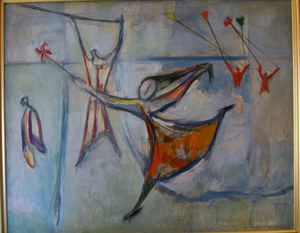
Children Flying Kites by Manfred Schwartz – from collection of Arkansas Arts Center

Manfred Schwartz’s Children Flying Kites is also in the Arkansas Arts Center collection. This 1960 oil on canvas measures 42 by 34 inches. It was a gift to the Arkansas Arts Center in 2005 from Janice M. Ireland.

In Manfred Schwartz’s lifetime, he produced a significant and varied oeuvre, and was extolled by art critics and museums. Born in Poland in 1909, he emigrated to New York in 1920 at the age of 11, and was something of a child prodigy. Early in his career he showed side by side with Maurice Vlaminck, Bernard Buffet, Edward Hopper, and Andrew Wyeth.

In 1929 he moved to Paris. There his art gained a new sense of freedom, which he expanded for the next forty years.  Educated at the Sorbonne in Paris, the Academie de la Grande Chaumiere in Paris, the Art Students League in New York, and the National Academy of Design in New York. Studied with Charles Hawthorne in Provincetown, John Sloan, and Bridgemen.

Manfred Schwartz created a sensational body of work; oils, pastels, lithographs, and we can see his evolution within three major periods that span fifty years of work.  His earliest paintings were portraits and still-lifes. The colors were deep and muted, he preferred the umbers to the yellows. By 1940 he began to paint in a more abstract manner. His colors intensified and his images seemed ahead of their time.

Schwartz died in New York in 1970.

 

The Ides of March

“The Ides of March hath come” – so wrote William Shakespeare.

In tribute to the day on which Julius Caesar was felled by assassins in Rome, a look at a two pieces of art featuring views of Rome, which are in the Arkansas Arts Center collection.

AAC Rome 1

Giovanni Battista Piranesi – from the collection of the Arkansas Arts Center

The first presents a classical take on Rome.  View of the Piazza del Campidoglio (Veduta della Piazza del Campdoglio) was painted in 1774 by Giovanni Battista Piranesi (1720 – 1778).  The print is an etching, acquired by the Arts Center in 1990; it was a gift of John and Grace Marjorie Wood Keppel and Nell Wood.

According to the Arkansas Arts Center,

The Campidoglio has been the seat of the city government of Rome from ancient times to the present. At the top of the Capitoline Hill-one of the famed Seven Hills of Rome-the buildings in Piranesi’s etching are the work of Michelangelo. These elegant Renaissance palaces, perched on this ancient site, were important tourist destinations in the 18th century just as they are today.

Piranesi takes a viewpoint from the side of the site, giving us a dramatic diagonal view of one palace and a head-on view of the other. In the foreground are Grand Tourists in their three-cornered hats as well as a number of less well dressed, slightly suspicious-looking figures.

John Heliker - from the collection of the Arkansas Arts Center

John Heliker – from the collection of the Arkansas Arts Center

The second piece is John Heliker’s Pertaining to Rome.  Heliker was a 20th Century artist from New York living from 1909 to 2000.  His painting is an abstract look at the Italian capital city.  It was a gift in 2005 to the Arkansas Arts Center from the Heliker-LaHotan Foundation, Inc.


Arkansas College Art History Symposium is today

ualr logoFive University of Arkansas at Little Rock art students will present papers at the 24th Annual Arkansas College Art History Symposium on Friday, March 14.

Students will give 20-minute illustrated talks on an area of their research, similar to professional art historians. The symposium is being held this year at the University of Central Arkansas.

The following UALR students will present their work:

  • Ann Beck, a Master of Arts student with an emphasis in art history, will deliver a presentation called “Mirror Game.”
  • Tessa Davidson, also a student emphasizing art history in the M.A. program, will present on “Laocoön and his Secrets: Dating Attribution Concerns of the Vatican Sculpture Laocoön and his Sons.”
  • Hayley Chronister, who is pursuing a Bachelor of Arts in art with an art history emphasis, will present “Thomas Gainsborough’s Response to Nature: An Analysis of Two Shepherd Boys with Dogs Fighting.”
  • Jeannie Lee, also pursuing a B.A. in art with an art history emphasis, will do her presentation on “Of Marriage and Death: Alternative Meaning in the Myth of Persephone.”
  • Badi Galinkin is in the Bachelor of Fine Arts in studio art program with a graphic design emphasis and will present “Mrs. Musters as Hebe by Sir Joshua Reynolds.”

The symposium was established in 1991 by Dr. Floyd Martin of UALR and Dr. Gayle Seymour of UCA as a means of encouraging and recognizing student achievements in art history in the state.

The symposium, which has been hosted by UALR, UCA, and Hendrix College, has helped encourage cooperation among art history faculty throughout the state.

Each symposium includes a guest art historian, this year’s is Dr. Ann Prentice Wagner, curator of drawings at the Arkansas Arts Center.

Marching to Historic Arkansas Museum and Butler Center for 2nd Friday Art Night

March 2FAN

It is time again for 2nd Friday Art Night in Downtown Little Rock.  Numerous locations from 5pm to 8pm with free admission and free shuttle to various sites.

Ciara Long: A Different Perspective at Historic Arkansas Museum‘s Second Floor Gallery.
Opening tonight and running through May 4, 2014 – Ciara Long’s art reflects the itinerate life of a military child. Moving from place to place, Long ritualistically sketched the people she met and left behind. “The fragmented lifestyle of my past has directly influenced the way I observe the environment around me now,” says Long.

The body of work on exhibit illustrates Long’s ongoing process of elaborately encoding her observations and has been carefully organized according to place of occurrence, specific moments in time, or specific individuals.

At the Butler Center Galleries of the Central Arkansas Library System –

Featured artist: Judy Tipton Rush is a self-educated fiber artist who studied at the University of Arkansas and came to her avocation from an art background. Her work has been exhibited in numerous juried shows and has toured the United States and abroad. Her work is also included in many private collections.
Featured musician: Tribal Motion & the Motioneers will pair bellydance performances with rhythmic tribal drumming.
Opening exhibitions:

Southern Voices: A Regional Exhibition of the Studio Art Quilt Associates – This show features contemporary textile works related to the folk art quilt tradition. Studio Art Quilt Associates (SAQA) is a nonprofit organization whose mission is to promote the art quilt through education, exhibition, professional development, and documentation. SAQA defines an art quilt as “a creative visual work that is layered or stitched or that references this form of stitched layered structure.” SAQA was founded in 1989 by a group of 50 artists and now has over 3,000 members.

An Exhibition of the Arkansas Printmakers Association – This show features prints in a variety of artistic media by members of the Arkansas Printmakers Association. Artist whose work will be shown include Robert Bean, Win Bruhl, Warren Criswell, Debi Findley, Melissa Gill, Diane Harper, Neal Harrington, Evan Lindquist, Dominique Simmons, Tom Sullivan, David Warren, Jorey May Greene, and Jane Watson.

Septaquintaquinquecentennial of Christ Church in Little Rock (that means 175 years)

christchurch_scaledThough there have been several churches and institutions in downtown Little Rock for over a century, Christ Episcopal Church has been at Scott and Capital Streets since 1840. That marks probably the longest continuous single use of one location in Little Rock’s history.

Today, the church marks its Septaquintaquinquecentennial.  The first church service was held on March 10, 1839, at Little Rock’s Presbyterian Church, which was then on what is now Second Street. The Rt. Rev. Leonidas Polk, missionary bishop of Arkansas, conducted the service.  After it was concluded, a group met in the home of Senator Chester Ashley and organized Christ Episcopal Church, named after Christ Church in Alexandria, Virginia, of which several of those present had been members.

Among the early members of the church were several future Little Rock Mayors including Lambert J. Reardon, John Wassell, Samuel Webb and Gordon Peay.  Nicholas Peay, Gordon’s father and a member of the church, served on the Little Rock City Council.  Future Little Rock Mayor William Ashley was the first Little Rock resident to be married at Christ Church.

The first sanctuary was constructed in 1840-1841 and was later destroyed by fire in 1873 (most likely due to a lightning strike).  After meeting in a variety of places, a chapel was constructed on the property and served as the church’s primary place of worship while the new sanctuary was being built.  It opened in 1887.  It was in the chapel that future General Douglas MacArthur was baptized as an infant while his family resided in Little Rock.

In 1928, a Parish Hall was built. This was one of the first church buildings in the South which featured a gym and other spaces available for use not just by church members but by the entire city.  It would later serve as the temporary sanctuary of Christ Church.  On October 1, 1938, the second sanctuary burned just as a renovation had been completed.  Though there was no official cause of the fire, it was most likely due to spontaneous combustion of construction materials.

The cornerstone for the third, and current, sanctuary was laid on October 1, 1940.  Construction was completed in 1941.  It was designed by Edwin Cromwell with the unofficial assistance of the then-Rector, Rev. Dr. William Postell Witsell. (Dr. Witsell appreciated architecture and the arts. He was very instrumental in the design of the stained glass windows which hang in the church today.  Charles Witsell, one of the founders of the Witsell, Evans, Rasco firm, is a grandson of Dr. Witsell.) In the 1980s, an addition was built along Scott Street to connect the sanctuary with the Parish Hall.

Along with the revitalization of downtown, Christ Church has been active in implementing innovative programming in a variety of areas including sustainability and the arts. The Rector, Rev. Scott Walters, and Associate Rector, Rev. Dr. Kate Alexander, often pepper their sermons with references to poetry, music (both sacred and secular), writers, artists and even comedians.

The Arts at Christ Church program has brought such varied artists as Mavis Staples, Baltimore Konsort and the Vienna Boys Choir to Little Rock. In 1990, Nichols & Simpson, a Little Rock based organ builder of international renown, constructed a new organ for the Christ Church sanctuary replacing a 1954 organ.  While used in worship, it is also used for a variety of organ recitals throughout the year.  Christ Church has been a sponsor of the Arkansas Literary Festival for the past several years and participates in the 2nd Friday Art Night with a rotating gallery of Arkansas artists. In addition, the Undercroft debuted in late 2013. This intimate music space is located underneath the sanctuary and offers a venue for acoustic music.

To mark the 175th anniversary, Rt. Rev. Larry R. Benfield, the thirteenth Bishop of the Diocese of Arkansas will be conducting an Evensong service this evening.  Prior to being named Bishop, he served as Rector of Christ Church.

The Art of Carroll Cloar at the Ark Arts Center

 Carroll Cloar, The Smiling Moon Cafe, 1965, casein tempera on Masonite, 25 in. x 36 in., Private Collection, ©Estate of Carroll Cloar

Carroll Cloar, The Smiling Moon Cafe, 1965, casein tempera on Masonite, 25 in. x 36 in., Private Collection, ©Estate of Carroll Cloar

The Crossroads of Memory: Carroll Cloar and the American South exhibit opens tomorrow and runs through June 1.  There is a member reception tonight.

The paintings of Carroll Cloar (1913-1993), rank among the most haunting and beautiful evocations ever made of the American South. Drawing upon family stories, photographs of ancestors, rural scenery, small town life, and memories of his childhood on an Arkansas farm, Cloar captured the quiet richness of a simpler world.

Marking the centenary of the artist’s birth, The Crossroads of Memory: Carroll Cloar and the American South will include approximately seventy paintings, ranging from early Realist masterpieces to the poignant pictures of his later career.

An exhibition organized by the Memphis Brooks Museum of Art and the Arkansas Arts Center curated by Stanton Thomas, Curator of European and Decorative Art at the Memphis Brooks Museum of Art, the exhibition will feature works from major public collections as well as rarely seen pictures still in private hands.

Presented in Arkansas by: Arkansas Democrat-Gazette; Lisenne Rockefeller; Stella Boyle Smith Trust.

Sponsored in Arkansas by: Anonymous; Bailey Foundation; Sandra and Bob Connor; Terri and Chuck Erwin; Friday, Eldredge & Clark, LLP; Eileen and Ricardo Sotomora; John Tyson & Tyson Foods, Inc.; Arkansas Farm Bureau/Agriculture Council of Arkansas; Capital Hotel; Cindy and Greg Feltus; Munro Foundation; J.D. Simpson; Don Tilton; Gus and Ellis Walton.

The Thursday night lecture is sold out. You will have another chance to hear from the lecturer, Stanton Thomas, Ph.D., on Friday at noon during Feed Your Mind Friday in the galleries.