“Antisocial Media: How Facebook Disconnects Us and Undermines Democracy” is focus of Clinton School program tonight

Image result for siva vaidhyanathanTonight at 6pm, Siva Vaidhyanathan will speak at the Clinton School on the topic of “Antisocial Media: How Facebook Disconnects Us and Undermines Democracy.”

Siva Vaidhyanathan is the Robertson Professor of Media Studies and Director of the Center for Media and Citizenship at the University of Virginia and the author of “Antisocial Media: How Facebook Disconnects Us and Undermines Democracy.”

If you wanted to build a machine that would distribute propaganda to millions of people, distract them from important issues, energize hatred and bigotry, erode social trust, undermine respectable journalism, foster doubts about science, and engage in massive surveillance all at once, you would make something a lot like Facebook. Of course, none of that was part of the plan.

In this fully updated paperback edition, Siva Vaidhyanathan explains how Facebook devolved from an innocent social site hacked together by Harvard students into a force that, while it may make personal life just a little more pleasurable, makes democracy a lot more challenging.

All Clinton School Speaker Series events are free and open to the public. Reserve your seats by emailing publicprograms@clintonschool.uasys.edu or by calling (501) 683-5239.

LaHarpe Sees a Rock on April 9, 1722

On April 9, 1722, French explorer Jean-Baptiste Bénard de La Harpe rounded the bend of the Arkansas River and saw La Petite Roche and Le Rocher Français.  He had entered the mouth of the Arkansas River on February 27 after traveling up the Mississippi River from New Orleans.

Though La Harpe and his expedition are the first Europeans documented to have seen La Petite Roche, the outcropping of rocks was well-known to the Quapaw Indians in the area.  The outcropping jutted out in the Arkansas River and created a natural harbor which provided a perfect place for boats to land.

The rock outcropping is the first one visible along the banks of the Arkansas River.  It marks the place where the Mississippi Delta meets the Ouachita Mountains.  Geologists now believe that the Little Rock is not the same type of rock as the Ouachita Mountains and more closely matches the composition and age of mountains in the western US.

In 1813, William Lewis became the first European settler to live near La Petite Roche but only stayed a few months.  Speculators and trappers continued to visit the area throughout the 1810s. During that time, the outcropping became known informally as the Little Rock.

La Petite Roche had become a well-known crossing when the Arkansas Territory was established in 1819. The permanent settlement of ‘The Rock’ began in the spring of 1820, and the first building has been described as a cabin, or shanty, and was built on the bank of the river near the ‘Rock.’ In March 1820, a Post Office was established at the ‘Rock’ with the name “Little Rock.”

Over the years, La Petite Roche was altered.  In 1872, Congress authorized the building of a railroad bridge. A pier for the bridge was built at the location of the La Petite Roche which caused the removal of several tons of rock.  The bridge was never built.  When the Junction Bridge was built in 1899, even more rock was removed in the process of erecting part of the bridge on top of the rock.  It was not viewed as being disrespectful of the City’s namesake at the time.  Indeed, it was viewed as a testament to the sturdiness of the rock.

In 2010, La Petite Roche plaza opened in Riverfront Park.  It celebrates the history of La Petite Roche and explores its importance to various aspects of Little Rock’s history and geography.

“Winning Westeros: How GAME OF THRONES Explains Modern Military Conflict” is topic of Clinton School discussion today

Image result for winning westerosWho will claim the Iron Throne and why? On the eve of the premiere of the final season of Game of Thrones, M.L. Cavanaugh’s new book brings together 30 expert strategists to answer that question and engage in questions surrounding the most popular television series of our time.

As characters battle for power and control, there is magic and witchcraft, fiery dragons, frozen zombies, chaotic combat, swordplay and brutal intrigue, creating one of the most intense worldwide strategy plotlines in contemporary television.

By applying the theories of our actual world to the examples in fictional Westeros, including Tyrion Lannister’s unlikely success, Daenerys Targaryen’s fire-strafing dragons and Jon Snow’s abilities as a leader, Cavanaugh will discern the fascinating connections between George R. R. Martin’s fantasy world and real war and politics.

Cavanaugh is an active duty Army Strategist with experience in 11 countries and assignments ranging from the Pentagon to Strategic Command and Iraq to West Point. He is the youngest recipient of the U.S. Military Strategists Association’s professional award, the Order of Saint Gabriel the Archangel (2015), in addition to earning West Point’s faculty-wide Apgar Award for Excellence in Teaching (2014), and being named the U.S. Army’s Athlete of the Year (2009).

A Founding Member of the Military Writers Guild, Cavanaugh is a Non-Resident Fellow and co-founder of the Modern War Institute at West Point.

All Clinton School Speaker Series events are free and open to the public. Reserve your seats by emailing publicprograms@clintonschool.uasys.edu or by calling (501) 683-5239.

70 Years of SOUTH PACIFIC

Original Broadway production marquee of the Majestic Theatre – photo from the Shubert Organization

Seventy years ago today, a fictional Little Rock heroine took the stage of a Broadway megahit when South Pacific opened at the Majestic Theatre on April 7, 1949. It settled in for a run of 1925 performances.

Based on the James Michener Pulitzer Prize winning novel Tales of the South Pacific, it featured a book by Oscar Hammerstein II and Joshua Logan, songs by Richard Rodgers and Hammerstein and direction by Logan. It was produced by Rodgers, Hammerstein, Logan and Leland Hayward. Set in the titular islands, it concerned the relationships of sailors, nurses, island natives and other island inhabitants.

The musical starred recent Tony winner Mary Martin as Little Rock native Nellie Forbush, opera star Ezio Pinza, stage veterans Myron McCormick and Juanita Hall, and stage newcomers William Tabbert and Betta St. John. Cloris Leachman was Martin’s understudy and would later succeed her in the part of Little Rock native Nellie Forbush.
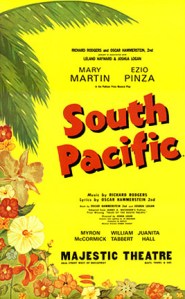
Like other Rodgers and Hammerstein musicals, this show tackled tough themes – this one being prejudice. That did not set well with some theatergoers. Indeed, some potential investors did not put money into the show because of its stance. But Rodgers, Hammerstein, Logan and Hayward persisted. Their diligence paid off when the musical received the 1950 Pulitzer Prize in Drama, only the second musical to receive this designation.

This was the first Rodgers & Hammerstein musical to not feature big dance numbers. In fact, there was no choreographer. The dance steps which existed were created by Martin, who had taught dance in her native Texas as a young mother.

Opening late in the season, South Pacific was named the 1949 New York Drama Critics Circle Best Musical, but was not part of the Tony Awards until 1950. (Though Jo Mielziner, who designed the set for South Pacific received a Tony for his set designs of shows during the 1948-49 season and South Pacific was one of the titles listed.)

At the 1950 Tonys, it received six Tony Awards (sometimes listed as eight because Book and Score were not broken separate from Best Musical that year—but some sources incorrectly separate them.) It was named Best Musical, Actor in a Musical (Pinza), Actress in a Musical (Martin), Featured Actor in a Musical (McCormick), Featured Actress in a Musical (Hall), and Director (Logan). This is the only time that all four acting awards in the musical category went to performers in the same production. In fact, the other two acting trophies that year were incorrectly engraved as being from South Pacific out of habit.

Logan’s win was also the first time that the Director Tony went for a musical, since at the time that award was not separated out among plays and musicals. Hall was the first African American to win a Tony Award for Acting. Martin would reunite with Hayward, Rodgers & Hammerstein ten years later for The Sound of Music. Pinza and Tabbert reunited in 1954 for Fanny which would be the final Broadway credit for each gentleman. McCormick stayed with the show the entire run, except for vacations.

In 1999 for the 50th anniversary and in 2008 for the opening of the first Broadway revival remaining cast members from the original production had reunions in New York City. At the 50th anniversary ceremony, a proclamation from Little Rock Mayor Jim Dailey was read declaring it South Pacific day in Little Rock and honoring the show. It is interesting to note that in 1949, there were two heroines on the Broadway stage from Little Rock: Nellie Forbush from South Pacific and Lorelei Lee from Gentlemen Prefer Blondes.

Little Rock Look Back: First Basketball Game in Little Rock

Very few sports can have a definitive “this was the first game in Little Rock” moment. But basketball does.

On April 7, 1893, the Arkansas Gazette ran stories about the final day of horse racing at Clinton Park racetrack (the park stretched roughly from what is today’s Clinton Presidential Park through the East Village to Clinton National Airport), the men who were soon to take office as aldermen met to plan for their upcoming City Council terms, and a preview of a new sport coming to Little Rock.

Less than two years earlier in Springfield, Massachusetts, a YMCA instructor named James Naismith had invented the new game of Basket Ball (then spelled with two words).  The sport caught on in popularity and spread throughout the country through the network of YMCAs.

Now, on April 7, 1893, Little Rock residents would get their first glimpse of the game.  Two hundred men and women gathered at the Little Rock YMCA (located at the northeast corner of Fourth and Main Streets) to see the game, which started at 8:30pm.

The Little Rock YMCA team (which had only formed the night before) took on the Pine Bluff YMCA team.  The Pine Bluff young men had been practicing for six months.  The results of the game reflected that.  At the end, Pine Bluff had scored 70 points and Little Rock had scored 9 points.

Following the game, the Little Rock chapter hosted both teams for refreshments.  Little Rock was scheduled to go to Pine Bluff to play again during the YMCA statewide convention at the end of April.

From those meager beginnings, Little Rock has seen its fair share of basketball triumphs.

Tartan Day – BRIGADOON appears in Little Rock for the first time in 1951

April 6 is Tartan Day – a chance to pay tribute to the achievements of Scots in the U.S.  It is also a good chance to wear plaid.

On January 17 and 18, 1951, the Broadway musical Brigadoon materialized at Robinson Memorial Auditorium for its first visit to Little Rock.  This musical by Alan Jay Lerner and Frederick Loewe is a Scottish fantasy about a town that materializes for one day every 100 years.

First performed on Broadway in 1947, it was revived at New York City Center in 1950. It was that production that toured in 1951 to Little Rock.  The production was produced by John Yorke (who had worked on the original Broadway production) and brought to Little Rock by Metropolitan Attractions.

The cast was led by future Tony nominee Susan Johnson.  Others in the cast were Elizabeth Early, Robert Busch, Betty Logue and Thaddeus Clancy. All had appeared at City Center, though some in different roles than on the tour.  This touring production featured the original Broadway creative team from 1947 with direction by Robert Lewis, choreography by Agnes de Mille (who won a Tony for it, at the first ceremony), scenery by future Tony winner Oliver Smith, costumes by Tony winner David Ffolkes, lighting by Peggy Clark, and orchestrations by Ted Royal.

Over the years, Brigadoon has resurfaced in Little Rock in community theatre and school productions.  But this was the first time that tartans of the MacLaren, Dalrymple, Brockie and Anderson clans first appeared in Little Rock.

Little Rock Look Back: First City Council meeting in current LR City Hall

City Hall circa 1908

On April 6, 1908, the first City Council meeting took place in the new Little Rock City Hall.  Located at the corner of Markham and Broadway Streets, this three story structure was designed by Charles L. Thompson.

The idea of a new City Hall had first been raised by Mayor W. E. Lenon in 1904.  After a couple of false starts and delays, the project finally got underway in the autumn of 1906.  (The date on the front of the building is the optimistic and ultimately wrong 1907.  But it is etched in stone and set into the exterior.)

City offices started moving in during January and February 1908 while construction continued.  By the end of March, the building was complete and all offices moved in.  The final City Council meeting in the 1868 City Hall took place on March 30.  One week later, the body reassembled in their new space.

All sixteen of the aldermen were present for this meeting, which was a rare occurrence.  The regular order of business was dispensed with except for approval of payments for the bills and payroll for March.  That totaled $25,719.56. (This is the equivalent of $664,729.65 in 2018).

The floor was then turned over to Mayor Lenon to make an announcement.  In his remarks, the Mayor praised the new building, and then stated he was resigning immediately.  His business interests were such that he did not have time to be mayor.

The Council reluctantly accepted the resignation.  Because there was over a year remaining in the term, a special election would need to be called to select a successor.  If Mayor Lenon had waited two more weeks to resign, the Council would have appointed a new mayor for the duration of the term.

Alderman John Herndon Hollis was chosen to serve as mayor until the special election could be held.  First elected in 1904, he was about to start his third term as an alderman.  Though he did not have to give up his seat (and in fact served as an alderman until 1918), he was referred to as Mayor Hollis during his brief tenure.  He is counted as one of Little Rock’s mayors.  Unlike other times where there was an acting mayor while a mayor was out of town, in 1908, there was no other mayor for whom Mayor Hollis was acting in absentia.

After the selection of the new mayor, a committee was appointed to draft a resolution praising retiring Mayor Lenon.  The final business at the meeting was the reading of a resolution memorializing longtime City Clerk H. Clay Jones.  The former city official had died in March.