
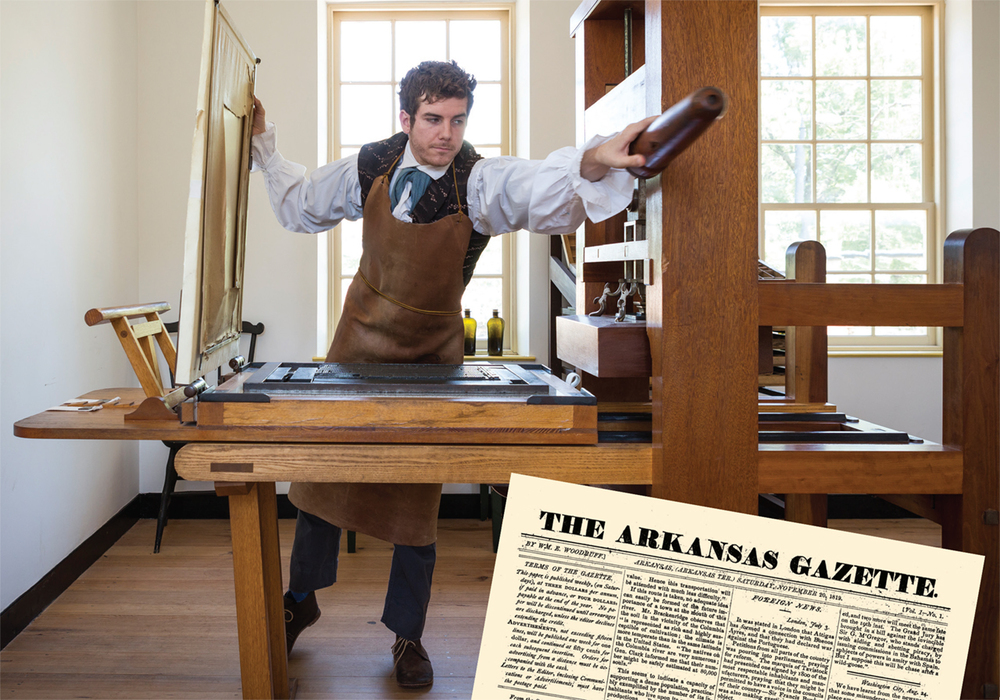
200 Years since Arkansas Gazette was founded is focus of 2nd Friday Art Night at Historic Arkansas Museum


On November 7, 1950, Little Rock voters approved the creation of the Little Rock Airport Commission. This was an extremely rare initiated ordinance.
Local business leaders had tried two times prior to get the City Council to create an Airport Commission. At the time, the Airport was managed by the Council’s Airport Committee, composed of aldermen. Both times, the Council rejected the measure.
This prompted an organization called the Private Flyers Association to begin the drive to collect the signatures to place the ordinance on the ballot. Mayor Sam Wassell was in favor of the creation of the separate commission to oversee the airport and was a member of the Private Flyers Association.
At the general election on November 7, 1950, the ordinance was on the ballot. It passed with an overwhelming majority: 13,025 voters approved of it, and only 3,206 opposed it. The Arkansas Gazette had been a proponent of the switch, endorsing it with a front page editorial entitled “An Airport for the Air Age.”
Also on the ballot in 1950 was a GOP challenger to a Democrat for one of the aldermen positions. George D. Kelley, Jr., ran against incumbent Lee H. Evans. Kelley was the first GOP contestant for a city race since Pratt Remmel ran unsuccessfully for City Council in 1938. Remmel would be back on the ballot in 1951, this time for the position of mayor in a successful effort.
Tonight (November 14) from 5:30pm to 7:30pm, Mosaic Templars Cultural Center will show the documentary “Birth of a Movement” and host a discussion.
In 1915, Boston-based African American newspaper editor and activist William M. Trotter waged a battle against D.W. Griffith’s technically groundbreaking but notoriously Ku Klux Klan-friendly The Birth of a Nation, unleashing a fight that still rages today about race relations, media representation, and the power and influence of Hollywood.
Birth of a Movement, based on Dick Lehr’s book The Birth of a Movement: How Birth of a Nation Ignited the Battle for Civil Rights, captures the backdrop to this prescient clash between human rights, freedom of speech, and a changing media landscape.
Birth of a Movement features interviews with Spike Lee (whose NYU student film The Answer was a response to Griffith’s film), Reginald Hudlin, DJ Spooky, Henry Louis Gates, Jr., and Dick Lehr, while exploring how Griffith’s film — long taught in film classes as an innovative work of genius — motivated generations of African American filmmakers and artists as they worked to reclaim their history and their onscreen image.
Take a break from your work day for a Midday Music Moment at Mosaic Templars Cultural Center! The program begins at 12 noon today (November 7).

They are partnering with the Arkansas Symphony Orchestra to bring a special lunchtime presentation and performance by pianist/composer Karen Walwyn.
Karen will talk about one of Arkansas’s most renowned classical composers, Florence Price, and play snippets of her work. Karen will also lead discussion about the barriers that Price and other African American classical musicians have faced.
This is a free event.

Refuse on the site where the Clinton Center would be built
On November 7, 1997, President Bill Clinton announced his intentions to locate his presidential library and school of public service in Little Rock at the end of a warehouse district.
The Little Rock City Board met in a special meeting that day to rename part of Markham Street, which would lead to the site, as President Clinton Avenue.
While the announcement was met with excitement in many quarters, there were still some skeptics who had a hard time envisioning a presidential library and park in the middle of a wasteland worthy of a T. S. Eliot poem.
There would be many hurdles between the November 1997 announcement to the December 2001 groundbreaking. But for the moment, City of Little Rock leaders, celebrated the achievement. Then Mayor Jim Dailey had appointed City Director Dean Kumpuris and City employee Bruce T. Moore to lead the City’s efforts. Moore and Kumpuris worked with Skip Rutherford and others to narrow the potential sites.
In September 1997, the Clintons were in town for the 40th anniversary of the integration of Central High School. They surprised Kumpuris and Moore with a decision for a Sunday afternoon visit to the warehouse district proposed site. Secret Service would not let the limousine drive in part of the property, so the Clintons, Moore, Kumpuris, and Rutherford walked up a path to the roof of the abandoned Arkansas Book Depository. It was there that the Clintons could see the Little Rock skyline which would be visible from the library.
Of course by the time the library had opened in November 2004, the Little Rock skyline was different. Spurred on by the library, several new highrises had been constructed in downtown.
Join the Little Rock Parks and Recreation Department as they welcome acclaimed journalist Hampton Sides at the MacArthur Museum of Arkansas Military History.

Sides is best-known for his gripping non-fiction adventure stories set in war or depicting epic expeditions of discovery and exploration including the bestselling histories Ghost Soldiers, Blood and Thunder, Hellhound On His Trail, In the Kingdom of Ice, and, most recently, On Desperate Ground about the greatest battle of the Korean War.
He’ll be speaking about On Desperate Ground, which features Little Rock’s John Yancey, whose family shared his notes and letters with the author. Hampton will also be signing books.
The program begins at 12 noon.
With the stroke of Territorial Governor John Pope’s pen, Little Rock was officially chartered as a town on November 7, 1831. This followed approval by the Arkansas legislature a few days earlier.
As a chartered, officially recognized municipality, the Town of Little Rock was authorized to create a government and to plan for a Mayor and Aldermen to be elected. That election would take place in January 1832 with the initial council meeting later that month.
There are several earlier and later days which could be used to mark Little Rock’s official birth (La Harpe sighting in 1722, first settler in 1812, permanent settlement in 1820, selection of trustees in 1825, chartered as a City in 1835, chartered as a City of First Class in 1875) — but it is November 7, 1831, which has been the officially recognized and accepted date.
In 1931, Little Rock celebrated her centennial with a series of events. Likewise, in November 1981, Little Rock Mayor Charles Bussey signed and City Clerk Jane Czech attested Resolution 6,687 which recognized the Little Rock sesquicentennial.