Bill Clinton announces for Presidency on October 3, 1991

The Clintons following his remarks.

On October 3, 1991, Governor Bill Clinton strode out the front doors of the Old State House Museum and announced his intentions to seek the 1992 Democratic Party’s nomination for President of the United States.

(While Clinton was a major fan of JFK, it is doubtful he realized that his announcement took place on the 28th anniversary of JFK speaking in Little Rock.)

Clinton was the fifth major Democrat to announce for the office. That there were that many by early October was somewhat surprising considering that the first half of 1991 saw many national Democrats announce they were NOT seeking the office.

Jerry Brown, Bob Kerrey, Paul Tsongas, and Tom Harkin were also in the race.  Clinton was seen as a centrist, along with Senator Kerrey while the others were viewed as being from the far-left wing of the Democratic Party.

In its coverage of the announcement, The New York Times noted the significance of Gov. Clinton’s remarks on race.  In the speech he referenced his desire to strengthen relations and remove barriers between the races.  As the Times pointed out, it was at the Old State House that Arkansas held two conventions on the issue of secession prior to the state’s entry into the Civil War.

At the time of the announcement, Gov. Clinton was far from a front-runner. His national profile was probably the lowest of any of the announced candidates. Most of the knowledge of him outside of Little Rock came from his lengthy speech about Michael Dukakis at the 1988 Democratic Convention and the subsequent appearance on “The Tonight Show” where both he and Johnny Carson poked fun as his loquaciousness.

Regardless of their views on his chances, the Governor’s family, friends, and fans packed the front lawn of the Old State House to cheer him.  The national media treated him as a serious, albeit largely unknown, candidate.  After having had Wilbur Mills, Dale Bumpers and others flirt with running and then backing out, the local media were probably thrilled to finally have someone from Arkansas actually running for the presidency.

One local media outlet would not see much of the campaign. Just fifteen days later, the Arkansas Gazette would close. As a paper which had covered nearly two decades of his career, the Gazette was often Clinton’s champion, though the paper was not afraid to point out times the two differed.  However, there would be no Gazette headline about Clinton in New Hampshire, at the Democratic Convention, or a general election victory.

On Election Day in 1992 and again in 1996, Bill Clinton would repeat the stride out the front doors of the Old State House accompanied by his wife and daughter.  Those two times the crowds would spill down the streets in all directions. Instead of a handful of media outlets there would be scores of them.

But it all started on a sunny autumn day in Little Rock in early October 1991.

JFK in LR

On October 3, 1963, President John F. Kennedy delivered remarks at the Arkansas State Fairgrounds.  Only a few weeks later, he would be felled by an assassins bullet in Texas.

In the speech, the President praised Arkansas’ congressional delegation including Senators John McClellan and J. William Fulbright and Congressmen Took Gathings, Bill Trimble, Wilbur Mills and Oren Harris.  Each of these men held senior leadership positions in key committees.  The main focus of the speech was to discuss President Kennedy’s vision for a new economy in the South.

The President was actually in the state to speak at the dedication of the Greers Ferry Dam. He agreed to make that appearance as a part of a negotiation with Congressman Mills as they were deadlocked over changes to the tax code.  He had previously visited Little Rock in 1957 when he came to the state to address the Arkansas Bar Association meeting in Hot Springs.

President Kennedy continued the string of 20th Century Presidents to visit Little Rock.  Presidents Theodore Roosevelt, William Howard Taft, Franklin Roosevelt and Harry Truman had all visited while in office.  Woodrow Wilson, Herbert Hoover and Dwight Eisenhower all visited prior to attaining the presidency.

This evening at the Clinton School – Theo Witsell discusses his Bicentenary interpretation of Thomas Nuttall’s exploration of the Arkansas Territory

Image result for theo witsellThe year 2019 marks the 200th anniversary of the great botanist and naturalist Thomas Nuttall’s year-long journey of discovery through the Arkansas Territory, present day Arkansas and Oklahoma.
Tonight at 6pm, as part of the Clinton School Speaker Series, Theo Witsell will discuss Nuttall’s trek and the implications it has for today.

Nuttall would be the first trained naturalist to record observations and collect specimens in most of the territory. His first-hand account of this trip, later published as “A Journal of Travels into the Arkansas Territory in the Year 1819,” provides some of the earliest reliable information on the natural history of the region. These observations and his surviving botanical specimens are central to our understanding of what the region was like before it was forever altered by the ravages of human progress.

To commemorate the bicentennial of Nuttall’s trip, Theo Witsell, Ecologist and Chief of Research for the Arkansas Natural Heritage Commission and the Curator of the ANHC Herbarium, worked for the past several years on a “200 years later” reinterpretation of all the natural history observations he made in Arkansas Territory.

This included retracing his route using both historical and modern geospatial datasets, updating the nomenclature and taxonomy of all the plants and animals he mentions, and weaving his own observations gained over the past 24 years conducting field work for the Arkansas Natural Heritage Commission. The aim is to provide a fairly detailed interpretation of Nuttall’s natural history observations, and discuss changes in the landscape since his trip, specifically as they relate to ecological and biological diversity.

All Clinton School Speaker Series events are free and open to the public. Reserve your seats by emailing publicprograms@clintonschool.uasys.edu or by calling (501) 683-5239.

The CALS Hitchcocktoberfest moves NORTH BY NORTHWEST tonight

North by Northwest (1959, NR)

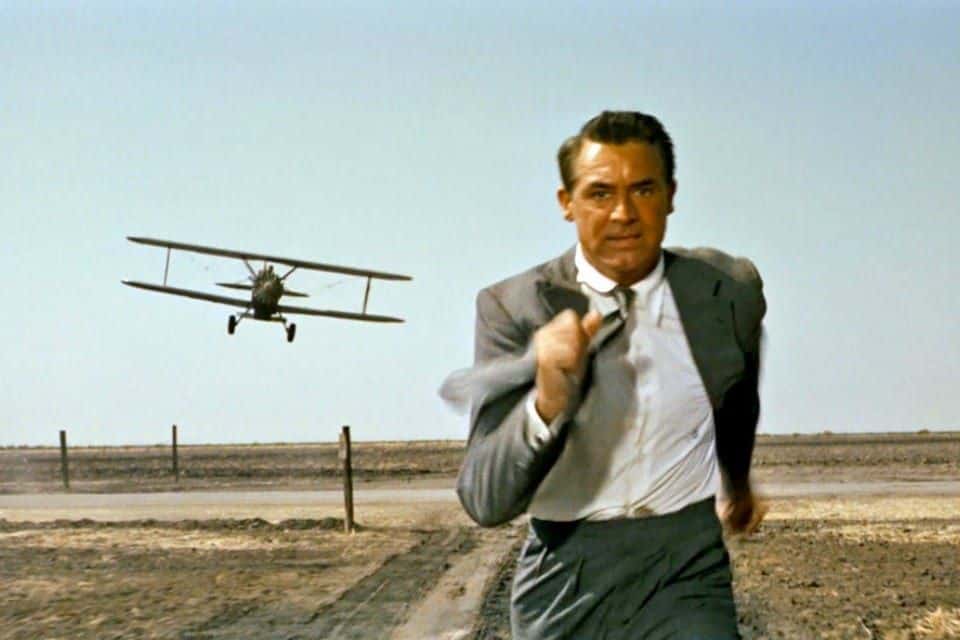
Dodge a plane. Climb on the face of Mount Rushmore. Spot the kid covering his ears before the gunshot.

Join the CALS Ron Robinson Theater for HITCHCOCKTOBERFEST! They will be screening FIVE classic Hitchcock films throughout October, and start the series off tonight (October 1) with North by Northwest.

The film turns 60 this year, but is as taut and engaging as when Hitchcock first made it.  The screening starts at 7pm.

Cary Grant teams with director Alfred Hitchcock for the fourth and final time in the superlative espionage caper, North by Northwest, judged as one of the American Film Institute’s Top 100 American Films and recipient of three Academy Award nominations.

Grant stars as an innocent man mistaken for a spy in one of Hitchcock’s greatest thrillers. While leaving New York’s Plaza Hotel, advertising executive Roger Thornhill (Grant) has the misfortune of standing just as the name “George Kaplan” is paged — starting a lethal case of mistaken identity and a nonstop game of cat and mouse as he is pursued across North America by espionage agents trying to kill him… and by police who suspect him of murder.

Pursued by spy (James Mason) and counterspy (Eva Marie Saint), Thornhill is variously abducted, framed for murder, chased and in another signature set piece, crop-dusted. He also holds on for dear life from the facial features of the Presidents on Mount Rushmore. It all adds up to another box-office smash from the Master of Suspense.

Artober – Art I Can’t Live Without

October is Arts and Humanities Month nationally and in Little Rock. Americans for the Arts has identified a different arts topic to be posted for each day in the month.  Starting off is Art I Can’t Live Without.

For me, it is Diego Rivera’s DOS MUJERES, or PORTRAIT OF TWO WOMEN.

Painted in 1914, it is part of the permanent collection of the Arkansas Arts Center.  This oil on canvas, which stands six and a half feet tall and five and a half feet wide, is a portrait of Angelina Beloff and Maria Dolores Bastian.

Influenced by cubists such as Picasso, Rivera adopted fracturing of form, use of multiple perspective points, and flattening of the picture plane.  Yet his take on this style of painting is distinctive.  He uses brighter colors and a larger scale than many early cubist pictures. Rivera also features highly textured surfaces executed in a variety of techniques.

The painting was a gift to the Arkansas Arts Center by Abby Rockefeller Mauzé, sister of Arkansas Governor Winthrop Rockefeller.