With the Arkansas Cinema Society’s FILMLAND 2019 later this month (August 21 to 25), Mondays in August will feature movies with Little Rock connections. Today’s films are both about World War II military heroes and both had their world premieres in Little Rock.
One was released during World War II and starred Gary Cooper as Dr. Corydon Wassell. The other was released in the 1970s and starred Gregory Peck as General Douglas MacArthur.
 Born in Little Rock on July 4, 1884, Corydon McAlmont Wassell (called “Cory”) was born to Albert and Leona Wassell. A grandson of Little Rock Mayor John Wassell, he graduated from what is now UAMS in 1909. In 1911, he married Mary Irene Yarnell, with whom he would have four children. In 1914, the couple volunteered to be Episcopal missionaries in China. He served there until 1927. Following Mary’s death and his remarriage, he and new wife Madeline Edith Day Wassell returned to Arkansas in 1927.
Dr. Wassell resumed his medical practice. Given his experience with malaria in China, he proved to be an asset fighting malaria among Civilian Conservation Corps members in Arkansas. He was subsequently called to active duty in the Navy in 1936 and stationed in Key West.
After the outbreak of World War II, he was stationed in Indonesia. In early 1942, he refused to abandon his patients after the Japanese started invading Indonesia. Instead, he was able to evacuate a dozen severely wounded men over 150 miles to get to a ship. It took ten days for the ship to get to Australia, during which time it was attacked numerous times. His official Navy Cross citation notes that he disregarded personal safety while caring for others.
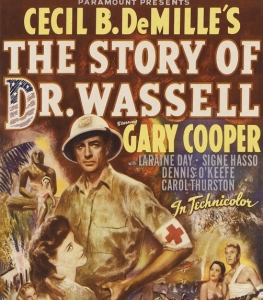
He became an instant international hero. During the early days of the war, his heroism was one of the few bright spots. President Roosevelt praised him in a fireside chat. James Hilton wrote of Dr. Wassell in a book which was then adapted by Cecil B. DeMille into the 1944 movie starring Cooper. Originally Arkansan Alan Ladd was wanted to play Cooper’s sidekick, but Ladd was pressed into military service and unavailable.
From April 24 to 26, 1944, Cecil B. DeMille was in Little Rock for the world premiere screening of The Story of Dr. Wassell. Little Rock rolled out the red carpet (literally and figuratively) for DeMille and a contingency from Hollywood. Dr. and Mrs. Wassell also returned to Little Rock for the festivities. Unfortunately, Gary Cooper (who played Wassell in the film) was unable to attend due to illness. His costar, Laraine Day, was making another film and could not attend either. Those in attendance with DeMille (and Mrs. DeMille) included actresses Signe Hasso and Carol Thurston, and actor Melvin Francis. The latter played himself; he had actually been one of the sailors saved by Dr. Wassell.
Sold-out screenings of the movie took place at the Capitol and Arkansas Theatres. On April 27, 1944, a regular run of the movie started at the Capitol Theatre. It would be released nationally on July 4, 1944, which also happened to be Dr. Wassell’s birthday.
Thirty-three years after The Story of Dr. Wassell was released, MacArthur was brought to the screen by Universal Pictures. It was their attempt to capitalize on the success of the movie Patton, including sharing some of the same members of the production team.
 Told entirely in flashback, it stars Gregory Peck as the fabled World War II general who was born in Little Rock. It focuses primarily on events in 1942 during the war, his dismissal by Truman in 1952, and his famous address to West Point in 1962.
Peck initially did not care for the subject or the script, but eventually stated that he grew to admire the challenges MacArthur faced. Peck later called it one of his favorites roles, if not one of his favorite movies.
Producer Frank McCarthy, who worked on both Patton and MacArthur once said of Patton and MacArthur: “Both were complex men but General MacArthur was complex on a much broader scale. Patton had no ambition except to be a soldier and to command a field army. He was strictly command.”
Most of the film was shot on the backlot at the movie studio, which impacted the quality of the film. The production budget simply would not allow for overseas location filming.
The film was released in July 1977. One of the premieres was held in Little Rock. Peck attended a reception in the Arsenal Building where MacArthur was born. Now the home to the MacArthur Museum of Arkansas Military History, in 1977 the building still housed the Museum of Science and Natural History (now the Museum of Discovery). Since MacArthur only spent a few hours in Little Rock as an adult, it is possible that Peck spent more time in the building than the General did.
The evening of August 5, 1977, started with an exclusive reception for 100 people with Gregory and Veronique Peck. The movie itself was shown at the Cinema 150, where its general run would start on Saturday, August 6. Following the film, a reception and silent auction brought people back to the museum. Tickets ran $250 a person for all events, $100 a person for the film and post-show reception, and $25 for the movie. It sold out.
Governor and Mrs. David Pryor escorted the Pecks into the theatre. Former Governor (and World War II hero) Sid McMath introduced Mr. Peck to the crowd. He extolled the virtues of Peck and MacArthur. (It is interesting that he should admire MacArthur so much, since the General and President Truman had a well-publicized tiff, and McMath and Truman had enjoyed a warm relationship.) Little Rock City Director Jim Dailey presented Peck with a Key to the City.

 On August 6, 1823, future Little Rock Mayor William Eliot Ashley was born in Little Rock. He would go on to become the first Little Rock Mayor to be born in Little Rock. Ashley was the son of Mary and Chester Ashley; his father would later serve as a U. S. Senator from Arkansas. He was the second of the couple’s seven children.
 Music director, organist & choirmaster Rees Roberts of St. Luke’s Episcopal Church will play a farewell concert at the church, 4106 JFK Boulevard, at 5:30 p.m. on Sunday, August 4.
 On August 4, 1834, future Little Rock Mayor William G. Whipple was born in Connecticut. He attended school in Massachusetts and graduated from Wesleyan University. After studying law at Albany Law School, he moved to Milwaukee, Wisconsin.
 The GinSingers will take you on a musical journey of a wide ranging world of jazz for SOMA After Dark on Friday, August 2. Concert beings at 9 pm. Purchase advance tickets for $7 or pay a $10 cover day of show. Tickets do not guarantee you a seat. To reserve a table please call (501) 244-9660.
 Little Rock Culture Vulture