
Arkansas Heritage Month – Cinco de Mayo with Diego Rivera

portrait-of-two-womenToday is Cinco de Mayo. This Mexican holiday seems a good day to return again to the art of Diego Rivera.  He is one of the Culture Vulture favorite artists, so any excuse to discuss him and his relationship with the Rockefeller family is greatly appreciated.

One of Rivera’s masterpieces is 1914’s Portrait of Two Women which is part of the permanent collection of the Arkansas Arts Center. The official name is Dos Mujeres.  It is a portrait of Angelina Beloff and Maria Dolores Bastian.  The former was Rivera’s first wife.

This oil on canvas stands six and a half feet tall and five and a half feet wide.

Influenced by cubists such as Picasso, Rivera adopted fracturing of form, use of multiple perspective points, and flattening of the picture plane.  Yet his take on this style of painting is distinctive.  He uses brighter colors and a larger scale than many early cubist pictures. Rivera also features highly textured surfaces executed in a variety of techniques.

The painting was a gift to the Arkansas Arts Center by Abby Rockefeller Mauzé, sister of Arkansas Governor Winthrop Rockefeller.  At the 1963 opening of the Arkansas Arts Center, James Rorimer, the director of the Metropolitan Museum of Art, remarked several times to Arts Center trustee Jeane Hamilton that the Met should have that piece. Jeane politely smiled as she remarked, “But we have it.”

Of all her brothers, Abby was closest to Winthrop. The other brothers, at best ignored, and at worst, antagonized the two.  Given the complicated relationship of Rivera with members of the Rockefeller family, it is not surprising that if Abby were to have purchased this piece, she would donate it to a facility with close ties to Winthrop.  (Though the Rockefeller brothers had Rivera’s mural at Rockefeller Center destroyed, he maintained a cordial relationship with Abby Aldrich Rockefeller — well as cordial as an anti-social Communist could be with the doyenne of capitalist NYC Society.)

The Arkansas Arts Center has several other works of art in their collection with ties to Mexico. Some are by Mexican artists. Others are inspired by Mexico. They have several by Elsie Fruend depicting scenes in Mexico.
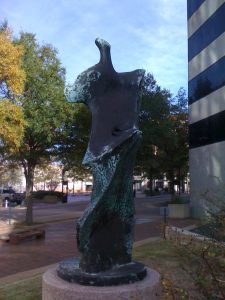
Arkansas Heritage Month – Public Art comes to Little Rock with Henry Moore’s LARGE STANDING FIGURE: KNIFE EDGE

HenryMooreIt was 1978, Bill Clinton was making his first run for Governor, Dallas and Robin Williams both made their TV debuts, disco was dominating the music scene, and Little Rock received its first major piece of public art.

Arguably Little Rock’s most famous piece of public art is Henry Moore’s 1961 creation Large Standing Figure: Knife Edge, which is known locally as “The Henry Moore Sculpture.”

The original model was created in 1961; this sculpture was cast in 1976 and purchased in June 1978 by the Little Rock Metrocentre Improvement District.

The purchase price was $185,000 — a princely sum at the time but now a bargain for a Henry Moore sculpture. (Adjusted for inflation, that amount would be the equivalent of $705,000 today.)

A committee consisting of Townsend Wolfe (then the director and chief curator of the Arkansas Arts Center), James Dyke and Dr. Virginia Rembert traveled to England to meet with Moore about the sculpture.

It was originally placed on Main Street when the street had been bricked over as part of the Metrocentre Mall pedestrian mall plan. As portions of the street became unbricked and reopened to vehicular traffic, it was moved to the intersection of Capitol and Main. Finally, when the last segment was reopened to vehicular traffic, it was put at its current location of the southeast corner of Capitol and Louisiana. Because it was purchased by the Improvement District, it must stay within the boundaries of the district.

There is currently discussion about the Metrocentre Improvement District disbanding and the sculpture being relocated elsewhere in the City.

A replica of the sculpture is featured in the 1980s classic The Breakfast Club.

Today is #ArkansasGives Day

Arkansas GivesIf you are like me, you’ve been receiving notifications about Arkansas Gives Day for months.  Well, today is the day!  From 8am until 8pm, you can help grow the love for Arkansas’s nonprofit organizations by making a donation to the charity of your choice.  The event is sponsored by the Arkansas Community Foundation.

As a special incentive to give, each gift made through ArkansasGives on April 7, 2016 will be matched with additional bonus dollars; the more you give, the more bonus dollars your favorite charity will receive.

Nonprofit organizations and other tax-exempt charitable organizations may participate if they:

  • Are headquartered in Arkansas or have a base of operations in Arkansas.
  • Are a member of the Arkansas Nonprofit Alliance.
  • Have 501c3 tax exempt status under IRS code AND are qualified as a 509(a)(1), (a)(2) or (a)(3) organization or as a private operating foundation.

The minimum amount is $25; there is no maximum amount you may give. You may designate up to 10 charities per transaction.

Accepted Forms of Payment: Visa, MasterCard, Discover and American Express credit cards online.
You will receive an email receipt of your gift; please retain it for tax purposes. Unless you choose to remain anonymous, your donor information will be sent to the nonprofits to which you give.

Here is a list of cultural organizations which offer services within the boundaries of the City of Little Rock.

There are MANY MANY MANY other worthy nonprofits which are participating. But since this is a culture blog, only the cultural institutions are listed.  But please consider visiting the website and perusing the entire list.

“Industrial Beauty: Charles Burchfield’s Black Iron” exhibit at Arkansas Arts Center through May 8

The massive counterweights of a railroad drawbridge over Buffalo Creek fascinated watercolorist Charles Burchfield as he traveled to the Port of Buffalo in 1933. The artist promised himself he would one day depict the bridge. In 1935, he said, “I made one trip in to look over the subject, and received a new thrill. . . What a delight! What a joy it was! The subject ‘over-powered me’” He recalled, “It was difficult working, that first day, but I rejoiced in all the handicaps . . . the ground had not settled yet from the spring thaw, and where I stood it was all sand; engrossed in my work I did not know how treacherous it was until I went to step backward and could not move my feet . . .” A bridge worker had to rescue the artist, who was captivated, indeed.

Charles Burchfield, American (Ashtabula Harbor, Ohio, 1893 – 1967, West Seneca, New York), Black Iron, 1935, watercolor, 28 1/8 x 40 in. Arkansas Arts Center Foundation Collection: Gift of Hope Aldrich, in memory of her father, John D. Rockefeller, 3rd. 2013.006.001.

Burchfield’s devoted labor resulted in one of his greatest watercolors, Black Iron. This exhibition celebrates the arrival of this masterpiece in Arkansas as a gift from Hope Aldrich in honor of her father, John D. Rockefeller, 3rd. This generous donation also includes seven sketches and a sheet of notes from which the artist’s commentary above is quoted. The exhibition Industrial Beauty sets this material in a wider context.

Burchfield is best known as a visual poet of nature who was one of America’s outstanding modern watercolorists. Early and late in his career he made graceful images of trees, flowers, clouds, and abstract lines suggesting such natural sounds as the chirping of crickets. But in the 1930s, the artist was riveted by the technology used to move and store the grain, iron ore, and other products of the Great Lakes region where he lived. His style became more realistic as he depicted the beautiful geometry of railroads, bridges, grain elevators, and factories.

This exhibition gathers such images from the 1930s, including a 1933 watercolor of Buffalo Harbor, Three Boats in Winter (Rhode Island School of Design Museum of Art, Providence, Rhode Island), which he was making when he first spotted the drawbridge over Buffalo Creek. The exhibition gathers drawings, watercolors, and a rare oil painting from distinguished collections around the country. These images show us Burchfield’s vision of industry. The artist concentrated on massive iron structures and industrial scenes in the 1930s, but he had been depicting bridges and trains since his youth in the 1910s.

2016 Mid-Southern Watercolorists Exhibition at Arkansas Arts Center

MSW Gold Award "Lake Lilies" by Judy Wright Walter

MSW Gold Award “Lake Lilies” by Judy Wright Walter

The artists of the Mid-Southern Watercolorists have been exploring the world through luminous color on paper since the group was founded in 1970. The MSW is one of the largest and most active art organizations headquartered in Arkansas. More than 200 members live and create across the Mid-South and beyond. Their works are widely exhibited in venues both regional and national. Each year their finest productions are gathered in a juried exhibition.

The guest juror for this year’s exhibition is nationally recognized watercolorist, Robert Burridge. From 136 entries submitted by 74 artists, he narrowed the exhibition list to thirty works. Burridge is the Honorary President of the International Society of Acrylic Painters (ISAP) and a Signature Member of both the ISIP and the Philadelphia Water Color Society. He is a recipient of their highest and most prestigious award, the Crest Medal for Achievement in the Arts.

The Mid-Southern Watercolorists hold their meetings on the third Wednesday of each month in the Lecture Hall here at the Arkansas Arts Center. They offer workshops where members can learn from locally and nationally recognized watercolorists. To learn more about the organization, or to join, please visit: MidSouthernWatercolorists.com.

On International Women’s Day, see the Dorthea Lange’s America at the Arkansas Arts Center

Today is International Women’s Day. The Arkansas Arts Center currently features several exhibitions celebrating women artists.  One of them is Dorthea Lange’s America.  It is on display through May 8.

Dorothea Lange, American (Hoboken, NJ, 1895 – 1965, San Francisco, CA), Migrant Mother, Nipomo, California, 1936, gelatin silver print, Private Collection, © Dorothea Lange/Oakland Museum of California

Migrant Mother strikes the heart. Dorothea Lange’s iconic image of the Great Depression forces us to confront the humanity and strength of one woman struggling to get her family through the privations they face when there is no money. Dorothea Lange’s America brings together many of the photographer’s images made as she traveled across America during the 1930s documenting the suffering of unemployed or terribly underpaid agricultural workers and their families. Lange took these photographs as part of the photography program connected to the Farm Security Administration, a federal agency formed under the New Deal to assist poor farmers with loans and other programs.

Lange and her fellow FSA photographers recorded the lives of people coping with the dust bowl, bank and business failures, and the loss of their jobs and homes. We see the hopelessness of hungry men in breadlines and the shattered, abandoned cabin of a tenant farmer in the Mississippi Delta. But Americans did not give up. We also see the determination of men doing the grueling work of cutting lettuce for a pittance a day. And there is the radiant smile of an Arkansas mother who went to California to make a new start with her husband and eleven children. Such powerful images helped government agencies and representatives to understand the urgency of helping suffering Americans who had no other place to turn. 80 years later, these black and white documents of American endurance have not lost their impact.

Dorothea Lange’s America includes photographs made by Lange and her FSA colleagues, including Walker Evans, Ben Shahn, and Marion Post Wolcott. Depression-era photographs from photographers outside the FSA give a wider understand of the time. Here are striking visions by Mike Disfarmer, who worked as a portrait photographer in Heber Springs, Arkansas; and documentary images made from Oklahoma to Alabama by photographic artists including Lewis Hine, Doris Ulmann, and Willard Van Dyke. The exhibition continues with photographs Dorothea Lange made in the same spirit after the FSA was disbanded in 1943.

The Game’s Afoot at the Arkansas Arts Center

AAC marathonGame On! The Little Rock Marathon is today.

As they have the past several years, the Arkansas Arts Center will have a cheering station set up as the runners go by the museum along Commerce Street.

Today (March 6) from 7am until 9am-ish.

Stop by and enjoy food, drinks, and entertainment while cheering on participants in the race.  Then hang out in MacArthur Park until the museum opens at 11am and enjoy the exhibits there as well as brunch at Best Impressions.