Little Rock Look Back: City Council approves 1935 auditorium plan

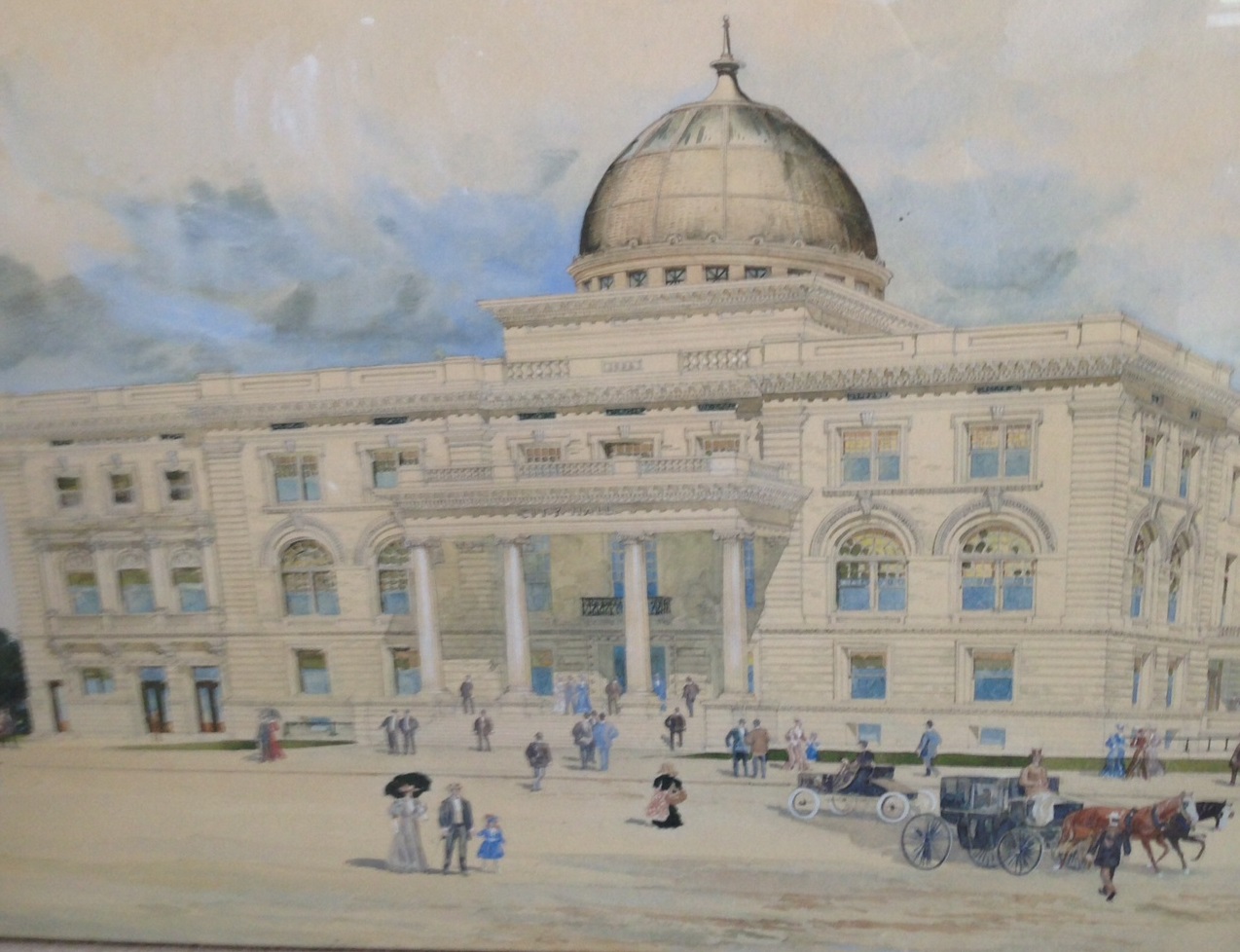
An August 25, 1935, rendering in the ARKANSAS GAZETTE of the proposed Little Rock auditorium at Capitol and Scott Streets.

An August 25, 1935, rendering in the ARKANSAS GAZETTE of the proposed Little Rock auditorium at Capitol and Scott Streets.

On August 26, 1935, the City of Little Rock took its first significant step in a decade for the creation of a City auditorium..  Under the leadership of Mayor R. E. Overman, the City Council approved authorization for the City to apply for $1,000,000 from the Federal Emergency Administration of Public Works (PWA) for the construction of an auditorium.  The PWA had issued a September 16, 1935, deadline for applications to be received as it sought to spend $4.8 billion in construction projects.

The auditorium plan was announced on Saturday, August 24, 1935.  Much preparation had already been undertaken before the project was publicly unveiled.  Private presentations hhad taken place, a team of architects had been chosen (Eugene Stern and the firm of Wittenberg & Delony), and a location had been selected.

The auditorium complex was slated for a block bounded by Capitol, Scott, Fourth and Cumberland Streets.  The Women’s City Club building on that block would remain with the new structure being built to wrap around two sides of the existing structure. The site was chosen because it was one block east of the Main Street business corridor and near existing meeting locations such as the Boys Club, Albert Pike Hotel, Albert Pike Masonic Lodge and several churches.

As planned by the architects, this structure’s front façade would have run the length of the Capitol Avenue side of the block.  The building was proposed to be constructed of concrete, stone and steel.  It would have a large hall with a proscenium stage and seating capacity of 4,000 with overflow of an additional 500.  The adjoining exhibition hall could seat 3,500 people.  The plan called for 150 cars to be parked in the building, and an additional 100 cars to be parked on a surface lot on the site.

Following an August 26 closed door meeting to discuss the project from which members of the public and press were excluded, in open session the City Council voted to pursue the funding for the million dollar auditorium.  If approved by the PWA, the funds would be provided in grants and loans, to be paid by over a 35 year period.

The auditorium proposal was filed with the PWA in Washington in September 1935.  Throughout the next several months, Mayor Overman and the city were engaged in a series of conversations and negotiations with the PWA for the expansion of both the water system and the sewer system. This diverted attention from pursuing the auditorium immediately.  This specific auditorium project stalled.  But because the plan had been filed by the September 16 deadline, it allowed the City to make use of PWA funds a few years later which would lead to the construction of Robinson Auditorium.
 

Little Rock Look Back: First City Auditorium Approved

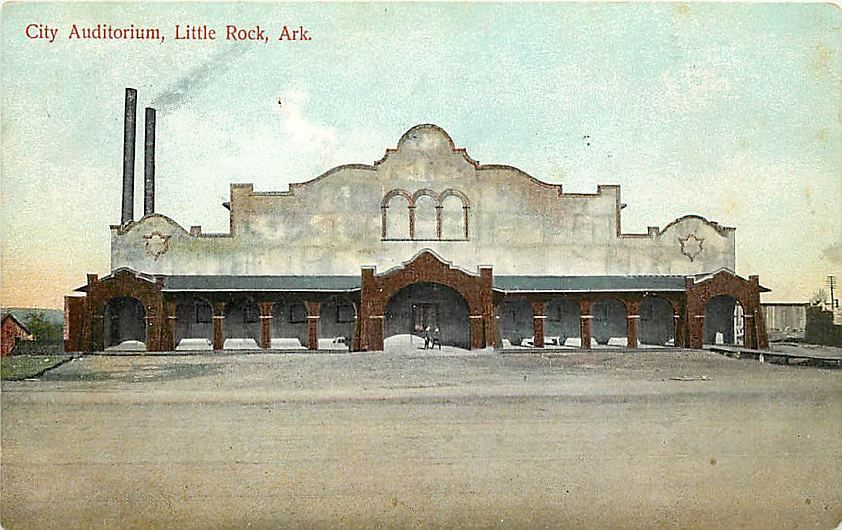
1906 auditoriumOn August 20, 1906, the Little Rock City Council approved plans for the City’s first municipal auditorium.

A week earlier, businessman A. C. Read petitioned the City for the right to construct a skating rink.  The matter was referred to the Street & Fire Committee, the Superintendent of Public Works and Aldermen Louis Volmer and Benjamin S. Thalheimer, who represented the Sixth Ward, in which the structure would be located.

Neither the Gazette nor the Democrat carried a mention of this petition in their coverage of that meeting.  By the next Council meeting a week later, the committee had reported back with a recommendation for approval.  Resolution 288 was adopted giving Mr. Read the right to build the skating rink.  Interestingly, the resolution did not contain the words “skating rink” though the original petition had.  Instead it permitted Mr. Read to construct a building “suitable for purposes as defined” by the City.  The resolution also stated that within three years the building would become property of the City.

Based on photos and postcards, the exterior of the building appears to have been covered in stucco.  It was said to be modeled after San Antonio’s Alamo, but what that really meant was that it was in the Spanish Revival style.  It was shorter and had more entrances than the Texas building did.  The Markham Street façade featured faux windows and a front portico which extended the length of the building only interrupted by three entrance archways. The center one was taller and wider than the eastern and western entrances.  All three, which projected southward from the building, mimicked the outline of the auditorium building.

The building was located on the western half of the City Hall property (and was constructed before City Hall).  In 1912, the new Little Rock Central Fire Station (now the City Hall West Wing) was built between the auditorium and Markham Street.  The auditorium stood until 1920.  During that time it was used as a roller rink, opera house, rifle range, National Guard armory, convention hall, and gymnasium.

Little Rock Look Back: Judge Eisele rules HAIR must flow at Robinson Auditorium

Ad for the original production of HAIR in Little Rock. Note the ticket prices. And that they could be purchased at Moses Music Shops.

Ad for the original production of HAIR in Little Rock. 

Forty-four years ago today, on August 11, 1971, Nixon appointee Federal Judge G. Thomas Eisele ruled that the musical Hair must be allowed to play in Little Rock in 1972 at Robinson Auditorium.

In February 1971, a young Little Rock attorney named Phil Kaplan petitioned the Little Rock Board of Censors to see if it would allow a production of Hair to play in the city. He was asking on behalf of a client who was interested in bringing a national tour to Arkansas’ capital city. The show, which had opened on Broadway to great acclaim in April 1968 after an Off Broadway run in 1967, was known for containing a nude scene as well for a script which was fairly liberally sprinkled with four-letter words. The Censors stated they could not offer an opinion without having seen a production.

By July 1971, Kaplan and his client (who by then had been identified as local promoter Jim Porter and his company Southwest Productions) were seeking permission for a January 1972 booking of Hair from the City’s Auditorium Commission which was charged with overseeing operations at Robinson Auditorium. At its July meeting, the Commissioners voted against allowing Hair because of its “brief nude scene” and “bawdy language.”

Kaplan decried the decision. He stated that the body couldn’t “sit in censorship of legitimate theatrical productions.” He noted courts had held that Hair could be produced and that the Auditorium Commission, as an agent for the State, “clearly can’t exercise prior censorship.” He proffered that if the production was obscene it would be a matter for law enforcement not the Auditorium Commission.

The Commission countered that they had an opinion from City Attorney Joseph Kemp stating they had the authority. One of the Commissioners, Mrs. Grady Miller (sister-in-law of the building’s eponym, the late Senator Robinson, she had served on the Commission since 1940), expressed her concern that allowing Hair would open the door to other productions such as Oh! Calcutta!

On July 26, 1971, Southwest Productions filed suit against the Auditorium Commission. Four days later there was a hearing before federal Judge G. Thomas Eisele. At that hearing, Auditorium Commission member Lee Rogers read aloud excerpts from the script he found objectionable. Under questioning from Kaplan, a recent touring production of Neil Simon’s Plaza Suite was discussed. That play has adultery as a central theme of one of its acts. Rogers admitted he found the play funny, and that since the adultery did not take place on stage, he did not object to it. Among those testifying in favor of it was Robert Reddington, who was director of performing arts at the Arkansas Arts Center.

Judge Eisele offered a ruling on August 11 which compelled the Auditorium Commission to allow Hair to be performed. Prior to the ruling, some of the Auditorium Commissioners had publicly stated that if they had to allow Hair, they would close it after the first performance on the grounds of obscenity. To combat this, Judge Eisele stated that the Commission had to allow Hair to perform the entire six day engagement it sought.

Upon hearing of the Judge’s ruling, Commissioner Miller offered a succinct, two word response. “Oh, Dear!”

On January 18, 1972, Hair played the first of its 8 performances over 6 days at Robinson Auditorium.  In his review the next day, the Arkansas Gazette’s Bill Lewis noted that Hair “threw out all it had to offer” and that Little Rock had survived.

Little Rock was by no means unique in trying to stop productions of Hair.  St. Louis, Birmingham, Los Angeles, Tallahassee, Boston, Atlanta, Charlotte NC, West Palm Beach, Oklahoma City, Mobile and Chattanooga all tried unsuccessfully to stop performances in their public auditoriums.  Despite Judge Eisele’s ruling against the City of Little Rock, members of the Fort Smith City Council also tried to stop a production later in 1972 in that city. This was despite warnings from City staff that there was not legal standing.

Learn about Little Rock’s earliest auditorium (which also was a roller rink AND rifle range) today at noon at Old State House Museum Brown Bag Lecture

11805726_10154024863604908_1192217255_nToday at noon, the Old State House Museum will have another Brown Bag Lecture.  This one focuses on three decades of unsuccessful efforts to build a municipal auditorium in Little Rock.  That time period was filled with big dreams, lawsuits, personality clashes, disappointments, and a Roller Rink that was also a Rifle Range.

In April 1904, Little Rock Mayor W. E. Lenon spoke of the need for a municipal auditorium in Little Rock. It would take thirty-six years for that dream to be realized. Along the way there were numerous twists, turns, detours and disappointments as the saga was played out in the newspapers, courtrooms, and offices of every major Little Rock architect at the time.

Until a permanent auditorium could be found, the City made do with vaudeville houses, high schools, and even a roller skating rink which doubled as a rifle range. Over the three decades of planning for an auditorium, some names came and went, others such as Mayor Lenon, architect Charles L. Thompson and Arkansas Gazette publisher J. N. Heiskell appeared time and time again. This Brown Bag Lunch Lecture explores the time period from 1904 to 1934 as it looks at the numerous unsuccessful attempts to construct a municipal auditorium in Little Rock.

In 2016, there will be a Brown Bag Lecture to look at construction and opening of Robinson Center Music Hall.

Scott Whiteley Carter is Special Projects Administrator for the City of Little Rock. As the unofficial historian of Little Rock City Hall, he can often be found leafing through sheaves of papers in the City Clerk’s vault or furiously scribbling notes in Little Rock research libraries. He is also the author of the LRCultureVulture.comblog. A native of Little Rock, he is a graduate of Missouri State University.

Shark Week Special: Mack the Knife at Arkansas Rep

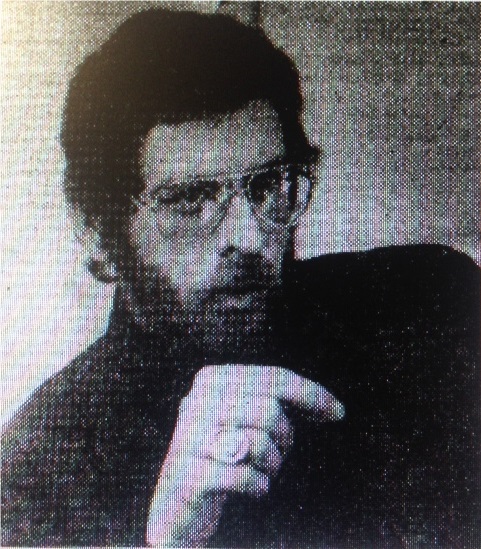
1976 Gazette photo by Steve Keesee

1976 Gazette photo of Cliff Baker by Steve Keesee

In honor of Shark Week and the upcoming 40th anniversary season at the Arkansas Repertory Theatre, a quick look back at the Rep’s first production.

In November 1976, the Arkansas Repertory Theatre’s debut production was the Kurt Weill-Bertolt Brecht musical The Threepenny Opera.  In the Marc Blitzstein translation, the opening song begins with these appropriate-for-Shark Week lyrics:

Oh, the shark has pretty teeth, dear,
And he shows them pearly white;
Just a jack-knife has Macheath, dear,
And he keeps it out of sight!

When the shark bites with his teeth, dear,
Scarlet billows start to spread;
Fancy gloves, though, wears Macheath, dear,
So there’s not a trace of red!

Often called “Mack the Knife” the song’s title is officially “Moritat” which translates to “Deadly Deed.”  In the original Arkansas Rep production, the song was sung about the Rep’s founder and artistic director Cliff Baker who played Macheath.  He also directed this production.  Others in the cast included Herb Rule, Jean Lind, Theresa Quick, Connie Gordon and Guy Couch.

In his review in the Arkansas Gazette, Bill Lewis called the production “memorable” and that it achieved the intentions of the authors.  He praised the cast, the designers and orchestra as well as Baker’s directing.   All in all, it was an auspicious beginning which has prepared the Rep well.

Interestingly, the Rep’s 40th season starts with another blood-thirsty Mack. This one, Mackers or the Thane of Cawdor, headlines Shakespeare’s Scottish Play. This Mac spends a lot of time on the heath, so it seems a very appropriate way to pay homage to the inaugural Rep production. The Rep’s 40th season kicks off on September 11.

Little Rock Look Back: New City Hall approved in 1906

The 1906 plans for City Hall with the Municipal Auditorium on the left portion.

The 1906 plans for City Hall with the Municipal Auditorium on the left portion.

On July 9, 1906, the Little Rock City Council approved Resolution 281 and Ordinance 1,295. These actions approved the plans for a new City Hall complex to be constructed on land at the northwest corner of Markham and Broadway Streets.  A few days later, the contract was awarded for the construction of the new building.

Mayor Warren E. Lenon had first called for a new city hall complex in his annual address in April 1904. He repeated his request in April 1905.   The City Council took up Mayor Lenon’s quest for a new city hall in December of 1905.  The Council appropriated money for the purchase of land for a city hall, jail and auditorium.

In response to this, the Arkansas Gazette daily newspaper ran a story featuring the viewpoints of a few civic leaders weighing in on the need for a new city hall complex which would also include a new jail and a city auditorium.  Two of the respondents, L. B. Leigh and P. Raleigh, stressed the need for paved streets and better sewers instead of a new city hall and auditorium.

The other three businessmen interviewed were more favorable to Mayor Lenon’s proposal.  Morris M. Cohn, a former Little Rock City Attorney, stated “I do not think we can make a better investment than in a fine city hall and auditorium.”  (Mr. Cohn, though an M. M. Cohn, was not related the M. M. Cohn who was the namesake for the longtime Little Rock department store.) County Judge William Marmaduke Kavanaugh offered his satisfaction with the action of the City Council on that matter.  R. E. Walt, a banker, opined that he thought $150,000 was not enough; he suggested $200,000 should be spent.

Later that month the Gazette reported that a site had been selected for the city hall and auditorium complex.  The proposed location was most of a city block located at the corner of Markham and Broadway Streets.  Mayor Lenon was vague as to the details of the deal because negotiations were still underway with the property owners

As 1906 dawned, Mayor Lenon and other city leaders continued to take steps to build the new city hall and auditorium.  They invited three local architects to make presentations for the chance to design the new complex.  The three were Charles L. Thompson, Frank W. Gibb and George R. Mann.  Mr. Thompson was chosen to receive the assignment.

On February 5, 1906, Mayor Lenon announced the creation of a special committee to work on the planning for a future city hall complex.  This committee consisted of Aldermen Louis Walther, A. B. Poe, L. N. Whitcomb, Christopher Ledwidge, and John A. Adams.

Mayor Lenon further stated that the new city hall complex and several private developments would “put us in that march of progress with which nothing can prevent us from having a 100,000 population in a few years.”

The saga to get the building built was just starting.

Little Rock Look Back: President Truman returns to LR

trumansmallOn July 1, 1952, President Harry S. Truman returned to Little Rock for the last time in his presidency.  He landed at Adams Field. After a short ride to the Missouri Pacific train station, he boarded a train for Newport where he made remarks.  Later that evening, the presidential train arrived at Norfork where Mr. Truman spent the night on the train.

The next morning, he went by car to the Norfork Dam before heading to Bull Shoals Dam where he gave an address.  An outdoor luncheon followed the Bull Shoals address.  After lunch, he got back on the train.  Truman made a whistle stop visit in Batesville before arriving back in Newport.  He boarded a plane in Newport and returned to Washington DC.

Congressmen James W. Trimble and Wilbur D. Mills accompanied the President on the entire trip from and to Washington.  Governor McMath joined the party once they were in Little Rock.  The press corps on the trip included the New York Times, Washington Star, Baltimore Sun, New York Herald-Tribune, Chicago Tribune, Associated Press, CBS Radio, NBC Radio, ABC Radio and NBC Television.  The local press included reporters and photographers from both the Arkansas Gazette and the Arkansas Democrat as well as KLRA Radio and the Memphis Commercial-Appeal.