Sandwich in History today at St. Edward’s Catholic Church

St. Edward Catholic Church_tour_tnThe monthly architectural history program “Sandwiching in History” visits St. Edward Catholic Church, lodated at 801 Sherman Street.

In 1883 Bishop Edward Fitzgerald sanctioned the creation of St. Edward parish to accommodate the growing number of German Catholics in Little Rock. The current church, dedicated in 1905, was designed by Charles L. Thompson in the Gothic Revival style.

Sandwiching in History is a program of the Arkansas Historic Preservation Program, an agency of the Department of Arkansas Heritage.

Sandwich in History today at the Dan Stowers Building

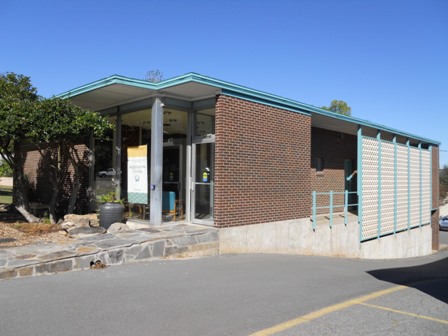
Dan Stowers Office Building_tour_tnThe monthly architectural history program “Sandwiching in History” visits the Dan Stowers Office Building, located at 1516 West Third Street.

Architect Dan F. Stowers, Sr., designed this Mid-century Modern building in 1960 to house his firm. Somewhat unassuming from Third Street, the Stowers Building was oriented to take advantage of the view to the north and provide natural light for the drafting room.

Although the majority of the building’s walls are solid masonry, the northern elevation is composed of a glass curtain wall. This provided the perfect amount of indirect light for the drafting room. Panels of screen block on the building’s eastern side shield an exterior staircase and create an interesting detail.

Sandwiching in History is a program of the Arkansas Historic Preservation Program, an agency of the Department of Arkansas Heritage.


“Then and Now – The Central High Neighborhood” focus of architecture lecture tonight

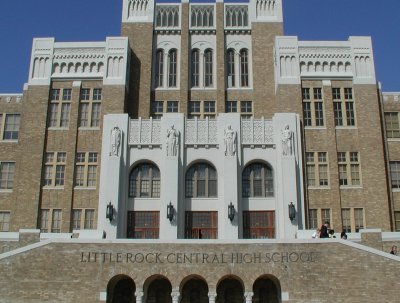
centralentranceThe Architecture and Design Network is hosting a panel presentation on the historic Central High neighborhood this evening at 6pm at the Arkansas Arts Center.

Panelists are:

  • Rachel Silva, Arkansas Historic Preservation Program
  • Kwendeche, an architect
  • Nancy Rousseau, principal of Central High School
  • Vanessa McKuin, president of the Central High School Neighborhood Assocation

The westward expansion of Little Rock in the mid-1890’s gave rise to the West End, a section of the city which, in time, became known as the Central High School neighborhood. At the time the high school was completed in 1927 it was designated by the American Institute of Architects as “the most beautiful high school in America.”  For its time it was the largest and most expensive high school building in the United States.  Thirty years later its reputation would be changed as it became the site of international media coverage of efforts to fight the integration.

In addition to discussing the history and development of the area, the panel will talk about the future of historic properties in the neighborhood. A trio of neighborhood groups is actively involved in the effort. The three are: Wright Avenue Neighborhood Association, Capitol Hill Neighborhood Association and Central High Neighborhood Association.

The Architecture and Design Network is a non-profit organization. It is supported, in part, by the Arkansas Arts Center, Central Arkansas section of the Arkansas Chapter of the American Institute of Architects, the Fay Jones School of Architecture and friends in the community.

A reception will begin at 5:30 prior to the lecture.

Sandwich in History today at noon at old Fire Station No. 2 in MacArthur Park

Little Rock Fire Station No 2_tour_tnThe monthly architectural history program “Sandwiching in History” visits the old Little Rock Fire Station No. 2 located at 1201 S. Commerce Street (on the southwestern corner of MacArthur Park).

Located in the MacArthur Park Historic District, Little Rock Fire Station No. 2 was built in 1917 and served as a fire station until the late 1950s. The Craftsman-style building was constructed with a mixture of materials. It features exposed rafter tails, false half-timbering, and triangular knee braces under the eaves.

From the early 1960s through the 1980s, it had a variety of uses by the City’s Parks Department and other entities. In the 1980s through the mid-1990s, it served as storage and preservation space for the nearby Museum of Science and History (then-located in the Arsenal Tower building on the northern edge of the park.)

It sat largely vacant for a couple of years and sustained damage during January 1999 tornado which ripped through downtown.  For the past several years, a group has been working to convert it into a 30-bed hostel and museum.

Sandwiching in History is a program of the Arkansas Historic Preservation Program, an agency of the Department of Arkansas Heritage.

Little Rock Look Back: Orval Eugene Faubus

FaubusOrval_fOn January 7, 1910, one of the most controversial figures in Arkansas history was born: future Governor Orval Eugene Faubus.

Faubus is today remembered for his role fighting for the continued segregation of the Little Rock public schools.  Raised in a socialist family, his staunch embrace of segregation was a surprise to many who viewed him as more of a moderate on the issue.  At the time, and later, it was viewed as more of an opportunistic move to head off a political challenge from segregationists such as Jim Johnson.  However, throughout the rest of his lifetime, as others such as George Wallace would recant and repent, Faubus continued to maintain he was “merely” upholding the law of the land (the Supreme Court striking down the law a few years earlier, notwithstanding).

Interestingly, Faubus was also known for hiring African Americans in state government for more than menial tasks. He worked to increase funding to historically black colleges and universities in Arkansas. He fought to abolish the predatory poll tax.

His segregation efforts curtailed Arkansas’ business recruitment for a few years in the late 50s and early 60s.  But a few years earlier, in 1955 Faubus had created the Arkansas Industrial Development Commission and appointed Winthrop Rockefeller to lead it.  He also increased teacher pay, overhauled the State Hospital, created the Arkansas Children’s Colony, expanded state parks, and stopped the Army Corps of Engineers from damming the Buffalo River.

In late 1965, by executive order, he created the Arkansas Arts and Humanities Council and funded it with his discretionary funds until the legislature would appropriate money in 1967. He also oversaw the creation of the state’s historic preservation program.

Certainly his efforts to flout federal law have tarnished his image. Looking at his accomplishments in the areas of industry, education reform and culture – one wonders what he could have accomplished if he had exerted even more efforts in those areas instead of fighting Eisenhower.  It is all moot, because he did not.  And the reality is that, yes had he supported Eisenhower, he might well have lost in 1958 to someone like Jim Johnson who would have continued fighting for segregation even more vehemently and would have been unlikely to champion these other issues.

Hurst to lead Department of Arkansas Heritage

stacy-hurstYesterday Governor-Elect Asa Hutchinson announced that Stacy J. Hurst of Little Rock will be the next director of the Department of Arkansas Heritage.

“Stacy is extremely bright and hardworking, and she understands the importance of protecting and preserving our state’s incredibly rich history and culture. I have no doubt she will do a remarkable job in her new position as the director of the Department of Arkansas Heritage,” Hutchinson said.

As director of the agency, she will serve as the state’s chief preservation officer. She will oversee the Arkansas Arts Council, Arkansas Historic Preservation Program, Arkansas Natural Heritage Commission, Delta Cultural Center, Historic Arkansas Museum, Mosaic Templar’s Cultural Center, and Old State House Museum.

From January 2003 until December 2014, Hurst represented Ward 3 on the Little Rock City Board.  A native of Pine Bluff, she moved to Little Rock in 1985 after graduating from the University of Arkansas in Fayetteville with a degree in Communications.  Since 1996, she has worked at Tipton & Hurst, Inc.  Prior to that, she worked for Arkansas Children’s Hospital Foundation for twelve years, retiring from the organization as Vice President.

From January 2007 to December 2008, she served as Vice Mayor of the City of Little Rock.  Prior to her election to the City Board, she served as co-chair of the Vision Little Rock, Recreation and Tourism workgroup.  She also served as a member of the Little Rock Zoo Board of Governors from 2000 to 2002.

Hurst chaired the three (3)-year community-wide planning process that led to a vision and Master Plan for the renovation of War Memorial Park.  Since the plan was adopted by the Board, over $2 million has been devoted to improvements within this signature park.  She was instrumental in the revitalization of the Midtown Redevelopment Corridor.  These efforts started with the Statement of Expectations planning document and a Design Overlay District adopted by the Planning Commission and board of Directors.  As a result of this work, tens of millions of dollars of private investment in the Midtown Corridor that continues today.

She was founding chair and board member of the City Parks Conservancy, which raises money for the City’s parks.  She has served as chair of the Nature Conservancy Board of Trustees in Arkansas.  She is currently a sustaining member of the Junior League of Little Rock, after having led the League’s efforts to purchase and restore the historic Women’s City Club in downtown.  Her numerous other community memberships include the Nature Conservancy,Arkansas Arts Center, Youth Home Board of Trustees, Arkansas Women’s Forum, CARTI Foundation Board of Trustees, Little Rock Garden Club, First Tee of Arkansas Board of Trustees, Arkansas Children’s Hospital Auxiliary, Alzheimer’s Arkansas Advisory Board.

Sandwich in History at Little Rock’s House House today at noon

Joseph W. House HouseToday at noon the Arkansas Historic Preservation Program’s Sandwiching in History tour visits the Joseph W. House House at 2126 Arch Street.

The “Sandwiching In History” program is a series of tours that seeks to familiarize people who live and work in central Arkansas with the historic structures and sites around us. The tours take place on Fridays at noon, last less than an hour, and participants are encouraged to bring their lunches so that they can eat while listening to a brief lecture about the property and its history before proceeding on a short tour. A representative from the property is encouraged to attend also and address the group.

The Arkansas Historic Preservation Program is an agency of the Department of Arkansas Heritage. All tours are free and open to the public.

Joseph W. House House, 2126 S. Arch Street, Little Rock. Located in the Governor’s Mansion Historic District, this home was built about 1892 for prominent attorney and statesman Joseph Warren House, Sr. He served in the Confederate Army during the Civil War and later practiced law at Searcy. In 1871 House was elected to represent White County in the General Assembly and helped draft Arkansas’s fifth and current constitution during the convention of 1874. In 1892 he moved to the home at 2126 S. Arch Street, where he lived until his death in 1926.