Heritage Month – Pfeifer Brothers Department Store

Pfeifer Brothers Department Store was an important part of imageMain Street’s commercial character. Built in 1899, the building’s interior was remodeled in 1939 and the exterior was remodeled in 1960. Pfeifer Brothers Department Store was originally occupied by Arkansas Carpet and Furniture Company. In 1911 Joseph Pfeifer leased the building for his clothing company. 
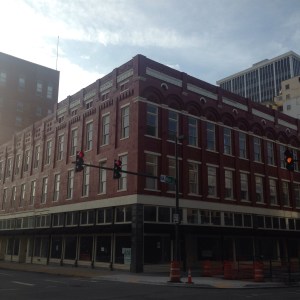
In 1912, the redevelopment of the building for the Pfeifer Brothers Department Store was designed by prominent Arkansas architect Charles Thompson.  The structure had originally been built in two stages. The south half being built first in 1899 and the north half added about a year later. In 1939 Pfeifer Brothers remodeled the interior first floor with streamlined, chrome-trimmed fixtures. A marble façade was added on the Sixth Street elevation.
A major exterior renovation was undertaken in 1960 when a false façade of granite panels was wrapped around the Main and Sixth street elevations, covering all openings and detail. At this time the original cornice was destroyed but the majority of historic detail remained.In 1963 Pfeifers was bought by Dillard’s Department Stores and as a new entity the store continued in business at 524 Main until closing in 1990. In 1996 a new owner undertook rehabilitation of the historic structure by removing the granite panels and exposing original windows and terra cotta elements.
The building, now called the Arkansas Building, is an anchor of the Creative Corridor revitalization. It will house Ballet Arkansas, additional space for the Arkansas Repertory Theatre, Cranford Co. and Matt McLeod’s art studio on the first floor. The Arkansas Symphony Orchestra will be on the ground floor of the Arkansas Building and in an adjacent building.  The upstairs will be apartments.
The building was listed on the National Register of Historic Places fifteen years ago today on May 18, 2000.
Heritage Month – Hotze House

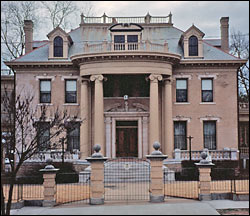
Hotze hosueThe Hotze House, located at 1619 Louisiana in Little Rock’s historic Quapaw Quarter district, was built by one of Arkansas’ most successful and prominent businessmen.  Designed by Charles L. Thompson, Little Rock’s most prominent architect and constructed in 1900, the house reflects the Beaux Arts tradition combined with Georgian influence.  The interior was reputed to have been designed by Tiffany Studios of New York.  The house has been remarkably well preserved and remains practically unaltered.

Peter Hotze was born in Innsbruck, Austria, on October 12, 1836.  He was young at the time of his father’s death, but Mrs. Hotze’s inheritance made it possible for her three sons to attend the University of Innsbruck.  In 1857 Peter Hotze moved to Little Rock and went into the general merchandise business.

Returning to Little Rock after service and imprisonment in the Civil War, Hotze went into a business as a merchant in partnership with Capt. John G. Fletcher, who had been his company commander.  Each man put $2,500 into the business.  After a while, they limited their business exclusively to the cotton trade.  In 1873 it was decided that Hotze should move to New York to handle that end of the firm’s business.  He lived there for 27 years, in a fashionable neighborhood near Central Park.

In 1900, Hotze retired and returned to Little Rock.  Upon his return in 1900 he built the large house in which he lived with his daughter Clara and son Frederick until his death on April 12, 1901.  He chose to build his home directly behind the small frame house he had built about l869 and lived in during his previous residence in Little Rock.

The Hotze House is one of the finer homes remaining in the state which expresses the opulence of the period in which it was constructed, particularly in the interiors, which are extraordinarily rich in quality. Resting on three and one-half lots, the Hotze House is remarkably well preserved and appears practically the same as when it was first constructed.

It was added to the National Register of Historic Places on August 11, 1975.


Heritage Month – Fordyce House

FordyceThe Fordyce House was built in 1904 for Mr. and Mrs John R. Fordyce.  The house was designed architect Charles L. Thompson in an Egyptian Revival style.  The Egyptian Revival style is rarely seen in houses in the United States,  major features of the style include the porch columns resembling bundles of stalks tied together and flared at the top and the “battered” walls that slant inward as they rise.

The Fordyce ‘s lived in the house until 1920 when it was sold to James Shipton who lived in the house until 1950.  The house has remained a single family home through the years.

It was added to the National Register of Historic Places on August 9, 1975.

Heritage Month – Beal-Burrow Building

Beal BurrowConstructed in 1920, the Beal-Burrow Dry Goods Company Building is believed to have been designed by the architectural firm of Charles Thompson and Thomas Harding (only mechanical drawings are present in the Thompson Archives).

The original owner and user, the Beal-Burrow Company, was founded in 1913 as a wholesale operation and quickly gained prominence on a regional level.  The location of their office and warehouse facilities near the intersection of Main and Markham Streets served to anchor the northern edge of Little Rock’s commercial district.  By 1926, the firm had begun to manufacture work clothes and several floors of this building were devoted to that industry.

In 1955, the Archer Drug Company purchased the building from Berry Dry Goods Company, another wholesale establishment that had earlier bought out the Beal-Burrow partnership.

It is presently part of the Block 2 Development which consists of commercial space on the first floor and loft apartments on upper floors. The Little Rock Tech Park is operating out of space on the first floor of this building.

It was listed on the National Register of Historic Places on June 26, 1995.

Heritage Month – Baer House

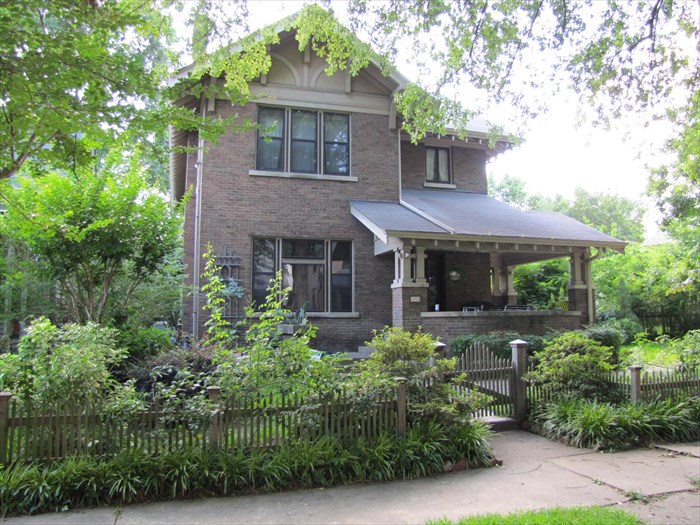
Baer HouseLocated at 1010 Rock Street, the Baer House was designed by the Charles Thompson firm in 1915.

Located in the MacArthur Park Historic District, the house displays a Craftsman Style influence in the abundant use of bracketing and the unusual paired squat box columns resting on brick piers which support the porch, The house has taken an additional historic significance within the district due to the discovery of the original drawings. The Baer House is also an important component of the streetscape and is significant in its representation of the firm’s much used Craftsman design.

It was added to the National Register of Historic Places on June 10, 1975.

Little Rock Look Back: 107 years of City Hall at Markham & Broadway

CityHa78107 years ago today, Little Rock City Hall officially opened at the corner of Markham and Broadway.

On April 15, 1908, the Italian Renaissance Revival style building, which had been designed by local architect Charles Thompson, played host to an open house. Staff had started moving into the building in March of that year.   This was, as often is the case, behind schedule.  The date in the cornice toward the top of the building is 1907, but the building was not completed until 1908.

In 1903, W. E. Lenon became Mayor of Little Rock. Back then, the terms were two-year terms.  By the start of his second term in 1905, he realized that the City was outgrowing City Hall, which was, at the time, on the northeast corner of Markham and Louisiana – where part of the Statehouse Convention Center sits today.

In February 1906, Mayor Lenon appointed a committee of five aldermen to over see the planning for the building of a new City Hall. In July 1906, the City Council approved plans, which called for a City Hall with an municipal auditorium wing. There was some hue and cry about wasteful spending and a resulting lawsuit, so, in September 1906, those plans were scrapped and a simpler City Hall was approved for the cost of $175,000.

The last resolution in the old City Hall called for the banning of smoking in the new Council Chambers – while the Council was in session. This may well have been the first smoking ban in a public government building in the history of Arkansas.

When the building opened, the third floor was not finished out. The space was not needed. When the Museum of Natural History and Antiquities (now the Museum of Discovery) moved into City Hall in 1929, they had to finish out their space.

In 1913, the new Central Fire Station, designed in the Beaux Arts style, was constructed adjacent to City Hall. During the 1930s, as the City grew, more space was needed. A garage, designed in the “austere, utilitarian” style was built in 1936 and a City Jail Annex, built by the WPA in the modified Art Deco style was built in 1938.

City Hall prior to 1912

By 1955, the copper-clad dome which sat on top of City Hall needed severe repairs. The wooden supports and the copper cladding were both in dire shape. Mayor Pratt Remmel set aside money for the dome to be repaired. After defeating Remmel in his bid for a third term, Mayor Woodrow Mann scrapped plans for the repair and, indeed, scrapped the dome.

Following the lead of County Judge Arch Campbell who had removed the tower at the County Courthouse, Mann proposed removal of the dome. He had an informal survey which had three options: repair the dome, replace the dome with an aluminum one, or remove it. This was open to anyone to respond – voting eligibility or Little Rock residency did not matter. By a slim margin, remove the dome won – so the dome was removed.

In 1960, as air conditioning was installed, windows were bricked in to promote energy efficiency. At the time, the feeling was that a new City Hall would be constructed in the 1970s somewhere more central to the growing city. Relocation talk persisted throughout the 1970s and early 1980s. By that time, City Hall had been modified a great deal – with no thought about historic preservation. When the Police and Fire Department had moved out into their new facilities, their old spaces had become storage.

By 1984, the decision was made to stay at Markham and Broadway. An extensive renovation and restoration effort was undertaken. In 1988, the building reopened, and the interior had been restored to its 1908 appearance.

Final weeks of “Piranesi and the Perspectives of Rome” at UALR Galleries

Piranesi_First-Edit_AO1The prints of Giovanni Battista Piranesi (1720-1778) have contributed much to defining what Europeans and Americans think of the as “ancient Roman glory.” An exhibit of several of his prints is currently on display at the UALR Art Galleries through October 5.

In approximately, architect Edwin Cromwell (1909-2001) was going through the papers of  his late father-in-law, architect Charles Thompson (1868-1959). Included in this was a loosely bound volume of 30 prints by Piranesi. In 1999, Cromwell approached the UALR Department of Art to suggest that research might be done on this set of prints. In fact, it provided the basis for the MA thesis project of Olga Elwood. In 2010, the three daughters of Edwin Cromwell donated the prints to the Department of Art.

Thompson and Cromwell were both leading architects of Little Rock in each of their eras.  Among Thompson’s many designs are both the 1908 Little Rock City Hall and the 1913 Central Fire Station which is now the City Hall West Wing.

The exhibit, was designed to accompany a special topics art history course taught at UALR this semester by Dr. Jane Brown and Dr. Floyd Martin.

There are two upcoming lectures this week in conjunction with the exhibit:
September 25, 10:50 a.m., room 161 in the Fine Arts Building
Dr. Carol C. Mattusch, Professor Emerita, George Mason University – Pompeiian Dreams: Myths and Realities about the Ancient Romans, a lecture to the students enrolled in the course “Piranesi and Perspectives of Rome.

September 25, 6:00 p.m., the Stella Boyle Smith Concert Hall in the Fine Arts Building

Dr. Richard S. Mason, Lecturer, University of Maryland, Baltimore County – Reliving the Ancient World: Rediscovering Herculanium and Pompey