

Robinson
After serving two, 2-year terms, Mayor Charles Moyer sought a third term in the Democratic primary of 1928. There were three people standing in his way of a new term: City Attorney Pat Robinson, School Board member H. T. “Will” Terry, and Alderman Joe H. Bilheimer, Jr.
Robinson had been elected City Attorney at the age of 27. He was viewed as a rising star in not only the Democratic Party of Little Rock, but for the state as well. He was no relation to US Senator Joe T. Robinson, who hailed from Lonoke County. Pat Robinson had roots in Clark County. Alderman Billheimer had served on the Little Rock City Council since 1917, while Mr. Terry had been on the School Board for several years and been president of that body.
As the incumbent, Mayor Moyer spent most of the campaign on the defensive. His policies and programs were attacked. What was not attacked (or even mentioned) was his disappearance from Little Rock during the 1927 lynching of James Carter. Mayor Moyer promoted his efforts for the successful amendment to the Arkansas Constitution which expanded the bonding capacity of cities. He also was proud of having established the Planning Commission for Little Rock.
Moyer largely ignored Bilheimer in his remarks. But he charged Robinson with dereliction in duty as City Attorney. He also questioned Terry’s business acumen. Terry for his part stressed his work as a man who had started driving a milk wagon and then rose to become the head of a large dairy. He took a swipe at single Robinson by stressing that he was a person with family ties.
Bilheimer questioned Moyer’s expenditures including $4,000 a year to keep City Hall clean. He claimed that was a payoff for a political contribution. He also noted that during Terry’s tenure on the school board, the Little Rock schools were only able to purchase milk from his dairy. He also charged Terry with campaign violations. At the time, state law set that campaign expenditures could not exceed the salary of the position being sought. At the time, Little Rock paid $5,000 per year to the mayor. Bilheimer charged that Terry was exceeding that.
Other than defend his record as City Attorney, Robinson fairly successfully stayed above the fray. He admitted that he was not aggressive prosecuting bootleggers or others connected to Prohibition offenses.
Rallies and radio were the order of the day as the campaign wound down. On November 26, 1928, the primary took place. Robinson won every precinct. He captured 4,077 votes to 1,682 for Moyer, 1,518 for Terry, and 298 for Bilheimer.
The polls closed at 6pm. By 8:30pm, the results were known and a Robinson victory parade filled the streets. It marched down Main Street and then down Markham to City Hall. On the steps, Mr. Robinson remarked, “I shall try always to be the same old Pat.”
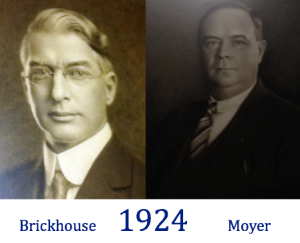 After serving three two-year terms as mayor, Ben D. Brickhouse decided to follow the precedent of his predecessor Charles Taylor and seek a fourth term in the Democratic Primary of 1924. In the election for his third term, Brickhouse was unopposed. So it would have appeared that he was well-positioned for this fourth bid.
 On August 27, 1944, the first USS Little Rock was launched in Philadelphia at the Cramp Shipbuilding Company shipyards. A 10,000 ton Cleveland Class light cruiser, it first touched water in the Delaware River.
 On May 6, 1894, Ira Eugene Sanders was born in Missouri. After receiving an undergraduate degree and rabbinate degree in Cincinnati, he was ordained a rabbi in 1919. He served congregations in Pennsylvania and New York before coming to Little Rock in September 1926.
 ystem. On that date, the City officially took possession of land which would become what is now known as MacArthur Park.
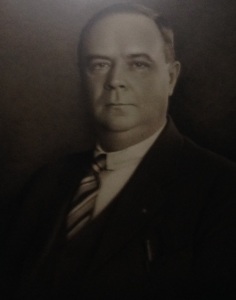 On April 18, 1880, future Little Rock Mayor Charles E. Moyer was born in Glenwood, Minnesota. A man of contradictions, he was both a candidate backed by (and probably personally involved in) the Ku Klux Klan, yet he also brought the Goodwill Industries organization to Little Rock and Arkansas to help those less fortunate.
 Little Rock Culture Vulture