
Little Rock Look Back: Robinson Auditorium hits construction milestone in 1939

Many months behind schedule, it was 77 years ago today (December 8, 1939) that the construction of the Joseph Taylor Robinson Memorial Auditorium was declared “substantially finished.”

On December 8, 1939, the work of the general contractor was complete. The building’s utilities were all fully connected as the steam line and electric transformer were hooked up. While the work of the general contractor was through, there was still much work to be done.

Though there were still unfinished portions of the structure, the exterior was complete and finished surfaces had been installed on the interior. Until the building was officially turned over to the City, the federal Public Works Administration still had to give approval for any uses of the building.Mayor J. V. Satterfield, Jr. told the press that he wasn’t sure when the City would formally accept the building. The connection of the utilities had used up the remaining funds, so there was uncertainty as to when the final tasks would be completed.

When it was built, Robinson Auditorium was the first municipal auditorium in the south central United States to be air conditioned. However, the air conditioning unit was not sufficient to cool both the music hall and the convention hall at the same time. In warm weather months concurrent events would not be able to take place on the two levels.

Little Rock Look Back: 75 Years Ago – the City of Little Rock responds to Pearl Harbor

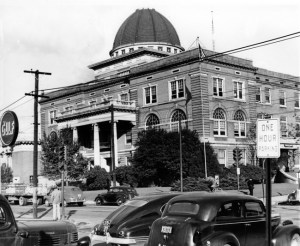
Little Rock City Hall in the 1940s

Little Rock City Hall in the 1940s

On December 8, 1941, one day after Pearl Harbor was attacked, the Little Rock City Council held a regularly scheduled meeting. While much of the business took place as previously planned, there were two actions that night which were in support of the war effort.

By a motion of Alderman Franklin E. Loy, seconded by Alderman L. L. Stewart, the City Council passed a motion to allow the erection of signage for a new Soldier Service Center which was to be set up in the War Memorial Building (now the Old State House Museum).

The same night, an ordinance was introduced for the City to purchase up to $40,000 in War Bonds. This was referred to the City Attorney to review.

Though the U.S. entry into World War II was only hours old, the City was already responding.

The following week, on December 15, 1941, the City Council discussed a plan to create a Civil Defense Coordinator for the City of Little Rock.  Also, City Clerk H.C. “Sport” Graham reported that City employees had purchased $4,819.50 in Defense Savings Stamps and Bonds. There were also pledges for another approximately $20,000. A payroll deduction plan was being set up.

Over the coming weeks and years, many City employees would enlist or be drafted into the armed services. Victory gardens would be planted by City employees and their families. Rationing would take place. Eventually a USS Little Rock battleship would be commissioned.

There would be much to be done to support the war effort. But in the early days, the City was already taking steps to do its part for the war.

Little Rock Look Back: A Dozen Years of the Clinton Library

SkipIt has been twelve years.  Have you warmed up yet?
Many remember November 18, 2004, for the rain and cold wind which greeted visitors to the opening of the William Jefferson Clinton Presidential Center and Park.  In the years which lead up to that day, November 18, 2004, was known simply as “Game Day” for a group of people.  The chief one was Skip Rutherford.

Overseeing the planning for the Clinton Presidential Center and the events surrounding it had been the focus of James L. “Skip” Rutherford for many years. A FOB for decades, he had stayed in Little Rock when so many went to Washington DC in 1993.

He oversaw the planning for the Clinton Library and led the Clinton Foundation.  No detail was too small or insignificant for him to consider. For months leading to the opening he led meetings to help restaurants, hotels, and attractions understand the scope of the opening.

Together with Dean Kumpuris and Bruce Moore on behalf of the City of Little Rock and Stephanie Streett of the Clinton Foundation, he reviewed plans for the Clinton Presidential Park and the streets and neighborhoods around the Clinton Presidential Center.

Skip used his connections with the business community in Little Rock and throughout the state to discuss the importance of a Presidential Library regardless of one’s personal political affiliations.  He withstood critics who second-guessed everything from the cost, the design, the location, the purpose, and even the anticipated tourism and economic impacts.

Finally the big day had come.  If the weather was not ideal, that was almost inconsequential. It was still the culmination of more than seven years hard work.  As he remarked later that evening when discussing the weather “Many who attended today go to events like this all the time.  This is one they won’t forget!”

However, the opening of the Clinton Presidential Center was not the end of the task. It merely was the move from one phase to another. A few years later, Skip’s role would change as he would leave the Foundation and become the second Dean of the Clinton School of Public Service.

RobinsoNovember: Auditorium Commission Abolished

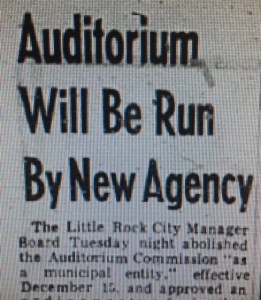
aud-com-abolOn November 16, 1971, the City of Little Rock Board of Directors abolished the Auditorium Commission which oversaw Robinson and transferred duties to the Advertising and Promotion Commission. This was done with the full support of both commissions.  The transfer took place immediately, with all assets and loose ends to be wrapped up by December 15, 1971.

With the adoption of a hospitality sales tax, by state statute, Little Rock had to have an A&P Commission.  By 1971 plans were afoot to use the A&P tax to build a conference center using some of the existing space in Robinson and adding space.  It did not make sense to have two separate commissions overseeing the same building.

For the Auditorium Commission members, it was possibly a relief.  For years, overseeing the building had been a quiet duty.  But with the social changes of the 1960s, they had been confronted ending the policy of segregation as well as changes in content and subject matter of acts booked at Robinson.  Being agents of social change was doubtful what any of them had envisioned when they joined the commission.  Emily Miller had been a member of the body since January 1940 and others had been on it for many years.

Transferring Robinson to the A&P Commission ushered in a new era for the building. It saw increased booking of meetings which led to a better revenue stream.  The use of the A&P tax would mean the opportunity to give the building an upgrade from 1972 to 1974.

Robinson would eventually prove to be inadequate for all of Little Rock’s needs, which led to the creation and subsequent expansion of Statehouse Convention Center.  But the action 45 years ago today set the stage for the transformation Robinson has undergone as it reopened last week.

RobinsoNovember: Lawrence Hamilton

LawrenceHamiltonAnother notable former Little Rock performing artist who is memorialized at Robinson Center is Lawrence Hamilton.

The son of the Dr. Oscar and Mae Dell Hamilton, he was born in the small southwest Arkansas town of Foreman With an interest in music stemming from childhood, Hamilton earned a music scholarship to attend Henderson State University in Arkadelphia where he studied piano and voice He graduated in 1976 with a bachelor’s degree in music education.

From Arkansas, Hamilton traveled to Florida to work as a performer at Walt Disney World in Orlando, Florida where he would meet talent manager, Tommy Molinaro. This fateful meeting would prove to be a life-changing encounter, as Molinaro would invite Hamilton to come to New York to audition for the famed actor/director Geoffrey Holder. This marked the beginning of Hamilton’s bold and creative career in the performing arts, leading to performances on Broadway and on tours in Sophisticated Ladies, The Wiz,Uptown – Its Hot, Porgy and Bess, Big River, Play On!, and Jelly’s Last Jam among others. Perhaps his crowning achievement was starring in Ragtime.

Hamilton has been a member of the Southern Ballet Theater, Brooklyn Dance Theater, Ballet Tap USA, and the Arkansas Opera Theater He has performed in concert with the legendary Lena Horne at the White House for President and Mrs. Ronald Reagan, and at the Vatican for Pope John Paul II. Hamilton’s career also led to a stint as musical director for the renowned opera legend Jessye Norman, as well as vocal coach/arranger for the pop group New Kids on the Block

Upon his return to Arkansas, Hamilton served for several years as director of choral music at Philander Smith College. He also appeared in several plays at the Arkansas Repertory Theatre.  In addition, he performed at countless concerts, benefits and galas throughout Arkansas.  In 2003, he was inducted into the Arkansas Black Hall of Fame.  In 2008, he was appointed to the Little Rock Mayor’s Task Force on Tourism.

Hamilton died in New York in April 2014 due to complications from surgery.  Just weeks prior to the surgery, he had appeared in August Wilson’s The Piano Lesson in Cape Fear, North Carolina.  He had also starred in that play at Arkansas Rep a few years earlier.

RobinsoNovember: First Dance at Robinson Center

RC-dance-orchestra

Jan Garber and his orchestra

Tonight the Arkansas Symphony Orchestra hosts its annual Opus Ball inside the new William Grant Still Ballroom at Robinson Center.  That the first public event in this space will be a dance is only appropriate.  The first public event in the original Robinson was also a dance.  It was held four months before the building even opened.

On October 4, 1939, the convention hall on the lower level was the site of a preview dance.  The pecan block flooring had been installed just the week before.

The first four people to enter the building as paying guests were Mr. and Mrs. Alfred Wilheim, Frances Frazier and Bill Christian.  Reports estimated 3,200 people attended and danced to the music of Jan Garber and His Orchestra.  By happenstance, Garber and his musicians had also played in Little Rock on January 26, 1937, the date of the election which approved the auditorium bonds.  Since Little Rock then did not have a suitable space, that appearance had been on the stage of the high school auditorium.


RobinsoNovember: Duke Ellington

On September 1, 1961, Duke Ellington announced he was cancelling his upcoming appearance at Robinson Auditorium. Ellington, who had previously appeared at Robinson at least once prior (on November 7, 1951), had been announced for a concert in late August.

In those days, Robinson did not have a formal box office.  Tickets were sold at various businesses, usually record stores.  When some African Americans called to inquire about tickets and were told they were only available in the segregated seating section of the balcony, they protested to the NAACP.  The local chapter then announced that it would encourage Ellington to cancel his concert.  The NAACP had a policy that they would boycott performers who ever played at segregated houses.  Since Robinson was still segregated, future Ellington appearances would have been met with boycotts.

The local presenters for the Ellington concert tried to negotiate a deal with the Auditorium Commission.  They were not successful.  One misguided commissioner stated, “Integration may be the law of the land, but it is not the law of Robinson Auditorium.”  When they commission refused to back down, Ellington cancelled.

This was only the latest in a string of issues surrounding the desegregation of Robinson.  The theatrical and opera producer organizations had both indicated that their touring shows would no longer play at segregated houses.  More and more entertainers were declining to play at segregated houses.

The Auditorium Commission was trying to balance their fear of lost revenue from cancelled bookings with their fears of poor attendance by audiences that did not want integration.  In a decade of rapid change, the commissioners tended to be older less likely to embrace change.

In 1962, a lawsuit was filed to integrate Robinson, city parks, and other public facilities.  It was settled in 1963 when the federal judge ruled against the City.  The Duke Ellington incident was often mentioned in media stories around the lawsuit.