Little Rock Look Back: Prohibition Repealed on December 5, 1933

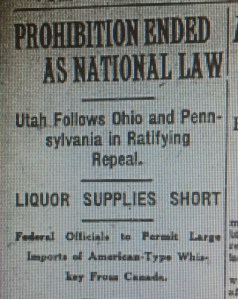
prohibition-repealOn December 5, 1933, Ohio, Pennsylvania and Utah provided the necessary support to officially repeal “the great experiment.”

Because this was such a foregone conclusion, the Arkansas Gazette and Arkansas Democrat carried only small, single column stories on their front pages.  Perhaps because this was Arkansas, it did not appear that any Little Rock businesses immediately set about to capitalize on this.  At least there were not any large scale advertisements in the days following that would indicate any specials or activities planned for the December 15 official end.

In fact, the only mention in the newspapers on December 15 was that President Roosevelt was trying to decide what the alcohol taxing structure should be.

One amusing story that ran in the Arkansas Democrat on December 6 was that Mrs. Roosevelt was keeping the wine glasses in storage at the White House for the time being.  She was awaiting action by Congress once it convened in January 1934 as to how it would deal with properly ending Prohibition in the District of Columbia.  Over 3,000 wine glasses had been in storage since Prohibition had been enacted.

Turkey Day Football in LR – Little Rock High vs NLR

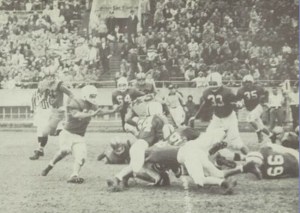
lrhs-nlrhs-grid-1957After 20 years of playing a variety of schools on Thanksgiving, in 1934 Little Rock High School had started the new tradition of playing the North Little Rock High School Wildcats.  These cross-river rivals had played a few games previously in the 1910s and early 1920s. The competition was resumed in 1931, but was not on Thanksgiving Day until 1934.  With that game, the Tigers of Little Rock would begin a 49-year tradition of taking on their biggest rival on Turkey Day.

For much of the 1920s and 1930s, a Thanksgiving Day game for Little Rock High School meant rain.  That was the case in the 1934 meeting at Kavanaugh Field. (Located at the current spot of Quigley Stadium, it was a baseball field on which football games could also be played.  In 1936, the current stadium opened.)  The Tigers and Wildcats played to a 2-0 win achieved by the southside Bengals of Earl Quigley.

Another notable matchup was the 1938 game.  Little Rock won 12 to 7. With that win, it captured its first official state football championship. (Though the Arkansas Activities Association does now credit LRHS with several prior championships.)

The 1939 edition took place on Arkansas Thanksgiving.  That November featured five Thursdays.  President Roosevelt issued a proclamation that Thanksgiving would be the fourth Thursday, as it traditionally was. However Arkansas and a few other states chose to observe it on the final Thursday.  Little Rock won 6 to 0, but it was a messy game. Some sports fans joked that the game was FDR’s revenge on Arkansas for ignoring him regarding Thanksgiving.

In 1941, only a few days before the US would be plunged into World War II, North Little Rock achieved its first Turkey Day win over Little Rock.  The score was 26 for the Wildcats and 0 for the Tigers.  This was only the third ever loss for the Tigers on a Thanksgiving Day.  The Tigers were so dominant on Turkey Day games, a student had once remarked to a Gazette reporter that the matchup against Pine Bluff should be moved to Thanksgiving since the Tigers always seemed to win on that day.  (Pine Bluff was the state’s other football powerhouse at the time and often gave the Tigers fits in games.)

North Little Rock repeated as winner in the 1942 game, this time with a 31 to 12 score.  Writing for the Gazette, Orville Henry wondered if this would be the final meeting for the duration of the war.  He opined that many of the players might be in a different type of uniform for future games and that rubber might be needed for the war effort instead of athletic equipment.  While some colleges and high schools did drop football during the war, neither LR nor NLR did.

The Tigers were back on top in 1943 by a 13-7 score.  (It would be the last football game for the NLR coach who had been drafted.)  The 1944 game also featured a 13-7 score, but this time it was flipped and the Wildcats were winners.  The 1945 edition ground to a 13-13 tie.

In 1947, both teams were undefeated heading into the Turkey Day classic.  The inky wretches and scribes were predicting another evenly matched slugfest.  Instead Little Rock owned the game and came out with a 13-0 win.

The teams met eight times in the 1950s on Thanksgiving.  Little Rock won seven of the eight, losing the 1951 game by one point (13 to 14).

With the anticipation of a second Little Rock high school to be opened in a few years, Little Rock High School was rechristened as Little Rock Central High in 1954. The new school, named Hall High, opened in 1957 but played much smaller schools for its first year on the gridiron.  Plans were underway for Hall and Central to meet on Turkey Day in 1958, so the 1957 meeting of Little Rock and North Little Rock would be the final time the two teams would meet on Thanksgiving Day.

Little Rock Central High had dominated world headlines in September and October 1957 with the integration of the Little Rock Nine.  The sports coverage of this game however belied all the drama off the field. News reports focused on Turkey Day as the final game between the longtime rivals and on the fact that it had a morning start time instead of the traditional afternoon start time.  In the end, the Tigers had the same result as they did in the first Turkey Day meeting: a win.  The Bengals scored 40 while the Cats only managed 7.

After 24 meetings on Thanksgiving Day, Little Rock had 19 wins, 4 losses, and one tie.  Seven times they shut out the Wildcats, and one time the northern team blanked them.  The fewest total points scored were 2 in the 1934 game, while the 1950 game produced a cumulative total of 71 points (LR 64, NLR 7).  The Tigers scored a total of 517 points over 24 games and gave up only 203.

Little Rock Look Back: November 8 Presidential Election Arkansas Newspapers

November 8 has been a Presidential Election Day in Arkansas six times.  The first time such a date happened in the US, Arkansas did not participate because it was 1864.  The times it has happened have been 1892, 1904, 1932, 1960, 1988, and today.

A look back at newspaper headlines from the previous years tells a lot about not only the elections, but also the way news was delivered.  For the 1892 and 1904 elections, only the Arkansas Gazette is available.  Though the Arkansas Democrat existed, it did not yet publish every day.  Tuesdays do not appear to have been dates it was published.  (The Gazette itself would not be at seven days until the early 1900s when it finally started publishing a Monday edition.)

elex-ag-1892The 1892 election day Gazette intersperses news stories with advertisements.  One headline states poetically:  “Ballots: Like flakes of snow they will gently fall throughout the Union today.”  Another headline stated “Confident.  Democrats everywhere feel assured of Grover Cleveland’s election today.”  Indeed, Cleveland returned to the White House in 1892 after four years of Benjamin Harrison.

elex-ag-04By 1904, most front page advertising at the Gazette had been banished from the front page, although an small box ad for Blass Department Store is at the top.  Only three of the seven columns on the front page have above-the-fold headlines devoted to election stories, and two of those are about the State of New York.  This reflects new editor J. N. Heiskell’s desire to have the Gazette be national in scope. While early Gazettes often relied on national news to fill space, by the post Reconstruction era, the focus was largely on local news.   The lone local headline was “Arkansas will go Democratic” which was certainly a foregone conclusion at the time.  While Arkansas did go Democratic, Theodore Roosevelt kept the presidency in the hands of the GOP.  Interestingly another headline was about efforts to get Prohibition adopted in the state.  It would become an election issue for years to come.

elex-ag-32By 1932, both the Gazette and Democrat published Election Day editions.  The Gazette’s stories included predictions that FDR would win and a record number of ballots would be cast.  There were also separate stories which highlighted the final day of campaigning for both FDR and Hoover.  One of Mr. Heiskell’s above-the-fold editorials encouraged voting No on a variety of measures which dealt with public school financing, sales tax reduction, bond issuance, and reorganization of county election commissions and state government.

elex-ad-32The afternoon Democrat featured stories on Hoover and FDR in the last hours of the campaigns. Like the Gazette it anticipated a record turnout and showed that Pulaski County was experiencing heavy turnout.  The headline trumpeted that FDR had a lead as early results were starting to trickle in.  The Democrat also offered succinct analysis of key battleground states.  In the end, FDR did carry 42 of the 48 states in an election that saw a record of 38,582, 531 people casting votes for one of the two top candidates.
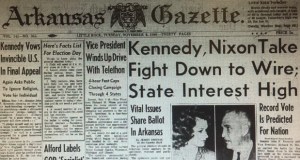
elex-ag-60The 1960 election ended up being one of the closest in popular vote in US history, with only 112,827 votes separating JFK from Nixon.  The Gazette headline was “Kennedy, Nixon take fight down to wire; State interest high.”  The front page also featured stories about Kennedy’s and Nixon’s last full day on the campaign trail.  A box on the front page reminded readers that liquor stores and beer sales could not take place during polling hours. Only persons who had paid their 1960 poll tax were eligible to vote–with an exception made for those who turned 21 after the poll tax deadline and through election day.  The last reminder was that the names of the parties, but not the candidates themselves, would appear on the ballot in the presidential race.
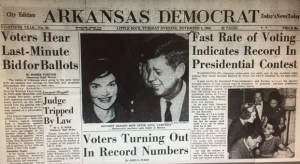
elex-ad-60The afternoon Democrat ran a large photo of Jackie and JFK after they had voted and a slightly smaller one of the Nixon family voting.  Two stories discussed the record turnout that appeared to be taking place — one was on a national scale, and the other was focused on Arkansas.  There was also a story on last minute campaigning.  In the end, over 68,000,000 votes were cast which was a record at the time.

elex-ag-88The most recent presidential election to take place on November 8 was in 1988.  It featured Vice President George H. W. Bush against Massachusetts Governor Michael Dukakis.  The Gazette (covering its final presidential election — though no one knew it at the time) featured a story on Bush and Dukakis in the final day of campaigning.  It also featured a guide to watching the returns and discussed how the networks made their decisions about calling states.  There was also a box highlighting key battleground states which included Massachusetts, Pennsylvania, New York, Illinois and Texas.  Interestingly, two of those were the home states of the candidates.

elex-ad-88By 1988, the Democrat had been a morning paper for several years going head to head with the Gazette.  It carried its own photos of Bush and Dukakis on the final full day of campaigning.  An inside story was highlighted on the cover which featured a Monday rally in Little Rock with Texas Senator Lloyd Bentsen (Dukakis’ running mate).  The 1988 campaign was long, by the standards of the time, but would be considered abbreviated today.  The 1988 election would mark the third consecutive presidential election that the GOP candidate carried Arkansas.

RobinsoNovember: Mayor J. V. Satterfield Jr.

Satterfield AuditUpon taking office as mayor in April 1939, J. V. Satterfield felt he was getting a handle on Little Rock’s precarious financial situation. He would soon discover that it was more unstable than he had imagined.  Included in this was Robinson Auditorium, currently under construction across the street from his office in City Hall.  Mayor Satterfield disclosed that he had voted against the auditorium in 1937 because he felt the finances were not sufficient. But as the mayor, he promised to open the building.

By the summer of 1939, it was becoming apparent that there would not sufficient money to finish the construction.  Even with the issuance of the final round of approved bonds (which had been held back as a reserve), there would not be enough money.  The Mayor and Harvey Couch made plans to go to Washington DC to try to get more money from the federal government.  Mr. Couch was a personal friend of President Roosevelt as well as head of Arkansas Power & Light.  The pair made the trip but returned with no additional money.

At the same time, the Auditorium Commission, which had been appointed by Mayor Overman to oversee the governance of the building, resigned as a group. They said they had been appointed to administer a building, not a construction site. Since it was uncertain as to when the building would open, they stepped down.

Mayor Satterfield was able to negotiate a series of deals to get the necessary work completed for construction of the building to be completed. Part of it involved issuing another round of bonds after the building had been officially opened to finish furnishing the building as well as complete the landscaping.  In January 1940, with a new opening date becoming a stronger possibility, the mayor appointed a new Auditorium Commission.

At the same time, regular events started to take place in the lower level exhibition hall.  There had been a few in November and December, but with a lack of utilities and ongoing construction upstairs in the music hall, those were curtailed.

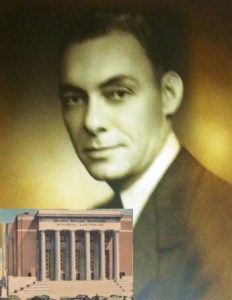
On February 16, 1940, Joseph Taylor Robinson Memorial Auditorium officially opened. Mayor Satterfield was joined onstage for the ribbon cutting with Senator Robinson’s widow and her sister-in-law, who was a member of the Auditorium Commission.

In April 1940, Little Rock voters approved the final round of bonds which allowed for the building to be finished.

After only two years in office, Mayor Satterfield chose not to seek another term. He left City Hall in April 1941 with finances in order and a new municipal auditorium across the street.

RobinsoNovember: Senator Joseph Taylor Robinson

150px-joseph_t-_robinson_croppedThis month, Robinson Center Music Hall will reopen after a two year renovation/restoration/remodeling/reconstruction.  To commemorate that, each day in November, the Culture Vulture will look at a person or event connected to Robinson Center Music Hall.

Up first, the eponym for the building.

Senator Joseph Taylor Robinson was born in Lonoke in 1872.  In 1894 Robinson was elected to the Arkansas General Assembly for one term.  From 1903 until 1913, he served in the US House of Representatives as a Congressman from Arkansas’ then-Sixth District.

He chose not to seek another term in Congress and ran for Governor in 1912.  On January 3, 1913, sitting US Senator Jeff Davis died in office.  Robinson was sworn in as Governor on January 16, 1913. Twelve days later he was chosen by the Arkansas General Assembly to become the next US Senator. He became the final US Senator to be selected by a legislator instead of popular vote.  At the time, Senate terms started in March, so Robinson served as governor until March 8, 1913.

He rose through the ranks of the Senate and eventually became the first person to hold the title of Senate Majority Leader.  In 1928, he was the Vice Presidential nominee for the Democratic Party.  Four years later, he rode with Franklin and Eleanor Roosevelt to the inauguration ceremonies before FDR took the oath.  He would be President Roosevelt’s go-to man on legislative issues.


Senator Robinson died in Washington D.C. on July 14, 1937.  His wife was in Little Rock making preparations for a trip the couple was to take. Following his demise, Mrs. Robinson went to Washington to accompany her husband’s body back to Arkansas.

The Senator was honored with a memorial service in the Senate chambers on Friday, July 17.  President Roosevelt and the cabinet joined members of the senate on the floor in what was described as a state funeral without pomp.  Mrs. Robinson sat with her brothers and two nephews as well as Bernard Baruch and Arkansas Power & Light’s Harvey Couch, who were Senator Robinson’s closest friends.  Eleanor Roosevelt was one of the many crowded in the senate galleries observing the service.  Following the service his body remained in the chambers until it was transferred to a train to make the journey to Little Rock.

The funeral train bore his body, his family, 50 senators and over twenty congressmen. It reached Little Rock around 8am on Sunday the 19th.  From there, Senator Robinson’s body was taken to his house on Broadway Street until noon.  It subsequently lay in state at the Arkansas State Capitol until being escorted by military to First Methodist Church.

As the funeral procession reached Roselawn Cemetery, thunder echoed. The skies which had alternated between sun and rain that day, returned to rain. A deluge greeted the end of the service and sent visitors hurrying for shelter at the end.

It was not until December 1937, that Senator Robinson’s name became attached to the municipal auditorium which Little Rock voters had approved in January 1937.

LR Look Back: JFK in LR (and Greers Ferry)

JFK LROn October 3, 1963, President John F. Kennedy delivered remarks at the Arkansas State Fairgrounds.  Only a few weeks later, he would be felled by an assassins bullet in Texas.

In the speech, the President praised Arkansas’ congressional delegation including Senators John McClellan and J. William Fulbright and Congressmen Took Gathings, Bill Trimble, Wilbur Mills and Oren Harris.  Each of these men held senior leadership positions in key committees.  The main focus of the speech was to discuss President Kennedy’s vision for a new economy in the South.

The President was actually in the state to speak at the dedication of the Greers Ferry Dam. He agreed to make that appearance as a part of a negotiation with Congressman Mills as they were deadlocked over changes to the tax code.  He had previously visited Little Rock in 1957 when he came to the state to address the Arkansas Bar Association meeting in Hot Springs.

President Kennedy continued the string of 20th Century Presidents to visit Little Rock.  Presidents Theodore Roosevelt, William Howard Taft, Franklin Roosevelt and Harry Truman had all visited while in office.  Woodrow Wilson, Herbert Hoover and Dwight Eisenhower all visited prior to attaining the presidency.

War Hero Cinema: Gary Cooper and Gregory Peck as LR natives

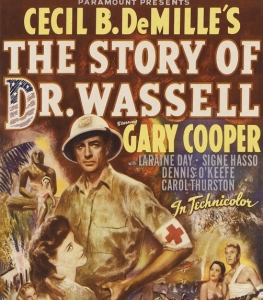
Dr. WassellThe exploits of two Little Rock natives during World War II have both been turned into Hollywood movies.  One was released during World War II and starred Gary Cooper as Dr. Corydon Wassell. The other was released in the 1970s and starred Gregory Peck as General Douglas MacArthur.

Born in Little Rock on July 4, 1884, Corydon McAlmont Wassell (called “Cory”) was born to Albert and Leona Wassell. A grandson of Little Rock Mayor John Wassell, he graduated from what is now UAMS in 1909. In 1911, he married Mary Irene Yarnell, with whom he would have four children.  In 1914, the couple volunteered to be Episcopal missionaries in China.  He served there until 1927. Following Mary’s death and his remarriage, he and new wife Madeline Edith Day Wassell returned to Arkansas in 1927.

Dr. Wassell resumed his medical practice. Given his experience with malaria in China, he proved to be an asset fighting malaria among Civilian Conservation Corps members in Arkansas. He was subsequently called to active duty in the Navy in 1936 and stationed in Key West.

After the outbreak of World War II, he was stationed in Indonesia. In early 1942, he refused to abandon his patients after the Japanese started invading Indonesia. Instead, he was able to evacuate a dozen severely wounded men over 150 miles to get to a ship. It took ten days for the ship to get to Australia, during which time it was attacked numerous times.  His official Navy Cross citation notes that he disregarded personal safety while caring for others.

He became an instant international hero. During the early days of the war, his heroism was one of the few bright spots. James Hilton wrote a biography of him; President Roosevelt praised him in a fireside chat. James Hilton wrote of Dr. Wassell in a book which was then adapted by Cecil B. DeMille into the 1944 movie starring Cooper.  Originally Arkansan Alan Ladd was wanted to play Cooper’s sidekick, but Ladd was pressed into military service and unavailable.

Thirty-three years after The Story of Dr. Wassell was released, MacArthur was brought to the screen by Universal Pictures.  It was their attempt to capitalize on the success of the movie Patton, including sharing some of the same members of the production team.

macarthur-gregory-peck-1977-everettTold entirely in flashback, it stars Gregory Peck as the fabled World War II general who was born in Little Rock. It focuses primarily on events in 1942 during the war, his dismissal by Truman in 1952, and his famous address to West Point in 1962.

Peck initially did not care for the subject or the script, but eventually stated that he grew to admire the challenges MacArthur faced.  Peck later called it one of his favorites roles, if not one of his favorite movies.

Producer Frank McCarthy, who worked on both Patton and MacArthur once said of Patton and MacArthur: “Both were complex men but General MacArthur was complex on a much broader scale. Patton had no ambition except to be a soldier and to command a field army. He was strictly command.”

Most of the film was shot on the backlot at the movie studio, which impacted the quality of the film.  The production budget simply would not allow for overseas location filming.

The film was released in July 1977.  One of the premieres was held in Little Rock. Peck attended a reception in the Arsenal Building where MacArthur was born. Now the home to the MacArthur Museum of Arkansas Military History, in 1977 the building still housed the Museum of Science and Natural History (now the Museum of Discovery).  Since MacArthur only spent a few hours in Little Rock as an adult, it is possible that Peck spent more time in the building than the General did.