
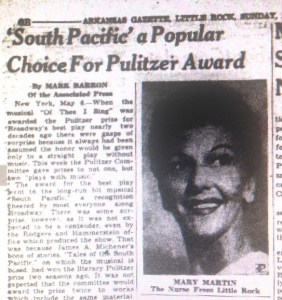
And the Pulitzer goes to SOUTH PACIFIC

On May 5, 1950, the Rodgers and Hammerstein musical South Pacific captured the Pulitzer Prize in Drama. This would receive special attention in the Arkansas Gazette. The reason this carried such weight in Arkansas was that the musical had a connection to Little Rock.

The 1950 Pulitzer for Drama went to a musical for only the second time in the history of the awards. The recipient was South Pacific by Richard Rodgers, Oscar Hammerstein II and Joshua Logan. The character was the leading lady of Nellie Forbush. She was an Navy ensign and a nurse stationed on an exotic island during World War II. The musical was based on a Pulitzer Prize winning novel, James Michener’s Tales of the South Pacific.

In the Michener novel, Miss Forbush is not from Little Rock. She is actually from a small town in Alabama. But the book does mention Nellie and her mother visiting Little Rock.  The part was written for Mary Martin from Weatherford, Texas. Rodgers, Hammerstein & Logan did not discuss why they relocated Nellie’s birthplace.

Originally the musical contained a song entitled “My Girl Back Home” in which Nellie sang of being from “Little Rock, A-R-K” while another character sang of being from “Philadelphia, P-A” and “Princeton, N-J.” It is possible the change to Little Rock was made because it offered more lyrical possibilities, but that is only a supposition on the part of the Culture Vulture. That song did appear in the movie version in which Mitzi Gaynor played Nellie Forbush. It was also featured in the 2008 Broadway revival, this time with Kelli O’Hara playing Nellie.

In the musical, Nellie struggles with her own prejudices. This issue of prejudice became an instance of fact meeting fiction. In 1957, a few weeks after Eisenhower sent troops into Little Rock to ensure that Central High would be desegregated, a production of South Pacific on Long Island was temporarily halted when the audience booed and yelled after Nellie mentioned she was from Little Rock. Interestingly, the movie was released in 1958, but retained references to Little Rock. That was either a testament to the expense of re-editing it, or the fact that audience reaction had lessened.

3 Finalists for 2019 Sculpture at the River Market public monument competition; winner to be announced this afternoon

The winner of a $60,000 commission to place a sculpture at Little Rock City Hall in 2020 will be announced on Sunday, May 5, 2019, as the 11th Sculpture at the River Market Show and Sale concludes.
The three semifinalists for the 2019 Sculpture at the River Market Public Monument Competition were announced Friday night at the conclusion of Sculptacular, the preview party for the 2019 Sculpture at the River Market Show and Sale. The three finalists are, alphabetical order:

  • Theresa Dyer – LITTLE ROCK
  • Nnamdi Okonkwo – UNITY
  • Charles Strain – THE GATHERING

Sculpture at the River Market invited all artists participating in the 2019 Show & Sale to submit a proposal for its $60,000 Public Monument Competition. This is the ninth such competition.

The proposals of the seven semifinalists were displayed during Sculptacular, the event’s preview party on the evening of May 3, and Preview Party guests voted for their 1st, 2nd and 3rd choice.  All votes were tallied and the top three finalists were announced at the end of the evening.

The top three proposals will be juried on May 4 and 5, and the 2019 winner will be announced at 3PM on Sunday, May 5.  The winning sculpture will be installed at the northwest corner of Markham Street and Broadway Street adjacent to Little Rock City Hall in the spring of 2020.

The other semifinalists were: Clay Enoch, Joe Norman, Ryan T. Schmidt, and Basil Barrington Watson.

Previous Public Monument Competition winners have been:

  • 2011 – Chapel, THE CENTER installed in Riverfront Park near the Junction Bridge
  • 2012 – Bryan Massey, Sr.,  NAUTILUS installed in Riverfront Park next to the Arkansas River near the Margaret Clark Adventure Park.
  • 2013 – Ted Schaal, OPEN WINDOW installed in Riverfront Park between the First Security Amphitheatre and La Petite Roche Plaza.
  • 2014 – Lorri Acott, PEACE installed at 2nd Street and Main Street
  • 2015 – Michael Warrick, MOCKINGBIRD TREE installed at Chenal Parkway and Chenal Valley Drive
  • 2016 – Clay Enoch, UNITED installed at Central High School
  • 2017 – Stephen Shachtman, ARKANSAS “A” installed at the Southwest Community Center
  • 2018 – Carol Gold, INFINITE DANCE installed in Riverfront Park near the Broadway Bridge

More information is available on the web at http://sculptureattherivermarket.com/.

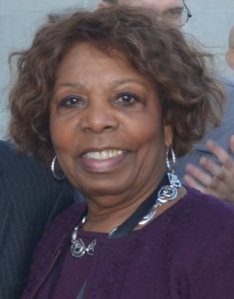
Happy Birthday to Lottie Shackelford, who served as Little Rock’s 68th mayor

On April 30, 1941, future Little Rock Mayor Lottie Shackelford was born. Throughout her career in public service she has been a trailblazer.
Active in community activities and politics, she ran for the City Board in 1974 and lost.  But she was appointed to the Little Rock City Board in September 1978 to fill a vacancy.

This made her the first African American woman to serve on he City Board, and indeed on any governing board for the City (during Reconstruction, there were at least six African Americans on the City Council, but they were all men.) She was subsequently elected to a full-term on the City Board in 1980 winning 55% of the vote over three male candidates.

She was subsequently re-elected in 1984 (unopposed) and in 1988 (with 60% of the vote).

In January 1987, Shackelford became the first female mayor of Little Rock when she was chosen by her colleagues on the City Board to serve in that position. She was Mayor until December 1988.  During that time, Mayor Shackelford invited the Little Rock Nine back to the City to be recognized for the 30th anniversary of their integration of Central High School.

From 1982 until 1992, she served as Executive Director of the Arkansas Regional Minority Purchasing Council.  She left that position to serve as Deputy Campaign Manager of Clinton for President.  She subsequently served on the Clinton/Gore transition team. She later served on the Overseas Private Investment Corporation from 1993 to 2003. She was the first African American to be in that position.

A graduate of Philander Smith College, she has also studied at the Arkansas Institute of Politics at Hendrix College and the Kennedy School of Government at Harvard University.

Mayor Shackelford has also served on numerous boards including the Little Rock Airport Commission, Philander Smith College, Chapman Funds (Maryland) and Medicis Pharmaceutical Corporation (Arizona).  She has the longest tenure of any serving as Vice-Chair of the Democratic National Committee.

Mayor Shackelford was in the first class of inductees for the Arkansas Black Hall of Fame.  In 2015, she was inducted into the Arkansas Civil Rights Heritage Trail.

A Pulitzer Preview – Prizing Mount Holly Cemetery

The Pulitzer Prizes are to be announced tomorrow (Monday, April 15).  This year marks the 102nd anniversary of the prizes, though not all of the current categories have been around since 1917.

Mount Holly Cemetery not only touts that it is the site of a whole host of elected officials, it is also the only place in Arkansas where two Pulitzer Prize recipients are buried.

The cemetery is open every day, but a special visit to these two prize winner gravesites can be made on Sunday, April 28, during the Mount Holly Cemetery Association’s annual “Restore in Perpetuity” fundraiser picnic.

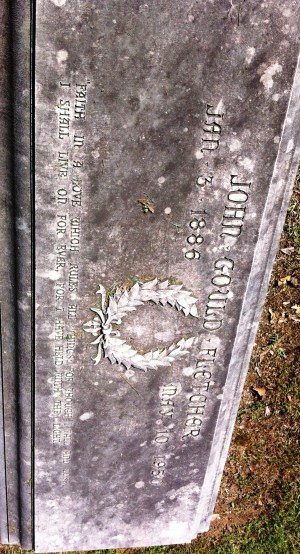
In 1939, John Gould Fletcher became the first Southern poet to win the Pulitzer Prize for Poetry.  He was born into a prominent Little Rock family in 1886.  Fletcher was awarded the prize for his collection Selected Poems which was published by Farrar in 1938.  Two years earlier, he had been commissioned by the Arkansas Gazette to compose an epic poem about the history of Arkansas in conjunction with the state’s centennial.

Fletcher is buried next to his wife, author Charlie May Simon and his parents (his father was former Little Rock Mayor John Gould Fletcher).  Other relatives are buried nearby in the cemetery.

The other Pulitzer Prize winner buried in Mount Holly is J. N. Heiskell, the longtime editor of the Arkansas Gazette.  It was Heiskell, in fact, who asked Fletcher to compose the poem about Arkansas.  Heiskell served as editor of the Gazette from 1902 through 1972.  He died at the age of 100 in 1972.

Under his leadership, the Gazette earned two Pulitzer Prizes for its coverage of the 1957 desegregation of Little Rock Central High.  One was for Harry Ashmore’s editorial writing and the other was for Public Service.

Heiskell remained in charge of the Gazette until his death in 1972.  He is buried alongside his wife with other relatives nearby.  Also not too far from Mr. Heiskell are two of his nemeses, proving that death and cemeteries can be the great equalizer. In the early days of his Gazette stewardship, he often locked horns with Senator (and former Governor) Jeff Davis. Later in Mr. Heiskell’s career, he vehemently disagreed with Dr. Dale Alford, who had been elected to Congress on a segregationist platform.

Little Rock Look Back: Broadway debut of Ben Piazza

Though he had been an understudy in the short-lived Too Late the Phalarope, Little Rock native Ben Piazza never went on in the production.  He made his Broadway debut in Kataki, which opened 56 years ago today at the Ambassador Theatre on April 9, 1959.

Piazza was the valedictorian of the Little Rock High School class of 1951. While there, he was recognized for his acting and writing abilities.  After being a Little Rock High School Tiger, he became a Princeton Tiger and graduated in 1955 before moving to New York City.

Written by Shimon Wincelberg, Kataki concerned an older Japanese pilot and a young American soldier stranded on an island at the end of World War II.  As was the case of many plays in the late 1950s, it had originally been a television play.  The title is the Japanese word for “enemy.”

Kataki starred Sessue Hayakawa and Piazza. Most of Hayakawa’s dialogue was in Japanese, so in some ways, Piazza acted in a two-character, one-person play – since he was the only one talking for most of the play.  The play was produced by Jay Garon and Bob Sokoler, with Richard Randall serving as associate producer.  David Amram provided the incidental music.  Peter Dohanos designed the island scenery.  Anne Graham provided the costume design, and Paul Morrison was the lighting designer.

The actors received high praise for their performances, but the play’s dramatic structure was criticized as being plodding and trite.  The play was directed by Alan Schneider, who would reunite with Piazza in the original production of Who’s Afraid of Virginia Woolf?  a few years later.  The play would run only 20 performances, but Piazza was recognized with a Theatre World Award for his portrayal of Alvin, the young soldier.

The play was revived in Los Angeles in 2010 to good reviews.

Little Rock Look Back: “Nine from Little Rock” wins an Oscar

On April 5, 1965, the Academy Award for Best Documentary, Short Subject went to the film “Nine from Little Rock.”
Narrated by Jefferson Thomas, Charles Guggenheim’s documentary looks at the nine African-American students who enrolled in Little Rock Central High School in 1957. Thomas, one of the students reflects on the state of race relations in the seven years that had elapsed (up to 1964).  The film also focuses on Ernest Green, Elizabeth Eckford and Thelma Mothershed.

Guggenheim both directed and co-wrote the film. The latter credit was shared with Shelby Storck, who also produced the film.   The film had been commissioned by George Stevens, Jr., for the United State Information Agency.

The Oscar that night was Guggenheim’s first of four.  His others would be for: 1968’s “Robert Kennedy Remembered” (Live Action Short), 1989’s “The Johnstown Flood” (Documentary Short) and 1994’s “A Time for Justice” (Documentary Short).  His son Davis Guggenheim won the Oscar for Documentary, Feature for An Inconvenient Truth.

The film was digitally restored by the Motion Picture Preservation Lab for the 50th anniversary of its win for Best Short Documentary at the 1965 Academy Awards.  It is available for purchase on DVD and can also be viewed in its entirety on YouTube

Little Rock Look Back: Werner C. Knoop

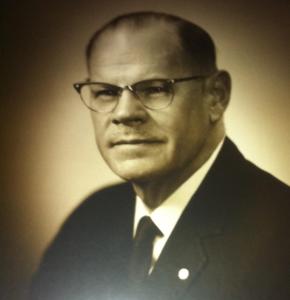
To Little Rock citizens under a certain age, the name Knoop means Knoop Park — a picturesque park tucked away in a pocket of Hillcrest.  There are, however, still many who remember Werner C. Knoop as a business and political leader who helped shape Little Rock as a modern city.

Knoop was born on March 30, 1902.

In 1946, Knoop joined with Olen A. Cates and P. W. Baldwin to form Baldwin Construction Company in Little Rock.  Knoop had previously founded Capital Steel Company and established his business reputation there.  From 1945 through 1951, he served on the Little Rock School Board.

Following a series of political scandals, efforts were undertaken for Little Rock to shift from Mayor-Council to City Manager form of government.  Even before the desegregation of Little Rock Central put the city in the eyes of the world, an election for new leaders had been set for November 1957.  Knoop was on a “Good Government” slate and was one of the members elected.

At the first meeting of the new City Board, Werner C. Knoop was chosen by his fellow directors to serve as Little Rock Mayor.  Knoop served as Mayor until December 1962.  For the first several months in office, Little Rock had no City Manager so Knoop oversaw the transition of City staff as the forms of government changed.

Though City Hall generally stayed out of school district matters, that did not mean that the public viewed the two entities separately.  In September 1959, the Baldwin Construction offices were bombed as part of a series of terrorist activities protesting the desegregated reopening of all Little Rock high schools.

Downtown LR as viewed from Knoop Park

Downtown LR as viewed from Knoop Park

After two terms on the City Board, Knoop decided against seeking a third term.  He concluded his elected public service on December 31, 1962.  Following his time on the City Board, Knoop did not retire from Civic Affairs.  In 1970, he served as Chairman of the Little Rock Chamber of Commerce.   The previous year he served as President of the Arkansas Chapter of Associated General Contractors.

Mayor Knoop died in July 1983.  He is buried at Roselawn Memorial Park next to his wife Faith Yingling Knoop, a renowned author.

In the 1930s, Knoop moved into an Art Moderne house on Ozark Point in Hillcrest.  It was adjacent to Little Rock Waterworks property which was developed around the same time.  Eventually much of the land was deeded to the City for creation of a park.  In 1989, it was named in tribute to long-time neighbor Knoop in honor of his lifetime of service to Little Rock.