Fourteen new names added to 2015 Arkansas Civil Rights Heritage Trail

2015 ACRHTLast month, the University of Arkansas at Little Rock Institute on Race and Ethnicity unveiled the 2015 Arkansas Civil Rights Heritage Trail markers. This year’s theme is “Politics and Law” to commemorate the 50th anniversary of the passage of the Voting Rights Act of 1965.

The fourteen new markers are installed at Scott and Markham Streets near the Statehouse Convention Center.

Established in the summer of 2011, the Arkansas Civil Rights Heritage Trail honors those who made significant contributions to civil rights in Arkansas. The trail raises public awareness of the long and rich legacy of Arkansas’s civil rights history.

A 12-inch bronze marker is placed in the sidewalk for each honoree. The trail begins in front of the Old State House Convention Center on Markham Street and will eventually extend to the William J. Clinton Presidential Center and Park and other points throughout the downtown corridor.

This year’s 14 honorees are:

  • Annie Mae Bankhead, who was a community activist in Pulaski County’s black College Station neighborhood
  • Wiley Branton, Sr., who was head of the Southern Regional Council’s Voter Education Project in the 1960s
  • Charles Bussey, who was leader of the Veterans Good Government Association and became Little Rock’s first black mayor in 1980
  • William Harold Flowers, who laid the foundations for the Arkansas State Conference of National Association for the Advancement of Colored People branches
  • Jeffrey Hawkins, who was for decades the unofficial mayor of Little Rock’s black East End neighborhood
  • Irma Hunter Brown, who was the first black woman elected to the Arkansas General Assembly
  • Scipio Africanus Jones, a leading black Republican who defended 12 prisoners for their role in the 1919 Elaine Race Riot
  • Mahlon Martin, who was the first black city manager of Little Rock
  • I.S. McClinton, who was head of the Arkansas Democratic Voters Association, a forerunner of today’s Black Democratic Caucus
  • Richard L. Mays and Henry Wilkins III, who were among the first blacks elected to the Arkansas General Assembly in the 20th century in 1972
  • Olly Neal, who was the first black district prosecuting attorney in Arkansas and later served on the Arkansas Court of Appeals
  • Lottie Shackelford, who was the first black woman mayor of Little Rock
  • John Walker, who for more than five decades has been involved in civil rights activism in the courts, most notably in school desegregation cases

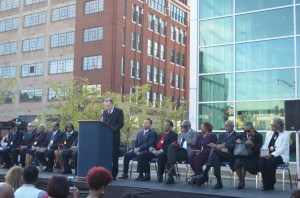
Dr. John Kirk is the director of the Institute.  At the November ceremony, he spoke along with UALR Chancellor Joel Anderson. At a reception following the ceremony, Senator Joyce Elliott gave a toast in honor of the 14 and several of the honorees or their descendants spoke.
Little Rock Look Back: LR City Flag Adopted

City FlagOn October 18, 1988, the City of Little Rock Board of Directors adopted the first official flag for the City of Little Rock.

The adoption of Ordinance No. 15,566 was the culmination of a design competition which had been spearheaded by Little Rock City Director Sharon Priest (later Little Rock Mayor, Arkansas Secretary of State and Executive Director of the Downtown Little Rock Partnership).

Prior to the Official Board of Directors meeting that day, a press conference was held in the Little Rock City Board Chambers for presentation of the City’s flag.  The City Beautiful Commission, a commission of the Department of  Parks and Recreation, sponsored a the contest which received a total of fifteen flag designs.

The flags were judged October 12, 1988, by City Directors and City Beautiful Commission Members. Director Sharon Priest presented the winning flag and introduced David Wilson, a law clerk at the Mitchell Law Firm, who designed the flag chosen for the $1,000 first prize. The second-place winner was Craig Rains, who received $500; and the third-place recipient was David Tullis, who received $250.

The flag was adopted by the City Board that night by a 6-0 vote; former mayor and current director Charles Bussey was absent.  Those voting to adopt the flag were Mayor Lottie Shackelford and directors Sharon Priest, Tom Prince, Buddy Villines, Buddy Benafield and Tom Milton.  Priest would be a future mayor while Prince, Villines and Benafield had all served as mayor.

The official description of the flag is as follows:

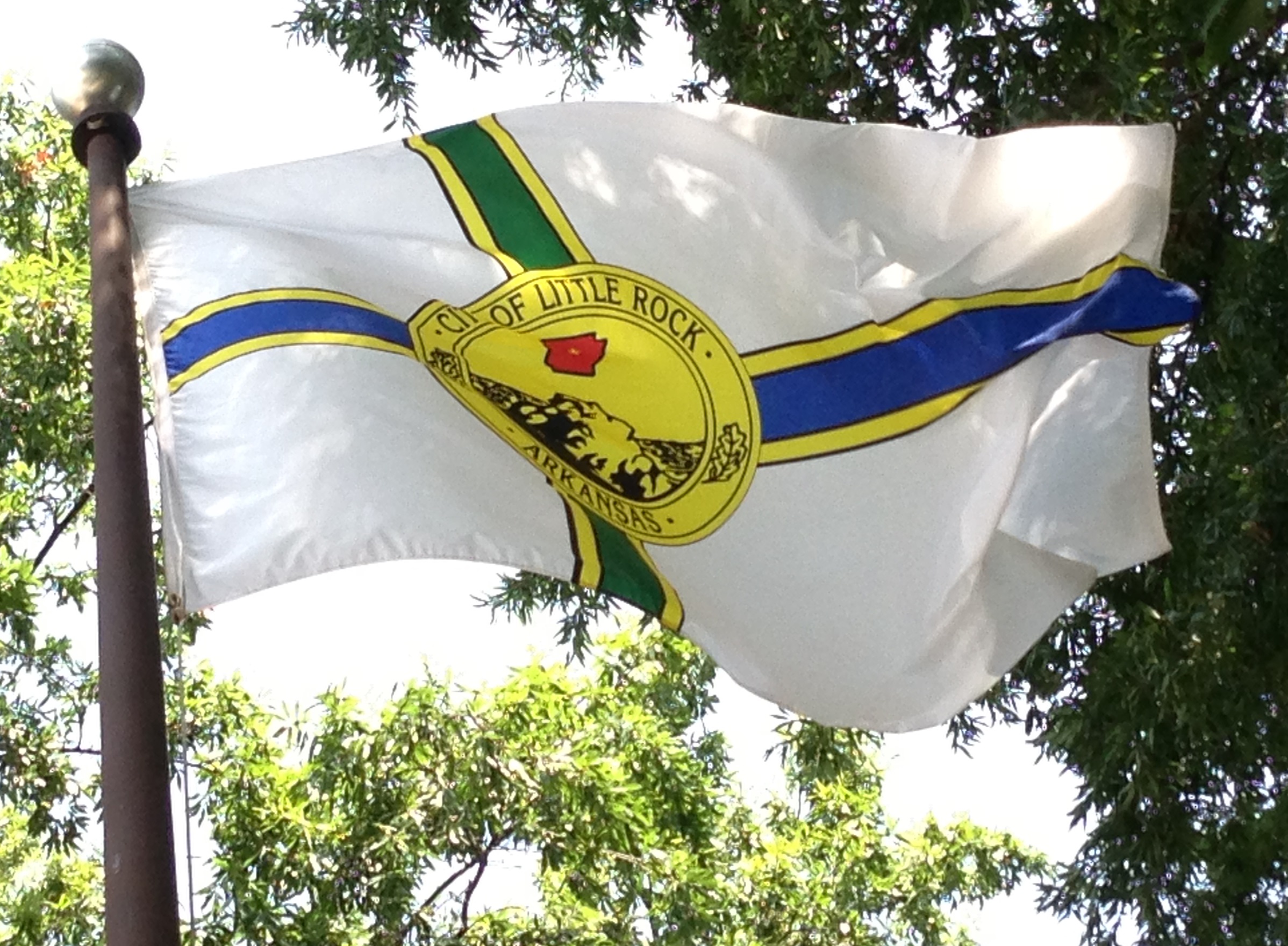
As the official flag of the City of Little Rock, its symbolism is described as follows: A clean white background of the banner represents the optimism and open potential that the city has to offer. The royal blue horizontal broad stripe symbolizes the Arkansas River which borders Little Rock, and has served as an economical and historical emblem since the city’s beginning. The forest green stripe runs vertical to the royal blue stripe, creating a cross which symbolizes the location and statute of Little Rock—a city serving not only as the crossroads of Arkansas, but a crossroad of the mid-southern United States as well.

The strong forest green color depicts the fields, parks and forests which contribute to the natural beauty of the city. The seal of the flag is a modernized adaptation of the current Little Rock seal. The razorback red silhouette of the great State of Arkansas shows her capitol, the City of Little Rock, represented by the centered star. The star rises directly above “The Little Rock”—the protruding cliff along the Arkansas River, which was discovered in 1722 by French explorer La Harpe, when the city was given the name. The Arkansas River behind the rock and the symmetrical oak leaves in the border of the seal are a stylized illustration of what the flag’s stripes represent—the natural beauty of the city. Finally, the gold color of the seal and bordering stripes symbolize the superior economic history, and the future economic potential that is available in the City of Little Rock, Arkansas.

Little Rock Look Back: Mayor Lottie Shackelford

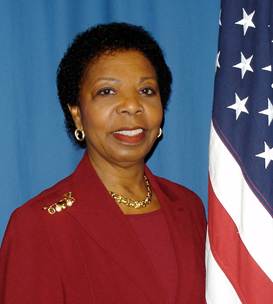
Mayor Lottie_ShackelfordOn April 30, 1941, future Little Rock Mayor Lottie Shackelford was born. Throughout her career in public service she has been a trailblazer.

Active in community activities and politics, she ran for the City Board in 1974 and lost.  But she was appointed to the Little Rock City Board in September 1978 to fill a vacancy.  This made her the first African American woman to serve on he City Board, and indeed on any governing board for the City (during Reconstruction, there were at least three African Americans on the City Council, but they were all men.) She was subsequently elected to a full-term on the City Board in 1980 winning 55% of the vote over three male candidates.

She was subsequently re-elected in 1984 (unopposed) and in 1988 (with 60% of the vote).

In January 1987, Shackelford became the first female mayor of Little Rock when she was chosen by her colleagues on the City Board to serve in that position. She was Mayor until December 1988.

From 1982 until 1992, she served as Executive Director of the Arkansas Regional Minority Purchasing Council.  She left that position to serve as Deputy Campaign Manager of Clinton for President.  She subsequently served on the Clinton/Gore transition team. She later served on the Overseas Private Investment Corporation from 1993 to 2003. She was the first African American to be in that position.

A graduate of Philander Smith College, she has also studied at the Arkansas Institute of Politics at Hendrix College and the Kennedy School of Government at Harvard University.

Mayor Shackelford has also served on numerous boards including the Little Rock Airport Commission, Philander Smith College, Chapman Funds (Maryland) and Medicis Pharmaceutical Corporation (Arizona).  She has been the longest serving Vice-Chair of the Democratic National Committee.

Mayor Shackelford was in the first class of inductees for the Arkansas Black Hall of Fame.

Little Rock Look Back: Happy 183 to Little Rock

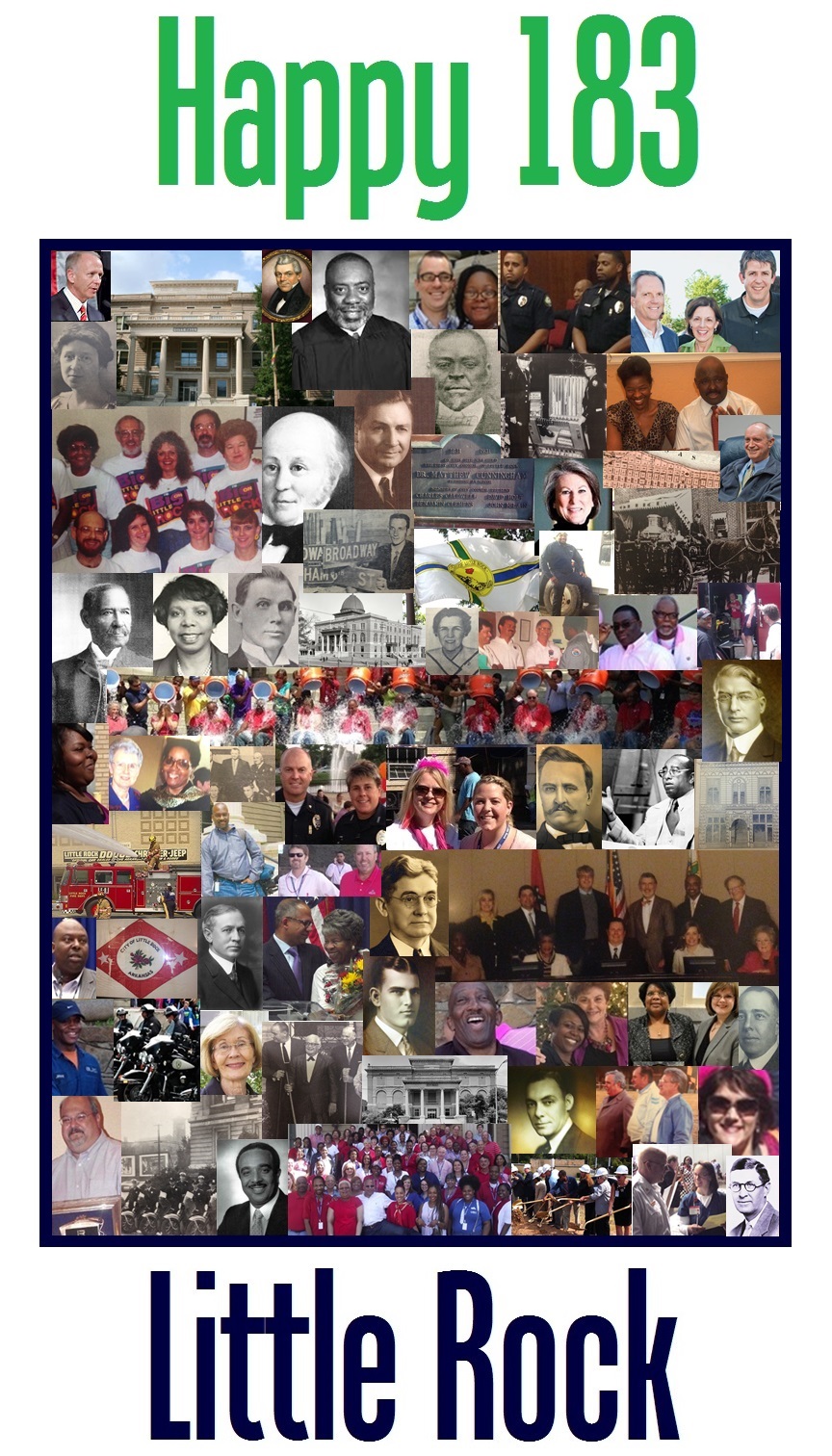
LR 183With the stroke of Territorial Governor John Pope’s pen, Little Rock was officially chartered as a town on November 7, 1831. This followed approval by the Arkansas legislature a few days earlier.

As a chartered, officially recognized municipality, the Town of Little Rock was authorized to create a government and to plan for a Mayor and Aldermen to be elected. That election would take place in January 1832 with the initial council meeting later that month.

There are several earlier and later days which could be used to mark Little Rock’s official birth (LaHarpe sighting in 1722, first settler in 1812, permanent settlement in 1820, selection of trustees in 1825, chartered as a City in 1835, chartered as a City of First Class in 1875) — but it is November 7, 1831, which has been the officially recognized and accepted date.

In 1931, Little Rock celebrated her centennial with a series of events.  Likewise, in November 1981, Little Rock Mayor Charles Bussey signed and City Clerk Jane Czech attested Resolution 6,687 which recognized the Little Rock sesquicentennial.

Little Rock Look Back: City Flag Adopted

City FlagOn October 18, 1988, the City of Little Rock Board of Directors adopted the first official flag for the City of Little Rock.

The adoption of Ordinance No. 15,566 was the culmination of a design competition which had been spearheaded by Little Rock City Director Sharon Priest (later Little Rock Mayor, Arkansas Secretary of State and now Executive Director of the Downtown Little Rock Partnership).

Prior to the Official Board of Directors meeting that day, a press conference was held in the Little Rock City Board Chambers for presentation of the City’s flag.  The City Beautiful Commission, a commission of the Department of  Parks and Recreation, sponsored a the contest which received a total of fifteen flag designs.

The flags were judged October 12, 1988, by City Directors and City Beautiful Commission Members. Director Sharon Priest presented the winning flag and introduced David Wilson, a law clerk at the Mitchell Law Firm, who designed the flag chosen for the $1,000 first prize. The second-place winner was Craig Rains, who received $500; and the third-place recipient was David Tullis, who received $250.

The flag was adopted by the City Board that night by a 6-0 vote; former mayor and current director Charles Bussey was absent.  Those voting to adopt the flag were Mayor Lottie Shackelford and directors Sharon Priest, Tom Prince, Buddy Villines, Buddy Benafield and Tom Milton.  Priest would be a future mayor while Prince, Villines and Benafield had all served as mayor.

The official description of the flag is as follows:

As the official flag of the City of Little Rock, its symbolism is described as follows: A clean white background of the banner represents the optimism and open potential that the city has to offer. The royal blue horizontal broad stripe symbolizes the Arkansas River which borders Little Rock, and has served as an economical and historical emblem since the city’s beginning. The forest green stripe runs vertical to the royal blue stripe, creating a cross which symbolizes the location and statute of Little Rock—a city serving not only as the crossroads of Arkansas, but a crossroad of the mid-southern United States as well.

The strong forest green color depicts the fields, parks and forests which contribute to the natural beauty of the city. The seal of the flag is a modernized adaptation of the current Little Rock seal. The razorback red silhouette of the great State of Arkansas shows her capitol, the City of Little Rock, represented by the centered star. The star rises directly above “The Little Rock”—the protruding cliff along the Arkansas River, which was discovered in 1722 by French explorer La Harpe, when the city was given the name. The Arkansas River behind the rock and the symmetrical oak leaves in the border of the seal are a stylized illustration of what the flag’s stripes represent—the natural beauty of the city. Finally, the gold color of the seal and bordering stripes symbolize the superior economic history, and the future economic potential that is available in the City of Little Rock, Arkansas.

Little Rock Look Back: Lottie Shackelford, LR’s 68th Mayor

Mayor Lottie_ShackelfordOn April 30, 1941, future Little Rock Mayor Lottie Shackelford was born. Throughout her career in public service she has been a trailblazer.

Active in community activities and politics, she ran for the City Board in 1974 and lost.  But she was appointed to the Little Rock City Board in September 1978 to fill a vacancy.  This made her the first African American woman to serve on he City Board, and indeed on any governing board for the City (during Reconstruction, there were at least three African Americans on the City Council, but they were all men.) She was subsequently elected to a full-term on the City Board in 1980 winning 55% of the vote over three male candidates.

She was subsequently re-elected in 1984 (unopposed) and in 1988 (with 60% of the vote).

In January 1987, Shackelford became the first female mayor of Little Rock when she was chosen by her colleagues on the City Board to serve in that position. She was Mayor until December 1988.

From 1982 until 1992, she served as Executive Director of the Arkansas Regional Minority Purchasing Council.  She left that position to serve as Deputy Campaign Manager of Clinton for President.  She subsequently served on the Clinton/Gore transition team. She later served on the Overseas Private Investment Corporation from 1993 to 2003. She was the first African American to be in that position.

A graduate of Philander Smith College, she has also studied at the Arkansas Institute of Politics at Hendrix College and the Kennedy School of Government at Harvard University.

Mayor Shackelford has also served on numerous boards including the Little Rock Airport Commission, Philander Smith College, Chapman Funds (Maryland) and Medicis Pharmaceutical Corporation (Arizona).  She has been the longest serving Vice-Chair of the Democratic National Committee.

Mayor Shackelford was in the first class of inductees for the Arkansas Black Hall of Fame.

Little Rock Look Back: City Flag Turns 25 Today

City FlagOn October 18, 1988, the City of Little Rock Board of Directors adopted the first official flag for the City of Little Rock.

The adoption of Ordinance No. 15,566 was the culmination of a design competition which had been spearheaded by Little Rock City Director Sharon Priest (later Little Rock Mayor, Arkansas Secretary of State and now Executive Director of the Downtown Little Rock Partnership).

Prior to the Official Board of Directors meeting that day, a press conference was held in the Little Rock City Board Chambers for presentation of the City’s flag.  The City Beautiful Commission, a commission of the Department of  Parks and Recreation, sponsored a the contest which received a total of fifteen flag designs.

The flags were judged October 12, 1988, by City Directors and City Beautiful Commission Members. Director Sharon Priest presented the winning flag and introduced David Wilson, a law clerk at the Mitchell Law Firm, who designed the flag chosen for the $1,000 first prize. The second -place winner was Craig Rains, who received $500; and the third -place recipient was David Tullis, who received $250.

The flag was adopted by the City Board that night by a 6-0 vote; former mayor and current director Charles Bussey was absent.  Those voting to adopt the flag were Mayor Lottie Shackelford and directors Sharon Priest, Tom Prince, Buddy Villines, Buddy Benafield and Tom Milton.  Priest would be a future mayor while Prince, Villines and Benafield had all served as mayor.

The official description of the flag is as follows:

As the official flag of the City of Little Rock, its symbolism is described as follows: A clean white background of the banner represents the optimism and open potential that the city has to offer. The royal blue horizontal broad stripe symbolizes the Arkansas River which borders Little Rock, and has served as an economical and historical emblem since the city’s beginning. The forest green stripe runs vertical to the royal blue stripe, creating a cross which symbolizes the location and statute of Little Rock—a city serving not only as the crossroads of Arkansas, but a crossroad of the mid-southern United States as well.

The strong forest green color depicts the fields, parks and forests which contribute to the natural beauty of the city. The seal of the flag is a modernized adaptation of the current Little Rock seal. The razorback red silhouette of the great State of Arkansas shows her capitol, the City of Little Rock, represented by the centered star. The star rises directly above “The Little Rock”—the protruding cliff along the Arkansas River, which was discovered in 1722 by French explorer La Harpe, when the city was given the name. The Arkansas River behind the rock and the symmetrical oak leaves in the border of the seal are a stylized illustration of what the flag’s stripes represent—the natural beauty of the city. Finally, the gold color of the seal and bordering stripes symbolize the superior economic history, and the future economic potential that is available in the City of Little Rock, Arkansas.