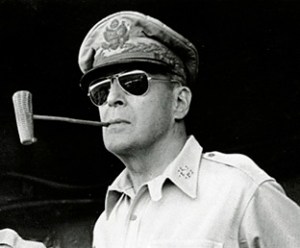
Little Rock Look Back: Douglas MacArthur

GOn January 26, 1880, Douglas MacArthur was born in the Arsenal Building while his father was stationed at the Little Rock Barracks.  Though he left Arkansas a few weeks later when his father was transferred, he returned to his birthplace on March 23, 1952. On that day he was greeted by crowds welcoming one of the USA’s most famous military figures.

Though Gen. MacArthur spent only a few weeks in Little Rock, he was baptized at Christ Episcopal Church.  The location of the baptism remains a mystery today because the church was meeting in temporary locations due to the first structure having been lost to a fire.

When the General returned to Little Rock in 1952, he did pay a brief visit to Christ Church.  He also spoke at the Foster Bandshell in the park which bore his name.  He was one of three presidential candidates to speak at the Foster Bandshell in 1952, the others were the eventual Democratic and Republican nominees Adlai Stevenson and Dwight Eisenhower.

When General MacArthur died, he was granted a state funeral.  He was one of the few non-Presidents to have been given this honor.

Today, the MacArthur Museum of Arkansas Military History is located in the Arsenal building.  It was created to interpret our state’s military heritage from its territorial period to the present.  Located in the historic Tower Building of the Little Rock Arsenal–the birthplace of General Douglas MacArthur–the museum preserves the contributions of Arkansas men and women who served in the armed forces.  Exhibits feature artifacts, photographs, weapons, documents, uniforms and other military items that vividly portray Arkansas’s military history at home and abroad.

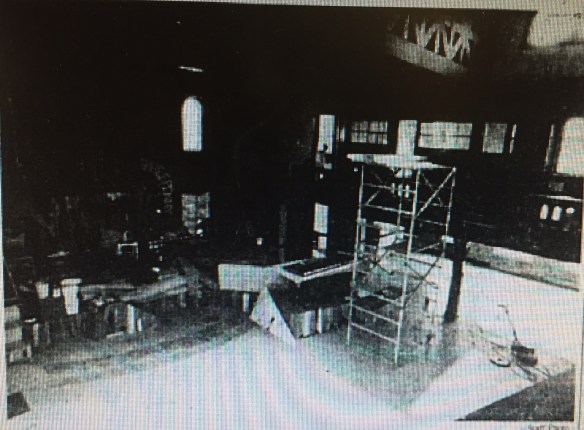
Little Rock Look Back: Groundbreaking for Museum of Fine Arts (forerunner to Arkansas Arts Center)

MFA postcardOn January 3, 1936, the ground was broken for the Museum of Fine Arts building in City Park.  The facility would face Ninth Street and be to the west of the Arsenal Tower Building.   That building was the one remaining structure of more than 30 which had populated the grounds when it was a federal military establishment.

Excavation for the building uncovered the foundation for another structure.  New footings for the Museum would be poured into the old footings.

The cornerstone would be laid in October 1936, and the building would open in October 1937.  The building would serve as the museum’s home until the new construction for the new Arkansas Arts Center began in 1961. That construction would enclose the original Museum of Fine Arts.  By that time, the City had long renamed the park in honor of General Douglas MacArthur, who was born there when it had been a military installation.

Subsequent additions to the Arkansas Arts Center over the decades have further expanded the museum’s footprint.  After the 2000 expansion, the original 1937 facade was featured more prominently than it had been since 1963. With the Arkansas Arts Center again slated for renovation and expansion, the original 1937 facade will be maintained and possibly even further highlighted.

But it all began on January 3, 1936.

Little Rock Look Back: Arkansas Rep’s First Show

rep-firstOn November 11, 1976, the curtain went up on the first Arkansas Repertory Theatre production.  It was the Kurt Weill-Bertolt Brecht musical The Threepenny Opera.  Rep founder Cliff Baker directed the show and played the leading role of Macheath aka Mack the Knife.

Others in the cast included local attorney Herb Rule, Jean Lind, Theresa Glasscock, Connie Gordon and Guy Couch.  Byl Harriell was the technical director and production designer while Donia Crofton was the costume designer.

The production took place in the Rep’s home which was the converted former home of Hunter United Methodist Church on the eastern edge of MacArthur Park.  (Harriell’s business Bylites is now in that location.)

Baker had previously worked at the Arkansas Arts Center theatre when it was attached to a degree granting MFA program. He had also directed shows in other parts of Arkansas.  He returned to Little Rock and founded the Arkansas Philharmonic Theatre which performed in Hillcrest.  The Arkansas Repertory Theatre was a step forward with the establishment of a professional repertory company.

The first season of the Rep would include Company, Suddenly Last Summer, Marat/Sade, and Stop the World–I Want to Get Off. Season tickets for a total of seven shows were $30.

Baker served as Artistic Director of Arkansas Rep from 1976 until 1999.  Earlier this year, he stepped in as Interim Artistic Director between the tenures of Bob Hupp and John Miller-Stephany.  He is currently preparing to direct Sister Act for the Rep in January 2017.


Arkansas Heritage Month – LR Mayor Brickhouse and a Municipal Auditorium

Brickhouse AuditIn anticipation of the November 2016 reopening of Robinson Center Music Hall, this week’s Arkansas Heritage Month entries look at seven Little Rock Mayors who worked on proposals for a municipal auditorium between 1904 and 1940.

Former Alderman Ben D. Brickhouse took office as mayor in April 1919.  As an alderman, he had been party to the discussions and hand-wringing over the existing “temporary” auditorium, which was twelve years old at the time.  In June 1920, he and the City Council authorized City Engineer James Rice to have the building demolished.  (Rice’s grandson Jim Rice is an integral member of the team overseeing the restoration of Robinson Center Music Hall.)

On what seemed to be an annual basis, Brickhouse entertained options for a new municipal auditorium.  Sometimes it would be private groups, on at least one occasion, Mayor Brickhouse himself led the effort.  Funding and location always seemed to be stumbling blocks.  Arkansas law forbade the use of public dollars on an auditorium, so the money would have to be raised privately. Few private entities had the money for this type of project.  Another temporary auditorium had been proposed for City Park (now MacArthur Park), but aldermen balked at the expense for a temporary building.

During the Brickhouse administration, the Hotel Marion was the main site for conventions. The auditorium at the Little Rock High School (later East Side Junior High) was used frequently for performances.

Mayor Brickhouse worked behind the scenes to have the Arkansas General Assembly pass legislation to allow for the creation of an auditorium taxing district, much like a street improvement district. In May 1925 Little Rock voters would be given the chance to approve this.  But Brickhouse would not be mayor by the time that election came around.  He was defeated in his bid for a fourth term and left office in April 1925.

Ben D. Brickhouse did return to public service in 1938, when he was elected to the Arkansas General Assembly.  He was reelected in 1940 and died in June 1941.

Arkansas Heritage Month – On Armed Forces Day visit the City of Little Rock’s MacArthur Museum of Arkansas Military History

MacPark ArsenalToday is Armed Forces Day.  It is a good day to visit Little Rock’s museum devoted to Arkansas’ military heritage.  Located in the historic Arsenal Tower in MacArthur Park, the MacArthur Museum of Arkansas Military History honors the Arkansans who have served in the armed forces.  Exhibits feature artifacts, photographs, weapons, documents, uniforms and other military items that vividly portray Arkansas’s military history at home and abroad.

The exhibits include:

  • From Turbulence to Tranquility: The Little Rock Arsenal
  • Capital In Crisis and Celebration: Little Rock and the Civil War
  • Alger Cadet Gun
  • Camden Expedition
  • David Owen Dodd
  • Through the Camera’s Eye: The Allison Collection of World War II Photographs
  • By the President in the Name of Congress: Arkansas’ Medal of Honor Recipients
  • Conflict and Crisis: The MacArthur- Truman Controversy
  • Duty, Honor and Country: General Douglas MacArthur
  • The Sun Never Sets on the Mighty Jeep: The Jeep During World War II
  • War and Remembrance: The 1911 United Confederate Veterans Reunion
  • First Call – American Posters of World War I
  • Undaunted Courage, Proven Loyalty: Japanese American Soldiers in World War II
  • Vietnam, America’s Conflict

The MacArthur Museum of Arkansas Military History is a museum of the City of Little Rock.  It is led by executive director Stephan McAteer who works with the MacArthur Military History Museum Commission.  The museum is open Tuesday through Friday from 9am to 4pm, Saturday from 10am to 4pm and Sunday from 1pm to 4pm.

The Game’s Afoot at the Arkansas Arts Center

AAC marathonGame On! The Little Rock Marathon is today.

As they have the past several years, the Arkansas Arts Center will have a cheering station set up as the runners go by the museum along Commerce Street.

Today (March 6) from 7am until 9am-ish.

Stop by and enjoy food, drinks, and entertainment while cheering on participants in the race.  Then hang out in MacArthur Park until the museum opens at 11am and enjoy the exhibits there as well as brunch at Best Impressions.


Arts+History Election Results – By The Numbers

Feb9electionlogoThe Culture Vulture loves crunching numbers almost as much as attending cultural events.

Here are some thoughts about the results from the February 9 MacArthur Park Bond election.  These bonds will pay for improvements to the Arkansas Arts Center, MacArthur Museum of Arkansas Military History and MacArthur Park.  Excess revenues from the bonds will be available for the Little Rock Zoo, Museum of Discovery, other Little Rock parks and other Little Rock cultural institutions.

There were 7,990 votes cast in the special election.  This was 6.61% of the electorate.  By comparison, there were 4,462 ballots cast in the July 2015 Central Arkansas Library System special election and 6,995 ballots cast in the December 2013 Robinson Center special election.  The latter election brought 6.14% of voters to the polls.

Comparing early and absentee voters to election day voters:

  • Robinson (December 2013) – 871 or 12.45% of all ballots cast
  • CALS (July 2015) – 750 or 16.81% of all ballots cast
  • MacArthur Park (February 2016) – 1,171 or 14.66% of all ballots cast

The top ten precincts for voter participation on February 9:

107 – LRFD Station #10 —– 23.66%
106 – LRFD Station #10 —– 22.85%
109 – Pulaski Heights Presbyterian —–  18.17%
91 – Cammack Village City Hall —– 17.43%
108 – Woodlawn Baptist —– 17.33%
90 – Second Presbyterian —– 15.86%
112 – Pulaski Heights Presbyterian —– 15.00%
96 –  St. Mark’s Episcopal —– 13.42%
70 – Pleasant Valley CoC —–  12.58%
92 – St. Paul UMC —–  12.27%

While most of these are in the midtown area of Little Rock, some are in the western portion of Little Rock.  They tend to have the highest percentage of voter turnout in primary, general and special elections regardless of what or who is on the ballot.


The top 10 precincts for number of voters were:
109 – Pulaski Heights Presbyterian —– 497
106 – LRFD Station #10 —– 351
107 – LRFD Station #10 —– 308
90 – Second Presbyterian —– 260
71 – Pulaski Academy —– 252
108 – Woodlawn Baptist —– 238
114 – Arkansas Arts Center —– 230
88 – St. James UMC —– 223
95 – Grace Presbyterian —– 211
68 – Chenal Valley Church —– 204

These results spread from downtown to midtown to west Little Rock and are fairly evenly distributed.


There were twelve precincts in which over 90% of the voters cast ballots in favor of the bonds.  Precinct 61 at Pilgrim Rest Baptist Church was 100% in favor of it. But there was only one ballot cast.  Of the remaining eleven precincts in which more than one vote was cast, here are the rankings by percentage:

112 – Pulaski Heights Presbyterian —– 96.97
118 – Dunbar Recreation Center —– 95.83
114 – Arkansas Arts Center —– 95.65
109 – Pulaski Heights Presbyterian —– 94.77
107 – LRFD Station #10 —– 94.16
108 – Woodlawn Baptist  —– 92.86
79 – Henderson UMC —– 92.59
128 – St. John Vision Center —– 92.37
90 – Second Presbyterian —– 91.54
110 – Woodlawn Baptist  —– 91.3
135 – Pilgrim Rest Baptist —– 91.18

Again, they are fairly evenly distributed from downtown to midtown to west Little Rock.