Little Rock Look Back: Nicholas Peay

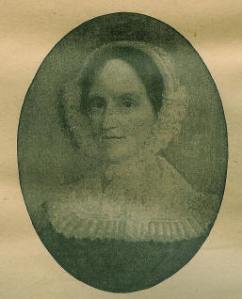
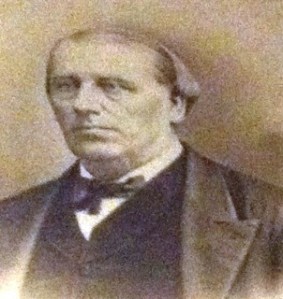
LR sealOn April 28, 1784, in Virginia, future Little Rock Alderman (and acting Mayor) Major Nicholas Peay was born the eleventh of at least thirteen children.  (His gravestone lists a May date for his birth, but other records indicate April 28, 1784.) A veteran of the War of 1812 and the Indian Wars, he later moved to Kentucky (where he met and married his wife, Juliet Neill, in 1814) before settling in Arkansas on September 18, 1825.  At the time, they were the ninth family to set up residence in Little Rock.

After arriving in Little Rock, he bought the Little Rock Tavern. This started a fifty year tradition of his family owning taverns and hotels in Little Rock. In 1828, he was appointed Assistant Postmaster of Little Rock.  From 1825 to 1831, Little Rock residents were allowed to elect five Trustees prior to the formal incorporation. Major Peay was one of those who served on the Board of Trustees.

He later served on the Little Rock City Council, and in 1839 served for seven months as Acting Mayor due to the prolonged absence of Mayor Jesse Brown.  In 1841, his friend Gen. Zachary Taylor, paid a visit to Little Rock and stayed with him on the General’s way to Fort Smith.

Nicholas and Juliet Peay had at least eleven children, though only five appeared to have lived until adulthood. One of those, Gordon Neill Peay, served as Little Rock’s 23rd Mayor from 1859 to 1861. Other descendants of Nicholas Peay who followed him into public service include his grandson Ashley Peay, who was an Alderman in the 1920s (son of John Coleman Peay) and great-great-grandson Joseph B. Hurst (a great-grandson of Mayor Peay), who was a City Director from 1967 to 1970. In addition, City Director Hurst’s daughter-in-law, Stacy Hurst served three terms on the City Board from 2003 to 2014; she is now Director of the Department of Arkansas Heritage.

Major Peay’s egg-nog recipe has been passed down for generations. It is the inspiration for the Historic Arkansas Museum yearly Nog-Off.  This past year, museum director Bill Worthen and his daughter were the sixth and seventh generation of the family to make Peay’s egg-nog. The Worthens are descended from Mayor Peay’s son who was also named Gordon Neill Peay.

Major Nicholas Peay is buried with his wife and many other family members in Mount Holly Cemetery.

The Smithsonian Institution records indicate they have an oil painting of Major Peay as well as of his wife. But there are conflicting records as to whether they have been lost or are in private collections.
Prizing Mount Holly Cemetery on Pulitzer Day

The Pulitzer Prizes are to be announced today.  This year marks the 100th announcement of the prizes, though not all of the current categories have been around since 1917.

Mount Holly Cemetery not only touts that it is the site of a whole host of elected officials, it is also the only place in Arkansas where two Pulitzer Prize recipients are buried. The cemetery is open every day, but a special visit to these two prize winner gravesites can be made next Sunday during the Mount Holly Cemetery Association’s annual “Rest in Perpetuity” fundraiser picnic.

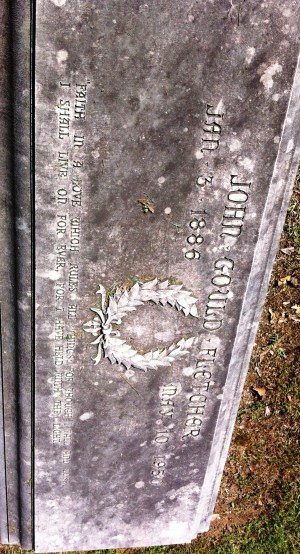
In 1939, John Gould Fletcher became the first Southern poet to win the Pulitzer Prize for Poetry.  He was born into a prominent Little Rock family in 1886.  Fletcher was awarded the prize for his collection Selected Poems which was published by Farrar in 1938.  Two years earlier, he had been commissioned by the Arkansas Gazette to compose an epic poem about the history of Arkansas in conjunction with the state’s centennial.

Fletcher is buried next to his wife, author Charlie May Simon and his parents (his father was former Little Rock Mayor John Gould Fletcher).  Other relatives are buried nearby in the cemetery.

The other Pulitzer Prize winner buried in Mount Holly is J. N. Heiskell, the longtime editor of the Arkansas Gazette.  It was Heiskell, in fact, who asked Fletcher to compose the poem about Arkansas.  Heiskell served as editor of the Gazette from 1902 through 1972.  He died at the age of 100 in 1972.

Under his leadership, the Gazette earned two Pulitzer Prizes for its coverage of the 1957 desegregation of Little Rock Central High.  One was for Harry Ashmore’s editorial writing and the other was for Public Service.

Heiskell remained in charge of the Gazette until his death in 1972.  He is buried alongside his wife with other relatives nearby.  Also not too far from Mr. Heiskell are two of his nemeses, proving that death and cemeteries can be the great equalizer. In the early days of his Gazette stewardship, he often locked horns with Senator (and former Governor) Jeff Davis. Later in Mr. Heiskell’s career, he vehemently disagreed with Dr. Dale Alford, who had been elected to Congress on a segregationist platform.

LR Women’s History Month – Adolphine Krause Fletcher

CLR Adolphine Krause FletcherIn 1878, Adolphine Krause Fletcher became First Lady of Little Rock when she married John Gould Fletcher, who was then serving as mayor.  Though records are incomplete, this may well be the first and only time that a sitting mayor has been married while in office.

She was born September 3, 1854, the daughter of John and Fredericka Krause.  Her father had immigrated from Denmark and her mother had come from what is now Germany.  Adolphine had at least two older sisters – Clara and Johanna.  When the girls were small children, their father died.  While all three girls reached adulthood, Clara died in 1866.  By the time Adolphine married Mayor Fletcher, her mother had died.  It is expected that Adolphine was introduced to her future husband by her sister Johanna. She was married to Peter Hotze, who was a business partner of Mayor Fletcher’s.

Adolphine and John Gould Fletcher had five children, three of whom survived to adulthood – Adolphine, Mary and John Gould.  (The Fletcher family often used the same names in subsequent generations and never distinguished among different people with the uses of Senior, Junior, Third, etc.)

In 1889, the Fletcher family moved in to what is now known as the Pike-Fletcher-Terry House. It stayed in the family until the 1970s, when Adolphine’s two daugthers deeded it to the City of Little Rock for use by the Arkansas Arts Center.

Mrs. Fletcher saw to it that each of her children were well-educated, even if she restricted them to spending most of their time at the family manse. The three were surrounded with literature and books on topics of the day.  She brought in tutors to teach them German and Latin.  At a time when few females were educated, the Fletcher girls were sent to college.

Though her children and husband traveled, Mrs. Fletcher never ventured from Arkansas. She was, however, enthralled by images of the upper classes from the North, about which she read in magazines. She dressed her children inappropriately for the warmer Arkansas climate but in clothing inspired by etchings from New York, Philadelphia, Boston, and other northern cities.  She also apparently did not care for many of her husband’s more rural relatives. As soon as Adolphine was old enough to act as hostess, Mrs. Fletcher would stay in her room and send her daughter downstairs to receive guests.

Her two passions were gardening and music.  She had the glass conservatory installed on the southeast corner and spent countless hours there cultivating plants which were not native to Arkansas.  She also spent many hours playing piano and singing — everything from popular music to classical songs. She regaled her children with stories about a tutor who had encouraged her to become an opera singer.  She tried to teach her son how to play the violin, but his father would not allow it.

It appears that most her her life was spent focused on her gardening, music and children.  In May 1910, Adolphine Krause Fletcher died and was buried at Mount Holly Cemetery alongside her husband.  Her parents and sisters are also buried in that cemetery.


LR Women’s History Month – Adolphine Fletcher Terry

adolphine

Photos from the collection of the Butler Center for Arkansas Studies

Adolphine Fletcher Terry was born on November 3, 1882 to former Little Rock Mayor John Gould Fletcher and his wife Adolphine Krause Fletcher.

Raised in Little Rock, in 1889 she moved into the Albert Pike House on East 7th Street, when her aunt transferred the title to her father. That house would be her primary residence the rest of her life.  Her sister Mary Fletcher Drennan never lived in Arkansas as an adult after marriage. Her brother John Gould Fletcher spent much of his adulthood in Europe before returning to Little Rock and establishing his own house, Johnswood.

At age 15, Adolphine attended Vassar. She later credited that experience as broadening her views on many issues.  After graduating at age 19, she returned to Little Rock.  Her parents both died prior to her 1910 wedding to David D. Terry, which took place at what was then known as the Pike-Fletcher House (and today is known as the Pike-Fletcher-Terry House).

She is perhaps best known today for establishing the Women’s Emergency Committee in 1958 and for her subsequent deeding of the family house to the City for use by the Arkansas Arts Center.  But her entire life was based on civic engagement.

She was instrumental in establishing the first juvenile court system in Arkansas and helped form the first school improvement association in the state. She was long an advocate for libraries, serving 40 years on the Little Rock public library board.  Through her leadership, the library opened its doors to African Americans in the early 1950s. Today a branch of the Central Arkansas Library System (the successor the Little Rock public library) is named after her.  Another branch is named after her Pulitzer Prize winning brother.

Adolphine formed the Little Rock chapter of the American Association of University Women, the Pulaski County tuberculosis association and the Community Chest.

In 1958, when the Little Rock public high schools were closed instead of allowing them to be desegregated again, she called Harry Ashmore the editor of the Gazette and exclaimed, “the men have failed us…it’s time to call out the women.”  With this, she formed the Women’s Emergency Committee to Open Our Schools. This group played a major role in getting the four high schools open the following year.

From 1933 to 1942, David Terry served in the U.S. Congress. During that time, Adolphine alternated her time between Washington DC and Little Rock. But she spent much time in Little Rock raising her five children.

After her husband’s death in 1963, she continued to remain active in civic affairs. In the 1960’s, she and her sister deeded the Pike-Fletcher-Terry House to the City of Little Rock for use by the Arkansas Arts Center upon both their deaths.  Following Adolphine Fletcher Terry’s death in 1976, Mary turned over the title to the City.

Adolphine Fletcher Terry is buried in Mount Holly Cemetery alongside her husband. Three of her children are also buried in that plot.  Her parents and brother are buried in a nearby plot.

Her son William Terry and his wife Betty continue to be active in Little Rock. Their daughters and their families also carry on Adolphine Fletcher Terry’s commitment to making Little Rock better.

LR Women’s History Month: Eliza Cunningham

Eliza CunninghamEliza Wilson Bertrand Cunningham was the First Lady of Little Rock.  She literally was the first lady and the founding mother.

She became the first permanent female resident when she joined her husband Matthew Cunningham in Little Rock.  She gave birth to Chester Ashley Cunningham, the first baby born in Little Rock, as well as several other children with Cunningham.  When he became the first Mayor of Little Rock, she was the first First Lady of Little Rock. They hosted the first Little Rock Council meeting at their house on what is now the block downtown bounded by Third, Main, Fourth and Louisiana Streets.  Her son Charles P. Bertrand, from her first husband, later served as Mayor of Little Rock, making her the only woman to be married to a Mayor and be mother of a Mayor.

Born in Scotland in December 1788, she emigrated with her parents to the United States as a young girl.  In 1804 or 1805, she married a French businessman, Pierre Bertrand in New York City.  She lived in New York City, while he traveled to his various business ventures.  He never returned from a trip to his coffee plantation in Santo Domingo and was presumed to have died in 1808 or 1809.  She and Bertrand had three children, Charles Pierre, Arabella and Jane. (Jane may have died in childhood, because records and lore only indicated Charles and Arabella coming to Little Rock with their mother.)

Eliza married Dr. Matthew Cunningham in New York City.  He later moved to Saint Louis and settled in Little Rock in early 1820.  Eliza and her two children came to Little Rock in September 1820.  In 1822, she gave birth to Chester Ashley Cunningham, the first documented baby born in Little Rock.  (There are unsubstantiated reports that at least one slave child may have been born prior to Chester.)  She and Matthew also had Robert, Henrietta, Sarah and Matilda.  The latter married Peter Hanger, after whom the Hanger Hill neighborhood is named.

Dr. Cunningham died in June 1851.  Eliza died in September 1856. They and Chester (who died in December 1856) are buried in the Hanger family plot at Mount Holly Cemetery.

Little Rock Look Back: Leap Day City Council meetings

CLR Leap Day 1932February 29 may come around only once every four years, but it is even rarer for the City of Little Rock to have City Council or City Board meetings on that date.

The most recent official meeting on a Leap Day was on February 29, 1932.  Mayor Horace A. Knowlton presided with all sixteen Aldermen present.  Among the items discussed were regulating of junk dealers, taxes on slot machines, a building condemnation, and setting a license fee for bowling alleys.

There were several issues related to cemeteries discussed throughout the evening.  One forbade any new burials in a section of Oakland Cemetery while another sought to prohibit the creation of any new cemeteries within the City limits.  The Council also passed a motion instructing the Mayor to notify the State Board of Health that the City was “seriously objecting and would strenuously oppose the establishment of a [new] Cemetery within the present boundaries of the City of Little Rock.”  The final cemetery issue was the acceptance of the annual report of the Mount Holly Cemetery Association.

That night the Council also passed a resolution to name the city government hospital as “Little Rock City Hospital.” The purpose of the name was to “clearly designate said hospital to the citizens of Little Rock as the hospital owned and operated by the City of Little Rock.”

The issue which seems to have taken up most of the time was overriding a Mayoral veto of a resolution opposing the firing of a firefighter.  The motion to sustain the veto ended in a tie. After the Mayor promised to rehire the firefighter as soon as a vacancy occurred, on alderman changed his vote and the veto was sustained.

The only other City Council meeting on a February 29 was in 1892.  Mayor H. L. Fletcher presided over the meeting.  The main focuses of that meeting were to discuss boundaries of various sewer districts, pay the monthly bills, approve the relocation of a house from 9th Street to the corner of 12th Street and Commerce Street and to bring certain City criminal penalties in line with a new state law.

Little Rock Look Back: Mayor John Wassell

JWassellFuture Little Rock Mayor John Wassell was born on February 15, 1813 in Kidderminster, England.

In 1829, he came to the United States.  He learned carpentry and construction in Ohio and ended up in Little Rock.  One of his jobs was as the finishing contractor on the State Capitol building, now known as the Old State House.

He later gave up carpentry and became an attorney.  (It is said that he did so after becoming embroiled in a legal dispute arising from one of his construction jobs.) Wassell also served as a judge.

In 1868, he was appointed Mayor of Little Rock by President Andrew Johnson.  He is Little Rock’s only Mayor to have served through a military appointment.  Mayor Wassell died in January 1881 and is buried at Mount Holly Cemetery along with his wife and other family members.  One of his grandsons, Samuel M. Wassell also served as Mayor of Little Rock.