Black History Month Spotlight – Little Rock Cemeteries

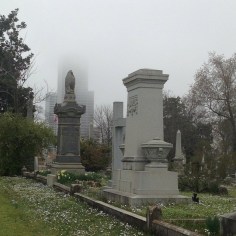
Mount Holly greyThe new Arkansas Civil Rights History Audio Tour was launched in November 2015. Produced by the City of Little Rock and the University of Arkansas at Little Rock allows the many places and stories of the City’s Civil Rights history to come to life an interactive tour.  This month, during Black History Month, the Culture Vulture looks at some of the stops on this tour which focus on African American history.

Mount Holly Cemetery: Broadway at Twelfth Street, est. 1843

Oakland and Fraternal Historic Cemetery Park: 2101 S. Barber, est. 1863

Haven of Rest Cemetery: 1702 Twelfth Street, est. 1903

National African Americans and important civil rights leaders are interred in several local cemeteries.

Mount Holly Cemetery is the final resting place of enslaved people, who were buried in their owner’s family plots, and the graves of several free blacks in the mid-1800s. One notable black leader buried here is Nathan Warren, founding pastor of Bethel AME Church. A marker is dedicated to Quatie Ross, wife of Cherokee Chief John Ross, who died along the Trail of Tears in 1839.

Oakland and Fraternal Historic Cemetery Park is composed of several cemeteries serving different communities: Oakland, Confederate, National, Jewish, and Fraternal, an historically black cemetery. Civil rights advocates buried in Fraternal include Mifflin Wistar Gibbs, John E. Bush, Charlotte Andrews Stephens, Dr. John Marshall Robinson, Isaac Gillam, Sr. and Jr., Asa l. Richmond, as well as members of the influential Pankey and Ish families.

Haven of Rest Cemetery is the largest cemetery for black people in Little Rock. Among the graves here are those of Daisy Gatson Bates, civil rights activist and mentor to the Little Rock Nine; attorney Scipio Africanus Jones; and Rev. Joseph Booker, president of Arkansas Baptist College.

The app, funded by a generous grant from the Arkansas Humanities Council, was a collaboration among UALR’s Institute on Race and Ethnicity, the City of Little Rock, the Mayor’s Tourism Commission, and KUAR, UALR’s public radio station, with assistance from the Little Rock Convention and Visitors Bureau

Little Rock Look Back: Acting Mayor John Herndon Hollis

John Herndon HollisOn February 5, 1870, future Little Rock alderman and acting mayor John Herndon Hollis was born shortly before his family moved to what is now Cleveland County. His parents were originally from Georgia and came from prosperous and longtime families there.

The Hollis family came to Arkansas after the Civil War and settled in Union County. A portion of that county was carved off and became Dorsey County (named after a Republican US Senator from Arkansas) but was renamed Cleveland County after Grover Cleveland was elected President. Cleveland was the first Democrat to be elected President in over 20 years. This name change also reflected the political shift in Arkansas from the Reconstruction-led Republican politics to the Democratic Party politics which would dominate for the next century.

John Herndon Hollis was one of six children, and the only one with a middle name. Herndon had been his mother’s maiden name. As one of his brothers described their childhood in Cleveland County, “they all went to country schools in their home neighborhood, worked hard on the farm in the summertime, and were inside their little Methodist Church every time the doors were open.”

Around 1900, Hollis and his new wife Malinda M. “Linda” Taliaferro Hollis (formerly of Rison) moved to Little Rock.  Together the couple had six children. In Little Rock, Hollis worked in the banking industry. For years he worked for People’s Building and Loan Association.

Hollis was first elected to the Little Rock City Council in April 1904. He would serve as one of the Aldermen from the city’s Fourth Ward until April 1918.  This was on the western border of Little Rock at the time. The family lived at 1510 S. Schiller, which is one block east of Central High, though at the time neither the school nor its predecessor (West End Park) existed.  From 1907 until 1913 he also served on the Little Rock School Board.

In April 1908, at the first City Council meeting in the new City Hall, Mayor W. E. Lenon announced his resignation. Because the resignation was effective immediately, there was a vacancy in the office of mayor.  Hollis was selected by his colleagues to serve as acting mayor until a successor could be elected. So from April 1908 through June 1908, Hollis was the City’s chief political and executive leader.

Though he was never formally mayor (and did not resign his position as alderman), since 1908, Hollis’ name has appeared on the list of mayors of Little Rock. The reason seems to be as a sign of respect since there was a vacancy.

There previously had been acting mayors when the mayor would be absent on business or due to illness. But in those instances, the mayor had not resigned. This is the only instance in Little Rock history when a mayor resigned immediately with no successor in place. So John Herndon Hollis holds a unique role in Little Rock history.

Hollis’ wife died in 1920.  He later married Ann Jewell of Little Rock (who was a distant cousin of his first wife). They were married until his death on October 23, 1941.  Ann Hollis lived in Little Rock until her death in 1980.  The Hollis family is entombed in the mausoleum at Mount Holly Cemetery.

Both of John Herndon Hollis’ wives are distant cousins of the Culture Vulture, so he is particularly fond of John Herndon Hollis.

Little Rock Look Back: Mayor Elijah A. More

Mayor More Marker in MOOn January 20, 1799, Elijah A. More was born in Kentucky.  By the early 1830s, he was residing in Hempstead County and practicing law. Because of the court system being based in Little Rock, he spent a great deal of time in Pulaski County.

By January 1834, he had obviously established a permanent residence in Little Rock, because he was chosen as the third mayor.  He served from January 1834 until January 1835.  According to records, he apparently continued to alternate between residing near what is now Hope and living in Little Rock.  In 1839, his wife Caroline Owens More died and was buried in Little Rock. Though not originally buried at Mount Holly (it did not open until 1843), she is now buried there.

In 1840, More was the subject of a court case before the Arkansas Supreme Court resulting from actions he had taken as an executor of an estate and subsequently as Pulaski County Probate Judge.

By 1864, More resided in Missouri. There is a record of him swearing a loyalty oath to the Governor of Missouri in that year (presumably in response to actions associated with the Civil War).

He died on April 15, 1878 and is buried in Columbia Cemetery in Columbia, Missouri.

Little Rock Look Back: Little Rock City Hall resumes after Civil War

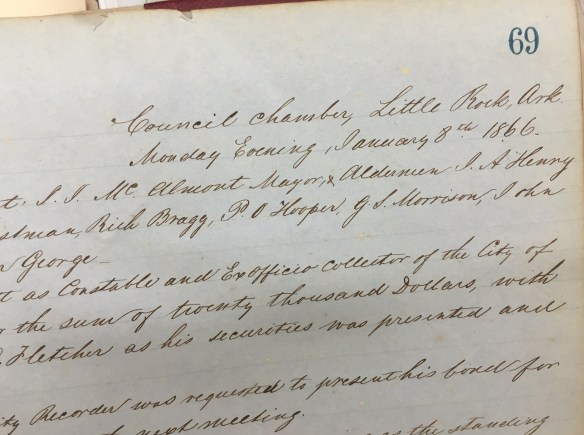
Jan 1866 minsOne hundred and fifty years ago this month, Little Rock City Hall resumed functioning after the Civil War.  The City government had disbanded in September 1863 after the Battle of Little Rock.  From September 1863 through the end of the war (on on through part of Reconstruction), Little Rock was under control of Union forces.

Following the April 1865 conclusion of the Civil War, plans were made to restart local government in Little Rock.  Even though Arkansas would not have Congressional representation in Washington until June 1868 (becoming the second Confederate state after Tennessee), the establishment of local government took place in January 1866.

The first City Council meeting took place on Monday, January 8, 1866. The council met again on Tuesday, January 9 and Monday, January 15 as they were trying to establish committees and rules for the new government.

The first post-Civil War mayor was Dr. J. J. McAlmont, who was a physician and pharmacist. Following his service as the city’s chief executive, he would later be a co-founder of what is now UAMS.  The initial aldermen were I.A. Henry (who had been on the City Council when it ceased in 1863), Henry Ashley, M. H. Eastman, Rick Bragg, P. O. Hooper, G. S. Morrison, John Collins and Alexander George.

Their first action was to approve the bond of Thomas C. Scott as Constable and City Collector.  Vouching for him were S. H. Tucker and John Gould Fletcher.  The Recorder was asked to present his bond and the next meeting.

The Mayor then established several committees of the City Council and named his appointments. Among the committees were Finances, Streets, Ordinances, Mount Holly Cemetery, Fire Department and Police.

That meeting and the following two meetings, the City continued to approve motions, resolutions and ordinances to set up the duties and responsibilities of a government.

Ordinance Number 1 established the rates of Licenses for 1866.  Among those were:

  • $100 for the privilege of selling goods at auction
  • $20 for a one-horse wagon, paid quarterly
  • $35 for a two-horse wagon, paid quarterly
  • $50 for a four-horse wagon, paid quarterly
  • $25 to run a cab or bus (which would have been in some horse drawn conveyance), paid quarterly
  • $40 a month to sell liquor, wine, ale, beer, etc., by the glass or bottle to be consumed in a store, tavern, shop or store
  • $25 each quarter for each billiard table
  • $50 each quarter for each ten pin alley


Little Rock Look Back: Mayor David Fulton

MayorFultonOn January 2, 1771 in Ireland, future Little Rock Mayor David Fulton was born.

He served as the fourth and final mayor of the Town of Little Rock in 1835. His term was cut short by the transition of Little Rock from town to city status. Once that happened in November 1835, a new election had to be held.

Mayor Fulton was also proprieter of the Tan Yard, a tanning operation in Little Rock.   He later served as a judge and was appointed as  Surveyor General of Public Lands in Arkansas by President Martin Van Buren in 1838.

Mayor Fulton married Elizabeth Savin in June 1795 in Maryland.  She died in November 1829, while they resided in Alabama.  Among their children was William Savin Fulton who served as Territorial Governor of Arkansas in 1835 and 1836 and was one of Arkansas’ first US Senators upon statehood in 1836.  Mayor Fulton was serving as Mayor at the same time his son was Governor.

Mayor Fulton came to Little Rock in 1833.  His daughter Jane Juliet Shall and her four children came to Little Rock as well.  The family made the move to be nearer to the future governor.  The Fultons and Shalls rented the Hinderliter House (now part of Historic Arkansas Museum) in 1834.

In addition to serving as Mayor, he was president of the Anti-Gambling Society and a Pulaski County Justice of the Peace.  From 1836 until 1838, he was County Judge of Pulaski County.

Mayor Fulton died on August 7, 1843 and is buried at Mount Holly Cemetery as are several other members of his family.

Little Rock Look Back: Mayor J.G. Botsford

Botsford GraveOn December 30, 1838, future Little Rock Mayor Jefferson George Botsford was born in Port Huron, Michigan.  He married Charlotte Adelia Henry on June 13, 1867.  She had been born in Massachusetts, but moved to Little Rock with her parents and grandparents.

The couple had seven children: Nellie, Charlotte, Harriett, James, Edward, George and Charles. Nellie, James and Charles died in childhood.

Botsford had served in the Union Army and fought in frontier battles against Indians.  Among his commercial involvements in Little Rock were serving as mail contractor between Little Rock and Baton Rouge, proprietor of Anthony House, organizer of Merchants National Bank and president of the White River Valley & Texas Railroad.

In 1868, Botsford was elected to the Little Rock City Council.  The City Council suspended Mayor A. K. Hartman in February 1870.  Elected in 1869, he was disliked by the aldermen, the press and a portion of the public.  A court order overturned the suspension in June 1870.  In January 1871, Mayor Hartman was again suspended by the Council.  This time, Botsford was declared Mayor.  However Hartman also still claimed the title of Mayor through the remainder of his term in November 1871.

After stepping down as Mayor with the election of Robert Catterson in November 1871, Botsford returned to private life.  He died on October 29, 1915 and is buried at Mount Holly Cemetery.

Little Rock Look Back: Mayor Frederick Kramer

Mayor KramerOn December 29, 1829, future Little Rock Mayor Frederick G. Kramer was born in Halle, Prussia.  In 1848, he immigrated to the United States.  Kramer enlisted in the United States Army and served in the Seventh Infantry until his discharge at Fort Gibson, Indian Territory, in July 1857. After his discharge, Kramer settled in Little Rock, and became a citizen in 1859. He married Adaline Margaret Reichardt, an emigrant from Germany, in 1857. They had six children Louisa, Mattie, Emma, Charles, Fred, and Henry.

From 1869 to 1894, Kramer served on the Little Rock School Board.  He was the first School Board president.  Among his other civic activities were serving as president of the Masonic Mutual Relief Association, a founder of the Mount Holly Cemetery Commission, and a founder of Temple B’nai Israel.  In 1875 he and F. A. Sarasin opened a mercantile business. Kramer later became the president of the Bank of Commerce.

Frederick Kramer was elected Mayor of Little Rock in November 1873.  He served until April 1875, when a new Arkansas Constitution took effect.

From November 1869 through March 1875, the City Council President presided over City Council meetings and signed ordinances, performing many of the duties formerly ascribed to the Mayor.  As such, during his Mayoral tenure from 1873 to 1875, Kramer was the Chief Executive of the City but did not preside over Council Meeting.  When he had served on the City Council, however, Kramer had been elected President of the Council and had presided over Council meetings from October 1871 to May 1872

Kramer was returned to the Mayoralty in April 1881 and served three more terms leaving office in April 1887.  His tenure as an Alderman and as Mayor overlapped with his service on the school board.

A new Little Rock elementary school which opened in 1895 on Sherman Street was named the Fred Kramer Elementary School in his honor.  Though the building’s bell tower was removed in the 1950s, the structure still stands today.  It now houses loft apartments.

Frederick G. Kramer died on September 8, 1896, in Colorado Springs, Colorado.  A few months earlier, he had traveled there with his wife and daughter Emma to recuperate from an illness. He is buried in Oakland Cemetery.