
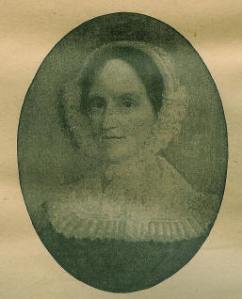
Little Rock’s Founding Mother: Eliza Wilson Bertrand Cunningham

Eliza Wilson Bertrand Cunningham was the First Lady of Little Rock.  She literally was the first lady and the founding mother.

She became the first permanent female resident when she joined her husband Matthew Cunningham in Little Rock.  She gave birth to Chester Ashley Cunningham, the first baby born in Little Rock, as well as several other children with Cunningham.

When he became the first Mayor of Little Rock, she was the first First Lady of Little Rock. They hosted the first Little Rock Council meeting at their house on what is now the block downtown bounded by Third, Main, Fourth and Louisiana Streets.  Her son Charles P. Bertrand, from her first husband, later served as Mayor of Little Rock, making her the only woman to be married to a Mayor and be mother of a Mayor.

Born in Scotland in December 1788, she emigrated with her parents to the United States as a young girl.  In 1804 or 1805, she married a French businessman, Pierre Bertrand in New York City.  She lived in New York City, while he traveled to his various business ventures.  He never returned from a trip to his coffee plantation in Santo Domingo and was presumed to have died in 1808 or 1809.  She and Bertrand had three children, Charles Pierre, Arabella and Jane. (Jane may have died in childhood, because records and lore only indicated Charles and Arabella coming to Little Rock with their mother.)

Eliza married Dr. Matthew Cunningham in New York City.  He later moved to Saint Louis and settled in Little Rock in early 1820.  Eliza and her two children came to Little Rock in September 1820.  In 1822, she gave birth to Chester Ashley Cunningham, the first documented baby born in Little Rock.  (There are unsubstantiated reports that at least one slave child may have been born prior to Chester.)  She and Matthew also had Robert, Henrietta, Sarah and Matilda.  The latter married Peter Hanger, after whom the Hanger Hill neighborhood is named.

Dr. Cunningham died in June 1851.  Eliza died in September 1856. They and Chester (who died in December 1856) are buried in the Hanger family plot at Mount Holly Cemetery.

The annual Mount Holly Cemetery RIP picnic is tonight

Mount Holly’s Annual Spring Picnic will be held April 28, 2019!

On the last Sunday of every April the supporters and friends of Mount Holly gather in the cemetery from 5-7 p.m. for a picnic, silent auction, and entertainment. Funds raised at the picnic help maintain the cemetery as a beautiful historic landmark.

Festivities include:

  • Appetizers
  • Dinner
  • Wine
  • Turn of the century picnic “delicacies”
  • Live music
  • Performances by several Parkview students reprising their roles from Tales of the Crypt
  • Silent auction of items, experiences, elegant dinner parties, and opportunities for exclusive events at Mount Holly Cemetery.

Guests will have the opportunity to join in a tour of the cemetery.  Enjoy either a history tour featuring famous and infamous residents of Mount Holly or a naturalist’s tour of the flora of Mount Holly.

Tickets are $75.00 for adults, $25.00 for children under 18. Purchase tickets online through Eventbrite.com

A Pulitzer Preview – Prizing Mount Holly Cemetery

The Pulitzer Prizes are to be announced tomorrow (Monday, April 15).  This year marks the 102nd anniversary of the prizes, though not all of the current categories have been around since 1917.

Mount Holly Cemetery not only touts that it is the site of a whole host of elected officials, it is also the only place in Arkansas where two Pulitzer Prize recipients are buried.

The cemetery is open every day, but a special visit to these two prize winner gravesites can be made on Sunday, April 28, during the Mount Holly Cemetery Association’s annual “Restore in Perpetuity” fundraiser picnic.

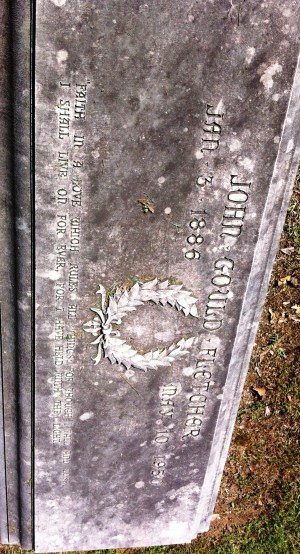
In 1939, John Gould Fletcher became the first Southern poet to win the Pulitzer Prize for Poetry.  He was born into a prominent Little Rock family in 1886.  Fletcher was awarded the prize for his collection Selected Poems which was published by Farrar in 1938.  Two years earlier, he had been commissioned by the Arkansas Gazette to compose an epic poem about the history of Arkansas in conjunction with the state’s centennial.

Fletcher is buried next to his wife, author Charlie May Simon and his parents (his father was former Little Rock Mayor John Gould Fletcher).  Other relatives are buried nearby in the cemetery.

The other Pulitzer Prize winner buried in Mount Holly is J. N. Heiskell, the longtime editor of the Arkansas Gazette.  It was Heiskell, in fact, who asked Fletcher to compose the poem about Arkansas.  Heiskell served as editor of the Gazette from 1902 through 1972.  He died at the age of 100 in 1972.

Under his leadership, the Gazette earned two Pulitzer Prizes for its coverage of the 1957 desegregation of Little Rock Central High.  One was for Harry Ashmore’s editorial writing and the other was for Public Service.

Heiskell remained in charge of the Gazette until his death in 1972.  He is buried alongside his wife with other relatives nearby.  Also not too far from Mr. Heiskell are two of his nemeses, proving that death and cemeteries can be the great equalizer. In the early days of his Gazette stewardship, he often locked horns with Senator (and former Governor) Jeff Davis. Later in Mr. Heiskell’s career, he vehemently disagreed with Dr. Dale Alford, who had been elected to Congress on a segregationist platform.

Women Making History – The Mount Holly Cemetery Association

Instead of featuring one woman, today’s entry focuses on scores of women. The Mount Holly Cemetery Association has been protecting, preserving, and promoting Mount Holly Cemetery for over 100 years. The organization was empowered with these roles by the Little Rock City Council at a time when women still did not have the right to vote.

The Mount Holly Cemetery is a treasure trove of history, architecture and horticulture on the edge of downtown Little Rock.  It was established in 1843 when Chester Ashley and Roswell Beebe donated the land to the city of Little Rock. Feeling the town fathers were not giving the cemetery the attention it deserved, a group of Little Rock businessmen formed a cemetery commission on March 20, 1877. Charter members of the commission were J. H. Haney, Fay Hempstead, James Austin Henry, Philo O. Hooper, and Frederick Kramer. However the private group of men did no better in maintaining the cemetery.

In 1914, a contingent of the town’s women became critical of the cemetery’s unkempt appearance and took over the reins from the men. Following adoption of City Ordinance No. 2199 in June 1915, the ladies’ Mount Holly Cemetery Association was incorporated on July 20, 1915. (It should be noted this action by the women came at a time when women did not have the right to vote.)

The Mount Holly Cemetery Association grew out of a meeting which took place on June 9, 1914 at the home of Mrs. A. H. Scott. Thirty-six women gathered for the purpose of improving the cemetery.

An executive committee was formed, and the women started working on improvements to the cemetery. Though first viewed by some men as an auxiliary to the Cemetery Commission, it quickly became apparent that the women were in no mood to take a back seat in matters pertaining to Mount Holly.

The first executive board (from June 1914 to July 1915) included Mrs. A. H. Scott, Mrs. B. S. Johnson, Mrs. George Thornburgh, Mrs. Moorhead Wright, Mrs. H. M. Bennett, Mrs. George Worthen, Mrs. W. E. Green, Mrs. George Stratman, Miss Louise Gibson and Miss Clara Hotze.

The July 1915 incorporators were Mrs. Scott as well as Julia E. Bennett, Eva C. Shields, Rosa M. Miller, Ruby P. Ratcliffe and Marguerite R. English. Mrs. Bennett, known affectionately as “Scrap” would serve as the first president, and Miss Miller was the first secretary.

Over the years the Association has undertaken countless projects large (construction of a mausoleum) and small (signs on the lanes) to improve Mount Holly Cemetery for its residents and for visitors.

In 1993, the Association published a history of the first 150 years of the cemetery.  More recently, they launched the annual RIP (Rest in Perpetuity) picnic held the last Sunday in April on the grounds.  They have also published a cookbook–Recipes in Perpetuity.

Today, the Mount Holly Cemetery Association is still going strong!

Women Making History – Louise Loughborough

Louise Loughborough was the first woman to serve on the Little Rock Planning Commission.  Not only was the she first woman to serve on this body, she was the first to serve on any City commission other than the Board of Censors or Library Board.
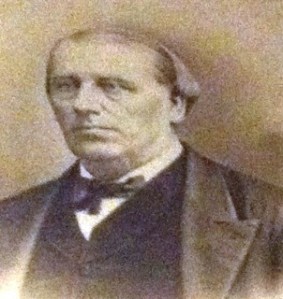
Born Louisa Watkins Wright in Little Rock 1881, her ancestors included many early Arkansas leaders including Little Rock Mayor David Fulton, who had been born in Ireland.

In 1935, Loughborough was appointed to the Little Rock Planning Commission, and it was in this role that she first heard about the plan to condemn the half-block of houses that she had grown up admiring on Cumberland and East Third streets. Although the neighborhood had fallen on hard times, becoming a red-light district and slum, Loughborough feared the loss of several historic structures, including the Hinderliter House, the oldest building in Little Rock and thought to be Arkansas’s last territorial capitol. She mobilized a group of civic leaders to save these buildings. She enlisted the aid of prominent architect Max Mayer and coined the term “town of three capitols” to try to capture the imagination of potential supporters, grouping the “Territorial Capitol” with the Old State House and the State Capitol.

The Arkansas Territorial Restoration opened on July 19, 1941. The project was the first Arkansas agency committed to both the restoration of structures and the interpretation of their history, and it served as a model and inspiration for historic preservation in the state. Around the same time, she was a moving force behind the creation of a museum at the Old State House as well.  Today both Historic Arkansas Museum (as the Territorial Restoration is now known) and the Old State House Museum are agencies of the Department of Arkansas Heritage.

As founding Chairman of the Arkansas Territorial Restoration Commission, Louise Loughborough provided daily direction for the museum house complex through the first twenty years of its existence. She died in Little Rock on December 10, 1962 and was buried at Mount Holly Cemetery.

Women Making History – Adolphine Fletcher Terry

Photos from the collection of the Butler Center

Adolphine Fletcher Terry was born on November 3, 1882 to former Little Rock Mayor John Gould Fletcher and his wife Adolphine Krause Fletcher.

Raised in Little Rock, in 1889 she moved into the Albert Pike House on East 7th Street, when her aunt transferred the title to her father. That house would be her primary residence the rest of her life.  Her sister Mary Fletcher Drennan never lived in Arkansas as an adult after marriage. Her brother John Gould Fletcher spent much of his adulthood in Europe before returning to Little Rock and establishing his own house, Johnswood.

At age 15, Adolphine attended Vassar. She later credited that experience as broadening her views on many issues.  After graduating at age 19, she returned to Little Rock.  Her parents both died prior to her 1910 wedding to David D. Terry, which took place at what was then known as the Pike-Fletcher House (and today is known as the Pike-Fletcher-Terry House).

She is perhaps best known today for establishing the Women’s Emergency Committee in 1958 and for her subsequent deeding of the family house to the City for use by the Arkansas Arts Center.  But her entire life was based on civic engagement.

She was instrumental in establishing the first juvenile court system in Arkansas and helped form the first school improvement association in the state. She was long an advocate for libraries, serving 40 years on the Little Rock public library board.  Through her leadership, the library opened its doors to African Americans in the early 1950s. Today a branch of the Central Arkansas Library System (the successor the Little Rock public library) is named after her.  Another branch is named after her Pulitzer Prize winning brother.

Adolphine formed the Little Rock chapter of the American Association of University Women, the Pulaski County tuberculosis association and the Community Chest.

In 1958, when the Little Rock public high schools were closed instead of allowing them to be desegregated again, she called Harry Ashmore the editor of the Gazette and exclaimed, “the men have failed us…it’s time to call out the women.”  With this, she formed the Women’s Emergency Committee to Open Our Schools. This group played a major role in getting the four high schools open the following year.

From 1933 to 1942, David Terry served in the U.S. Congress. During that time, Adolphine alternated her time between Washington DC and Little Rock. But she spent much time in Little Rock raising her five children.

After her husband’s death in 1963, she continued to remain active in civic affairs. In the 1960’s, she and her sister deeded the Pike-Fletcher-Terry House to the City of Little Rock for use by the Arkansas Arts Center upon both their deaths.  Following Adolphine Fletcher Terry’s death in 1976, Mary turned over the title to the City.

Adolphine Fletcher Terry is buried in Mount Holly Cemetery alongside her husband. Three of her children are also buried in that plot.  Her parents and brother are buried in a nearby plot.

Her granddaughters and their families carry on Adolphine Fletcher Terry’s commitment to making Little Rock better.

Little Rock Look Back: John Wassell

Future Little Rock Mayor John Wassell was born on February 15, 1813 in Kidderminster, England.

In 1829, he came to the United States.  He learned carpentry and construction in Ohio and ended up in Little Rock.  One of his jobs was as the finishing contractor on the State Capitol building, now known as the Old State House.

He later gave up carpentry and became an attorney.  (It is said that he did so after becoming embroiled in a legal dispute arising from one of his construction jobs.) Wassell also served as a judge.

In 1868, he was appointed Mayor of Little Rock by President Andrew Johnson.  He is Little Rock’s only Mayor to have served through a military appointment.  Mayor Wassell died in January 1881 and is buried at Mount Holly Cemetery along with his wife and other family members.  One of his grandsons, Samuel M. Wassell also served as Mayor of Little Rock. Another one, Dr. Corydon Wassell, was the subject of the Hollywood film The Story of Dr. Wassell.