
Central to Creativity – Ben Piazza


benpiazza book coverActor-director-playwright-author Ben Piazza was born on July 30, 1933, in Little Rock, and graduated from Little Rock High School in 1951 as valedictorian. He also had starred in the senior play that year (The Man Who Came to Dinner) and edited the literary magazine.

After graduating from Princeton, he moved to New York City to become an actor.  He made his Broadway debut in 1958 in Winesburg, Ohio.  In April 1959, he starred in Kataki and received a Theatre World Award for his performance.

As the 1960s dawned, Piazza joined a small cadre of actors who had achieved status on Broadway who then also returned to acting Off Broadway.  Colleen Dewhurst, George C. Scott, and James Earl Jones were others in this select group who helped establish Off Broadway as an entity in itself, instead of being just a farm team for Broadway.

In February 1963, he took over the role of Nick in the original run of Who’s Afraid of Virginia Woolf? on Broadway.  During the run of this show, Piazza’s novel The Exact and Very Strange Truth was published.  It is a fictionalized account of his growing up in Little Rock during the 1930s and 1940s.  The book is filled with references to Centennial Elementary, Westside Junior High, Central High School, Immanuel Baptist Church and various stores and shops in Little Rock during that era.

In August of 1967, his play The Sunday Agreement premiered at LaMaMa.  This was Piazza’s first playwright output to be professionally staged.  In March 1969, a double bill of his one-acts: Lime Green/Khaki Blue opened at the Provincetown Playhouse.  It

Throughout the 1960s and early 1970s, Piazza toured in many plays nationally and internationally. He also appeared in major regional theatres as an actor and a director.  As the 1970s progressed, he turned his focus to television and movies.

Piazza’s film debut had been in a 1959 Canadian film called The Dangerous Age. That same year, his Hollywood film debut came opposite Gary Cooper in The Hanging Tree.  Throughout the 1950s and 1960s, he appeared in a number of TV shows including Studio One, Kraft Theatre, Zane Grey Theatre, The Naked City and Dick Powell Theatre.

In the 1970s and 1980s, his appearances included I Never Promised You a Rose Garden, The Bad News Bears, The Blues Brothers, and Mask.  On TV, he appeared in Dallas, Dynasty, Saint Elsewhere, Barnaby Miller, Moonlighting and Family Ties. 

Piazza’s final big screen appearance was in the 1991 film Guilty by Suspicion.  He played studio head Darryl Zanuck in this Robert DeNiro-Annette Bening tale of Hollywood during the Red scare.

Ben Piazza died on September 7, 1991.  In 2016, a meeting room in the new Robinson Conference Center was named in his memory.
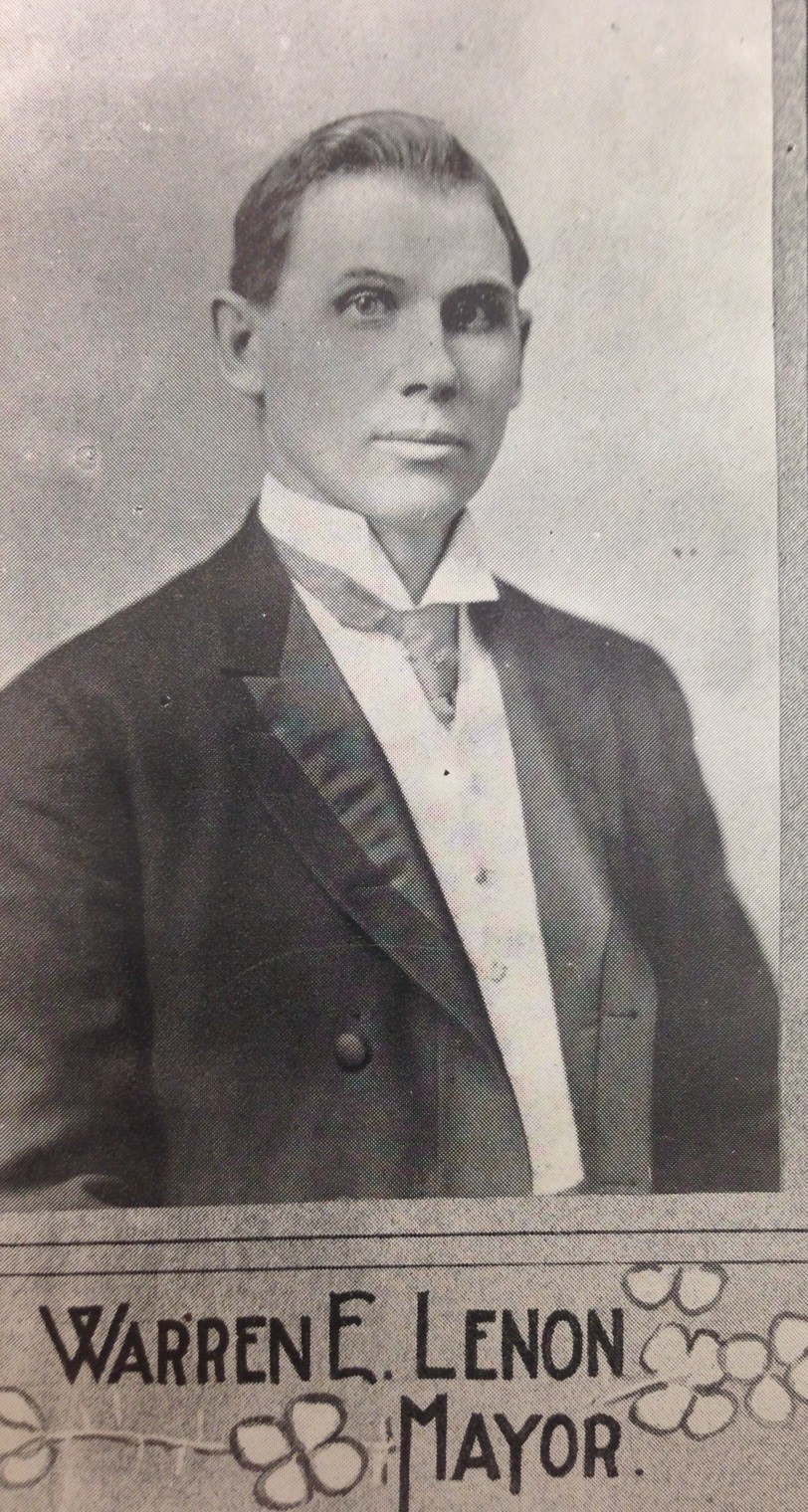
Little Rock Look Back: Warren E. Lenon

OMayor Lenonn October 8, 1867 in Panora, Iowa, future Little Rock Mayor Warren E. Lenon was born.  He was one of eleven children of John D. and Margaret M. Long Lenon.

Lenon came to Little Rock in 1888 after finishing his schooling in Iowa.  He helped set up an abstract company shortly after his arrival.  In 1902 he organized the Peoples Savings Bank.  Among his other business interests were the City Realty Company, the Factory Land Company, the Mountain Park Land Company, and the Pulaski Heights Land Company.

From 1895 to 1903, he was a Little Rock alderman, and in 1903, he was elected Mayor of the city. A progressive Mayor, he championed the construction of a new City Hall which opened in 1908.  At the first meeting of the City Council in that building, Mayor Lenon tendered his resignation.  His duties in his various business interests were taking up too much of his time.

Mayor Lenon had been a champion for the establishment of a municipal auditorium. He had wanted to include one in the new City Hall complex. But a court deemed it not permissible under Arkansas finance laws at the time.  He also worked to help establish the first Carnegie Library in Little Rock which opened in 1912.

Mayor Lenon continued to serve in a variety of public capacities after leaving office.  In the 1920s, he briefly chaired a public facilities board for an auditorium district. It appeared he would see his dream fulfilled of a municipal auditorium.  Unfortunately the Arkansas Supreme Court declared the enabling legislation invalid.

In 1889, he married Clara M. Mercer.  The couple had three children, two of whom survived him.  A son W. E. Lenon Jr., and a daughter Vivian Mercer Lenon Brewer.  Together with Adolphine Fletcher Terry (also a daughter of a LR Mayor), Mrs. Brewer was a leader of the Women’s Emergency Committee.

Mayor Lenon died June 25, 1946 and is buried at Roselawn Cemetery.  Lenon Drive just off University Avenue is named after Mayor Lenon.

Central to Creativity – Gail Davis

gail_davisGail Davis is best known as TV’s Annie Oakley.  She was born Betty Jeanne Grayson on October 5, 1925. Her mother was a homemaker and her father, W. B. Grayson, was a physician in McGehee (Desha County), which did not have a hospital, so her birth took place in Little Rock (Pulaski County).
When her father became the state health officer, the family moved from McGehee to Little Rock, where Grayson attended Little Rock High School. Grayson rode horses and was a tomboy growing up. Grayson also held various beauty titles in high school and college, and she sang and danced in local shows from the time she was eight.

While studying dramatics at the University of Texas in Austin, she married Robert Davis in 1945, with whom she had a daughter, Terrie (the couple divorced in 1952). After World War II, they moved to Hollywood, where she worked as a hatcheck girl until being discovered by an agent who obtained an MGM screen test for her. She was signed to a contract, with her first appearance in 1947’s The Romance of Rosy Ridge, starring Van Johnson.

She worked steadily in movies, including fourteen films with Gene Autry in the late 1940s and early 1950s. He was impressed with her, changed her name to Gail Davis, and cast her as the star of the Annie Oakley TV show, which he produced. The show ran for eighty-one episodes from 1954 through 1956.

After her TV series ended, she appeared as Annie Oakley in the 1959 film Alias Jesse James starring Bob Hope. In that film, she appears in an uncredited role along with such other stars, also uncredited, as Gary Cooper, Bing Crosby, Roy Rogers, James Garner (as Bret Maverick), and Fess Parker (as Davy Crockett).

Her television appearances include guest roles on The Lone Ranger, The Gene Autry Show, The Cisco Kid, and Death Valley Days, as well as a 1961 episode of the Andy Griffith Show (Episode 37, “The Perfect Female”), her final appearance as a performer and in which she demonstrated her trademark sharpshooting.

Gail toured with Gene Autry’s Wild West show and made appearances as herself on TV programs such as Wide, Wide World: “The Western” (1958) with fellow Arkansan Ben Piazza. For her work in television, she was awarded a star on the Hollywood Walk of Fame, located at 6385 Hollywood Boulevard, and in 2004, she was inducted posthumously into the National Cowgirl Hall of Fame.

Gail Davis died of cancer in Los Angeles on March 15, 1997, and is buried in Hollywood’s Forest Lawn cemetery.  In 2007, she was posthumously inducted into the Arkansas Entertainer’s Hall of Fame.  In 2016, a room was named in her memory at the newly renovated Robinson Center.

Little Rock Look Back: Louis Armstrong speaks out

As the Civil Rights movement started taking hold in the mid-1950s, many African American entertainers were vocal in their support.  Louis Armstrong stayed silent.  Until, that is, September 17, 1957.

That night, in Grand Forks, North Dakota, Armstrong blasted President Dwight Eisenhower for his lack of action to make Governor Orval Faubus obey the law.  This was in an interview conducted by a 21 year old University of North Dakota journalism student named Larry Lubenow.

Journalist David Margolick wrote about the incident in The New York Times in September 2007 in conjunction with the 50th anniversary of the integration of Little Rock Central High School.  He recounted how the story, written for the Grand Forks Herald, was picked up all over the country.  The entire Margolick piece can be read here.  Margolick tells that when Armstrong was given the chance to back off the comments, he asserted that he meant all of it.

On September 24, 1957, the night that the 101st Airborne was being mobilized to come into Little Rock, Armstrong sent Eisenhower a telegram again criticizing him for lack of action.  He used colorful language which sarcastically spoofed the “Uncle Tom” moniker which some of his critics had bestowed when they felt he was not doing enough for Civil Rights.  The Eisenhower Presidential Library has a copy of that telegram.  The incident between Satchmo and Ike was the basis for two different plays: Terry Teachout’s Satchmo at the Waldorf and Ishmael Reed’s The C Above C Above High C.

Little Rock Look Back: Miss America in Little Rock

Tonight a new Miss America will be crowned.  Arkansas’ own Savvy Shields will conclude her whirlwind year as the third Miss America to come from the Natural State.

Earlier this year, two of Arkansas’ three Miss Americas were in Little Rock for the Miss Arkansas pageant.  So as Savvy wraps up her reign, it seems a good time to remember when Donna Axum first brought the Miss America title to Arkansas.

A native of El Dorado and a student at the University of Arkansas, during her reign as Miss America Miss Axum (or simply Donna as the newspaper headlines referred to her) made four public visits to Little Rock.  As the first Miss Arkansas to become Miss America, the state’s Capitol City was very interested in giving her a warm welcome.

After being crowned on September 7, 1963, Axum’s first official visit to Arkansas was November 1 through 3.  In addition to stops in Hot Springs and El Dorado, she appeared in Little Rock to attend events including an Arkansas Razorback football game at War Memorial Stadium.  Her entourage included the top four runners up from the Miss America pageant.

In February 1964, she made a brief appearance in Little Rock which included a press conference.

Donna Axum spent nearly two weeks in Arkansas in May 1964 attending several pageants as well as spending time with family.  During that visit she appeared in Little Rock twice.  The second time she headlined a concert with the Arkansas Symphony (not related to the current Arkansas Symphony Orchestra) and the Arkansas Choral Society. It took place at Robinson Auditorium.

Little Rock Look Back: Duke Ellington refuses to play in segregated Robinson

Newspaper ad for the concert that was not to be

In August 1961, it was announced that Duke Ellington would perform in concert at Robinson Center.  He had previously played there in the 1940s and early 1950s.  His concert was set to be at 8:30 pm on Tuesday, September 5.

Due to the changes of times, the NAACP had a relatively new rule that they would boycott performers who played at segregated venues.  When it became apparent that Robinson would remain segregated (African Americans restricted to the balcony), the NAACP announced they would boycott any future Ellington performances if he went ahead and played Robinson.

The music promoters in Little Rock (who were white) petitioned the Robinson Auditorium Commission asking them to desegregate Robinson – even if for only that concert.  The Commission refused to do so.  Though the auditorium was finding it harder to book acts into a segregated house, they felt that if it were integrated, fewer tickets would be sold.

On September 1, 1961, Ellington cancelled the concert.

Robinson remained segregated until a 1963 judge’s decision which integrated all public City of Little Rock facilities (except for swimming pools).

Little Rock Look Back: Birth of Joseph Taylor Robinson

Future Senator Joseph Taylor Robinson was born in Lonoke in August 26, 1872.  In 1894 Robinson was elected to the Arkansas General Assembly for one term.  From 1903 until 1913, he served in the US House of Representatives as a Congressman from Arkansas’ then-Sixth District.

He chose not to seek another term in Congress and ran for Governor in 1912.  On January 3, 1913, sitting US Senator Jeff Davis died in office.  Robinson was sworn in as Governor on January 16, 1913. Twelve days later he was chosen by the Arkansas General Assembly to become the next US Senator. He became the final US Senator to be selected by a legislator instead of popular vote.  At the time, Senate terms started in March, so Robinson served as governor until March 8, 1913.

He rose through the ranks of the Senate and eventually became the first person to hold the title of Senate Majority Leader.  In 1928, he was the Vice Presidential nominee for the Democratic Party.  Four years later, he rode with Franklin and Eleanor Roosevelt to the inauguration ceremonies before FDR took the oath.  He would be President Roosevelt’s go-to man on legislative issues.

Senator Robinson died in Washington D.C. on July 14, 1937.  His wife was in Little Rock making preparations for a trip the couple was to take. Following his demise, Mrs. Robinson went to Washington to accompany her husband’s body back to Arkansas.

It was not until December 1937, that Senator Robinson’s name became attached to the municipal auditorium which Little Rock voters had approved in January 1937.  Mrs. Robinson participated in the December 24, 1937, groundbreaking for the auditorium.

Naming the auditorium after him was not Little Rock’s first attempt at honoring Senator Robinson.  In 1930, portions of Lincoln, Q, and Cantrell streets were renamed Robinson Drive in his honor. This was part of an effort to give Highway 10 (which had four different names as it wended through the City) a single name in Little Rock.  A few months later the Senator requested that the original names be returned.  Cantrell had been named in honor of a developer who was continuing to work in the area surrounding that street.  The Senator felt it should be named after Mr. Cantrell.  As part of that, the name Cantrell was extended to most of Highway 10 within the Little Rock city limits.

In 1935, on Senator Robinson’s ante-penultimate birthday, the Little Rock City Council coincidentally approved the plans for a municipal auditorium which would then be submitted to the Public Works Administration.  It was this project which would become Robinson Auditorium.