New Rooftop Terrace planned for Robinson Center

RCMH EXT-01_Aerial1The Little Rock Convention & Visitors Bureau (LRCVB) is now booking events for the all-new Robinson Conference Center, set to reopen in November of this year.  Located on the north side of the building, the Grand Ballroom and adjoining meeting rooms offer magnificent views of the Arkansas River.  With seamless connectivity to the DoubleTree Hotel’s meeting space, the center offers flexibility for convention activities, meetings, and banquets.  For booking information, please call 501-255-3323.

Earlier this week, the Little Rock Advertising and Promotion Commission (LRA&P) also approved the addition of a 5,800 sq. ft. outdoor terrace.  The terrace was part of the original project plans, however, but it was removed from the plans in 2014 during contract negotiations due to budget constraints.  Now, less than eight months from completion, LRCVB and LR A&P are able to add the finished outdoor space back into the project.  The space will offer amazing views of the Arkansas River and sits on the highest level of the new conference center, and its addition will not impact the project’s completion date.

“We are so pleased with the progress of this complex project.  Our project team, including architects Polk Stanley Wilcox and Ennead, construction manager CDI/Hunt joint venture, owner’s representatives Mike Steelman of SCM architects, and a host of sub-contractors, have continued to provide meticulous attention to detail and countless effort to this project.  The all-new Robinson Center is going to be a show-piece for Little Rock and all of Central Arkansas,” said Gretchen Hall, President & CEO of LRCVB.

For more information on the Robinson Center Second Act renovation and expansion project, visit www.RobinsonCenterSecondAct.com and follow us on https://www.facebook.com/pages/Robinson-Center/276515585880 and https://twitter.com/RobinsonCenter.

Robinson Construction Facts to Date:

  • Over 10,878 tons of material have been recycled, representing 90% of the waste material diverted
  • 1,800 tons of steel has been erected
  • 3,000 cubic yards of concrete has been placed
  • 1,104 individuals have gone through CDI/Hunt Safety Orientation
  • 75% of the project subcontractors are local
  • 250,000 +/- man hours have been utilized to date

Robinson History

The historic Robinson Auditorium has long been a landmark in Central Arkansas.  Construction of the Joseph T. Robinson Memorial Auditorium began in 1937 and officially opened in February 1940.  The structure was a WPA (Works Progress Administration) project, and is an excellent example of the Art Deco style architecture of the time.  The building was added to the National Register of Historic Places in 2007.  The facility is owned by the City of Little Rock and managed by the Little Rock Convention & Visitors Bureau.

Black History Month Spotlight – Downtown Desegregation

Ozell Sutton, one of the honorees

Ozell Sutton, one of the honorees

The new Arkansas Civil Rights History Audio Tour was launched in November 2015. Produced by the City of Little Rock and the University of Arkansas at Little Rock allows the many places and stories of the City’s Civil Rights history to come to life an interactive tour.  This month, during Black History Month, the Culture Vulture looks at some of the stops on this tour which focus on African American history.

The Arkansas Civil Rights Heritage Trail was launched in 2011 by the UALR’s Institute on Race and Ethnicity.  Each year, a theme is chosen to honor a particular group of people who were active in Arkansas’s civil rights movement.  Year by year, the trail grows.  The plan is that over time the trail will stretch from the current starting point at the Old State House, down West Markham Street and President Clinton Avenue to the Clinton Presidential Library and Museum, and then back up the other side of the street to opposite the Old State House.

Downtown Desegregation

In January 1963, Little Rock set in motion a process that ended segregation in its downtown businesses.  Following student sit-ins coordinated by the Student Nonviolent Coordinating Committee and Philander Smith College students, in November 1962 white businessmen and merchants formed a secret Downtown Negotiating Committee to set out a timetable for change in consultation with black community representatives.  On January 1, 1963, lunch counters in downtown Little Rock began to serve black customers on an equal basis.  Downtown hotels desegregated their facilities.  Drinking fountains and restrooms had their “White” and “Colored” signs removed.  In June, movie theaters desegregated.  In October, city restaurants desegregated.  That same year, Robinson Auditorium, the Arkansas Arts Center, and city parks desegregated.  In April 1963, in Jet magazine, James Forman, executive secretary of the Student Nonviolent Coordinating Committee, hailed the city as “just about the most integrated…in the South.”

The app, funded by a generous grant from the Arkansas Humanities Council, was a collaboration among UALR’s Institute on Race and Ethnicity, the City of Little Rock, the Mayor’s Tourism Commission, and KUAR, UALR’s public radio station, with assistance from the Little Rock Convention and Visitors Bureau.

Little Rock Look Back: The first Elvis concert at Robinson Auditorium

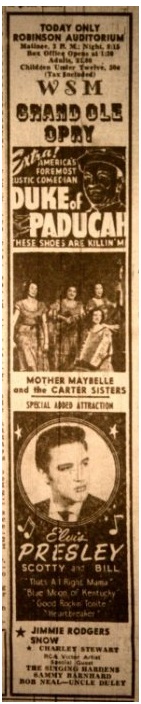
eap feb 55 adSixty-one years ago today, on February 20, 1955, Elvis Presley made his first appearance on stage in Little Rock. He performed at Joseph Taylor Robinson Memorial Auditorium.

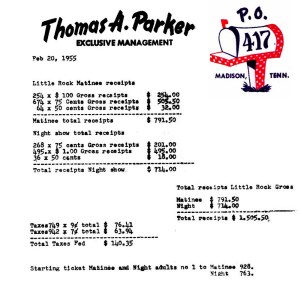
eap receits 05-little.rock_.feb_.55He was billed as “an added attraction” to a Grand Ole Opry Show headlined by the Duke of Paducah.  Others on the bill included Mother Maybelle and the Carter Sisters, Jimmie Rodgers Snow, Charlie Stewart, the Singing Hardens, Sammy Barnhart, Bob Neal, Uncle Dudley and Smilin’ Mac Cyclone. (It is interesting to note that at least some of the advance tickets billed it as The Elvis Presley Show, though the newspaper ads billed the Duke of Paducah as the headliner.)

This concert was part of a weeklong tour of Arkansas and Louisiana.  There were two shows that day – one at 3p.m. and the other at 8:15p.m.  Tickets on the day of the concert were $1.00 for adults and fifty cents for children.  Advanced tickets had sold for 75 cents at Walgreens.

The night before, Elvis played the Louisiana Hayride in Shreveport.  Following his Little Rock appearance (for which he and his band were paid $350 instead of their usual $200), they played in Camden, Hope, and Pine Bluff.

eap 02-little.rock_It is believed that Elvis’ parents attended this concert in Little Rock. Gladys Presley was a big fan of the Duke of Paducah. Elvis apparently also wanted his parents to meet with Colonel Tom Parker, who would become inexorably linked with Elvis’ career.
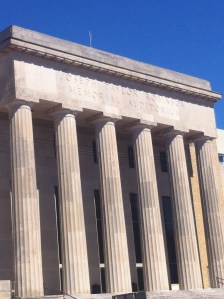
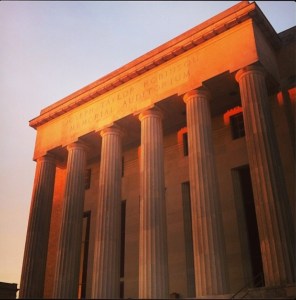
Black History Month Spotlight – Joseph Taylor Robinson Auditorium

IMG_7690The new Arkansas Civil Rights History Audio Tour was launched in November 2015. Produced by the City of Little Rock and the University of Arkansas at Little Rock allows the many places and stories of the City’s Civil Rights history to come to life an interactive tour.  This month, during Black History Month, the Culture Vulture looks at some of the stops on this tour which focus on African American history.

In March 1974, Little Rock hosted the second National Black Political Convention at the Joseph T. Robinson Auditorium and Camelot Hotel (now a Doubletree Hotel). The first convention was held in Gary, Indiana, in 1972, and garnered much publicity, producing a National Black Political Agenda that included demands for the election of a proportionate number of black representatives to Congress, community control of schools, and national health insurance. The Little Rock convention was co-convened by Congressman Charles Diggs of Detroit, Michigan; Mayor Richard Hatcher of Gary, Indiana; and poet Amiri Baraka. Plenary speakers included Atlanta Mayor Maynard Jackson and comedian and activist Dick Gregory. Jesse Jackson was also in town for the convention. The convention featured a moving testimonial and tribute to local civil rights leader Daisy Bates at Central High School.

For many years, the lower Exhibition Hall of Robinson Auditorium hosted many concerts, dances and sporting events, popular with black audiences. However, because the large concert hall upstairs had segregated seating, Duke Ellington declined to play there in 1961. Louis Armstrong played to the first integrated audience in 1966 after the 1964 Civil Rights Act ended segregation in public facilities and accommodations.

The app, funded by a generous grant from the Arkansas Humanities Council, was a collaboration among UALR’s Institute on Race and Ethnicity, the City of Little Rock, the Mayor’s Tourism Commission, and KUAR, UALR’s public radio station, with assistance from the Little Rock Convention and Visitors Bureau.

Little Rock Look Back: Robinson Auditorium opens in 1940

auditoriumduskOn February 16, 1940, after three years of planning and construction including several delays due to lack of funding, the Joseph Taylor Robinson Memorial Auditorium officially opened. It was a cold, rainy night, but those in attendance did not care.

Searchlights painting arcs in the sky greeted attendees. They were borrowed from the Arkansas National Guard. Newspaper accounts noted that only a few of the men who attended were in tuxedos, most were simply in suits. The work to get the building opened had been so harried, that it was discovered there was not an Arkansas Flag to fly in front of the building. Mayor Satterfield found one at the last minute courtesy of the Arkansas Department of the Spanish War Veterans.

The weather delayed arrivals, so the program started fifteen minutes late. Following a performance of Sibelius’ Finlandia by the fledgling Arkansas State Symphony Orchestra, Mayor J. V. Satterfield, Mrs. Joseph T. Robinson, Mrs. Grady Miller (the Senator’s sister-in-law and a member of the Auditorium Commission) and D. Hodson Lewis of the Chamber of Commerce participated in a brief ribbon cutting ceremony. Mrs Robinson cut the ribbon on her second attempt (once again proving that nothing connected with getting the building open was easy).

The ceremony was originally set to be outside of the building but was moved indoors due to the inclement weather. The ribbon cutting took place on the stage with the ribbon stretched out in front of the curtain. The opening remarks were broadcast on radio station KGHI.

Mr. Lewis, Mrs. Miller and Mayor Satterfield look on as Mrs. Robinson cuts the ribbon

Mr. Lewis, Mrs. Miller and Mayor Satterfield look on as Mrs. Robinson cuts the ribbon

Though he had previously discussed how he had voted against the auditorium in 1937 before entering public life, the mayor’s remarks that evening were appropriately gracious, statesmanlike and a testament to the effort he had invested to get it open upon becoming mayor. “We hope you have a very pleasant evening and hope further that it will be the first in a long series which you will enjoy in this, your auditorium.”

Tickets for the event, advertised as being tax exempt, were at four different pricing levels: $2.50, $2.00, $1.50 and $1.00.

The estimated attendance was 1700. Following the ribbon cutting, the main performance took place. The headliner for the grand opening was the San Francisco Opera Ballet accompanied by the new Arkansas State Symphony Orchestra (not related to the current Arkansas Symphony Orchestra). The featured soloist with the ballet was Zoe Dell Lantis who was billed as “The Most Photographed Miss at the San Francisco World’s Fair.”

At the same time that the gala was going on upstairs in the music hall, a high school basketball double-header was taking place in the downstairs convention hall. North Little Rock lost to Beebe in the first game, while the Little Rock High School Tigers upset Pine Bluff in the marquee game.

Arts+History Election Results – By The Numbers

Feb9electionlogoThe Culture Vulture loves crunching numbers almost as much as attending cultural events.

Here are some thoughts about the results from the February 9 MacArthur Park Bond election.  These bonds will pay for improvements to the Arkansas Arts Center, MacArthur Museum of Arkansas Military History and MacArthur Park.  Excess revenues from the bonds will be available for the Little Rock Zoo, Museum of Discovery, other Little Rock parks and other Little Rock cultural institutions.

There were 7,990 votes cast in the special election.  This was 6.61% of the electorate.  By comparison, there were 4,462 ballots cast in the July 2015 Central Arkansas Library System special election and 6,995 ballots cast in the December 2013 Robinson Center special election.  The latter election brought 6.14% of voters to the polls.

Comparing early and absentee voters to election day voters:

  • Robinson (December 2013) – 871 or 12.45% of all ballots cast
  • CALS (July 2015) – 750 or 16.81% of all ballots cast
  • MacArthur Park (February 2016) – 1,171 or 14.66% of all ballots cast

The top ten precincts for voter participation on February 9:

107 – LRFD Station #10 —– 23.66%
106 – LRFD Station #10 —– 22.85%
109 – Pulaski Heights Presbyterian —–  18.17%
91 – Cammack Village City Hall —– 17.43%
108 – Woodlawn Baptist —– 17.33%
90 – Second Presbyterian —– 15.86%
112 – Pulaski Heights Presbyterian —– 15.00%
96 –  St. Mark’s Episcopal —– 13.42%
70 – Pleasant Valley CoC —–  12.58%
92 – St. Paul UMC —–  12.27%

While most of these are in the midtown area of Little Rock, some are in the western portion of Little Rock.  They tend to have the highest percentage of voter turnout in primary, general and special elections regardless of what or who is on the ballot.


The top 10 precincts for number of voters were:
109 – Pulaski Heights Presbyterian —– 497
106 – LRFD Station #10 —– 351
107 – LRFD Station #10 —– 308
90 – Second Presbyterian —– 260
71 – Pulaski Academy —– 252
108 – Woodlawn Baptist —– 238
114 – Arkansas Arts Center —– 230
88 – St. James UMC —– 223
95 – Grace Presbyterian —– 211
68 – Chenal Valley Church —– 204

These results spread from downtown to midtown to west Little Rock and are fairly evenly distributed.


There were twelve precincts in which over 90% of the voters cast ballots in favor of the bonds.  Precinct 61 at Pilgrim Rest Baptist Church was 100% in favor of it. But there was only one ballot cast.  Of the remaining eleven precincts in which more than one vote was cast, here are the rankings by percentage:

112 – Pulaski Heights Presbyterian —– 96.97
118 – Dunbar Recreation Center —– 95.83
114 – Arkansas Arts Center —– 95.65
109 – Pulaski Heights Presbyterian —– 94.77
107 – LRFD Station #10 —– 94.16
108 – Woodlawn Baptist  —– 92.86
79 – Henderson UMC —– 92.59
128 – St. John Vision Center —– 92.37
90 – Second Presbyterian —– 91.54
110 – Woodlawn Baptist  —– 91.3
135 – Pilgrim Rest Baptist —– 91.18

Again, they are fairly evenly distributed from downtown to midtown to west Little Rock.

Little Rock Look Back: Movie Stars send LR fans in frenzy at Robinson Auditorium

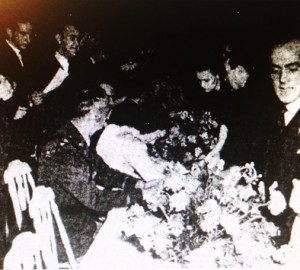
Autograph seekers crowd around the actors at the Movie Ball (photo from Arkansas Gazette)

Autograph seekers crowd around the actors at the Movie Ball (photo from Arkansas Gazette)

As final preparations were being made for the opening of the Joseph Taylor Robinson Municipal Auditorium in early 1940, a glamorous evening took place in Robinson’s lower level convention hall on February 1.

In conjunction with a meeting of film executives and movie theatre owners sponsored by Robb and Rowley Theaters (which later became the United Artists theatre chain), several Hollywood actors were in Little Rock and headlined a Movie Ball. While in Little Rock, Maureen O’Hara, Phyllis Brooks, Arleen Whelan, Tim Holt and Gene Autry had also made a variety of public appearances.

Mr. Autrey had to miss the ball because he had to return to Hollywood early to attend to business matters. Actress Ilona Massey had also been scheduled to attend the events but was unable due to illness.

The quartet who did appear at the Movie Ball caused quite a scene. Upon their entrance, so many of the attendees crowded around for autographs that the evening’s grand march could not take place (a newspaper headline in the Democrat innocently used the word “orgy” to describe the crowd). After two attempts, Little Rock Mayor J. V. Satterfield (who was escorting Miss O’Hara) and the other members of the Little Rock host delegation led the Hollywood foursome to their reserved table. For quite a while that evening, the table was besieged by autograph seekers.

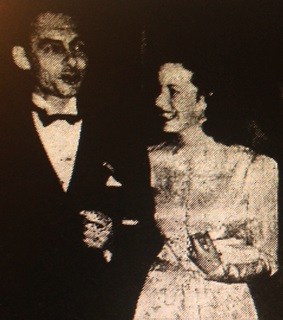
Mayor J V Satterfield escorting actress Maureen O'Hara at the Movie Ball (photo from Arkansas Democrat)

Mayor J V Satterfield escorting actress Maureen O’Hara at the Movie Ball (photo from Arkansas Democrat)

Though it is unknown as to whether he sought an autograph, photos from the evening showed a very satisfied Mayor Satterfield with Miss O’Hara on his arm. Satterfield family lore joked that Mrs. Satterfield (who had stayed home that night to tend to a sick son) was not a fan of Miss O’Hara’s films after that evening.

The Movie Ball showed Little Rock citizens the value of Robinson Auditorium even before it had been officially dedicated. The film industry meetings had taken place at the Albert Pike Hotel which did not feature a ballroom large enough to host the ball. Without the auditorium’s availability for the gala, organizers might not have chosen Little Rock for the meeting.

With the auditorium’s convention hall not attached to any hotel, it opened up the chance for Little Rock to host more events. This had been one of the key arguments for an auditorium since Mayor W. E. Lenon’s first proposal back in 1904. Having a glamorous event this early in the auditorium’s life validated that contention. After having endured the challenges to open the building, it was a nice lagniappe for the auditorium’s proponents who were present.

The actor Tim Holt would again be connected to Little Rock. In September 1951, he tried to obtain a divorce in Arkansas and stated that he had been a resident of the state for at least six weeks. He also had someone else testify to that fact. In October 1951, the divorce was granted. Later Mr. Holt was charged with perjury and fined $200 for falsely representing his length of residence in Arkansas. Judicial sanctions for his legal team, which included a State Senator, were eventually reviewed by the Arkansas Supreme Court.